








The PDO thread lift timeline is not one curve. It is two curves running at different speeds, in opposite directions, and the point where they cross is the single most predictable source of an unhappy phone call in thread practice. The suture material is leaving. The collagen response has not yet arrived in force. For a window of weeks, the patient is objectively less lifted than they were, and nothing has gone wrong.
Tatiana Sarmiento, faculty at Empire Medical Training, teaches this crossover explicitly rather than hoping patients do not notice it. Her framing in the hands-on curriculum is a two-part clock: roughly three months for the body to metabolise the suture material, then roughly three more months to metabolise the tissue response the suture provoked. The consequence is not just a duration figure. It is a shape — and if you counsel the duration without counselling the shape, you have set up the complaint.
These figures and intervals reflect Tatiana Sarmiento's clinical practice as taught in Empire Medical Training's hands-on curriculum. Technique is learned under supervision; this article is educational and is not a substitute for training.
Clock one: the filament is hydrolysing from day one
Polydioxanone does not sit inert and then dissolve. It begins losing tensile strength almost immediately through hydrolysis, long before it disappears physically, and this matters more than the disappearance date does.
For a mono or screw thread, tensile strength is largely irrelevant — the filament was never carrying load. For a cog thread it is the whole mechanism. A barbed thread lifts because it grips tissue and holds against gravity, and holding is a load-bearing function. As the filament weakens, its capacity to hold weakens with it, on a curve that starts well before the patient's follow-up appointment.
This is the first thing that separates cog outcomes from mono outcomes over time. A cog thread's mechanical contribution is highest on the day it is placed and declines from there. A mono thread's biological contribution is zero on the day it is placed and climbs from there. Same material, opposite curves, and the patient experiences the difference as two completely different products.
Clock two: the collagen response starts late and peaks later
The tissue response to a PDO thread is a healing response. It takes the time healing takes.
Sarmiento places the beginning of the useful collagen phase at weeks four to twelve. Before that window, there is inflammatory activity, but it is not yet producing the organised collagen deposition that supports a result. After it, the response continues to mature and remodel. This is the same biology that governs injectable collagen stimulation, and the patience it demands is the same — the comparison is worth making in consultation, because patients who have had biostimulator injections already understand that the good part comes late.
What that means practically: the collagen phase has barely started at the moment most patients decide whether the treatment worked. Four weeks is when they are looking hardest. Four weeks is the earliest edge of the phase that will produce their actual result.
The first two weeks are mostly not the result
Before the two clocks matter, there is a period where what the patient sees is neither of them.
Day one to two. Sarmiento's expectation setting is that the patient will see lift and swelling together, and that the two are not separable by eye. Bruising is common; swelling is expected. The patient should be told both before the procedure, not discovered after.
Around day five. Bruising and swelling should be substantially settling. Cold application to the area and standard bruise management are what she offers here. A patient who is still markedly swollen well past this point is a follow-up, not a reassurance call.
Day three to fourteen. Tenderness, visible dimpling and a sensation of tightness "usually improve" across this window. All three are expected findings in this period, and all three are also the findings that, if they persist beyond it, mean something else is going on — over-correction, crowded vectors or a plane problem rather than normal recovery.
The clinically important point is that the lift the patient photographs on day two is inflated. Some proportion of it is oedema. It is not dishonest for that lift to exist, but it is dishonest to let the patient believe it is the baseline they will keep.
The mid-course drop: where the two clocks cross
Here is the moment the article exists for.
Post-procedure inflammation resolves. The tissue oedema that was contributing to the early appearance goes away. Simultaneously, the filament has been weakening for weeks and — if it is a cog thread — is carrying less than it was. And the collagen response, the thing that will eventually hold the result, is still building.
The patient looks in the mirror and the face has come down.
Sarmiento's own words to her patients at this point:
"Yes, you may feel that the inflammation has gone and then the tissue drops a little bit. However, now is when the stimulation is starting to take place, and then you will start feeling a little tightening and lift natural coming from the stimulation that the PDO gave you."
Two things make this counselling work. First, it is delivered before the drop, not in response to a complaint. A warning given in advance is expertise; the identical explanation given after the phone call sounds like an excuse. Second, it names the mechanism rather than asking for trust. The patient is not being told to be patient — they are being told what their tissue is doing and when the next change is due.
Why the drop is more visible with cogs
The magnitude of the crossover trough is not uniform. It is worst where the early result was largest and most mechanical.
A cog patient had genuine day-one lift, plus swelling on top of it. When the swelling resolves and the filament's grip is softening, the visible loss is substantial, and it is being measured against a very high anchor. A mono patient had almost nothing to lose — their curve only ever went up — so there is no perceptible trough at all.
This is a selection and counselling consequence, not a technique failure. The patient who was sold on immediacy is the patient most exposed to the trough. That is the trade they made, and they are entitled to have been told about it.
What not to do at the trough
Three reflexes to resist:
Do not re-treat on the spot. Adding threads during the crossover window treats a phase, not a deficit. The collagen response has not finished declaring itself, and threads placed now will be assessed against a tissue state that is about to change on its own.
Do not reinterpret it as technique failure. A drop at this point, in a well-selected patient, with an organised vector plan, is the expected shape of the curve. Genuine technique failure looks different: it is visible early, it is asymmetric, it dimples, and it does not recover.
Do not go quiet. The patient who has been warned and then hears nothing assumes the warning was a hedge. A short scheduled check-in inside this window costs almost nothing and converts the trough from a crisis into a milestone.
What the two clocks mean for combination planning
The two-curve model produces one non-obvious planning consequence, and it is the strongest argument for combining thread families in a single plan.
The cog curve falls. The mono curve rises. They are not synchronised by accident — they are governed by the same two mechanisms in opposite proportions, which means a plan containing both has a mechanical contribution declining exactly while a biological contribution is climbing.
The practical effect is that a combination plan has a shallower trough than a cog-only plan. Some of what the cog threads are giving up during the crossover is being replaced, in the same face, by the mono response coming online through weeks four to twelve. The patient still experiences a change, but they experience it as the result settling rather than as the result leaving.
Two cautions keep this from becoming a reflex. First, it only works if the mono component was placed for a job that genuinely exists in that face — adding monos purely to cushion a curve is stimulation applied where no stimulation was indicated, with all of the layout and density risk that carries. Second, the two families occupy the same tissue, so a combination plan doubles the crowding exposure in a single plane and demands more layout discipline, not less.
Where the combination is genuinely indicated — cogs to reposition, monos to improve the envelope that has been repositioned — the timeline benefit is a real secondary gain rather than the reason to do it.
The full shape, in one view
| Phase | What is happening | What the patient sees |
|---|---|---|
| Day 1–2 | Placement effect plus inflammatory oedema | Lift and swelling together; bruising common |
| ~Day 5 | Oedema and bruising settling | Swelling down; some of the early lift going with it |
| Day 3–14 | Insertion trauma resolving | Tenderness, dimpling and tightness improving |
| Weeks 4–12 | Collagen phase begins and builds | Little visible change early; gradual firming later |
| The crossover | Oedema gone, filament weakening, collagen not yet dominant | The drop — the disappointed phone call |
| Months 3–6 | Suture material metabolised; tissue response carrying the result | Gradual return of tightening and natural lift |
| 6–18 months | Response maturing, then declining | Result held, then slowly softening |
Sarmiento's overall duration figure is six to eighteen months, with the variables that move a patient within that range being the vector plan, the thread type, the patient's own tissue and their aftercare. That spread is wide because those variables are genuinely determinative, not because the number is vague — and the honest way to quote it is as a range with named drivers, not as a single figure. The patient-facing framing of that duration question is covered in how long a thread lift lasts; this article is the mechanism underneath it.
Two phases, two different conversations
The practical output of all of the above is that a thread consultation needs two timelines, not one, and the patient should be able to repeat both back to you:
The suture timeline. "Something is holding your tissue, and it is designed to go away. It starts going away immediately and it is essentially gone by around three months."
The collagen timeline. "Your own tissue is building the thing that holds the result after that. It starts around week four, it builds through about week twelve, and it carries you from there."
And the sentence that joins them, which is the one that prevents the refund request:
"Between those two, there is a stretch where you will look like you have lost some of it. That is the handover. It is expected, it is on the calendar, and I will see you through it."
Regional applications change the emphasis but not the structure — the submental and jawline application runs the same two clocks with more mechanical load on the first one. Clinicians who want the counselling and the technique taught together will find both in Empire's Advanced PDO Thread Lift Training, and the broader sequencing of threads alongside other modalities in Complete Facial Aesthetic Training.
Related guides in this cluster
Part of Thread Lifting and Suspension.
 Clinical GuideMono, Screw and Cog — Matching the PDO Thread Family to the Clinical JobPDO thread types explained by mechanism, not by brand. How mono, screw and cog threads differ in what they ask tissue to do — and how t
 Clinical GuideWho Is Not a Thread Candidate — Patient Selection That Protects Your OutcomesThread lift patient selection by failure mechanism — severe laxity, heavy tissue, crepey skin, fat herniation, and the expectation you
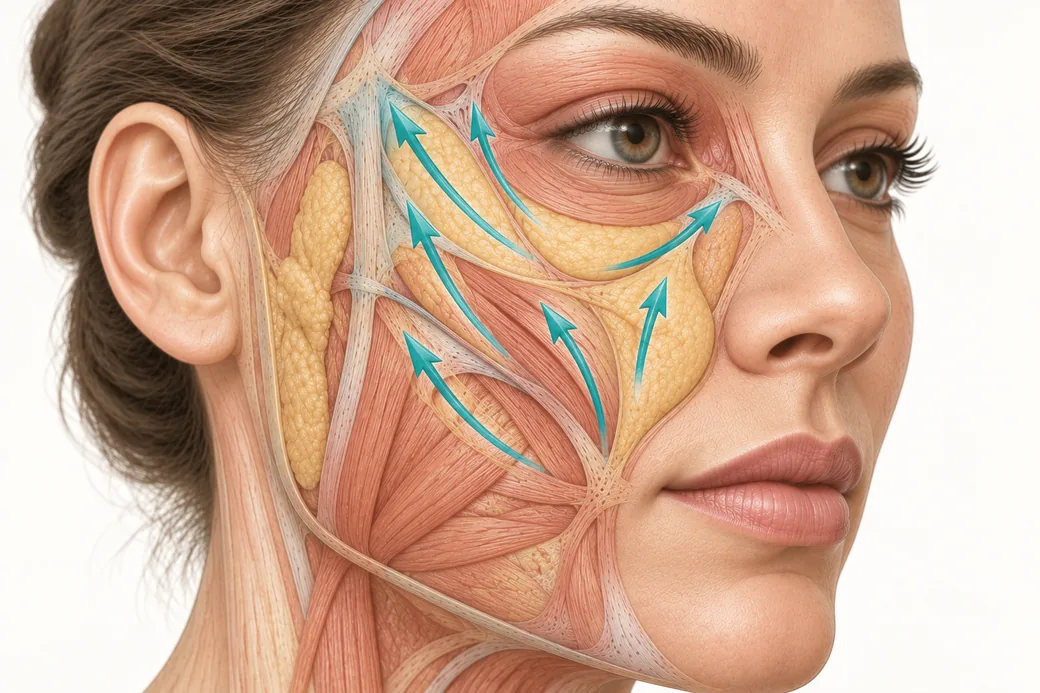 Clinical GuideVector Planning for the Midface — Why Direction Decides the ResultThread lift vector planning for the midface: why direction decides the result, how the V-configuration maximises lift, when to reverse
Train with Empire
This guide is clinical education. The technique behind it is taught hands-on, on live patients, with faculty beside you.
Explore PDO Thread Lift Training →Disclaimer
This article reflects the clinical opinions and experience of Tatiana Sarmiento, Faculty, Empire Medical Training, an independent faculty member contributing to Empire Medical Training's curriculum. The views expressed are the author's own and do not necessarily represent those of Empire Medical Training.
It is professional education, not medical advice, and is no substitute for hands-on training or independent clinical judgment. Licensed clinicians remain responsible for their own patient selection, technique and outcomes, for verifying current product labelling, and for practising within their scope and applicable law. Empire Medical Training accepts no liability for reliance on this content.
 Claim Your Prize!