








There are only three PDO thread types that matter to a decision, and none of them is a brand. Mono, screw and cog describe three different things you can ask tissue to do, and the injector who chooses by mechanism rather than by catalogue page stops having conversations about which thread is "best" and starts having the only conversation that predicts an outcome: what is actually wrong with this face, and which of those three jobs will fix it.
Tatiana Sarmiento, faculty at Empire Medical Training, frames the whole of thread selection in one phrase in Empire's hands-on curriculum — choose by job. Not by price, not by thread count in the pack, not by what the rep brought. The material is the same material. The geometry is the variable, and the geometry is what determines whether the tissue is being stimulated, thickened or physically moved.
These techniques and clinical judgements reflect Tatiana Sarmiento's practice as taught in Empire Medical Training's hands-on curriculum. Technique is learned under supervision; this article is educational and is not a substitute for training.
One polymer, three jobs
Polydioxanone is not new and it is not aesthetic in origin. It is a synthetic absorbable monofilament that has been used as surgical suture for decades, degraded by hydrolysis and cleared by the body without a retrieval procedure. That surgical history is the reason PDO threads are reasonable to place at all, and it is worth remembering when a patient asks what is being left in the face: the answer is suture material, not an implant, not a filler, not a permanent device.
Because the polymer is constant, none of the meaningful differences between thread families are chemical. They are structural. Sarmiento groups them exactly as they behave:
- Mono — a smooth, unmodified filament. Its job is collagen stimulation and the tissue-level support that follows it.
- Screw (twist) — one or more filaments wound around the cannula. Its job is volume stimulation, a locally concentrated version of the same biological response.
- Cog (barb) — a filament cut, moulded or otherwise configured with projections that grip. Its job is mechanical lift and tissue engagement. Sarmiento groups cog, moulded and multi-configurations together here, because they share the mechanism: they hold.
Everything downstream — onset curve, how you counsel, what the failure looks like, how you plan vectors, what you charge for chair time — follows from which of those three you chose.
Mono threads: stimulation without repositioning
A smooth filament does not grip. That is not a deficiency; it is the design. Placed into tissue, a mono thread produces a controlled foreign-body and healing response along its track, and the clinically useful output of that response is new collagen deposition in the plane where the thread sat. The filament hydrolyses; the tissue response is what remains.
The implication that injectors most often miss is directional: a mono thread does not move tissue, so it cannot correct a position problem. If a jawline has descended, mono threads placed along it will improve the quality and thickness of the tissue envelope over the following months. They will not put the jawline back where it was. Asking them to do that is the single most common category error in thread practice, and it produces a disappointed patient at month three who is technically getting exactly what was placed.
What mono threads are genuinely good at is the tissue that is thin, lax in texture rather than position, and in need of a collagen scaffold before anything else is layered on it. This is the same clinical reasoning that governs injectable biostimulation, and it is worth reading alongside what facial collagen stimulation actually does and the biostimulator-versus-filler distinction — the decision logic transfers almost cleanly.
Two practical consequences:
The onset is slow and the patient must be told so. There is nothing to see on day one except insertion trauma. The result the patient was sold arrives over weeks to months. A patient who wanted to look different for a wedding in three weeks has been mis-sold if they were given monos.
Mono threads are the family most punished by crowding. Because the visible effect is stimulation rather than lift, overlapping paths concentrate the stimulation response in one area and can produce abnormal elevation of the tissue rather than a smooth plane. Sarmiento is specific that this problem is "specific with the smooth threads." Layout discipline matters more here, not less, precisely because the effect is invisible at the time of placement.
Screw threads: stimulation, concentrated
Screw or twist configurations take the same smooth-filament mechanism and wind it, so that more filament length occupies less linear distance. Sarmiento's shorthand for the result is volume stimulation: the tissue response is denser in a smaller footprint, and what the patient perceives is localised thickening rather than a generalised improvement in skin quality.
Two things are worth being precise about when you set this up with a patient.
First, be explicit about which kind of volume you are offering. What a screw thread builds is collagen-mediated fullness in a defined footprint, which is a different product from the space-occupying volume a hyaluronic acid filler or a calcium hydroxylapatite biostimulator provides. A patient with genuine structural deficit is a volumisation patient, and the honest answer is a different product category; see facial volume loss for where that line sits.
Second, the same concentration that makes screw threads useful makes them intolerant of over-placement. Dense stimulation in a small footprint is exactly the circumstance in which the tissue response becomes palpable or visible rather than merely supportive. Restraint at the time of placement is the only control you have, because the response develops long after the patient has left.
Screw threads earn their place where a small, specific area needs more than diffuse stimulation but does not need repositioning — and where the surrounding tissue is thick enough to hide the response.
Cog threads: the only family that actually lifts
Cogs, moulded and multi-directional configurations are the threads that perform mechanical work. The projections engage the tissue along the thread track, and traction on the thread transmits force into that tissue rather than sliding through it. Sarmiento's phrasing is that these are "the ones that actually give the wow to the patient" — and that word choice is doing real clinical work, because wow is a description of timing as much as of magnitude.
The lift from a cog thread exists the moment it is engaged. That is a fundamentally different product from stimulation, and it should be sold as a fundamentally different product.
Sarmiento is direct about the honest reason a patient chooses cogs:
"Some of the patients are not ready to wait for the bio-stimulation to take place in six months, or in a year. They want a lift immediately because they have a special event. So this is why I use my barbed cog threads in the patient."
That is a legitimate indication, stated plainly, and it is more useful to a clinician than any comparison chart. The patient with a date on the calendar is not being impatient or unrealistic — they have a different requirement, and the thread family that meets it is the one that does mechanical work on the day.
What cogs demand in exchange:
A vector plan, not a placement list. Because cogs transmit force, direction determines result. A cog placed on the wrong vector does not do nothing; it does the wrong thing, visibly. Direction planning is a separate discipline and deserves its own treatment.
Tissue that can be engaged and can hold. Barbs need something to grip and something to pull against. This is where patient selection stops being a formality — heavy tissue, established ptosis and severe laxity defeat cogs specifically, because the load exceeds what the engagement can carry and the result either fails to appear or fails to last.
Honest expectation setting. A cog result that is immediate invites the comparison the patient is already making in their head. Sarmiento's line for that moment is simply: this is not a facelift.
Choosing: four jobs, worked
Selection becomes easy once the question is phrased as a job. Four that come up constantly:
"The skin quality is poor but nothing has moved." Thin, lax-textured tissue in a face that is still in the right position. This is a stimulation job. Monos, distributed with layout discipline, and a consultation that puts the result at weeks to months rather than days. Adding cogs here buys mechanical work that is not needed and adds risk that is.
"A small area needs support and the surrounding tissue is thick." A stimulation job with a concentration requirement. Screw configurations, placed conservatively, with the patient told that the change will be subtle and slow.
"There is early, subtle descent — the jawline is starting to go, the midline is folding slightly, and the under-eye vectors are pulling down." This is a repositioning job in a patient whose tissue can still be repositioned. Cogs, on a planned vector. Sarmiento identifies this pattern as the right candidate for barbed PDO threads precisely because the tissue is asking to be moved and is still light enough to be moved.
"There is an event in four weeks." A timing constraint, not a tissue diagnosis. Cogs deliver on the day; stimulation does not. But this is also the case that most often needs a second conversation, because the event is driving the request and the tissue may not support it. A timing requirement never overrides a selection contraindication.
Combination is a plan, not a default
Combining families is defensible when each family is doing a job you can name. Cogs to reposition and monos to improve the envelope that has been repositioned is a coherent plan. Monos everywhere plus a few cogs because cogs sound better is not — it is two mechanisms competing for the same tissue plane and doubling the crowding risk.
The discipline is to write down the job before you write down the thread. If you cannot state in one sentence what each thread in the plan is being asked to achieve, remove it.
The same logic extends across modalities. Threads sit alongside injectable biostimulation, not in competition with it, and the sequencing question — what to place, in what order, in which plane — is treatment planning rather than thread selection. Empire's facial contouring injectables curriculum covers the neighbouring product decisions; the double chin application is a worked example of a regional job where the family choice is the whole decision.
What selection cannot do
Sarmiento's closing position on this section is worth quoting in full, because it is the boundary condition on everything above:
"No thread can overcome poor patient selection. You can have an amazing technique, but if you lack in — you [have] poor selection of the patient and you compromise the outcome of your treatment."
Choosing correctly between mono, screw and cog improves an outcome in a patient who should be treated. It does not rescue an outcome in a patient who should not. If the tissue is too heavy, the ptosis is established, the skin is crepey, or the expectation is surgical, there is no thread family that fixes that — and the selection exercise in this article does not begin until the candidacy question has been answered.
Clinicians working through the practical side of thread family choice, vector planning and layout will find the hands-on component in Empire's Advanced PDO Thread Lift Training, where selection is taught against live tissue rather than against a chart.
Related guides in this cluster
Part of Thread Lifting and Suspension.
 Clinical GuideThe Two-Phase PDO Thread Timeline — and the Mid-Course Drop Nobody Warns Patients AboutThe PDO thread lift timeline runs two clocks — suture absorption and collagen response. The gap between them is when patients call disa
 Clinical GuideWho Is Not a Thread Candidate — Patient Selection That Protects Your OutcomesThread lift patient selection by failure mechanism — severe laxity, heavy tissue, crepey skin, fat herniation, and the expectation you
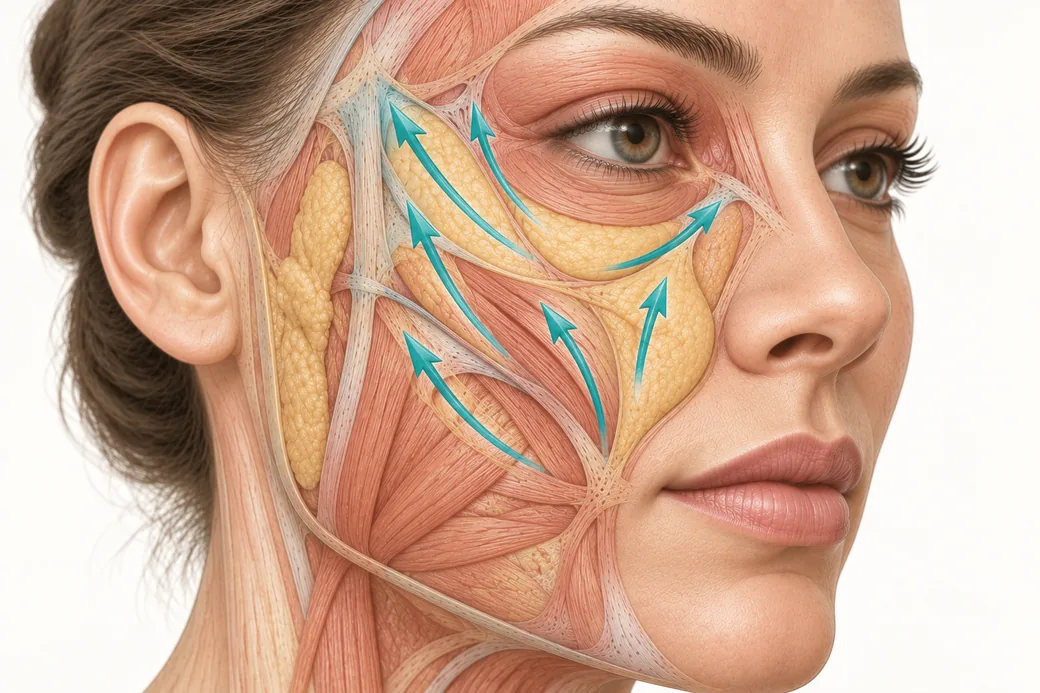 Clinical GuideVector Planning for the Midface — Why Direction Decides the ResultThread lift vector planning for the midface: why direction decides the result, how the V-configuration maximises lift, when to reverse
Train with Empire
This guide is clinical education. The technique behind it is taught hands-on, on live patients, with faculty beside you.
Explore PDO Thread Lift Training →Disclaimer
This article reflects the clinical opinions and experience of Tatiana Sarmiento, Faculty, Empire Medical Training, an independent faculty member contributing to Empire Medical Training's curriculum. The views expressed are the author's own and do not necessarily represent those of Empire Medical Training.
It is professional education, not medical advice, and is no substitute for hands-on training or independent clinical judgment. Licensed clinicians remain responsible for their own patient selection, technique and outcomes, for verifying current product labelling, and for practising within their scope and applicable law. Empire Medical Training accepts no liability for reliance on this content.
 Claim Your Prize!