








Thread lift patient selection is the decision that determines your outcome, and it is made before a cannula is opened. Tatiana Sarmiento, faculty at Empire Medical Training, states the principle in a sentence that should be printed above every consultation room door in a thread practice:
"No thread can overcome poor patient selection. You can have an amazing technique, but if you have poor selection of the patient, you compromise the outcome of your treatment."
The asymmetry inside that sentence is what makes it useful. A well-selected patient makes an average technique look accomplished — Sarmiento's phrasing is that "the right patient makes the technique look better." A poorly selected patient makes an excellent technique look like a failure, and does it in front of the patient, their photographs and their friends. Technique improves your ceiling. Selection sets your floor, and the floor is where practices get hurt.
This article is organised around why each exclusion fails, not around a checklist. A clinician who knows the mechanism can recognise the variant case; a clinician with a list can only recognise the cases on the list.
These clinical judgements reflect Tatiana Sarmiento's practice as taught in Empire Medical Training's hands-on curriculum. Technique is learned under supervision; this article is educational and is not a substitute for training.
Start with what a candidate actually looks like
Exclusions mean nothing without a reference case, so define the target first.
Sarmiento's description of the right patient for a barbed PDO thread lift is a face with early, subtle, directional change:
- A jawline showing "subtle start descending" — the beginning of a jowl, not an established one.
- Some laxity in the midface region, "folding down" slightly, visible as a softening of the midline structures rather than a collapse of them.
- Under-eye tissue where "we can see some vectors going down" — the direction of change is apparent, and it is downward.
The unifying feature is not age, and it is not a severity score. It is that the tissue has moved a short distance in a readable direction and is still light enough to be moved back. Threads reposition. A candidate is a patient whose problem is position.
Sarmiento does observe that this pattern clusters in patients roughly between 40 and 50. That is a clinical observation about where the pattern usually appears, and it should be treated as a pattern rather than a criterion. A 38-year-old with early directional descent is a candidate. A 45-year-old with heavy established jowls is not. Selecting by decade instead of by tissue is how practices end up treating the wrong faces with defensible-sounding reasoning.
Exclusion 1: severe laxity and heavy tissue
This is the most common inappropriate booking, and it is also the most seductive, because on the consultation photograph the threads look like exactly the right answer.
Sarmiento is candid about the temptation and then closes the door on it:
"It would be beautiful for the threads to reposition the skin. However, this is not a realistic treatment for the threads to lift all this tissue, because it's heavy tissue, and as well it will not last longer."
Two distinct failures are packed into that, and they are worth separating.
The load failure. A cog thread lifts by engaging tissue and holding against gravity. The holding capacity is a function of how much tissue each barb can grip and how much force the filament can carry before it yields or cheese-wires through. Heavy tissue exceeds that capacity. What you get is not a proportionally smaller lift — you get engagement that pulls through, dimples at the entry point where force concentrated, and a result that never looked like the plan.
The duration failure. Even where the initial lift appears, load accelerates the problem described in the two-phase timeline: the filament is hydrolysing and losing strength from placement onwards, and a filament under heavy load loses clinical function considerably sooner than one that is barely working. A heavy-tissue patient does not just get a worse result; they get a shorter one, and they paid the same price for it.
The practical test at the chairside is manual. If you have to apply real force to reposition the tissue with your hands, and it falls immediately when you release, the thread is going to be asked to do something your hand had to work at continuously. It cannot.
Exclusion 2: ptosis that is already established
There is a difference between tissue that is descending and tissue that has descended, and threads live entirely on one side of it.
Early descent is a repositioning problem: the tissue is in the wrong place and can be returned to approximately the right one. Established ptosis is a structural problem — the supporting architecture has changed, the soft tissue has settled into a new position and accommodated to it, and the skin envelope has remodelled around the new shape.
Threads engage soft tissue. They do not reconstruct support. Pulling a settled envelope upward over structures that have themselves descended produces tension without correction: the surface moves, the underlying contour does not, and the result reads as pulled rather than lifted. That is the appearance patients describe as "done", and it is a selection error rather than a technique error.
The honest conversation here is that the patient's problem has moved past what a minimally invasive repositioning tool addresses, and that a surgical assessment is a reasonable next step. Making that referral costs you a booking and buys you a reputation.
Exclusion 3: infraorbital fat herniation
Sarmiento singles out "fat pad herniation under the eye" as a specific challenge for PDO threads, and it deserves its own heading because it is so frequently misread.
A herniating infraorbital fat pad presents as a bulge with a shadow beneath it, and patients — and inexperienced injectors — describe that as sagging. It is not sagging. It is a compartment problem: fat has moved forward past its containing structures. The overlying skin is a bystander.
Lifting the skin envelope over a herniated pad does not reduce the herniation. At best the change is invisible because the pathology is deeper than the plane you treated. At worst, tightening the envelope over a protruding compartment makes the protrusion more defined, and you have sharpened the exact contour the patient came in to soften.
The discipline is diagnostic, not technical: decide whether you are looking at descended tissue or displaced fat before you decide what to place. They look similar in a mirror and behave completely differently under a thread. The periorbital region is unforgiving of this confusion, and anatomical clarity in this area is worth the dedicated study Empire covers in Anatomical Based Aesthetics Training.
Exclusion 4: crepey skin and thin skin
Sarmiento's position here is unusually absolute:
"If you have this patient that has crepey skin, it's a patient that should not get any PDO thread, because it will be visible."
The mechanism is simple and worth stating plainly: a thread is a physical object placed under a covering. The thinner and less elastic the covering, the more the object shows. In crepey skin there is neither the dermal thickness to conceal the filament nor the elastic recoil to smooth the surface over it. The patient sees a line, feels a ridge, or both — and what they see is not a side effect of the treatment, it is the treatment.
This exclusion also traps a specific reasoning error. Crepey skin is a quality problem, and mono threads are the family indicated for quality problems, so the logic appears to close: poor skin quality, therefore stimulate it. But the placement constraint bites before the indication does. The thread has to be concealed before it can stimulate anything, and in this skin it cannot be.
The right answer for crepey and thin skin is a modality that improves the envelope without placing an object inside it. Injectable collagen stimulation is the natural alternative, and Sarmiento names biostimulation explicitly as the redirect. The collagen stimulation and biostimulator versus filler reasoning applies directly, and Sculptra as a specific agent is a common landing point for these patients.
Exclusion 5: active infection or impaired healing
This one is categorically different from the others, and it is the one exclusion that is not negotiable under any expectation-setting.
Every PDO thread mechanism — mono, screw and cog alike — depends on the patient mounting a controlled healing response. The collagen that carries the long-term result is the patient's collagen, produced by the patient's wound healing. You are not implanting a result; you are provoking one.
That has two consequences.
Active infection is an absolute stop. You would be placing a foreign body into an infected or inflamed field. Nothing about the risk calculation is favourable and nothing about the expected benefit survives it.
Impaired healing removes the mechanism. A patient whose healing response is compromised — by disease, by medication, or by circumstance — is a patient in whom you place the material and accept the risk but do not reliably get the biology that justified it. The suture still absorbs. The collagen phase is the part that may not arrive. This is why a healing history matters more in thread practice than injectors coming from a toxin background expect: with a neurotoxin you deliver the effect, whereas with a thread the patient manufactures it.
Exclusion 6: the expectation, not the face
The last exclusion is the only one that is in the room rather than in the tissue, and Sarmiento lists it alongside the anatomical ones without softening it: "unrealistic expectation" sits in the same sentence as active infection and poor healing.
The characteristic presentation is a patient who is anatomically acceptable and conversationally impossible. They are asking for a facelift result from a minimally invasive procedure, and every clarification you offer is absorbed and then quietly discarded. Sarmiento's list of the combination that guarantees a disappointed patient is "wrong patient, heavy laxity, very thin skin, unrealistic goals" — three tissue findings and one conversation.
Three tests that separate an expectation you can manage from one you cannot:
Can they say the limit back to you? Not nod at it — say it. A patient who can articulate that this is not a facelift, in their own words, has understood. A patient who responds with "but you'll get it as close as you can, right?" has not.
Do they accept the timeline as well as the magnitude? Patients who accept a smaller result but reject the possibility of a mid-course drop have accepted half the deal. The two-phase timeline has to be part of the agreement before consent is meaningful.
Are they treating the result as an outcome or as a fix for something else? A patient whose stated goal is the appearance is manageable. A patient whose stated goal is what the appearance will change for them is a different conversation, and threads are not the subject of it.
Declining on expectation grounds is harder than declining on anatomy, because you cannot point at a photograph. It is also the decline that prevents the most damage, because a poor anatomical outcome produces a dissatisfied patient while a poor expectation outcome produces a public one.
"Beautiful, but not realistic"
The hardest cases are not the obvious declines. They are the patients for whom threads would genuinely help — the ones where, as Sarmiento says, it "would be beautiful for the threads to reposition the skin" — but where the help will not last long enough to justify what it costs the patient.
This is the case that most needs a named policy, because the temptation is structural: the patient wants it, the anatomy partially supports it, and the improvement is real on the day. The discipline is to ask the second question rather than only the first. Not will this work, but will this still be working at a point the patient would consider fair. If the answer to the second is no, you are selling a result you know is leaving early, and the patient will remember the ending rather than the beginning.
What to offer instead
Declining should never end the consultation. Every exclusion above has a defensible redirect:
| Finding | Why threads fail | Reasonable alternative direction |
|---|---|---|
| Heavy tissue, severe laxity | Load exceeds engagement; short duration | Surgical assessment; volumisation where deficit contributes |
| Established ptosis | Repositioning tool applied to a structural problem | Surgical assessment |
| Infraorbital fat herniation | Wrong plane, wrong pathology; can sharpen the bulge | Diagnostic reassessment of the periorbital compartment |
| Crepey or thin skin | Thread will be visible or palpable | Injectable collagen stimulation; energy-based skin quality options |
| Volume deficit misread as sagging | Position tool applied to a volume problem | Volumisation — see facial volume loss |
| Active infection or impaired healing | The mechanism itself is unavailable | Defer; treat the underlying issue first |
| Unrealistic expectation | No technical solution exists | Decline, document, and offer nothing as a consolation |
That last row matters. The most common way a declined thread consultation goes wrong is that the clinician, uncomfortable with an empty outcome, offers something smaller to soften the no. A patient who wanted a facelift and leaves with a compromise treatment they did not want is still a disappointed patient — and now they have a bill.
Document the decline
If you decline, write down what you saw and what you said. Which findings drove the decision, what alternative you offered, and the fact that the limitations were explained. The same discipline that governs documenting consent for an injectable procedure applies to documenting the procedure you chose not to perform. A declined patient who returns to another injector, gets a poor result, and later describes the sequence to a third party is a situation in which your note is the only version of events that exists in writing.
The floor, not the ceiling
Selection does not make you a better injector. It makes you a more reliably good one, which is a different and more durable asset. The practices that struggle with threads are rarely the ones with poor hands; they are the ones treating patients who were never going to succeed, and then attributing the result to technique and chasing it with more training.
The technique is worth learning properly — Empire's Advanced PDO Thread Lift Training teaches placement, vector planning and layout against live tissue. But the sentence at the top of this article is the one that governs the rest of it. No thread can overcome poor patient selection.
Related guides in this cluster
Part of Thread Lifting and Suspension.
 Clinical GuideMono, Screw and Cog — Matching the PDO Thread Family to the Clinical JobPDO thread types explained by mechanism, not by brand. How mono, screw and cog threads differ in what they ask tissue to do — and how t
 Clinical GuideThe Two-Phase PDO Thread Timeline — and the Mid-Course Drop Nobody Warns Patients AboutThe PDO thread lift timeline runs two clocks — suture absorption and collagen response. The gap between them is when patients call disa
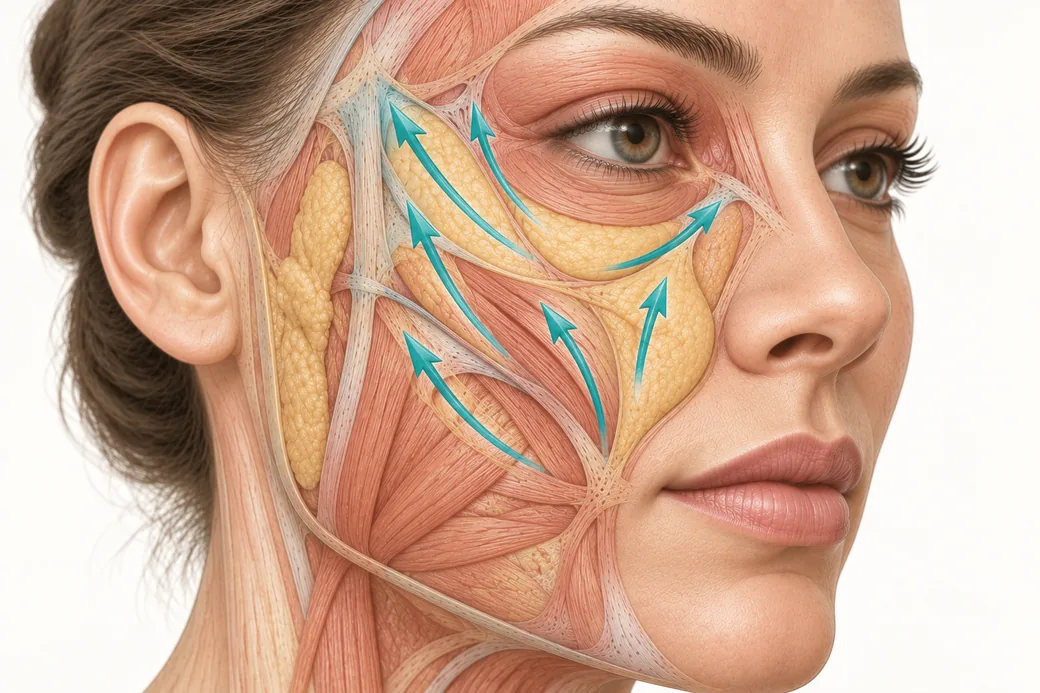 Clinical GuideVector Planning for the Midface — Why Direction Decides the ResultThread lift vector planning for the midface: why direction decides the result, how the V-configuration maximises lift, when to reverse
Train with Empire
This guide is clinical education. The technique behind it is taught hands-on, on live patients, with faculty beside you.
Explore PDO Thread Lift Training →Disclaimer
This article reflects the clinical opinions and experience of Tatiana Sarmiento, Faculty, Empire Medical Training, an independent faculty member contributing to Empire Medical Training's curriculum. The views expressed are the author's own and do not necessarily represent those of Empire Medical Training.
It is professional education, not medical advice, and is no substitute for hands-on training or independent clinical judgment. Licensed clinicians remain responsible for their own patient selection, technique and outcomes, for verifying current product labelling, and for practising within their scope and applicable law. Empire Medical Training accepts no liability for reliance on this content.
 Claim Your Prize!