







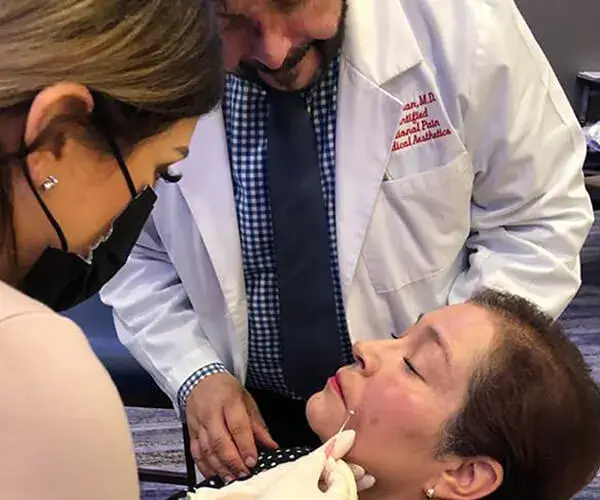
A thread lift uses absorbable sutures to mechanically lift sagging tissue and stimulate collagen production — a cost-effective alternative to surgical lifting for the right patient. So how long does a thread lift last? Expect results in the range of 12 to 36 months, with most patients noticing some regression between 18 and 24 months. That number moves considerably depending on the thread material, the area treated, and the patient in the chair.
This guide breaks down thread lift duration by thread type (PDO, PLLA, and PCL), by treatment area, and by the patient factors that quietly determine whether someone lands at the 12-month end of that range or the 36-month end. It also covers when results peak, what actually happens when the threads dissolve, and what your options are if you aren’t satisfied.
How Long Does a Thread Lift Last?
The short answer: one to three years, or 12 to 36 months.
The useful answer requires separating two effects that run on different clocks:
- The mechanical lift. Barbs or cones on the thread grip the underside of the skin and hold tissue in a repositioned place. This is immediate and it is finite — it lasts as long as the thread holds tension.
- The collagen response. The body reads the thread as a foreign body and mounts a controlled healing response, laying down new collagen along the thread tract. This builds slowly and persists after the thread itself is gone.
That second mechanism is why thread lift results outlast the threads. The suture material is fully absorbed months before the visible result fades, because the collagen scaffold it provoked is still there. It’s also why thread lifts are a fundamentally different proposition from neuromodulators — Botox® relaxes a muscle for a few months and then wears off cleanly. A thread lift repositions tissue and leaves behind structural change.
When Do Thread Lift Results Peak?
Results appear almost immediately after the procedure — that’s the mechanical component. But the visible result at day one is usually obscured by swelling, and full results take anywhere from a few days to a few weeks to declare themselves as that swelling resolves.
The collagen-driven improvement peaks later, generally somewhere in the one-to-three-month window, and can continue subtly refining for months after that. Patients evaluating their result at week one are looking at an incomplete picture.
Thread Lift Duration by Thread Type
Not all absorbable threads behave the same way. The polymer determines how long the material persists in tissue, how aggressive the collagen response is, and ultimately how long results hold.
PDO (Polydioxanone) Threads
PDO is the most widely used thread material and the workhorse of the category. It has decades of use as a surgical suture behind it, which is a meaningful safety argument.
PDO threads hydrolyze relatively quickly — the material is typically absorbed within about six months. Results generally last 12 to 18 months, with the collagen response carrying the effect well past the point at which the thread has disappeared. PDO comes in several configurations:
- Barbed (cog) threads — the lifting workhorse, with bidirectional or unidirectional barbs that anchor and reposition tissue.
- Smooth (mono) threads — no barbs, minimal mechanical lift; used primarily to stimulate collagen and improve skin quality.
- Twist/screw threads — intertwined threads used for localized volumization.
For cosmetic lifting, aesthetic providers generally recommend barbed threads. They grip and lift tissue far more effectively than smooth threads and produce longer-lasting results because they drive a stronger collagen response in addition to holding tissue in position.
PLLA (Poly-L-Lactic Acid) Threads
PLLA degrades more slowly than PDO and is a more potent collagen stimulator — the same property that makes PLLA a long-acting dermal filler material. The material typically persists for around 12 to 24 months.
Results commonly last 18 to 24 months or longer. The trade-off is that PLLA works more gradually. Patients who want an immediate, dramatic mechanical lift may find the collagen-forward profile underwhelming at first.
PCL (Polycaprolactone) Threads
PCL is the slowest-degrading of the three, often persisting well beyond two years in tissue, with a correspondingly prolonged collagen response.
Results are typically the longest of the three materials — commonly 24 months or more, and in some patients approaching three years. The longer the material lingers, however, the longer the window in which a suboptimal placement is also lingering. Slow-absorbing material rewards good technique and punishes bad technique for longer.
Thread Lift Duration by Treatment Area
Different parts of the body respond differently to thread lifts, and duration follows the mechanical load on the threads. The more gravity and muscle movement work against a lifted vector, the shorter the result.
Brow and Forehead
The skin over the brow is taut and the tissue load is light, so threads have relatively little weight to hold. Brow lifts tend toward the longer end for their thread type, though the frontalis is in near-constant motion, which works against the result. For pricing on this specific application, see our breakdown of how much a PDO thread brow lift costs.
Ready to put this into practice?
Explore Empire's hands-on, CME-accredited Aesthetic & Injectable Training courses — live patients, expert faculty, and ongoing mentorship.
Midface and Cheeks
The midface is the classic thread lift target and generally the most durable result, because the threads can be anchored into stable tissue above and the vector works with the anatomy rather than against it.
Jawline and Jowls
Heavier tissue and constant jaw movement mean more mechanical load. Results here often land at the shorter end of the range, and patient selection matters more — substantial jowling with significant skin excess is a surgical problem, not a thread problem.
Neck
Loose neck skin is one of the harder areas to hold. The tissue is mobile, the skin is thin, and gravity is relentless. Neck results typically require earlier maintenance than midface results.
Abdomen and Body
Body threads face the largest tissue mass and the most movement. An abdominal thread lift presents very differently from a thread lift on the loose skin of the neck or the taut skin of the eyebrows, and expectations should be set accordingly.
Other Factors That Affect How Long a Thread Lift Lasts
Beyond material and area, several variables shape the result:
- The preexisting state of the treatment area. How much excess skin there is to lift and tighten, and how deep any lines or wrinkles run, both change what the threads can realistically achieve and how long the achievement holds.
- The body’s response to the threads. Every patient generates collagen differently. Results are generally strongest in patients from roughly age 35 to 55, after which collagen stimulation becomes less efficient. That isn’t a hard cutoff — plenty of older and younger patients respond favorably.
- Complementary procedures. Providers often pair thread lifts with other minimally invasive treatments, especially dermal filler injections. The threads generally outlast the filler, but the combination can sharpen results during the first six to 12 months.
- Lifestyle and behaviors. The same factors that drive early signs of aging — sun exposure, smoking, poor nutrition — will curtail thread lift results.
- Technique. Anchor point, vector selection, and depth of placement do more to determine longevity than the brand on the package.
How to Make Your Thread Lift Results Last Longer
Unlike a surgical facelift or tummy tuck, a thread lift has an expiration date. Maintaining results means repeating the procedure every one to two years. But patients can buy meaningful time with a skin-healthy lifestyle:
- Avoid smoking and other forms of tobacco
- Limit alcohol and other dehydrating foods and drinks
- Drink plenty of water
- Use an SPF moisturizer daily
- Wear sunscreen during periods of prolonged sun exposure
- Eat a nutrient-dense diet
- Use quality skincare products morning and evening
How Thread Lifts Compare to Other Non-Surgical Treatments
Thread lifts sit in a broader category of non-surgical options, and duration is one of the clearer points of differentiation. Surgery is still the right answer in cases not suited to these alternatives — but in many cases it isn’t necessary or even advisable.
- Thread lift: 12 to 36 months. Mechanically lifts tissue and stimulates collagen.
- Botox and other botulinum toxin injectables (including Dysport® and Xeomin®): 3 to 6 months. Relaxes muscle to soften dynamic wrinkles; no lifting effect. Its fast recovery earned it the “lunchtime facelift” nickname. Learn more about what Botox is and how it works.
- Dermal fillers: six months to more than four years, depending on material — hyaluronic acid 6 to 18 months, CaHA 24 to 36 months, PMMA and PLLA 24 to 48 months, and filler-like implants such as Bellafill® five years or longer. (Some purists exclude filler-like implants from the filler category despite the superficial similarity.) See our dermal filler price list for cost by type.
These are complementary, not competing. Threads lift, toxin relaxes, filler restores volume. Which combination fits is a consultation question, best answered by a qualified provider assessing your anatomy and goals.
Frequently Asked Questions
How long does a thread lift last?
Twelve to 36 months, or one to three years. Most patients report some regression by 18 to 24 months, but it can take considerably longer for results to fade entirely. Thread material, treatment area, and individual collagen response all shift where you land in that range.
How long does a PDO vs. PLLA vs. PCL thread last?
PDO is absorbed fastest — typically within about six months — with results lasting roughly 12 to 18 months. PLLA persists around 12 to 24 months, with results commonly holding 18 to 24 months or longer. PCL is the slowest to degrade, often persisting beyond two years, with results frequently reaching 24 months or more. In all three cases, the visible result outlasts the material because of the collagen laid down along the thread tract.
What happens when thread lift threads dissolve?
Nothing dramatic. The polymer hydrolyzes into byproducts the body clears through normal metabolic pathways. The threads don’t need to be removed and they don’t leave anything behind but the collagen scaffold they stimulated — which is precisely the point. Results persist after absorption and then fade gradually as that collagen remodels, not abruptly.
Do thread lifts last longer with repeat treatments?
Often, yes. Each treatment adds to the cumulative collagen deposited in the treatment area, so repeat patients frequently start from a better structural baseline and report that subsequent results hold longer. This isn’t guaranteed and it isn’t unlimited — it’s a reasonable expectation, not a promise.
Can you redo a thread lift?
Yes. Thread lifts are repeatable, and maintaining results generally requires re-treatment every one to two years. Timing matters: providers typically prefer to re-treat before the previous result has fully regressed, and to wait until any swelling from a prior procedure has resolved before reassessing.
What if I’m not satisfied with my thread lift?
Thread lift side effects are mostly mild and temporary, rarely outlasting the recovery period — our guide to what pain is normal after a thread lift covers what to watch for. But even with a well-trained provider, results don’t always meet expectations. If you don’t want to wait for the threads to dissolve, they can be removed to restore the pre-treatment status quo. Once swelling resolves, the procedure can be attempted again — possibly with a different provider.
Who can perform a thread lift?
Scope of practice varies by state and by license type. Physicians, physician assistants, nurse practitioners, registered nurses, and dentists may all be eligible depending on jurisdiction and supervision requirements. See our guide on who can perform thread lifts, and verify current rules with your state board.
Learn to Perform Thread Lifts That Last
Thread lift longevity is not a property of the product. It’s a property of the injector — vector selection, anchor points, placement depth, thread choice for the area, and honest patient selection are what separate a result that holds for two years from one that regresses in eight months.
Empire Medical Training has trained healthcare professionals in aesthetic medicine since 1998. Our PDO Thread Lift Training course is CME-accredited and hands-on, with live-patient thread placement under expert supervision — because facial anatomy and thread technique are learned with a cannula in hand, not from a slide deck.


 Claim Your Prize!