







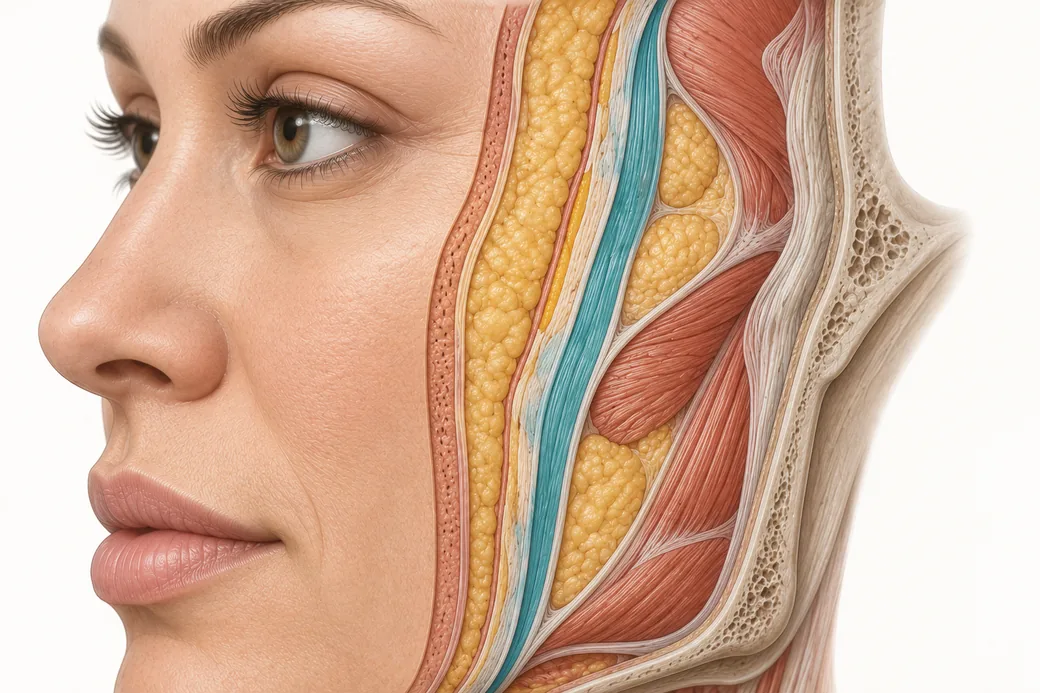
The correct PDO thread insertion plane has no number attached to it, and Tatiana Sarmiento, faculty at Empire Medical Training, teaches it that way on purpose. There is no depth in millimetres in her instruction, because a depth is not what you are looking for. You are looking for a tissue plane, and the instrument that finds it is your hand.
Her whole rule fits in two sentences:
"If you have resistance, you may be too superficial. And if you are too deep and you feel resistance as well, it's because you are getting into the muscle. You need to have a plane where you feel that cannula gliding inside the patient, and the patient doesn't feel any discomfort — and then that is the right plane."
Read quickly, that sounds like a beginner's heuristic. Read carefully, it is a complete sensory protocol with a diagnostic signal, a confirmation signal and a second independent instrument. It is also more robust than any depth figure could be, for reasons worth setting out properly.
These techniques reflect Tatiana Sarmiento's clinical practice as taught in Empire Medical Training's hands-on curriculum. Technique is learned under supervision; this article is educational and is not a substitute for training.
Why a millimetre figure cannot do this job
A depth in millimetres is a proxy. What you actually want is a specific tissue plane, and a distance from the surface only identifies that plane if the tissue above it is a known and constant thickness. It never is.
Soft tissue thickness varies by facial region within the same patient, between patients of the same age, with weight and weight history, with the degree of atrophy in the face you are treating, and — critically — with the very laxity that brought the patient to you. The thinner or more redistributed the tissue, the less a fixed number means. Then add the variables of the moment: how much the tissue is being tented by your non-dominant hand, the angle of entry, how much local anaesthetic volume has been deposited, and how much oedema has already developed along the track.
A number that is correct in the midface of one patient is superficial in the same region of the next and intramuscular in a third. It gives false confidence in exactly the situation where confidence is most dangerous, because the injector believes they have a criterion when what they have is an average.
The tactile signal has none of these problems. It is measured at the tip of the cannula, in the tissue actually in front of it, in real time, in this patient. It is not a proxy for anything.
Resistance: a reliable alarm with an unreliable direction
The first thing Sarmiento's rule establishes is that resistance is the error signal. If the cannula is not moving freely, you are not in the plane.
The second thing — and this is the part injectors miss — is that resistance is directionally ambiguous. It occurs when you are too superficial, and it occurs when you have entered muscle. The sensation tells you reliably that you are wrong, and it does not tell you which way.
This has a direct practical consequence that runs against instinct. The reflex when a cannula stops gliding is to adjust: angle a little deeper, or a little more superficial, and push on. But adjusting requires knowing which way is wrong, and the signal you have does not contain that information. Half the time the adjustment moves you further out of plane, and because you have now committed a new angle, the correction is harder than the original error.
The correct response to resistance is to stop, withdraw, and re-establish the plane rather than to steer through it. It costs seconds. Steering through costs a result.
A small number of secondary observations can help disambiguate at the surface — a cannula whose outline can be seen or a track that tents the skin is superficial, more or less by definition — but these are confirmatory, not primary. The primary discipline is the same regardless of direction: freedom of movement is the criterion, and its absence is the signal to reset.
Glide: the confirmation, not the absence of a problem
Glide is a positive finding, not merely the absence of resistance, and the distinction matters when you are training the skill.
What the correct plane feels like is the cannula travelling with very little force. The tip is separating a natural tissue interface rather than cutting through a structure, and interfaces separate easily. You are not pushing; you are advancing. If you notice yourself applying force, you have already left the plane, and you noticed it late.
Two habits build the discrimination faster than repetition alone:
Advance slowly enough to feel the whole track. Speed masks texture. A cannula pushed quickly through changing tissue produces one averaged sensation; the same cannula advanced deliberately produces a sequence of them, and the sequence is the information.
Notice where along the track the feel changes. The plane is not uniformly easy to stay in across a whole vector. Knowing where a given track tends to tighten is regional knowledge that accumulates, and it is what allows an experienced injector to anticipate rather than react.
The patient is your second instrument
The most underused half of Sarmiento's rule is the final clause: the patient doesn't feel any discomfort.
She is naming a second, independent channel of information, and it is independent in the useful sense — it can contradict the first. A cannula can feel acceptable in your hand while the patient reports pain, and that combination is meaningful. Correct-plane placement should not hurt. Discomfort during advancement is a signal in its own right and deserves a pause rather than reassurance.
The consequence that follows is one injectors rarely think through in advance: anything that removes the patient's ability to report removes the instrument. Heavy local anaesthesia along the entire track, or sedation that blunts reporting, buys comfort at the cost of a safety and accuracy signal you were relying on. That is not an argument against anaesthesia — entry points need it and patients deserve it. It is an argument for being deliberate about how much of the track you anaesthetise and for recognising that a fully numb patient has left you working on one channel instead of two.
The related discipline is how you ask. "Does that hurt?" invites a stoic patient to say no. "Tell me the moment anything feels sharp, or different from what you felt a second ago" asks for a change rather than a verdict, and change is what you need to hear about.
Aggressive handling is a plane problem wearing different clothes
Sarmiento lists aggressive handling — excessive traction, excessive massage — as a distinct common mistake, and it connects directly to plane discipline.
Force is the common factor. Forcing a cannula that is not gliding, forcing traction on a thread that has not engaged cleanly, and forcing tissue into position with heavy manipulation afterwards all produce the same category of outcome: trauma along the track, discomfort out of proportion to the procedure, and surface irregularity. A procedure performed in the correct plane requires remarkably little force at any stage, and the amount of force being used is itself a diagnostic.
If a step in your thread placement requires effort, the question to ask is not how to apply the effort more skilfully. It is what is wrong that is requiring it.
Why depth figures creep back in, and why to resist
Written protocols want numbers. Numbers are teachable at a distance, they look rigorous in a handout, and they let a clinician feel they have a criterion. Tactile criteria have none of those advantages, which is exactly why they get quietly replaced with a millimetre figure borrowed from a different technique, a different region or a different product.
Three reasons to hold the line:
The number will be wrong for some of your patients and you will not know which ones. Tactile feedback fails safely — it tells you at the moment of the error. A wrong depth figure fails silently.
It transfers false competence. An injector who has memorised a depth believes they have learned the step. An injector who knows they are looking for glide knows they have to develop the feel, which is an accurate assessment of where they stand.
It cannot adapt. The plane in a thin periorbital region and the plane in a submental region are different propositions, and the submental application in particular involves tissue where a facial depth figure would be meaningless. Glide travels between regions. Millimetres do not.
How the skill is actually built
Tactile discrimination is trained, not read. It is built by advancing a cannula in tissue, repeatedly, with someone experienced watching your hand and telling you what you just felt — which is the one part of this that an article genuinely cannot supply.
What an article can do is make sure you are attending to the right thing when you get there. Go in knowing that resistance is an alarm and not a direction, that glide is a positive finding you should be able to name, and that the patient is a second instrument you can lose by over-anaesthetising. Those three ideas make supervised practice considerably more productive.
The supervised component is what Empire's Advanced PDO Thread Lift Training is built to deliver, with the underlying tissue relationships taught in Anatomical Based Aesthetics Training and the cadaver-based anatomy programme.
Related guides in this cluster
Part of Thread Lifting and Suspension.
 Clinical GuideMono, Screw and Cog — Matching the PDO Thread Family to the Clinical JobPDO thread types explained by mechanism, not by brand. How mono, screw and cog threads differ in what they ask tissue to do — and how t
 Clinical GuideThe Two-Phase PDO Thread Timeline — and the Mid-Course Drop Nobody Warns Patients AboutThe PDO thread lift timeline runs two clocks — suture absorption and collagen response. The gap between them is when patients call disa
 Clinical GuideWho Is Not a Thread Candidate — Patient Selection That Protects Your OutcomesThread lift patient selection by failure mechanism — severe laxity, heavy tissue, crepey skin, fat herniation, and the expectation you
Train with Empire
This guide is clinical education. The technique behind it is taught hands-on, on live patients, with faculty beside you.
Explore PDO Thread Lift Training →Disclaimer
This article reflects the clinical opinions and experience of Tatiana Sarmiento, Faculty, Empire Medical Training, an independent faculty member contributing to Empire Medical Training's curriculum. The views expressed are the author's own and do not necessarily represent those of Empire Medical Training.
It is professional education, not medical advice, and is no substitute for hands-on training or independent clinical judgment. Licensed clinicians remain responsible for their own patient selection, technique and outcomes, for verifying current product labelling, and for practising within their scope and applicable law. Empire Medical Training accepts no liability for reliance on this content.
 Claim Your Prize!