







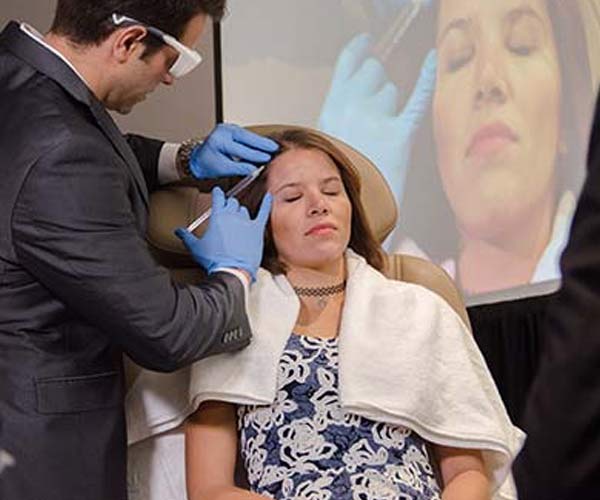
You looked in the mirror a few days after your Botox® appointment and one eyebrow sits higher than the other. Or one side of your forehead still creases and the other is smooth. Or your eyes look subtly different in a way you can’t quite name. This is one of the most common things patients notice after botulinum toxin treatment, and it is unsettling in a way that’s hard to explain to anyone who hasn’t experienced it.
Here is the honest version: uneven Botox in the first two weeks is usually not a complication at all. It’s the treatment mid-flight. Botulinum toxin does not switch on evenly across every injected muscle, and the gap between “one side is working” and “both sides are working” is exactly where most people panic. Genuine asymmetry — the kind still there at full effect — does happen, and it has real causes. This guide covers why asymmetry appears, when it’s expected, what can be corrected and what has to be waited out, and when to pick up the phone.
What Is Uneven Botox?
Uneven Botox — clinically, post-treatment asymmetry — is when the effect of botulinum toxin appears stronger, weaker, or differently positioned on one side of the face than the other. It shows up in a handful of recognizable patterns:
- One eyebrow sitting higher than the other, sometimes with an exaggerated arch on the raised side (often called a “Spock brow” when the outer brow peaks sharply).
- One side of the forehead still creasing while the other stays smooth.
- Uneven eyes — one eye looking more open, more hooded, or set differently than its partner.
- A crooked or one-sided smile, which has its own distinct mechanism and is covered in detail in our guide on what to do about a crooked smile after Botox.
- Asymmetric crow’s feet — lines fanning out on one side and not the other when you smile.
- Uneven softening around the jawline after masseter treatment.
The eyebrows and eyelids account for the overwhelming share of complaints, and that’s not a coincidence. The muscles there are small, thin, layered, and separated by millimeters. The frontalis is the only brow elevator you have, and it sits directly above the muscles that pull the brow down. A dose landing slightly differently on one side produces a visible difference in brow height. Elsewhere on the face, the same variance would be invisible.
Why Does Botox Look Uneven? Six Real Causes
Asymmetry after Botox is not one phenomenon. It’s six different things that all produce a similar-looking result, and they have very different implications.
1. The Toxin Simply Hasn’t Finished Working Yet
This is the most common explanation, and the one most patients don’t consider. Botulinum toxin doesn’t act instantly — it has to bind to nerve terminals, be internalized, and cleave the protein machinery that releases acetylcholine. Most people notice softening at 3 to 5 days and reach full effect around 10 to 14 days.
Nothing guarantees both sides finish on the same schedule. One side can genuinely kick in faster than the other — different muscle bulk, local blood flow, or how the dose distributed within the muscle can each put one side a few days ahead. What you see at day 3 or 5 is a snapshot of an unfinished process, not the result. Our breakdown of how long Botox takes to work walks through the timeline.
2. Pre-Existing Facial Asymmetry You’d Never Noticed
Almost no one has a symmetrical face. One brow naturally sits higher, one eye is slightly more open, one side of the mouth pulls harder when you smile. Most people have looked at their own face every day for decades without registering any of it, because the movement of the face distracts from the structure.
Take the movement away and the structure becomes visible. When Botox relaxes the muscles that were masking your baseline asymmetry, the underlying difference is suddenly on display — and the natural conclusion is that Botox caused it. Frequently, it didn’t. It revealed it. This is why good injectors photograph patients at rest and in animation beforehand: those photos are often the only way to settle the question later.
3. Differential Muscle Strength
Even when your face looks symmetrical, the muscles on each side may not be equally strong. Most people favor one side when they raise their brows, squint, or smile — the same way you favor one hand. A bulkier, dominant muscle needs more units to relax as much as its weaker counterpart.
If an injector doses both sides identically without assessing strength in animation, the weaker side relaxes more completely and the stronger side keeps pulling. It looks like an injection error. It’s really an assessment gap — symmetric dosing applied to an asymmetric face.
4. Placement Variance
In the upper face, a millimeter is a meaningful distance. Frontalis fibers vary in position and density between people, and the boundary between the frontalis and the depressors below isn’t a clean line. An injection slightly too low, too lateral, or too medial on one side changes which fibers relax and by how much.
A common example: if the lateral frontalis is under-treated on one side while the medial portion is fully relaxed, the untreated outer fibers keep lifting and produce a sharply peaked brow. Placement variance is what most people assume is behind all uneven Botox. It’s a real cause — just not the most common one.
5. Uneven Diffusion
Toxin doesn’t stay in a perfect sphere around the needle tip. It spreads through tissue, and how far depends on volume, dilution, depth, and local tissue characteristics. A dilute product in a larger volume spreads further than a concentrated one in a small volume.
Diffusion is what makes toxin work at all — it needs to reach nerve terminals across the muscle. But it’s also what lets the effect reach a neighboring muscle you never intended to treat. When it goes slightly further on one side, you get asymmetry. When it reaches the levator palpebrae superioris, you get eyelid ptosis — a different problem with a different management path.
6. Dosing Decisions
Sometimes asymmetry traces to units, plainly. Too few on one side leaves residual movement; too many on the other over-relaxes it. Reconstitution errors, imprecise draw-up, or a plan that didn’t account for the patient’s actual muscle mass all produce the same visible outcome.
When Does Uneven Botox Show Up — and How Long Does It Last?
Timing is the most useful diagnostic information you have, because it separates “still developing” from “this is the result.”
- Days 1–2. Very little should be happening. If you see no difference two days after Botox, that isn’t a failure — it’s the expected onset curve. Any unevenness at this stage is far more likely to be swelling or a small bruise than toxin effect.
- Days 3–7. The peak window for perceived asymmetry. One side is working, the other is catching up, and the contrast is at its most obvious. This is when most people search for answers. Most of what looks alarming here resolves without intervention.
- Days 10–14. Full effect. What you see now is the actual result. Asymmetry that persists at two weeks is real asymmetry and worth a conversation with your injector.
- Weeks 3–12. Whatever remains at two weeks tends to hold roughly steady, then fade as the toxin wears off over 3 to 4 months. Asymmetry usually softens gradually rather than disappearing abruptly.
The critical takeaway: time is the primary treatment. Not comforting when you’re staring at one raised eyebrow, but it’s the truth. There is no reversal agent for botulinum toxin — nothing can be injected to undo it, the way hyaluronidase dissolves a hyaluronic acid filler. The effect ends when nerve terminals regenerate their signaling, and that timeline belongs to your biology, not to any product.
Can Uneven Botox Be Fixed?
Partly — and the distinction matters enormously.
What Can Be Corrected
Under-treatment can be added to. If one side kept moving because it didn’t get enough toxin, a small touch-up dose to the stronger, under-treated side can bring it into balance with the other. This is the single most common and most reliable correction: you don’t remove product from the over-treated side; you bring the under-treated side down to match.
Ready to put this into practice?
Explore Empire's hands-on, CME-accredited Aesthetic & Injectable Training courses — live patients, expert faculty, and ongoing mentorship.
A peaked brow can often be softened. When untreated lateral frontalis fibers are producing a sharp arch, a few well-placed units into those fibers can relax the peak. It’s a small, precise adjustment and it works well in the right hands.
Both require full effect first. A touch-up at day 4, before the original dose has settled, risks stacking onto a side that was about to even out on its own — creating over-treatment where you had a timing artifact. Reputable injectors assess at two weeks for exactly this reason.
What Cannot Be Corrected
Over-treatment cannot be reversed. If a muscle received too much toxin, no injection, drop, massage, or supplement will restore its function faster. The only path is time. Anyone promising to “dissolve” or “flush out” your Botox is describing something that does not exist.
A heavy brow from over-relaxed frontalis has to wear off. Adding toxin to the depressor muscles below can sometimes offer marginal help, but this is a judgment call for your injector to make in person — and it can just as easily compound the problem.
Baseline asymmetry can’t be injected away as a rescue. If the asymmetry was always there, correcting it is a planned treatment goal for your next appointment, not an emergency fix.
What About “Exercising” the Muscles?
You’ll see advice everywhere to frown, raise your brows, or squint repeatedly to help Botox “settle in” evenly. The rationale — that muscle activity increases toxin uptake at the nerve terminal — has some theoretical basis, but the evidence that it meaningfully improves symmetry is thin. It is unlikely to hurt. It is not a fix, and it shouldn’t be the reason you delay calling your injector. Follow the aftercare you were actually given; our do’s and don’ts after Botox covers the guidance with a rationale behind it.
When to Call Your Injector
Mild asymmetry in the first week is usually a wait-and-watch situation. These are not:
- A drooping upper eyelid — the lid itself covering more of your eye, not just a lower brow. This suggests the toxin reached the levator muscle and should be reported.
- Any change in vision — blurring, double vision, or a visual field that seems reduced.
- Difficulty swallowing, speaking, or breathing. These are rare, they are not normal at any point, and they warrant immediate medical attention rather than a message to the clinic.
- Generalized muscle weakness away from the treated area.
- Signs of infection — spreading redness, warmth, significant swelling, or fever.
- Asymmetry that’s still present at two weeks and bothers you. At full effect, it’s reasonable to ask for assessment.
Calling your injector is not an accusation and shouldn’t feel like one. A good clinician wants to see the result and wants the chance to correct what’s correctable. A provider who gets defensive about a follow-up request has told you something useful about whether to return.
How Uneven Botox Is Prevented
Most asymmetry is preventable, and prevention lives almost entirely in the assessment — before a needle is ever uncapped.
- Assessment in animation, not just at rest. The injector should watch you raise your brows, frown, squint, and smile, and note which side pulls harder. A face at rest hides everything that matters.
- Baseline photography at rest and in animation. Without it, no one can distinguish pre-existing asymmetry from a treatment effect after the fact.
- Asymmetric dosing for asymmetric faces. Equal units to both sides is not the same as an equal result. The stronger side often needs more.
- Anatomic mapping rather than a template. Injection points should follow your muscle anatomy, not a diagram. Our guide to Botox injection sites covers the landmarks that vary most between patients.
- Deliberate control of dilution and volume to keep diffusion within the intended muscle.
- Conservative first treatments and a scheduled two-week follow-up. You can always add units later; you cannot take them out.
- Setting the expectation up front that days 3 to 7 often look uneven, and that this is normal. A patient told this in advance doesn’t spend a week frightened.
The highest-leverage thing you can do as a patient happens before treatment: choose an injector with real anatomic training who assesses your face rather than a template. Our guide on what to expect during a Botox consultation outlines what a thorough assessment looks like.
Frequently Asked Questions
Is it normal for Botox to be uneven at first?
Yes. Early asymmetry is common and expected. Botulinum toxin takes 10 to 14 days to reach full effect, and both sides rarely progress on an identical schedule. Uneven results at days 3 to 7 are usually a snapshot of an unfinished process rather than a final outcome. Judge the result at two weeks.
Can one side of Botox kick in faster than the other?
Yes, and it happens routinely. Differences in muscle bulk, local blood flow, and how the dose distributed within each muscle can put one side several days ahead. It is one of the most common reasons Botox looks lopsided in the first week and evens out later.
Why is my Botox uneven after 3 days?
Day 3 is the earliest point most people see any effect at all, and it is the peak window for asymmetry — one side has begun working while the other is still binding. Some of what you see at day 3 may also be residual swelling or bruising rather than toxin effect. Most of it resolves by day 10 to 14 without intervention.
Why is my forehead uneven after Botox?
The frontalis is the usual culprit, for one of several reasons: it hasn’t finished responding, one side is naturally stronger and needed more units, placement varied slightly between sides, or part of the muscle was under-treated while the rest relaxed. The forehead is also where small differences are most visible, because the frontalis is your only brow elevator.
Why do my eyes look uneven after Botox?
Most often it’s brow position rather than the eyes themselves — one brow sitting lower changes how open the eye beneath it appears. This differs from true eyelid ptosis, where the lid itself droops because toxin reached the levator muscle. If the lid margin has dropped or your vision has changed, contact your injector rather than waiting.
Can asymmetry after Botox be permanent?
No. Botulinum toxin’s effect is temporary by mechanism. Nerve terminals regenerate and normal signaling returns, typically over 3 to 4 months. Asymmetry caused by Botox resolves as the product wears off. If asymmetry persists well past that, it likely reflects underlying baseline asymmetry rather than the treatment.
I see no difference two days after Botox — did it work?
Almost certainly it’s just early. Onset typically begins at 3 to 5 days with full effect at 10 to 14. Two days is well inside the window where nothing visible is expected. If you still see no effect at all by two weeks, that is worth raising with your injector.
Asymmetry Is a Technique Problem — and Technique Is Trainable
Nearly every avoidable case of uneven Botox traces back to the same handful of things: assessment done at rest instead of in animation, symmetric dosing applied to an asymmetric face, placement that drifted a few millimeters, dilution that let the toxin spread too far, or a plan that skipped the two-week follow-up. None are product failures. They are gaps in training.
Empire Medical Training has taught healthcare professionals aesthetic injection technique since 1998. Our Botox Training & Certification course is CME-accredited and hands-on, covering facial anatomy, assessment of baseline asymmetry and muscle dominance, dosing by muscle mass, diffusion control, and complication management — with live-patient injection under expert supervision. The difference between a result a patient loves and a week of anxious mirror-checking is almost always what the injector understood before picking up the syringe.


 Claim Your Prize!