







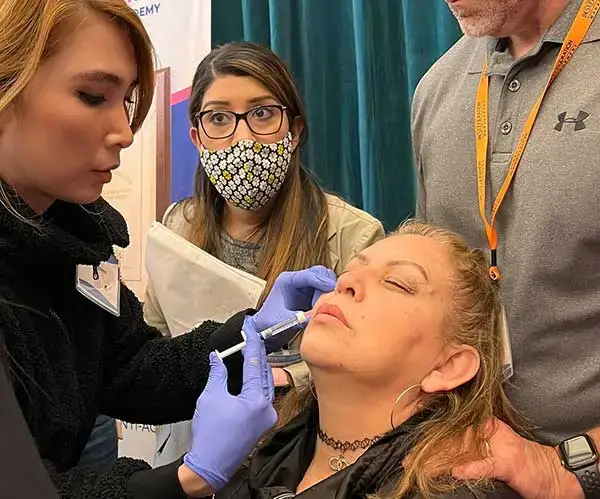
A crooked smile after Botox® isn’t really a side effect. It’s a complication — and almost always a technique problem rather than a drug problem. The toxin went somewhere it wasn’t meant to go, a muscle that should have kept working stopped working, and now one side of the mouth lifts and the other doesn’t.
The honest answer about what to do next isn’t the one most people want: there is no reversal agent for botulinum toxin, and the primary treatment is time. Below is a straight account of why a crooked smile happens after Botox, what can and cannot be done about it, how long it actually lasts, and when a lopsided smile has nothing to do with Botox at all and needs urgent medical attention instead.
What Causes a Crooked Smile After Botox?
Your smile is produced by a small group of muscles that elevate the corner of the mouth and the upper lip — principally the zygomaticus major, zygomaticus minor, and levator labii superioris. None of them is a cosmetic target. If any takes up toxin, that side of the mouth loses some of its ability to lift and the smile goes asymmetric. The toxin gets there in one of two ways.
Misplaced Injection
The intended target is often just millimeters from a muscle you must not touch. The classic example is the depressor anguli oris (DAO), a legitimate target for softening downturned mouth corners and marionette lines. Immediately medial to it sits the depressor labii inferioris. Miss the DAO, catch the depressor labii inferioris, and the lower lip loses its ability to depress on that side — producing the stiff, uneven, partly “frozen” smile patients describe.
Because the two muscles sit so close together, this is a common error among injectors who don’t treat the perioral region regularly. Our Botox injection sites guide covers the anatomy of each treatment area.
Diffusion from a Nearby Site
The more common mechanism is unintended spread. Botox does not stay on a pinpoint — it diffuses through tissue for a short distance from the injection point. Injection depth, angle, volume, and dilution all determine how far. Three procedures account for most cases:
- Masseter injections placed too anteriorly or too superficially. The masseter is a deep, thick muscle; treating it for jaw slimming or bruxism requires depth and posterior placement. Drift forward and the toxin reaches the zygomaticus major. See our guide to Botox for jaw clenching and masseter treatment.
- DAO injections placed too medially, too deeply, or with too much volume.
- Lip flip injections placed too laterally or too deep. The lip flip targets the superficial orbicularis oris near the vermilion border. Go lateral or deep and levator labii superioris involvement is a real risk.
In each case the drug performed exactly as designed — it simply reached tissue that wasn’t supposed to receive it. That is why a crooked smile is best understood as an injector-dependent complication, not a random reaction.
Will a Crooked Smile After Botox Go Away on Its Own?
Yes. In essentially all cases it resolves completely as the toxin wears off. Nerve terminals gradually re-establish signaling to the affected muscle, function returns, and the smile normalizes. This is the same process that causes cosmetic results to fade — here it works in your favor. Our guide on how long Botox takes to work and how long it lasts explains the underlying timeline.
The catch is that resolution is measured in weeks to months, not days. Expect several weeks to a few months, and note that the affected muscle usually received only a small, diffused fraction of a dose — so it frequently recovers ahead of the fully treated area. Many patients see meaningful improvement before the toxin has fully worn off everywhere.
Can a Crooked Smile After Botox Be Fixed?
This is where honesty matters more than reassurance.
There is no reversal agent for botulinum toxin. Dermal filler has one — hyaluronidase dissolves hyaluronic acid filler within hours. Nothing comparable exists for neuromodulators. Once the toxin has bound to the nerve terminal, no injection, medication, massage, or device removes it. Any provider who tells you they can “reverse” your Botox is either confused or selling something.
What can sometimes be done is balancing: placing a small, carefully judged dose into the corresponding muscle on the opposite side to weaken it toward the affected side’s level. Symmetry improves not because the problem is fixed, but because both sides now behave similarly.
Balancing is a judgement call, not a default, and it comes with real trade-offs:
- It adds toxin rather than removing it, so it can extend the total time before your face is fully back to baseline.
- It requires accurate assessment of exactly which muscle is affected and how much. Get that wrong and you compound the asymmetry rather than correcting it.
- Both sides may now be weaker than you want, trading a lopsided smile for a diminished one.
- It cannot be undone either.
Balancing is most defensible when the asymmetry is marked, the affected muscle is clearly identified, the patient understands the trade-off, and the injector treats the perioral region routinely. It is least defensible as a reflex response to a mild asymmetry that would have resolved on its own.
If you pursue it, seek a physician, PA, NP, or RN who injects the perioral area regularly and has completed advanced, hands-on training — not necessarily the person who caused the problem. Ask them directly what they think is affected and why. A good answer names a specific muscle. Our overview of what to expect during a Botox consultation covers the questions worth asking.
What Actually Helps in the Meantime
There is no evidence that massage, heat, exercise, supplements, or facial workouts speed toxin clearance. What genuinely helps:
- Documentation. Photograph the asymmetry at rest and smiling, and date the images. This informs any decision about balancing and tracks recovery.
- Follow-up at two weeks. Full toxin effect is reached at 10 to 14 days. Asymmetry seen at day 3 may look different at day 14.
- Reporting functional problems. Difficulty with speech, drinking from a cup, or eating should be reported to your provider promptly.
- Urgent evaluation for red flags. Difficulty swallowing or breathing after any botulinum toxin injection warrants immediate medical attention.
Other Causes of a Crooked Smile
Not every lopsided smile is a Botox complication. If you haven’t had injections, or the timing doesn’t fit, the cause lies elsewhere — and the right treatment is entirely different.
Sudden-Onset Facial Droop: Seek Emergency Care
A crooked smile that appears suddenly is a medical emergency until proven otherwise. Facial droop is one of the cardinal warning signs of stroke. If one side of the face droops abruptly — particularly alongside arm weakness, slurred or garbled speech, confusion, vision changes, or severe headache — call 911 immediately. Do not wait, do not drive yourself, and do not assume it’s your Botox. Stroke treatment is time-critical, and the window for intervention is measured in hours.
Ready to put this into practice?
Explore Empire's hands-on, CME-accredited Aesthetic & Injectable Training courses — live patients, expert faculty, and ongoing mentorship.
Bell’s palsy also causes sudden one-sided facial weakness and is thought to follow viral inflammation of the facial nerve. It is generally not dangerous and often resolves, but it can be difficult to distinguish from stroke without evaluation — which is precisely why sudden facial droop needs to be assessed by a clinician, not by you or your injector. Other neurological causes include seizure, multiple sclerosis, and Guillain-Barré syndrome, a rare autoimmune condition.
Dental Issues
Missing adult teeth, naturally crooked or crowded teeth, weak or broken teeth, and trauma-affected teeth all produce an uneven smile. Treatment depends on the specific problem and may involve caps or crowns, dental implants, or tissue grafting.
Orthodontic and Jaw Alignment Issues
Crooked teeth and bite problems — underbite, overbite, jaw misalignment — often respond to orthodontia, which is considerably less invasive than implants or oral surgery. TMJ dysfunction can also contribute to an asymmetric smile.
Abnormal Facial Structure
Congenital differences in the bones and soft tissue of the lower face — malformed facial bones, missing or misshapen facial tissue, cleft lip — are a distinct category. Correction, when appropriate, usually means facial surgery with a plastic surgeon who specializes in that specific issue.
Physical Trauma and Lifestyle Factors
Car and cycling accidents, falls, and interpersonal violence can produce lasting dental damage, structural change, and facial muscle atrophy. Treatment follows whatever the trauma actually damaged. Lifestyle factors act mostly through oral health: a diet high in sugar and starch (particularly with diabetes), smoking, chewing tobacco, and heavy alcohol or drug use all contribute to the decay and tooth loss that produce an uneven smile over time.
Where Botox Fits — and Where It Doesn’t
Botox is appropriate for a crooked smile only when improper Botox injection caused it, and even then as a balancing measure with the limits described above. It does not fix teeth, bone, trauma, or nerve injury. For non-Botox causes, treatment ranges from physical therapy for muscle weakness without permanent nerve damage, through dental work and orthodontia, to facial surgery. Never self-inject, and never accept neurotoxin from anyone who isn’t a licensed medical provider.
How to Prevent a Crooked Smile from Botox
Prevention is almost entirely about who is holding the syringe.
- Choose an injector who treats the perioral area routinely. The lower face is less forgiving than the glabella. Volume for volume, the margin for error is smaller.
- Ask about their approach to the DAO and masseter specifically. Injection depth and placement should come up unprompted.
- Start conservatively. Under-dosing and adding at the two-week follow-up is always safer than over-dosing on day one, because too much cannot be taken back.
- Follow aftercare. Stay upright for about four hours, don’t rub or massage treated areas, and skip strenuous exercise for 24 hours. This reduces avoidable diffusion.
- Disclose your history. Prior asymmetry, prior complications such as eyelid ptosis, or any neuromuscular condition changes the plan.
Most faces are mildly asymmetric before any needle touches them. A careful injector photographs and points out pre-existing asymmetry during consultation, which both sets expectations and establishes a baseline. Our guide to uneven results after Botox covers asymmetry across other treatment areas.
Frequently Asked Questions
How long does a crooked smile after Botox last?
Weeks to a few months. It resolves as the toxin wears off and nerve signaling returns to the affected muscle. Because the muscle typically received only a small diffused amount rather than a full dose, it often recovers sooner than the intentionally treated area — many patients improve well before the three-to-four-month mark.
Can a crooked smile after Botox be fixed?
It cannot be reversed — no agent removes botulinum toxin once it has bound to the nerve terminal. It can sometimes be balanced by placing a small dose in the corresponding muscle on the opposite side so both sides move similarly. That is a judgement call with real trade-offs and should only be done by an experienced injector after careful assessment.
What causes a crooked smile after Botox?
Unintended weakening of a smile muscle — usually the zygomaticus major or minor, or levator labii superioris — either from a misplaced injection or from diffusion out of a nearby site. Masseter injections placed too anteriorly or superficially, DAO injections that catch the depressor labii inferioris, and lip flips placed too laterally or deeply are the usual sources.
Will a crooked smile after Botox go away on its own?
Yes. This is the expected outcome and, in most cases, the best plan. Botox effects are temporary by nature. Doing nothing carries no risk of making things worse, which is not true of every alternative.
Can more Botox fix an uneven smile?
More Botox can improve symmetry, but it does not fix the original problem — it weakens the good side to match the affected one. It may extend your total recovery time, and if the assessment is wrong it can worsen the asymmetry. Sometimes worth it for marked asymmetry; rarely worth it for a mild one that will resolve anyway.
How do I prevent this from happening?
Select your injector on training and perioral experience rather than price. Ask specifically how they approach the DAO, masseter, or lip flip. Start with conservative dosing and reassess at two weeks. Follow aftercare instructions to limit diffusion. Disclose any prior asymmetry or complications.
Should I worry that Botox spread somewhere dangerous?
A crooked smile is a local diffusion effect confined to the injection field — it is not evidence of systemic spread. Distant spread of toxin effect is rare and overwhelmingly associated with high therapeutic doses, not cosmetic ones. That said, difficulty swallowing, difficulty breathing, generalized weakness, or changes in your voice after any botulinum toxin injection require immediate medical evaluation.
Complication Avoidance Is a Training Issue
Every mechanism described on this page — the missed DAO, the anterior masseter, the over-deep lip flip — is a technique failure, not a drug failure. Botox does what it is supposed to do. Whether it does it in the right muscle depends on the injector’s command of facial anatomy, injection depth, dilution, dose, and diffusion control. Those are learnable, teachable skills, and they are the difference between a predictable result and a patient waiting three months for their smile to return.
Empire Medical Training has trained healthcare professionals in aesthetic medicine since 1998. Our Botox Training & Certification course is CME-accredited and hands-on, with live-patient injection under expert supervision — including the perioral and lower-face anatomy where these complications actually happen.


 Claim Your Prize!