







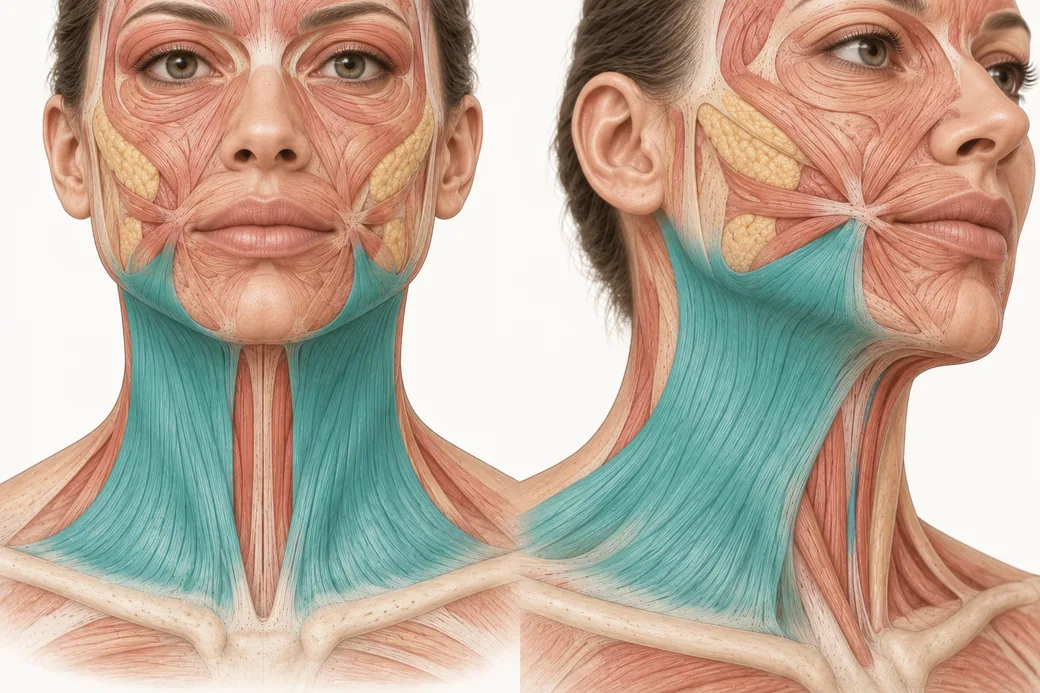
The platysma Nefertiti lift is the clearest illustration in aesthetic medicine of a principle that sounds abstract until you see it work: a muscle can change the shape of a structure it does not touch. Melissa Pulcini-Buttine, PA introduces it in one sentence of anatomy: "Your platysma muscle is this very thin, sheet-like muscle that comes from your clavicle and inserts up over your mandible. So we could do a Nefertiti neck lift, or modified Nefertiti, by relaxing that muscle, and we'll see a nice elevation over the jawline."
A muscle that begins at the collarbone is the reason a jawline looks pulled down. Understanding why requires following it all the way up, because where it ends is more surprising than where it starts.
The full course of the muscle
The platysma is a broad, flat, sheet-like mimetic muscle of the anterior neck. Its origin is the superficial fascia over the deltoid, trapezius and pectoral muscles and the clavicular region. Its fibres run upward toward the lower face, crossing over the sternocleidomastoid and the submandibular gland. On reaching the cervicomental angle, the fibres change direction — from vertical in the neck to more horizontal in the submandibular area and lower face (Toxins 2026;18(8):332).
That change of direction is the hinge of the whole subject. Above the cervicomental angle the muscle stops being a neck muscle in its vector and becomes a lower-face depressor.
The muscle is described two different ways in the literature, and both are useful clinically.
By region. A cervical part below the hyoid, a submandibular part between the mandible and the hyoid, and a facial part above the mandible.
By insertion — the subdivision that matters most. The anterior third, the pars mandibularis, attaches directly to the mandible. The intermediate part, the pars labialis, crosses the body of the mandible, runs underneath the depressor anguli oris, and inserts directly into the dermis of the lower lip where it intermingles with orbicularis oris fibres. The posterior third, the pars modiolaris, inserts into the buccinator and the modiolus — the dense fibro-muscular band at the oral commissure formed by the convergence of zygomaticus major, depressor anguli oris, levator anguli oris, buccinator, orbicularis oris and risorius.
So the answer to "how does a muscle that starts at the clavicle change the jawline" is that it does not stop at the jawline. A third of it inserts into the mandible, a third into the skin of the lower lip, and a third into the anchor point of the entire perioral muscular system.
One further anatomical note with clinical consequences: along the upper region of the middle neck, platysmal fibres from the left and right sides decussate and interdigitate in a variable manner, while in the lower part of the middle neck the fibres are absent altogether. The muscle is not a continuous sheet, and the pattern of decussation differs between people — which is one reason band patterns vary so much.
What it does, and therefore what relaxing it does
The platysma's documented functions are to pull the lower lip and the corners of the mouth downwards and outwards, to open the mouth by lowering the lower jaw, and to pull down the skin and soft tissues of the lower face and jawline.
Every one of those is a downward vector. Neurotoxin does not lift anything — it removes opposition. Weakening the platysma releases a sustained downward pull on the mandibular border and the modiolus, and the elevators that insert into the same modiolus, chiefly zygomaticus major and levator anguli oris, act on it without that opposition. The visible result is a sharper mandibular border and a small elevation at the commissure.
This is also the correct way to describe it to a patient. It is not a lift. It is a release, and the amount of change available is bounded by how much downward pull there was to release.
The Nefertiti technique and its actual evidence
The technique is named for the elongated jawline of the Nefertiti bust, and it has a documented origin. Levy extended platysma treatment from the bands to the jawline itself, injecting along and under each mandible and into the upper part of the posterior platysmal band, at a total of 15 to 20 units per side. In a series of 126 patients the author reported an immediate and visible release of the downward pull of the platysma with noticeable recontouring and elevation of the skin at the jawline.
Then the evidence gets more interesting, and an honest account has to include this part.
Subsequent authors reported that the standard Nefertiti technique does not succeed in at least half of patients, and modified it — extending treatment to all platysmal bands, delivering a larger quantity of units at the most active part of the muscle, and distributing injection points according to an assessment of platysma contraction rather than a fixed pattern. Total doses in that modified approach ranged from 10 to 70 units per session with a median of 36.
That is a striking range, and it is not noise. It is the signature of a treatment whose correct dose is set by how much muscle is actually pulling — which varies enormously — rather than by a protocol. The 2026 Italian expert consensus recommended a mean total dose of 48.4 units, substantially higher than the international average of 38.2 units across previously published consensus statements, with a mean of 24.2 units per side.
This is the point at which Melissa's general principle governs a region she treats very differently from the forehead: the pattern follows the movement. A platysma assessed at rest tells you almost nothing. A platysma assessed during forced contraction — the grimace that makes the bands stand out — tells you which bands are active, which part of the muscle is doing the pulling, and whether the problem is muscular at all.
Where to concentrate, and where not to bother
This is the most immediately actionable anatomy in the subject, and it is not widely taught.
The facial part of the platysma receives motor innervation from the marginal mandibular nerve and sporadically from buccal branches of the cervical branch of the facial nerve. The submandibular segment and the upper portion of the cervical part are supplied primarily by the cervical branch. The lower part of the cervical platysma, however, is innervated predominantly by sensory nerves — the transverse cervical, great auricular and supraclavicular nerves — which play no role in muscle contraction.
The consequence is a distribution of motor endplates clustered in the upper part of the muscle: the facial, submandibular and upper cervical segments. The lower cervical portion has mainly sensory innervation and few motor endplates. On that basis, Yi and colleagues argue that injections should be concentrated in the upper half of the platysma to optimise efficacy, and that injections into the lower platysma provide no additional benefit while increasing complication risk.
Read that twice if you have ever treated a band from the jawline down to the clavicle. Toxin placed low in the neck is being deposited where there is little to block.
What the treatment is genuinely good for
Expert consensus separates the indications by strength of agreement, and the gradient is informative:
- Platysmal bands — 100 percent agreement. This is the core indication.
- Jawline recontouring — 85.7 percent. Solid consensus.
- Improvement in skin texture — 78.5 percent. Consensus.
- Lifting of ptotic lower-face soft tissues — 64.2 percent, which the authors classify as majoritarian agreement rather than consensus.
The gradient is worth reading as a consultation script. Bands and jawline definition are what you promise, because that is where the agreement is strongest. Lift of the lower face is a secondary effect — Melissa describes elevation reaching "even in the mid face", and the mechanism behind it is real, since the pars modiolaris inserts into the structure the midface elevators pull on. Describe it as a bonus some patients notice, not as the reason to treat.
Patient selection: the question that decides the result
Given that up to half of patients may not respond to a standard approach, selection is where most of the outcome is determined. Three questions, asked with the patient contracting.
Are there bands, and are they active? Have the patient tense the neck and draw the corners of the mouth down and out. Bands that appear only on contraction are muscular and treatable. Bands visible at complete rest have a static component that toxin will soften rather than eliminate.
Is the jawline blurred by muscle, by skin laxity, or by fat? Only the first responds to this treatment. Submental fullness has a different set of answers — Empire covers one of them in thread lift for double chin — and a patient whose problem is laxity will be disappointed by a technically perfect platysma treatment.
Where is the active portion? Not all bands pull equally, and the modified technique in the literature exists precisely because distributing units evenly ignores this. Assessment during contraction identifies where the work is being done.
What changes at the chairside
- Assess on contraction, never at rest. A resting neck conceals the finding the whole plan depends on.
- Weight treatment to the upper muscle. The motor endplates are concentrated in the facial, submandibular and upper cervical segments; the lower cervical portion is predominantly sensory.
- Set expectations as release, not lift. The available change is bounded by the amount of downward pull present.
- Do not promise a midface effect. The mechanism via the modiolus is anatomically coherent and the evidence for it is weak; say so.
- Treat a non-response as a selection error, not a dosing error, and re-examine whether the presenting problem was muscular before escalating units.
This region sits at the junction of neurotoxin, structural laxity and skin quality, and it is rarely a single-modality problem. Empire's neck and hands rejuvenation master course addresses the combination-therapy question directly, and the underlying structural reasoning is covered in anatomical based aesthetics training and special anatomical cadaver aesthetics training.
The clinical approach above reflects Melissa Pulcini-Buttine's practice as taught in Empire Medical Training's hands-on curriculum. Technique is learned under supervision; this article is educational and is not a substitute for training.
Melissa Pulcini-Buttine, PA is a physician assistant of two decades and has been a professor of anatomy and physiology for approximately fourteen years. She is a faculty member at Empire Medical Training and the founder of an aesthetics practice in Greenwich, Connecticut.
Related guides in this cluster
Part of Facial Muscle Anatomy for Neurotoxin.
 Clinical GuideMost Neurotoxin Complications Are Diffusion, Not Misplacement — Rethinking Root CauseMost neurotoxin complications come from diffusion into an adjacent muscle, not from injecting the wrong site. Here is how to tell which
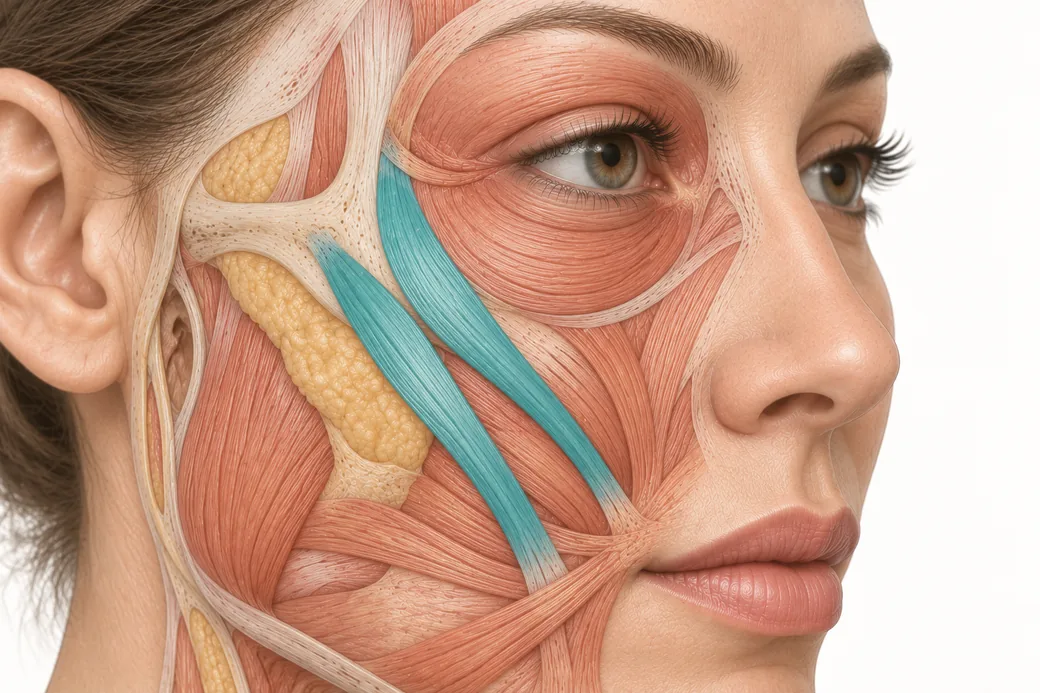 Clinical GuideThe Crow's Feet Trap — How Chasing Lateral Cheek Lines Reaches the ZygomaticusA zygomaticus botox complication after crow's feet treatment has one usual cause — chasing lateral cheek lines too low and too deep. Th
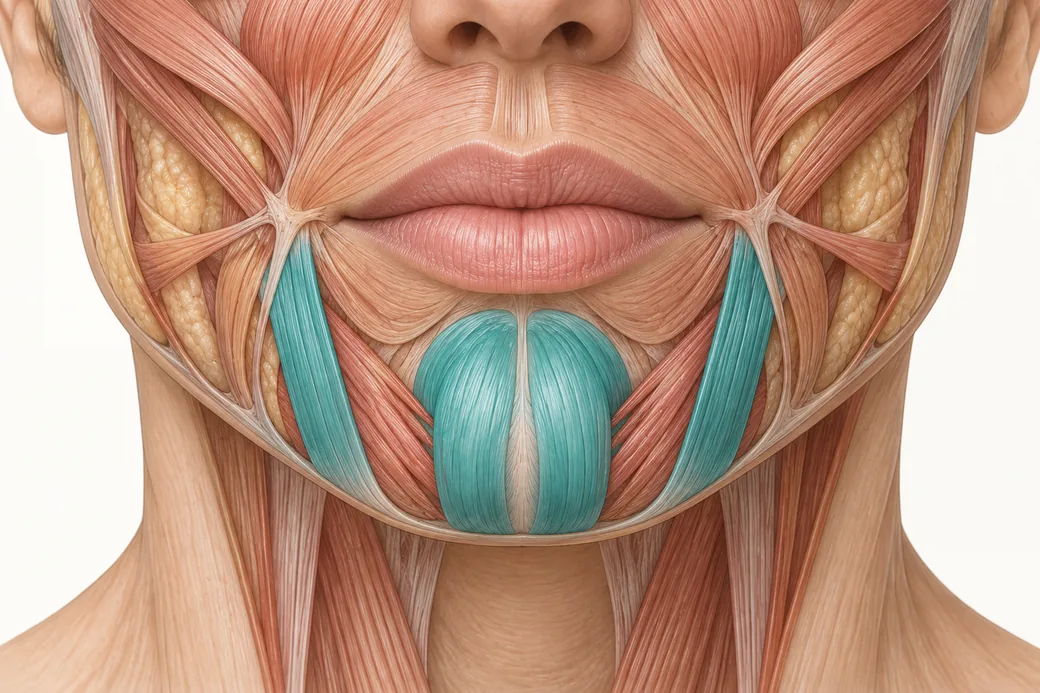 Clinical GuideDepressor Anguli Oris, DLI and Mentalis — Three Overlapping Muscles, Millimetres ApartDepressor anguli oris anatomy is a depth problem, not a map problem. The DAO, DLI and mentalis overlap in layers, and confusing them al
Train with Empire
This guide is clinical education. The technique behind it is taught hands-on, on live patients, with faculty beside you.
Explore Botox Training & Certification →Disclaimer
This article reflects the clinical opinions and experience of Melissa Pulcini-Buttine, PA, an independent faculty member contributing to Empire Medical Training's curriculum. The views expressed are the author's own and do not necessarily represent those of Empire Medical Training.
It is professional education, not medical advice, and is no substitute for hands-on training or independent clinical judgment. Licensed clinicians remain responsible for their own patient selection, technique and outcomes, for verifying current product labelling, and for practising within their scope and applicable law. Empire Medical Training accepts no liability for reliance on this content.
 Claim Your Prize!