







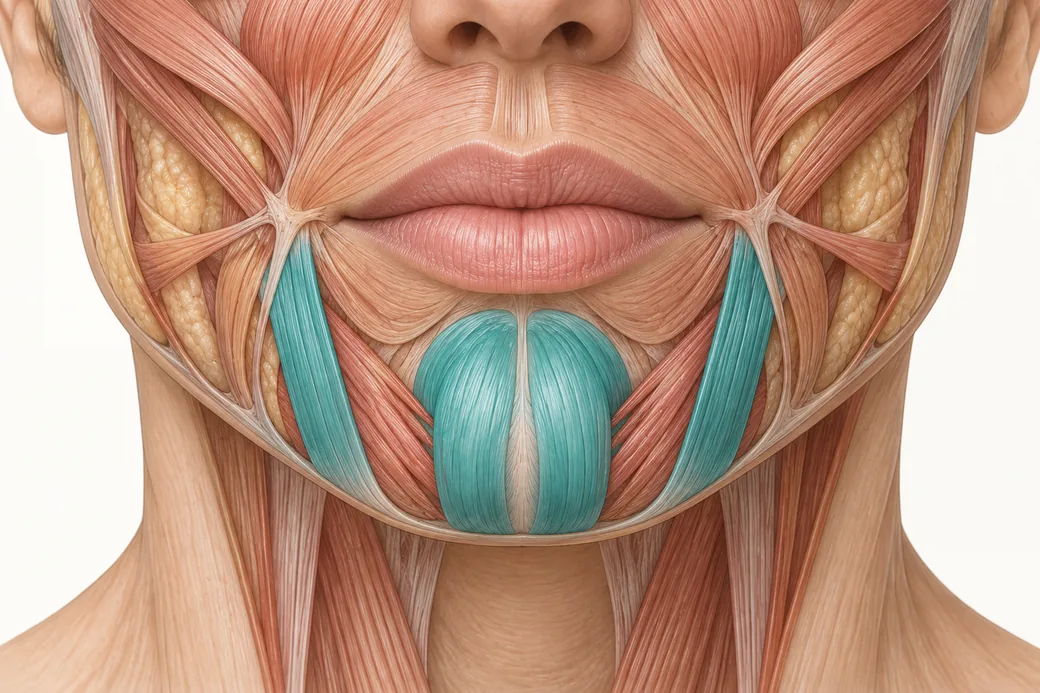
The most disfiguring complication in aesthetic neurotoxin practice is not a brow that sits wrong or a smile that flattens. It is a lower lip that stops moving on one side. Depressor anguli oris anatomy is where that outcome is decided, and the reason it happens is not that injectors put the needle in the wrong place on the face. It is that three functionally different muscles occupy nearly the same address at different depths, and the distances involved are measured in millimetres.
Dr. Chris Croley lays the geography out directly: "This is our DAO. And then we also have our depressor labii inferioris, which is kind of on the side here. And notice these muscles overlap. This is superficial, and right under that is going to be our depressor labii inferioris. And then we have our mentalis. And so those muscles are fairly close together."
This resource owns the anatomy and the placement reasoning. Reconstitution volume and dilution — a genuine and separate lever on the same problem — are covered by a companion resource in Empire's neurotoxin dosing cluster, and the two should be read together.
The three muscles
Depressor anguli oris
A triangular, superficial muscle arising broadly from the oblique line of the mandible and converging superiorly to insert at the modiolus, the fibrous node at the corner of the mouth. Its action is to depress the oral commissure — the muscle of the downturned mouth.
This is the intended target in a commissure-lift treatment. As Dr. Croley frames the intent: "If we're treating intentionally our DAO, we're treating it to elevate the corners of the mouth" — by weakening the depressor and letting the elevators win.
Position: most lateral of the three. Plane: superficial.
Depressor labii inferioris
A quadrangular muscle also arising from the oblique line of the mandible, but anterior and medial to the DAO origin, running superomedially to insert into the skin and mucosa of the lower lip, blending with the orbicularis oris and with its opposite number. Its action is to depress and evert the lower lip.
Critically, its lateral portion lies deep to the DAO. The two muscles share surface coordinates over part of their course and are separated in the vertical axis, not the horizontal one.
Position: intermediate. Plane: deep to DAO laterally.
Mentalis
A paired muscle arising from the incisive fossa of the mandible and descending to insert into the skin of the chin. It elevates and protrudes the lower lip and puckers the chin skin. It is the most medial of the three and the deepest at its origin, sitting close to bone.
Dr. Croley's clinical note on it opens a separate question entirely: "This is the chin muscle here. Creates a dimple chin. A lot of patients like that. I want to remind you that many times we see a dimple chin for volume loss, not because of muscle overactivity." Whether a dimpled chin is a neurotoxin problem at all is its own differential and is addressed separately.
Position: most medial. Plane: deep, close to bone.
The real coordinate system
Most injectors carry a mental map of the lower face that is two-dimensional — a set of surface points. The anatomy here has three dimensions and both of the relevant axes are tight.
The lateral-to-medial axis runs DAO, then DLI, then mentalis. The distance between them at the level where you are injecting is small, and it varies between patients.
The superficial-to-deep axis is the one that causes the serious complications. The DAO is superficial. The DLI is beneath it. A needle at a perfectly correct surface coordinate, angled or advanced slightly too far, is in a different muscle with a different action.
Dr. Croley's account of how the error occurs names both axes and the force variable in a single sentence: "By treating them, moving our syringe just millimetres, injecting with a little bit too much force, we can drastically alter the smile."
That is the whole mechanism. Millimetres of translation, millimetres of depth, and a bolus delivered under pressure that travels further than the needle tip did.
Why the consequences are not graded
In most of the face, an adjacent-muscle complication produces a muted or slightly wrong version of the intended effect. In the lower face, adjacent muscles have opposed or unrelated actions, so reaching the wrong one does not weaken your result — it inverts it.
| Muscle | Action | Effect of weakening it |
|---|---|---|
| Depressor anguli oris | Depresses the commissure | Corner of the mouth sits higher — the intended effect |
| Depressor labii inferioris | Depresses and everts the lower lip | Lower lip fails to move, evert or show lower teeth on that side |
| Mentalis | Elevates and protrudes the lower lip, puckers chin skin | Chin skin flattens; overshoot risks chin ptosis and reduced lip seal |
Dr. Croley's description of the DLI outcome is the one clinicians remember, and it is worth preserving in his words because it captures how the patient experiences it: "If we treat the DLI, all of a sudden we paralyse the lower lip. So we go from trying to create an upturned smile to having the patient look like they had a stroke. And so, problematic, to say the least."
The comparison is not hyperbole. Asymmetric lower lip depression is one of the visible signs the public associates with neurological injury, which is why patients find this complication far more distressing than its purely aesthetic magnitude would suggest.
Placement reasoning
The following is reasoning about how to think in this region, not a set of coordinates. No injection points or depth figures appear here — surface mapping is covered in the facial mapping reference and the chin injection site discussion.
Locate by palpation and animation, not by the line. These muscles are individually variable in width, bulk and overlap. Have the patient animate to identify each one specifically: forced depression of the lower lip to recruit the DLI; a deliberate downturn or grimace of the commissure to recruit the DAO; protrusion and elevation of the lower lip to recruit the mentalis. You are localising the muscle in this patient, not recalling where it is in an illustration.
Treat the DAO from its lateral, superficial aspect. The safety margin in this region runs laterally and superficially — away from the DLI in both of the axes that matter. Understanding the direction of your margin is more useful than memorising a point, because it tells you which way to err when the anatomy in front of you is not textbook.
Make depth a deliberate decision. State the plane you intend to be in before the needle enters. The most common error here is not choosing a depth at all — advancing until the needle feels right, which in a superficial muscle overlying a deeper one is not a criterion.
Use the smallest effective dose and the smallest workable volume. Both the number of units and the volume they arrive in determine how far the effect extends. In a region where the neighbouring muscle is a few millimetres away, the volume of the deposit is an anatomical variable.
Inject slowly. Pressure pushes drug through tissue planes mechanically, before diffusion is in play. Dr. Croley names injection force explicitly as one of the three things that go wrong here.
Fractionate across the mentalis rather than depositing a single bolus. In the correction case Dr. Croley teaches from, the mentalis was treated fractionated across the muscle to address chin imbalance. Spreading a small total across the muscle respects its paired midline anatomy and avoids a single deep focal block.
Treat asymmetric anatomy as the expectation. These muscles are frequently not mirror images. Assess and dose each side on its own findings rather than automatically matching units left to right.
Recognising a complication in this region
Depressor labii inferioris involvement. Asymmetric lower lip movement, most obvious on a full smile and during speech, with failure of the affected side to depress and evert. Loss of lower incisor show on that side. Often more conspicuous when the patient is talking than when posing, so examine during conversation as well as on command.
Mentalis overshoot. Flattening of the chin, and in more pronounced cases chin ptosis and reduced lip competence — the patient may report difficulty with a firm lip seal, or an altered sensation when drinking.
Distinguish diffusion from placement. Partial weakness in a muscle immediately adjacent to or directly beneath your deposit indicates diffusion, and a partial dose recovers ahead of a full one. Complete weakness suggests more of the dose arrived than intended, and the timeline is correspondingly longer.
Management, and its hard limit
There is no injection that restores movement to a weakened depressor. The only route to symmetry is weakening the corresponding muscle on the other side, and Dr. Croley presents the trade-off exactly as it must be presented to the patient:
"Yes, we can make your smile symmetric, but it may not look natural until we let this wear off."
Symmetric and natural are different targets. A patient with a fixed event may reasonably choose symmetric-and-static. A patient without one is usually better served by waiting, since the diffusion effect is on a shorter clock than a corrective full dose would be. If you do correct, the dose must sit below your usual dose for that muscle, or you will reproduce the same asymmetry in the opposite direction and for longer.
The consent implication
Because the consequence here is both visible and socially loaded, the specific risk deserves naming rather than being covered by a general statement about asymmetry. A patient consenting to commissure-lift treatment should understand that the adjacent muscle controls lower lip movement, that weakness there is a recognised possibility, that it resolves with time, and that the interim correction option produces symmetry at the cost of expression.
Saying that before the treatment costs thirty seconds. Saying it afterwards sounds like an excuse.
What changes at the chairside
Stop thinking of the lower face as a set of points and start thinking of it as layers. Decide your plane before your point. Localise by animation in the patient in front of you rather than by recall. Reduce volume and pressure in proportion to how close the neighbouring muscle is. And when treating the mentalis, spread the dose rather than concentrating it.
Whether the chin finding in front of you is a mentalis problem at all is a prior question, and one worth settling before any of this applies — the chin dimpling discussion is the starting point for that.
This approach reflects Dr. Chris Croley's clinical practice as taught in Empire Medical Training's hands-on curriculum. Technique is learned under supervision; this article is educational and is not a substitute for training.
Layered anatomy of this kind cannot be learned from diagrams, because a diagram removes the one dimension that causes the complication. Empire teaches these relationships on tissue in Special Anatomical Cadaver Aesthetics Training, with the applied foundation in Anatomical Based Aesthetics Training.
Related guides in this cluster
Part of Facial Muscle Anatomy for Neurotoxin.
 Clinical GuideMost Neurotoxin Complications Are Diffusion, Not Misplacement — Rethinking Root CauseMost neurotoxin complications come from diffusion into an adjacent muscle, not from injecting the wrong site. Here is how to tell which
 Clinical GuideThe Crow's Feet Trap — How Chasing Lateral Cheek Lines Reaches the ZygomaticusA zygomaticus botox complication after crow's feet treatment has one usual cause — chasing lateral cheek lines too low and too deep. Th
 Clinical GuideTwo Clocks, One Muscle: The Masseter Botox Results TimelineThe masseter botox results timeline runs on two clocks — symptom relief in 1–2 weeks, visible facial slimming over months. How to couns
Train with Empire
This guide is clinical education. The technique behind it is taught hands-on, on live patients, with faculty beside you.
Explore Botox Training & Certification →Disclaimer
This article reflects the clinical opinions and experience of Dr. Chris Croley, Chief Medical Officer, Empire Medical Training, an independent faculty member contributing to Empire Medical Training's curriculum. The views expressed are the author's own and do not necessarily represent those of Empire Medical Training.
It is professional education, not medical advice, and is no substitute for hands-on training or independent clinical judgment. Licensed clinicians remain responsible for their own patient selection, technique and outcomes, for verifying current product labelling, and for practising within their scope and applicable law. Empire Medical Training accepts no liability for reliance on this content.
 Claim Your Prize!