







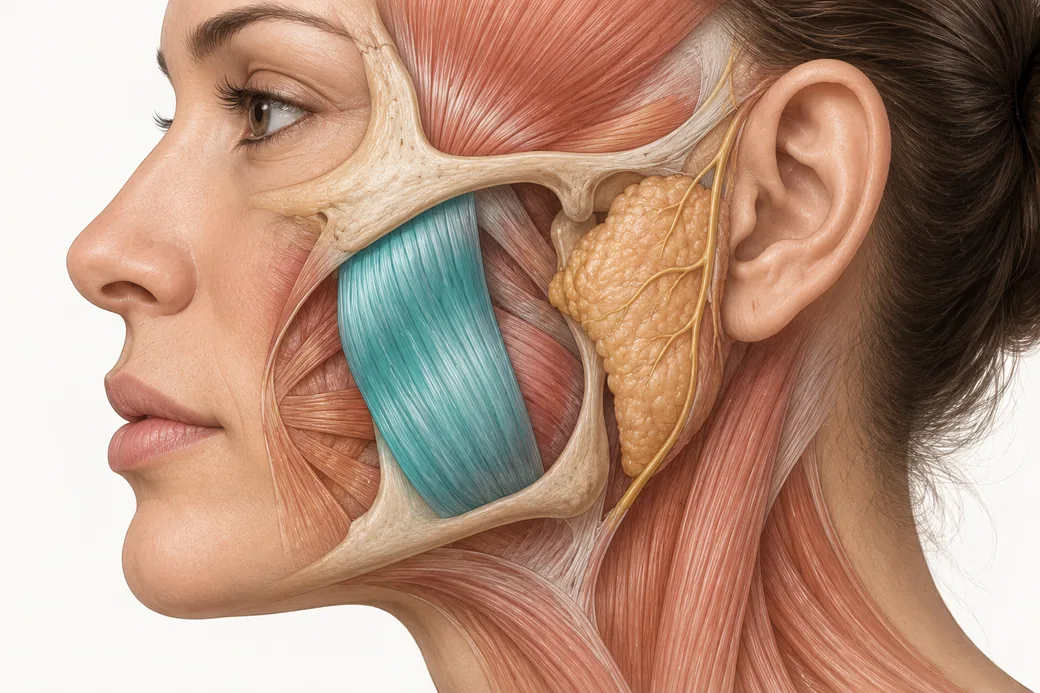
Masseter botox and jowls are the trade-off nobody puts on the consent form. Every conversation about lower-face slimming is framed as removal — remove bulk, get a narrower jaw. What that framing leaves out is that the masseter is not only a motor. It is structural bulk, sitting over the mandibular ramus and forming a substantial part of the platform the lateral lower face is draped across. Take the platform away and the drape has to accommodate.
In a young patient with excellent skin quality, it does. The skin retracts, it tightens, and she keeps a sharp jawline over a narrower foundation. In a patient in her fifties or sixties, or one with a significant weight-loss history and reduced elasticity, it may not — and you will have delivered the narrowing she asked for together with the sagging she did not.
Keep in mind that the masseter provides bulk and provides structure. As we treat it and that muscle atrophies, we may have problems with skin sagging and skin laxity. That sentence should be part of the consultation, not part of the apology.
The trade-off is real but it is not common
The numbers keep this proportionate. In a single-centre series of 680 patients across 2,036 masseter neurotoxin sessions, sagging was recorded after 4 sessions — 0.20% — and sunken lateral cheek, described as subzygomatic volume loss, after 9 sessions, 0.44% (Peng and Peng, Journal of Cosmetic Dermatology, 2018).
Those are small numbers, and they should be. Most masseter patients are young women with good skin who do well. But rates measured across an unselected clinic population are not the rate in the patient sitting in front of you. The patient who arrives with an existing jowl, poor elasticity and a request for facial slimming is not a 0.20% risk — she is a foreseeable adverse outcome that your assessment is supposed to catch.
These figures reflect Dr. Croley's clinical practice as taught in Empire Medical Training's hands-on curriculum. Technique is learned under supervision; this article is educational and is not a substitute for training.
Why atrophy can make a jowl look worse
It helps to be precise about what a jowl is, because it explains why reducing the masseter does not reduce it.
A jowl sits anterior to the masseter, at the jawline in front of the angle. The masseter occupies the posterior and lateral portion of the lower face, over the ramus and angle. They are different territories. Chemodenervating the masseter has no direct effect on the anterior jawline soft tissue that constitutes the jowl.
What it does change is the contour the jowl is seen against. As the masseter loses bulk, the posterior-lateral lower face flattens and steps inward. The anterior jowl does not move. The result is an increase in the contrast between the two — the jowl becomes more conspicuous against a narrower background, even though nothing about the jowl itself has changed. If the patient already has prominent jowling, removing any volume at all behind it makes the appearance worse, not better.
The same logic explains the sunken lateral cheek. The masseter's upper portion contributes to the subzygomatic contour. Reduce it substantially in a patient who is already thin there, and you can produce a hollow rather than a taper.
So the honest counselling sentence for a patient with existing lower-face heaviness is not "this will help." It is: "this will narrow the part of your face behind the problem and may make the part in front of it more obvious."
The screening questions that actually predict a bad outcome
Six things to establish before you commit to a slimming plan.
1. Age and skin quality. This is the crude but reliable axis. A patient in her twenties or thirties with thick, elastic, undamaged skin has the recoil to follow a shrinking foundation. Assess elasticity directly — pinch and release at the jawline and the lateral cheek, and watch how fast it returns — rather than inferring it from the date of birth.
2. Existing jowl. Look at the jawline in repose and in the oblique and profile views, not just straight on. A jowl that is visible at rest on a forty-five-degree view is a jowl that will be more visible after slimming.
3. Weight-loss history. Significant weight loss changes the calculus twice over: the soft-tissue envelope has already been stretched and the facial fat compartments are already depleted. Patients on GLP-1 receptor agonists are presenting in this category with increasing frequency, and they deserve a more conservative approach to any volume-reducing procedure in the face. Our material on facial volume loss covers the broader picture.
4. Submental and neck laxity. Assess the whole lower third. A patient with platysmal laxity and submental fullness is describing a lower-face problem that masseter slimming will not solve and may unbalance.
5. What the patient actually wants. "I want a slimmer face" and "I want a sharper jawline" are different requests that occasionally point in opposite directions. Narrowing a jawline that has lost definition does not sharpen it. Establish which outcome the patient is imagining before you agree that neurotoxin is the way to get there.
6. Whether this is a slimming patient at all. A bruxism patient who happens to have laxity is a different decision entirely, because the therapeutic benefit is real and the contour change is incidental. Symptom relief may well be worth a small contour cost, and the trade-off should be discussed on those terms. The therapeutic side is covered in our management of bruxism material.
The pause criteria: baseline asymmetry and prior facial nerve injury
There is a second group of patients where I stop, and it has nothing to do with skin.
If a patient has any baseline smile asymmetry or smile weakness — a history of Bell's palsy, a prior facial nerve injury, any residual weakness of facial expression — we want to pause. Not necessarily avoid treating them, but pause and look at what muscles are impacted that are causing that asymmetry, and ask whether we will be close to any muscles on the other side that may worsen it.
The reasoning is worth spelling out because it is easy to dismiss. The masseter itself is innervated by the masseteric nerve from the mandibular division of the trigeminal nerve, CN V3 — not by the facial nerve. Treating the masseter does not directly affect facial nerve function.
The risk is entirely about the neighbourhood. The muscles that shape the smile — zygomaticus major and minor, risorius, depressor anguli oris, lateral orbicularis oris — sit immediately above and anterior to the masseter injection field, and excessively anterior or superior placement is a recognised route to smile asymmetry. In a face that is already asymmetric, the margin for that error is smaller in one specific direction, and the consequence is not a subtle finding — it is the unmasking or amplification of the very problem the patient has spent years managing.
The structured pause looks like this:
- Characterise the baseline. Photograph and, ideally, record video of the patient at rest, on full smile, on forced eye closure and on lip pursing. Document which muscles are weak and on which side. This is medico-legal protection as much as clinical assessment.
- Decide whether your injection field encroaches. Where are the affected muscles relative to the tragus-to-commissure line you are about to draw?
- Consider the contralateral side. If the weakness is on the left, an error on the right that weakens a normal smile elevator does not average out — it deepens the asymmetry.
- Adjust or decline. Reduce dose, stay lower and further from the anterior border, or decline and redirect.
Alongside this sit the ordinary contraindications: prior adverse reactions to the product, known hypersensitivity, neuromuscular disorders affecting transmission, pregnancy and breastfeeding, and active infection at the injection site. Any of those means redirecting the patient to another treatment rather than proceeding carefully.
Combination therapy: supporting the tissue while you reduce the foundation
For the patient who genuinely wants slimming but does not have the skin to carry it unaided, the answer is usually not "no." It is "not alone."
The approach I take is to talk about what will occur as we decrease the size of the structure underneath, and then plan combination therapy — poly-L-lactic acid, hyperdilute calcium hydroxylapatite, radiofrequency and microneedling — to support that tissue.
Each has a different job:
- Poly-L-lactic acid is a collagen biostimulator rather than a volumiser, working over months as the polymer is metabolised and a collagen response develops. Its timeline is a natural fit for masseter slimming, because both processes unfold across the same several-month window rather than acting immediately. Our material on Sculptra injections and on biostimulators versus fillers covers the category distinction.
- Hyperdilute calcium hydroxylapatite is used for skin quality and diffuse dermal support over broader areas rather than for structural volume, which makes it a reasonable partner for the lateral lower face and the neck.
- Radiofrequency addresses tissue tightening through controlled thermal injury to the dermis and subdermal tissue.
- Microneedling drives a collagen induction response in the dermis, and is often combined with radiofrequency in the same device platform. The general principles are covered in our material on facial collagen stimulation.
Two planning points matter more than the choice of modality.
Sequencing. Because masseter atrophy takes months to become visible, there is time to build collagen in parallel rather than waiting to see how bad the sagging is. Starting biostimulation at or near the first masseter treatment, rather than at month six, uses the window the biology gives you. The alternative — slim first, assess the damage, then repair — asks the patient to spend several months looking worse.
Honesty about the ceiling. Collagen stimulation and energy-based tightening improve skin quality and produce modest tightening. They do not substitute for surgical lift, and neither does any other injectable. A patient whose laxity is beyond what these modalities can support should be told that plainly, and offered a surgical opinion rather than an expensive series of treatments that will not meet her expectation. Other structural-support options occupy adjacent ground — our material on thread lift for a double chin covers one of them — but the same ceiling applies.
Combination protocols across biostimulators, energy devices and toxins are worked through in Empire's Facial Contouring Injectables workshop and the Neck & Hands Rejuvenation Master Course.
Pause, reframe, refer: the three outcomes that are not "inject today"
Not every screen-positive patient is a refusal. There are three distinct off-ramps and they should be used deliberately.
Pause. Gather more information before deciding. Baseline asymmetry documentation, a dental or temporomandibular opinion, imaging where the differential is unclear, or simply a second consultation once the patient has seen their own photographs.
Reframe. The patient's stated request may not be the treatment that serves them. A patient with laxity and a heavy lower face who asks for slimming may actually want definition, which is a skin-quality and support problem before it is a muscle-bulk problem. Reframing is not a downsell; it is naming the real problem.
Refer. Genuine skeletal width, a differential that needs a diagnosis, laxity beyond the reach of injectables, or a temporomandibular disorder that needs specialist management. Referring a patient you could technically have injected is one of the clearest markers of a practitioner worth returning to.
What this changes at the chairside
- Assess the jawline and the neck before you assess the masseter. If the lower third is already heavy or lax, that finding outranks the width measurement.
- Say the trade-off out loud and write it down. "Reducing this muscle reduces structural support in your lower face. In your case I expect your skin to follow it; here is what we will do if it does not."
- Plan the support in parallel, not in retrospect. If the patient needs collagen stimulation, start it alongside the slimming plan and use the months the atrophy takes.
- Treat baseline facial asymmetry as a stop sign, not a footnote. Document it, map it against your injection field, and adjust or decline.
Lower-face assessment and combination planning are taught hands-on in Empire's Advanced Botulinum Toxin & Filler Training.
About the author
Dr. Chris Croley — Chief Medical Officer, Empire Medical Training. The clinical approach described here is what he teaches in Empire's hands-on neurotoxin curriculum.
Related guides in this cluster
Part of Facial Muscle Anatomy for Neurotoxin.
 Clinical GuideMost Neurotoxin Complications Are Diffusion, Not Misplacement — Rethinking Root CauseMost neurotoxin complications come from diffusion into an adjacent muscle, not from injecting the wrong site. Here is how to tell which
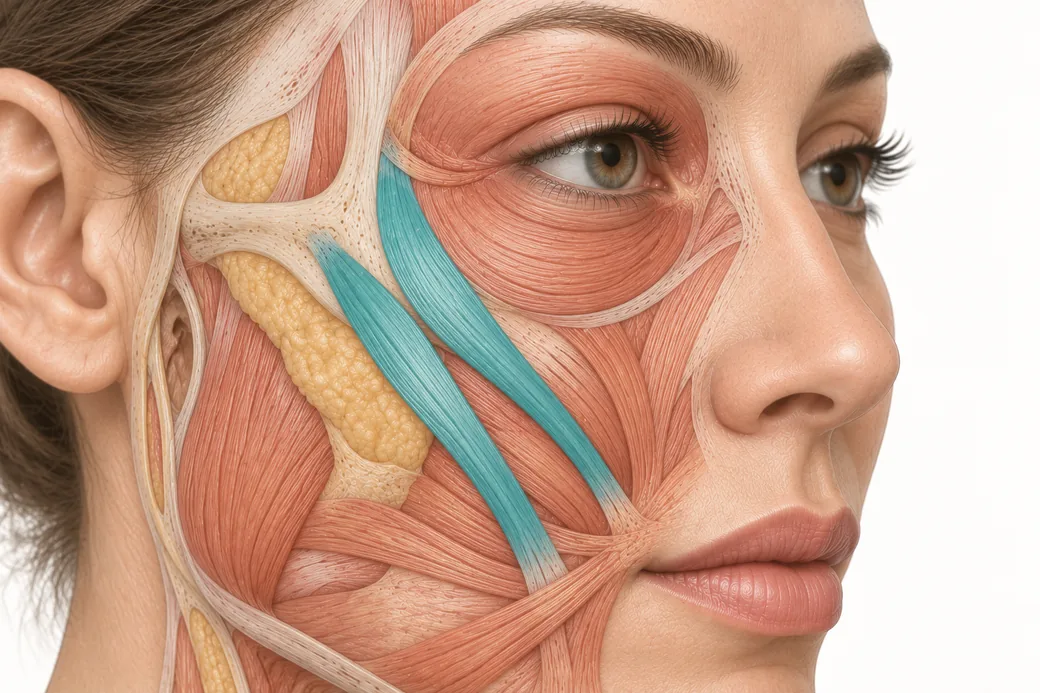 Clinical GuideThe Crow's Feet Trap — How Chasing Lateral Cheek Lines Reaches the ZygomaticusA zygomaticus botox complication after crow's feet treatment has one usual cause — chasing lateral cheek lines too low and too deep. Th
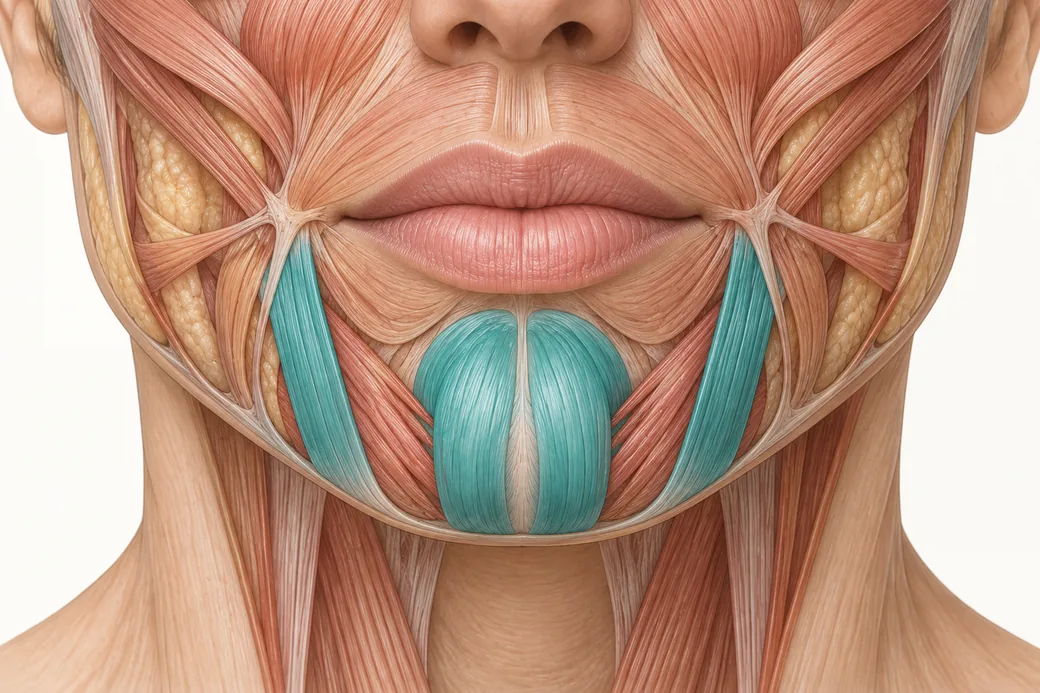 Clinical GuideDepressor Anguli Oris, DLI and Mentalis — Three Overlapping Muscles, Millimetres ApartDepressor anguli oris anatomy is a depth problem, not a map problem. The DAO, DLI and mentalis overlap in layers, and confusing them al
Train with Empire
This guide is clinical education. The technique behind it is taught hands-on, on live patients, with faculty beside you.
Explore Botox Training & Certification →Disclaimer
This article reflects the clinical opinions and experience of Dr. Chris Croley, Chief Medical Officer, Empire Medical Training, an independent faculty member contributing to Empire Medical Training's curriculum. The views expressed are the author's own and do not necessarily represent those of Empire Medical Training.
It is professional education, not medical advice, and is no substitute for hands-on training or independent clinical judgment. Licensed clinicians remain responsible for their own patient selection, technique and outcomes, for verifying current product labelling, and for practising within their scope and applicable law. Empire Medical Training accepts no liability for reliance on this content.
 Claim Your Prize!