







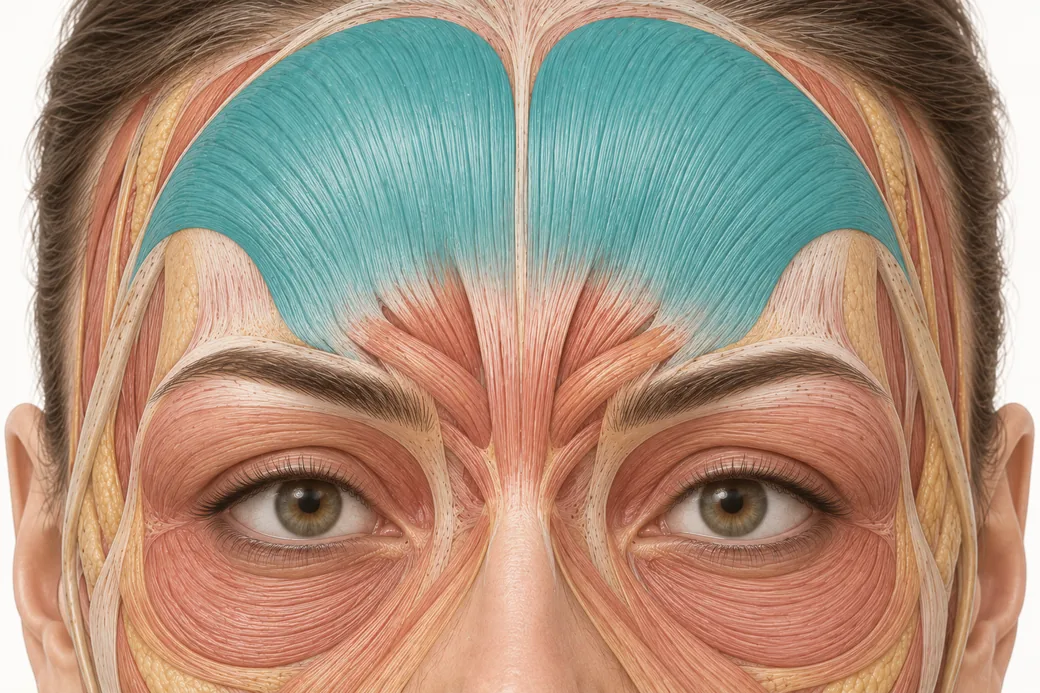
The line of convergence in the frontalis is the horizontal level on the forehead where the muscle's movement reverses direction — and it is, in practical terms, the boundary between an injection that preserves brow elevation and one that removes it. Melissa Pulcini-Buttine, PA teaches it as the decision point for forehead placement: "Right here is going to be your line of convergence. And if I want to cause as much elevation as possible, I'm going to stay higher up."
It is also the most useful piece of anatomy in her forehead material, because it explains something the simple model of the frontalis does not. This resource sets out the landmark, how to find it on a real patient, and what the published displacement data establish.
The simple model, and what it leaves out
The familiar teaching is straightforward: the frontalis elevates the brow, so the lower you inject the more elevation you remove, and brow ptosis follows from injecting too close to the brow. That model is correct about the consequence. Melissa states the consequence exactly: "If you're worried about true eyebrow ptosis, that's when you come too low. Now the patient can't elevate, because the job of the frontalis is to elevate — but now you're going to cause depression there."
What the conventional model does not explain is why injecting high on the forehead is not simply a diluted version of injecting low. If the whole muscle elevates the brow, treating the upper forehead should reduce brow elevation somewhat — less than treating the lower forehead, but in the same direction. Clinical observation says otherwise: high placement preserves brow position to a degree that a simple gradient does not account for.
The bidirectional finding
The explanation comes from skin displacement vector analysis. Twenty-seven healthy volunteers of diverse ethnicity, aged 22 to 73, were filmed at maximal frontalis contraction and the magnitude and direction of forehead skin movement were mapped (Cotofana S, Freytag DL, Frank K, et al. Plastic and Reconstructive Surgery. 2020;145(5):1155–1162).
In 100 percent of volunteers, forehead skin movement on contraction was bidirectional. The skin of the lower forehead moved cranially — upward, as expected of a brow elevator. The skin of the upper forehead moved caudally, downward. The two movements met at a horizontal level the authors named the line of convergence, or C-line.
That finding is what makes Melissa's teaching coherent, and it is worth stating what it means mechanically. Above the C-line, frontalis contraction is not contributing to brow elevation at all; it is pulling tissue down toward the convergence level, in effect drawing the scalp and upper forehead inferiorly rather than lifting the brow superiorly. Relaxing fibres above the C-line therefore removes a downward vector, not an upward one. Relaxing fibres below it removes the elevation the patient depends on.
The authors' conclusion is appropriately measured: identification of the C-line may guide practitioners toward more predictable forehead outcomes, and injections above it could mitigate the risk of neuromodulator-induced brow ptosis.
Where the line sits — and why you should not use the number
In the original study, the position of the C-line relative to the total height of the forehead was 60.9 ± 10.2 percent in men and 60.6 ± 9.6 percent in women, a difference that was not statistically significant. No difference was detected across ethnicities. Independent of sex, the C-line was located at the second horizontal forehead line counting from superior to inferior.
Two things about that number matter more than the number itself.
It is a proportion of total forehead height. The measurement is taken from the whole forehead, hairline to orbital rim, so 60 percent means roughly three-fifths of the way up that span. If you are going to carry the figure at all, carry it in that form.
The standard deviation is roughly ten percentage points. On a typical forehead that is a band, not a line. Using 60 percent as a measured target would place the mark correctly in only a minority of patients and would defeat the entire purpose of the landmark, which is individualisation. The number is useful for one thing — sanity-checking that your dynamically identified line is in a plausible place — and useless for placement.
How to find it on the patient in front of you
The identification method is mechanical, takes a few seconds, and requires nothing but a finger.
Ask the patient to elevate the brows maximally. Rest an index finger gently on the central forehead, without pressure — pressure defeats the test. Move the finger up and down across the forehead during repeated contractions and identify the vertical level at which the skin is pushing the finger neither cranially nor caudally. That null point is the line of convergence for that patient (method as described with the LEBO frontalis algorithm, Toxins. 2025;17(12):594).
Three practical notes:
- Do it before marking anything. The line of convergence is an input to the plan, not a check on it.
- Do it on both sides. Forehead biomechanics are not symmetric in a substantial fraction of patients, and the null point is not obliged to sit at the same height on each side.
- Repeat it on return visits. It is a dynamic finding on a face whose tone changes with age, and in a previously treated patient it will be distorted by residual toxin — a point that matters for reassessment rather than initial planning.
What it changes about placement
The rule that follows is the one Melissa teaches, and it is directional rather than numerical.
To preserve or maximise elevation, stay above the line. "If I want to cause as much elevation as possible, I'm going to stay higher up."
Below the line, change the depth rather than the plan. Her approach where treatment below the convergence level is required: "If I want to come below this I would change my depth to a little bit more superficial, so that it's not too strong and you're not getting too much depression."
To straighten or lower a brow deliberately, come lower. This is the underused half of the rule. A patient with an over-arched brow, or a male patient wanting a flatter brow line, benefits from exactly the placement that is treated as a hazard in everyone else. The line does not define a forbidden zone; it defines which side of a decision you are on.
None of this replaces dose selection, which is a separate lever with separate reasoning — that is covered in botox dosages for the forehead and frontalis area.
How Melissa wants the landmark used
The line of convergence earns its place as an observable, patient-specific finding, and that is how she teaches it. It is identified on the face in front of you, at the moment of contraction, and identified again at the next visit rather than carried forward as a number in the chart.
That is also her caution about the percentage. The C-line is a dynamically identified, individually variable level, not a fixed measurable location — and it should never be presented to a trainee, or used in a patient, as a placement target. What makes it valuable to the injector is precisely that it is the patient's own.
What changes at the chairside
- Add the finger test to your forehead assessment, before marking, bilaterally, in every patient.
- Stop measuring fixed distances above the orbital rim. "At least 1.5 to 2 cm above the rim" is a population heuristic; the null point is the patient's own.
- Use the level as a decision boundary, not a barrier. Above it for preservation and lift, below it deliberately and at altered depth when you want a flatter brow.
- Record where the line sat. It belongs in the note alongside brow position and dominant vectors, because it is a finding, not a technique.
- Do not quote the 60 percent figure to trainees as a placement target. With a standard deviation near ten percentage points, teaching it as a measurement guarantees misplacement in most foreheads.
Working from dynamic landmarks rather than fixed distances is the core skill this cluster is built around. Empire's anatomical based aesthetics training and special anatomical cadaver aesthetics training work through the structural reasoning directly, and the neurotoxin fundamentals sit in cosmetic neurotoxins training.
The clinical approach above reflects Melissa Pulcini-Buttine's practice as taught in Empire Medical Training's hands-on curriculum. Technique is learned under supervision; this article is educational and is not a substitute for training.
Melissa Pulcini-Buttine, PA is a physician assistant of two decades and has been a professor of anatomy and physiology for approximately fourteen years. She is a faculty member at Empire Medical Training and the founder of an aesthetics practice in Greenwich, Connecticut.
Related guides in this cluster
Part of Facial Muscle Anatomy for Neurotoxin.
 Clinical GuideMost Neurotoxin Complications Are Diffusion, Not Misplacement — Rethinking Root CauseMost neurotoxin complications come from diffusion into an adjacent muscle, not from injecting the wrong site. Here is how to tell which
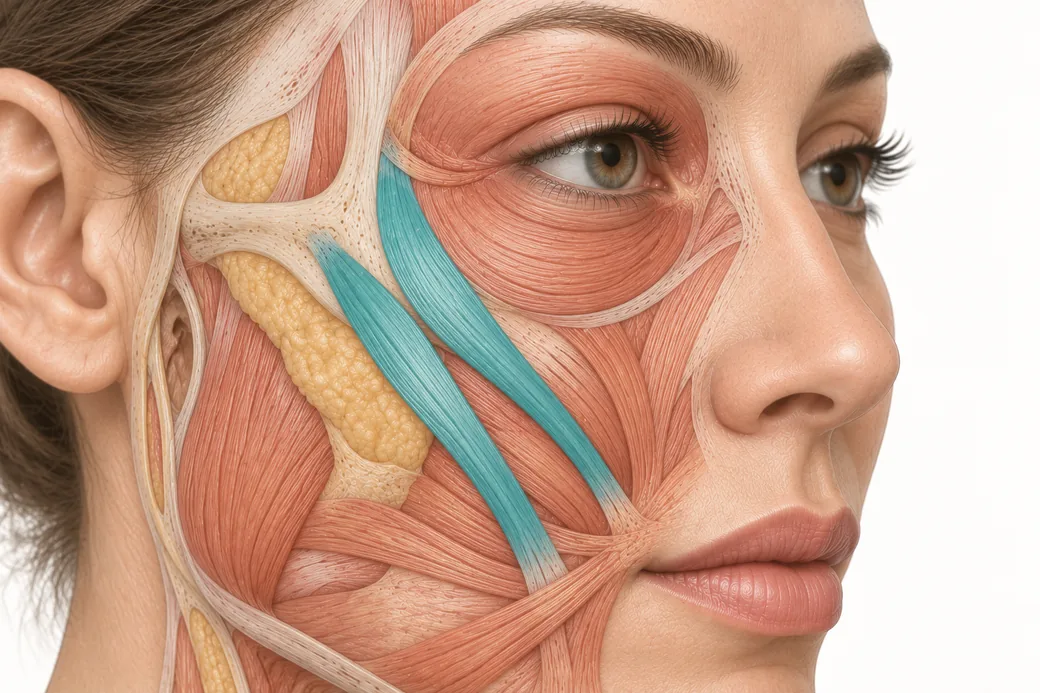 Clinical GuideThe Crow's Feet Trap — How Chasing Lateral Cheek Lines Reaches the ZygomaticusA zygomaticus botox complication after crow's feet treatment has one usual cause — chasing lateral cheek lines too low and too deep. Th
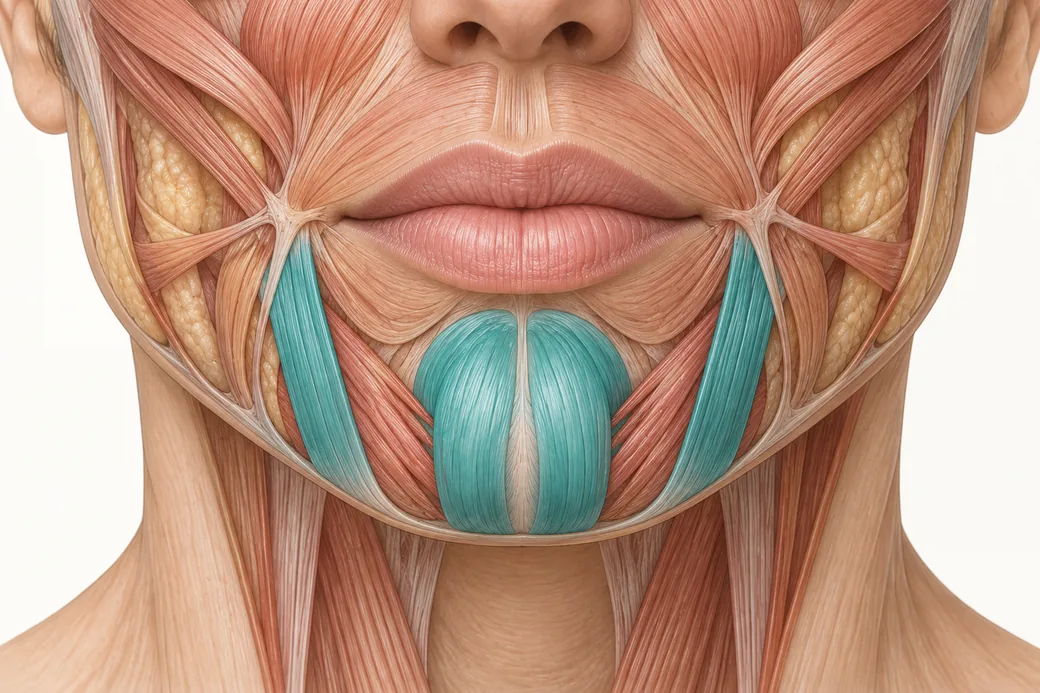 Clinical GuideDepressor Anguli Oris, DLI and Mentalis — Three Overlapping Muscles, Millimetres ApartDepressor anguli oris anatomy is a depth problem, not a map problem. The DAO, DLI and mentalis overlap in layers, and confusing them al
Train with Empire
This guide is clinical education. The technique behind it is taught hands-on, on live patients, with faculty beside you.
Explore Botox Training & Certification →Disclaimer
This article reflects the clinical opinions and experience of Melissa Pulcini-Buttine, PA, an independent faculty member contributing to Empire Medical Training's curriculum. The views expressed are the author's own and do not necessarily represent those of Empire Medical Training.
It is professional education, not medical advice, and is no substitute for hands-on training or independent clinical judgment. Licensed clinicians remain responsible for their own patient selection, technique and outcomes, for verifying current product labelling, and for practising within their scope and applicable law. Empire Medical Training accepts no liability for reliance on this content.
 Claim Your Prize!