







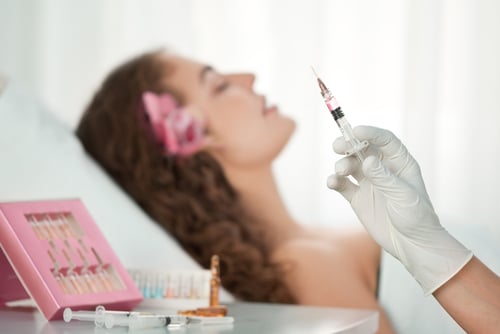
Forehead injection is the most commonly performed procedure in aesthetics and one of the hardest to get consistently right. The reason is not technique — it is dose. The dominant error among new injectors, and plenty of experienced ones, is putting too many units into the frontalis. Up to roughly 30 units can be placed in this region, but that ceiling gets mistaken for a target, and the result is the heavy, immobile forehead the whole industry recognizes on sight.
This guide is about the number, not the map: typical unit ranges for the frontalis, how an experienced injector arrives at a dose, why men usually need more, why more units do not mean longer duration, and how dosing changes over years of treatment. For where the needle goes — injection patterns, point placement, and anatomy — see our companion guide to the best forehead Botox injection sites.
Typical Botox Dosage for the Forehead
Commonly reported ranges for the upper face:
- Frontalis (horizontal forehead lines): roughly 8–20 units total, spread across the injection points.
- Glabellar complex (“11” lines): roughly 10–25 units, commonly around 20.
- Crow’s feet: roughly 5–15 units per side, commonly around 12.
These are typical ranges observed in practice and reflected in product labeling — not rules. Every one of them varies by patient. Treat any published number as the midpoint of a conversation, not the answer.
Empire’s long-standing recommendation for the frontalis, taught in our Botox workshop and recommended for experienced injectors as well as beginners, is more specific: start at roughly 12 units total in the frontalis and review the patient at day 10 to 14.
Why Start at 12 Units?
The logic is asymmetric risk. You can always add units. You can never remove them.
Start at 12 and one of two things happens. Most often, 12 units produced the result the patient wanted, and you have achieved it with the smallest effective dose — less product, less cost, lower cumulative antigen exposure, and no brow heaviness. Or 12 units left more movement than the patient wanted, and at the two-week review you top up with precise knowledge of how that individual’s frontalis responds. Either way you gain information. Start at 25 on a first visit instead, and if the brow drops there is no reversal: the patient waits three to four months, and you have taught them that the treatment makes them look tired.
The follow-up visit is the part people skip, and it is what makes low-dose starting work rather than just being timid. Without a day-10-to-14 review, a conservative dose is just an undertreated patient.
How Dose Is Actually Decided
Dose is not read off a chart. It is assessed. Six variables drive it, in rough order of weight:
- Muscle strength and bulk. The single biggest factor. Have the patient raise their brows maximally and palpate. A thick, powerfully contracting frontalis needs more units than a thin, weak one. This is assessed, not assumed.
- Baseline brow position. A patient with a low or heavy brow at rest has less margin before treatment reads as heaviness. Lower dose, higher placement.
- Forehead height and surface area. A tall, broad forehead has more muscle to cover and often needs more total units distributed over more points — not more units per point.
- Line depth and character. Dynamic lines that appear only on animation respond to the toxin. Static lines etched in at rest do not, no matter how many units you add. Adding dose to chase a static line is the most common way over-injection happens.
- Treatment history. A first-time patient gets a conservative dose. A returning patient gets the dose that worked last time, adjusted by what they told you at review.
- What the patient actually wants. Some patients want zero movement. Many want to keep expressing. Ask before you decide — a “perfect” clinical result on a patient who wanted to keep raising their eyebrows is a failure.
Men vs. Women
Men typically require more units than women in the frontalis and glabella. Male facial musculature is generally bulkier and stronger, and the doses reflected in clinical labeling and in practice trend higher.
But the variable is muscle, not sex. A small-framed man with a weak frontalis needs less than a strong-browed woman. Palpation beats demographics every time.
Two things do change genuinely with male patients. The male brow sits lower and flatter at baseline, so there is less vertical margin before treatment produces visible heaviness — which argues for conservative dosing even though the muscle is stronger. And the aesthetic goal differs: a flat brow should stay flat, and an arch is not the objective. Our guide to the most common Botox areas for men covers this in more depth.
First-Time vs. Experienced Patients
These are genuinely different dosing problems.
For a first-time patient, you have no response data. You do not know how their frontalis metabolizes the product, how much movement they will tolerate, or whether they are a fast metabolizer. Start low, review at two weeks, document the dose and the result. That first visit is a calibration exercise.
For an experienced patient, you have a record. Use it. And expect the number to drift downward over time: patients treated regularly often need less as the years pass, because chronically relaxed muscle undergoes disuse atrophy. A frontalis that has been treated three times a year for five years is a smaller, weaker muscle than it was at baseline, and it needs fewer units to control. An injector who mechanically repeats the year-one dose in year six is over-treating.
Why More Units Is Not Better
Over-dosing the frontalis has four distinct costs, and none of them is offset by a better result.
- Brow heaviness and brow ptosis. The frontalis is the only brow elevator in the face. Weaken it too much and the brow descends — the “heavy forehead” that is one of the most common complaints in aesthetics. It is a dose problem as much as a placement problem.
- Eyelid ptosis. Larger volumes spread further. More product in the region increases the chance of migration onto the levator palpebrae superioris and true lid droop, which is a considerably worse problem than a heavy brow. See our guide to what ptosis is and how to prevent it.
- Loss of natural expression. A face that cannot move is a recognizable look, and most patients did not ask for it.
- Immunogenicity. Repeated exposure to higher doses is the scenario associated with developing neutralizing antibodies. It is uncommon at cosmetic doses, but the way to keep it uncommon is to use the smallest effective dose rather than routinely maxing the region.
There is no upside column here. Beyond the dose that stops the muscle from creating the line, additional units purchase nothing except risk.
Ready to put this into practice?
Explore Empire's hands-on, CME-accredited Aesthetic & Injectable Training courses — live patients, expert faculty, and ongoing mentorship.
Dose vs. Duration
This is the most persistent misconception in Botox dosing, and it deserves a direct answer: more units does not straightforwardly mean longer-lasting results.
Duration is driven mostly by how quickly the treated nerve terminals recover and resprout — a biological process influenced by individual metabolism, muscle mass, activity level, and treatment history. Results generally last around three to four months across a wide span of doses. Pushing units well past the effective dose in the hope of stretching that to six months mostly buys a frozen forehead, not a longer one. Our guide on how long Botox takes to work and how long it lasts covers the full timeline.
If a patient consistently gets six weeks out of an appropriate dose, the answer is a conversation about metabolism, treatment interval, and expectations — not a bigger number.
Units Are Product-Specific — Never Convert Casually
A critical safety point that dosing discussions often skip: a unit of Botox is not a unit of Dysport, Xeomin, Jeuveau, or Daxxify. Units are a measure of biological potency defined by each manufacturer’s own assay. They are not interchangeable, and the conversion ratios between products are not 1:1.
Every dosing number in this article refers to Botox (onabotulinumtoxinA). Applying them to another product without understanding that product’s own dosing is a genuine patient-safety error. See our comparison of Botox vs. Xeomin vs. Dysport for how the products differ.
Dilution is a related source of confusion. Reconstituting a vial with more or less saline changes the volume you inject per unit — it does not change the number of units the patient receives. The dose in units determines the effect; volume determines how far it spreads.
Documenting the Dose
The habit that separates injectors who improve from injectors who plateau is record-keeping. For every treatment, record the total units per region, units per point, the product and its dilution, standardized photos at rest and on animation, and the patient’s own assessment at review. Do this and every patient becomes a calibrated data point. Skip it and you are guessing from scratch at every visit, no matter how many years you have been injecting.
Frequently Asked Questions
What is the typical Botox dosage for the forehead?
The frontalis commonly receives roughly 8–20 units total, with many injectors — Empire included — recommending a starting dose of around 12 units for a first-time patient, reviewed at day 10 to 14 and topped up if needed. The glabella typically adds another 10–25 units. These are typical ranges that vary by assessed muscle strength.
Is 20 units of Botox a lot?
It depends entirely on where it goes. Twenty units is a conventional full dose for the glabellar complex. In the frontalis alone, 20 units is at the upper end of the usual range and would be a high starting dose for a first-time patient with an average-strength muscle.
What about 15, 25, 30, or 40 units of Botox?
None of these numbers means anything without a region attached. Fifteen units is a modest frontalis dose or a light glabellar dose. Twenty-five is a full glabellar dose or a heavy frontalis dose. Thirty units is roughly the ceiling usually cited for the frontalis region, and it is a ceiling, not a target. Forty-plus units generally implies multiple areas treated in one session — a typical full upper-face treatment across frontalis, glabella, and both sides of the crow’s feet can reach 50–60 units total. Always ask which muscles the units are going into.
How many units are in a vial of Botox?
Botox Cosmetic is supplied in 50-unit and 100-unit vials as a vacuum-dried powder, reconstituted with preservative-free saline before injection.
What is Botox dilution and does it change the dose?
Dilution is how much saline is used to reconstitute the vial. It changes the volume injected per unit, not the number of units delivered. A more dilute preparation spreads more; a more concentrated one stays tighter. The unit dose determines the effect on the muscle.
Do men need more units of Botox than women?
Generally yes — male frontalis and glabellar musculature tends to be bulkier and stronger, and doses trend higher. But the driver is muscle strength, not sex. Assess by palpation. Male patients also have a lower baseline brow, which argues for keeping placement high and dosing carefully despite the stronger muscle.
Does more Botox last longer?
Not meaningfully. Duration is driven mainly by how fast nerve terminals recover, which is individual. Results generally last three to four months across a broad range of doses. Units beyond the effective dose add risk of brow heaviness and loss of expression rather than months.
Do regular patients need more Botox over time?
Usually the opposite. Muscles kept relaxed for years undergo disuse atrophy and often require fewer units to control. A long-term patient still receiving their year-one dose is likely being over-treated.
Learn Dosing Judgment, Not Just Numbers
No chart can tell you how strong the frontalis in front of you is. That assessment — palpating the muscle, reading the brow, and choosing a dose you can defend — is learned by injecting under supervision. Empire Medical Training’s Botox Training & Certification course combines didactic instruction in facial anatomy, reconstitution, and dose selection with hands-on injection practice, taught by board-certified physicians with decades of clinical experience.




 Claim Your Prize!