







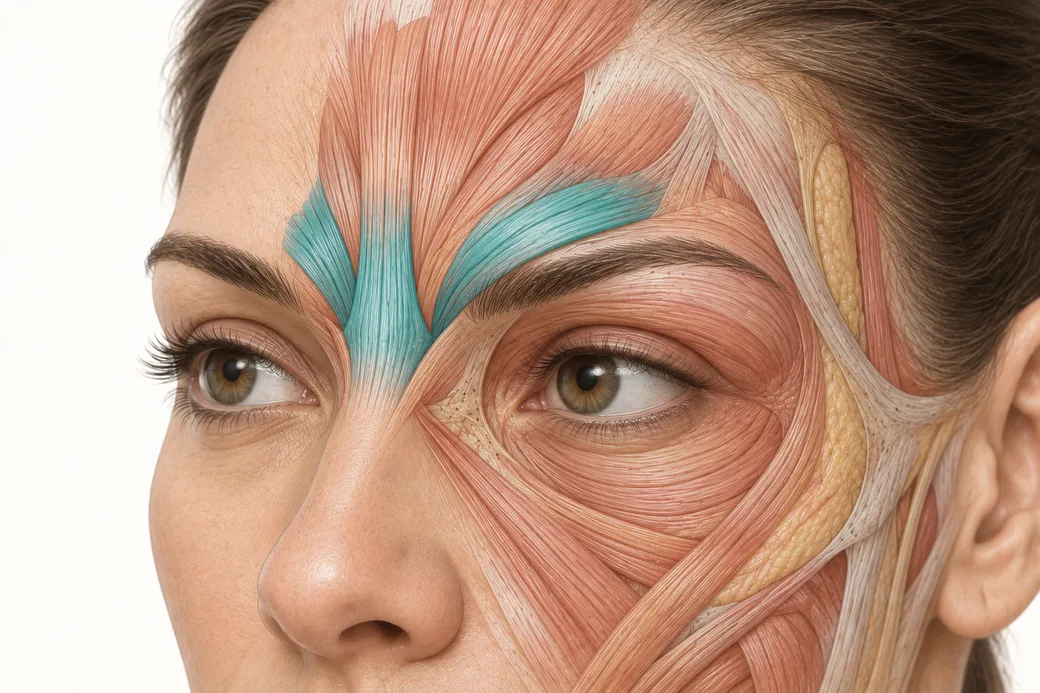
The frontalis and glabellar complex are not two treatment areas that happen to sit near each other. They are an opposed muscle pair, and the position of the brow at any moment is the net result of a contest between them. Melissa Pulcini-Buttine, PA, who has taught anatomy and physiology for roughly fourteen years, treats that as a planning rule rather than a piece of trivia: "I would never just inject a frontalis muscle, whose job is to elevate, without properly injecting the glabellar complex."
This resource is about planning and sequence — which muscles you consider together, in what order, and why. It is not a dosing guide; forehead unit selection is covered separately in botox dosages for the forehead and frontalis area. What follows is the reasoning that has to happen before any dose is chosen.
The pair, stated precisely
The elevator. The frontalis is the only elevator of the brow. There is no second one, no accessory, no redundancy. It arises from the galea aponeurotica — it has no bony origin at all — and inserts into the subcutaneous fat and dermis of the forehead skin and into the soft tissue of the brow, where its fibres interdigitate with procerus, corrugator supercilii and orbicularis oculi. Melissa's summary is deliberately alarmist about the consequence: "This is the only brow elevator... don't cut the cable."
The depressors. The glabellar complex — procerus and the corrugator supercilii, with its medial head and lateral tail — pulls the brow down and medially. "When you're frowning and you're angry, they're pulling down," Melissa says. The superior and lateral fibres of the orbicularis oculi act as depressors of the lateral brow in the same way, which is why the crow's feet region belongs in this conversation even though it is usually taught as a separate treatment area.
The functional consequence is that brow position is a subtraction, not a value. Weaken the depressors and the unopposed elevator lifts. Weaken the elevator and the unopposed depressors descend. Both are single interventions producing a paired result, which is why it is not possible to treat one member of the pair and leave the other "untouched." Leaving a muscle untreated is a decision about the balance just as much as injecting it is.
Why the order is depressors first
Melissa's practice is to treat the glabellar complex before the frontalis on a patient receiving both. "I always in practice like to start with treating the glabellar complex first, because that's a depressor and I'm trying to elevate."
There are three defensible reasons for that order, and it is worth separating the one she states from the ones that follow from it.
Her stated reason: intent alignment. The purpose of most upper-face treatment is to soften lines without losing brow height. Treating the depressor first is treating in the direction of the goal. It positions the frontalis work as a modification of an already-lifted brow rather than a subtraction from a neutral one.
A practical reason: the frontalis is the cautious half. The frontalis is where brow ptosis is manufactured, and it is also the muscle whose extent is hardest to estimate. Doing the more predictable work first means that whatever caution you apply to the frontalis is applied last, when you have already committed to the release of the depressors.
A reason about attention. Sequence is also an attention device. An injector who reflexively treats the glabellar complex first cannot forget the antagonist relationship, because the antagonist is already treated. The commonest version of this error is not a clinician who rejects the muscle-pair model; it is a clinician who books "forehead only," treats the forehead only, and discovers the model at the two-week review.
The order is Melissa's taught practice and a coherent application of the anatomy. Its value is largely cognitive, and that is the point: it forces the pair to be considered as a pair every time, and it puts the cautious half of the treatment last.
The failure modes of treating one side of the pair
Forehead alone. The elevator is weakened and the depressors are left at full strength. The brow descends. In a young patient with good tissue support and a high brow this may be invisible or even desirable. In an older patient with orbital aperture widening, loss of fat support and increased depressor tone, the same treatment converts a compensated brow into a heavy one. Published consensus identifies exactly this pattern, noting that aging changes combine to contribute to brow ptosis with or without upper lid dermatochalasis, and that many patients presenting for cosmetic forehead treatment are already recruiting the frontalis compensatorily to keep the upper outer visual field clear (Aesthetic Surgery Journal Open Forum 2025;7:ojaf032).
That last point deserves its own sentence, because it changes what "no complication" means. If a patient is chronically using her frontalis to hold her brow up and you relax it, you have not created a new problem. You have removed a compensation and revealed an existing one. The patient experiences it as a complication regardless.
Glabella alone. The depressors are weakened and the elevator is left unopposed. The brow rises. Medially this is usually welcome. Laterally, if the lateral frontalis is strong and untreated, the result is the sharply upturned lateral brow known as the Mephistopheles effect or spock brow — a compensation pattern with its own resource in this cluster.
Partial frontalis. The most instructive failure mode, because it looks like caution. Melissa: "If you only treat medially in the frontalis, you're leaving all of this lateral portion on, it's really unaffected. So you may relax the medial part, but then the lateral part is going to overcompensate." The published version of this is that efforts to minimise brow ptosis risk by partially treating the frontalis can lead to uneven muscle immobilisation and excessive recruitment of the unrelaxed fibres, producing a range of undesirable aesthetic outcomes including accentuation of previously unnoticed wrinkles and unattractive lateral brow elevation.
Partial treatment is not a smaller version of full treatment. It is a different intervention with a different result.
The three questions that set the plan
Rather than a template, the pair logic reduces to three assessments made with the patient animating.
1. Which side of the pair is currently dominant? Look at brow position at rest, then at maximal elevation, then at maximal frown. A brow that sits low at rest and travels a long way on elevation is a strong elevator working against strong depressors. A brow that sits low and barely travels is a weak elevator, and it is a different planning problem entirely — treating its depressors may produce most of the result you want.
2. Is the current brow position being held by effort? Ask the patient to close the eyes gently, relax completely, then open without raising the brows. A brow that drops on relaxation is a compensated brow. In that patient, frontalis treatment is the part of the plan that requires an explicit consent conversation, and the conversation is easier before treatment than after. Empire's overview of what to include in botox consent forms covers the documentation side.
3. What is the goal — lift, preserve, or soften? These produce different plans on the same anatomy. Melissa's teaching example is a patient whose brow shape is already good: "I want to keep her nice and lifted... I don't really need to lift her more." Preservation is an aesthetic goal, not an absence of one, and it usually implies a higher-placed, more conservative frontalis approach with the depressor work doing most of the work.
The relationship between lines and balance
One conceptual point underlies all of this, and it is the reason the pair model beats a region model.
Toxin does not treat lines. It weakens muscles, and the lines change as a consequence. A line perpendicular to a muscle's fibre direction is evidence that the muscle is contracting; it is not the target. Once you accept that, the question "how do I treat these horizontal forehead lines?" becomes badly formed. The correct question is "what is the balance at this brow, what do I want the balance to be, and what is the smallest set of changes that moves it there?" The lines follow.
This is also why static and dynamic assessment are separate examinations. A crease that persists at complete rest has a dermal component that toxin cannot address, and promising its resolution is how satisfied patients become dissatisfied ones. Empire covers that boundary in dynamic vs static wrinkles.
What changes at the chairside
- Book the pair, not the region. A "forehead" consultation should be assessed as an upper-face consultation. If the patient declines glabellar treatment, that is their decision, but it should be a decision made with the consequence stated, not an artefact of how the appointment was booked.
- Treat the depressors first when doing both, and let that order function as your reminder.
- Test for compensation before treating the frontalis, every time, in every patient over roughly forty and in any patient with visible upper lid hooding.
- Never treat the medial frontalis in isolation. If you are limiting frontalis treatment, limit it by dose and by height, not by leaving a lateral territory at full strength.
- Document the balance, not just the units. "Strong lateral frontalis pull, depressors moderate, goal preserve arch" is the note that makes the next visit better.
Reasoning through muscle pairs rather than regions is the core of anatomy-led injecting, and it is trained fastest where the anatomy can be seen rather than inferred. Empire's cosmetic neurotoxins training covers the neurotoxin foundation, and anatomical based aesthetics training is built around the structural reasoning this resource describes.
The sequencing and clinical reasoning above reflect Melissa Pulcini-Buttine's practice as taught in Empire Medical Training's hands-on curriculum. Technique is learned under supervision; this article is educational and is not a substitute for training.
Melissa Pulcini-Buttine, PA is a physician assistant of two decades and has been a professor of anatomy and physiology for approximately fourteen years. She is a faculty member at Empire Medical Training and the founder of an aesthetics practice in Greenwich, Connecticut.
Related guides in this cluster
Part of Facial Muscle Anatomy for Neurotoxin.
 Clinical GuideMost Neurotoxin Complications Are Diffusion, Not Misplacement — Rethinking Root CauseMost neurotoxin complications come from diffusion into an adjacent muscle, not from injecting the wrong site. Here is how to tell which
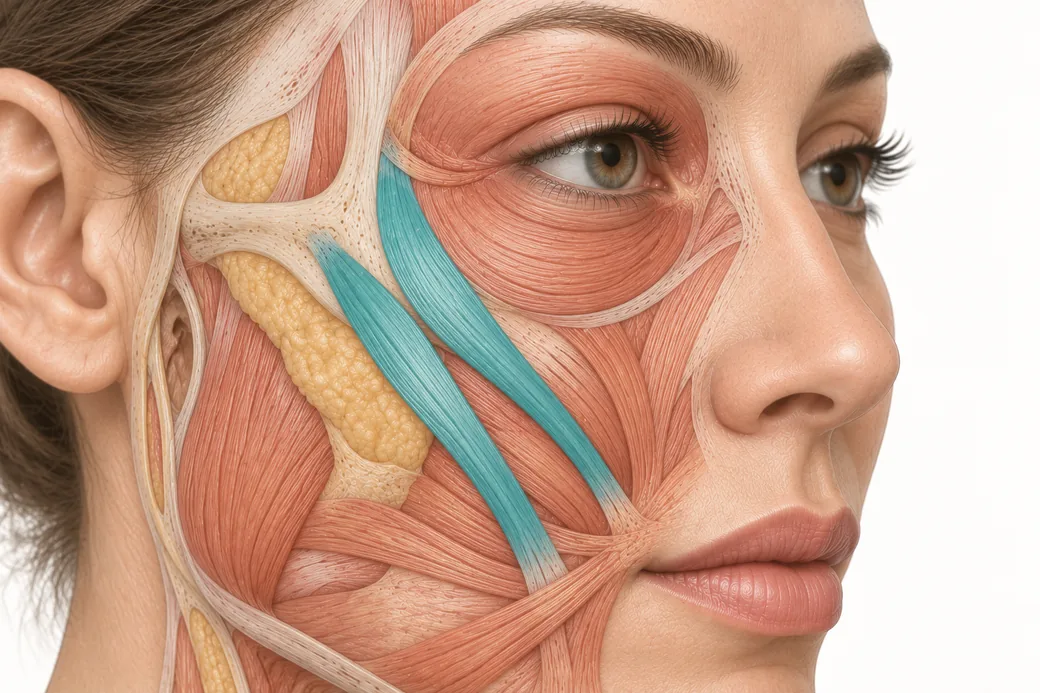 Clinical GuideThe Crow's Feet Trap — How Chasing Lateral Cheek Lines Reaches the ZygomaticusA zygomaticus botox complication after crow's feet treatment has one usual cause — chasing lateral cheek lines too low and too deep. Th
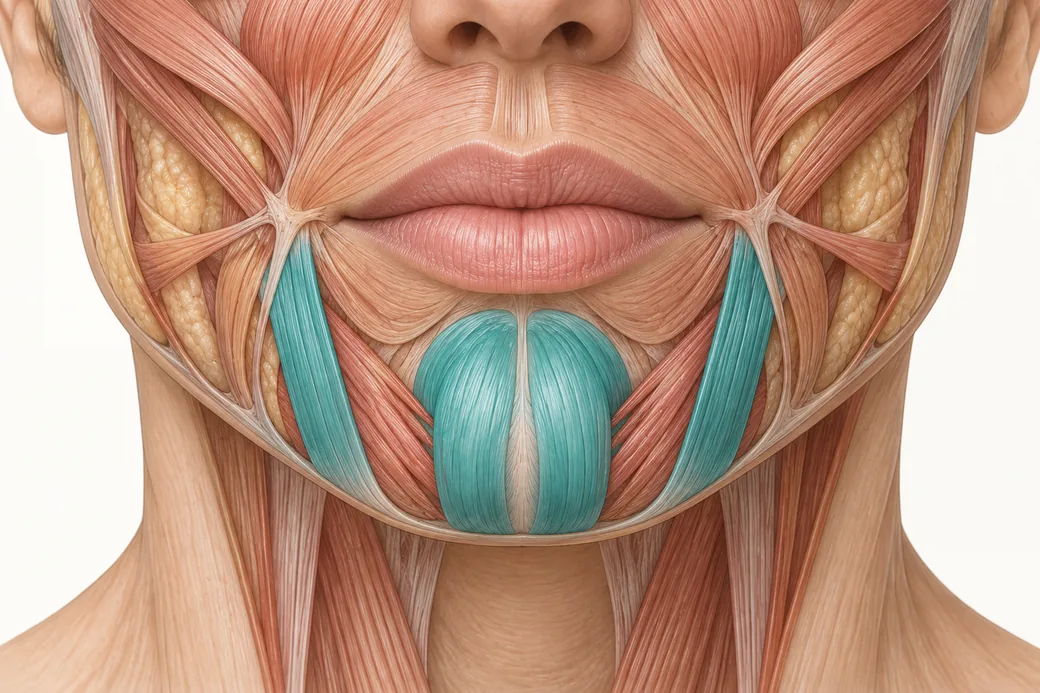 Clinical GuideDepressor Anguli Oris, DLI and Mentalis — Three Overlapping Muscles, Millimetres ApartDepressor anguli oris anatomy is a depth problem, not a map problem. The DAO, DLI and mentalis overlap in layers, and confusing them al
Train with Empire
This guide is clinical education. The technique behind it is taught hands-on, on live patients, with faculty beside you.
Explore Botox Training & Certification →Disclaimer
This article reflects the clinical opinions and experience of Melissa Pulcini-Buttine, PA, an independent faculty member contributing to Empire Medical Training's curriculum. The views expressed are the author's own and do not necessarily represent those of Empire Medical Training.
It is professional education, not medical advice, and is no substitute for hands-on training or independent clinical judgment. Licensed clinicians remain responsible for their own patient selection, technique and outcomes, for verifying current product labelling, and for practising within their scope and applicable law. Empire Medical Training accepts no liability for reliance on this content.
 Claim Your Prize!