







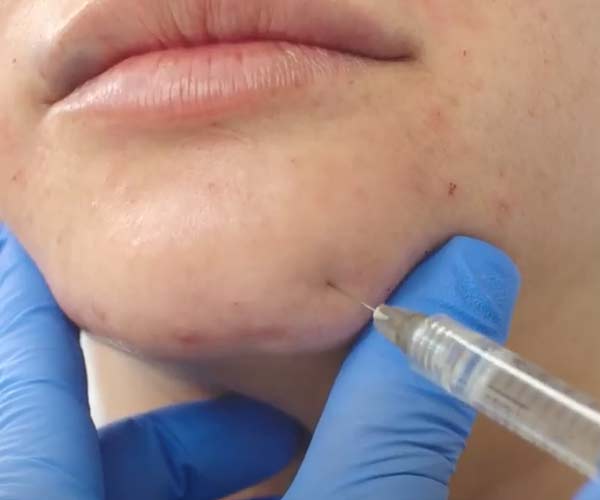
Chin Botox® is a small-volume, high-precision treatment. The doses are tiny — often under 10 units total — but the margin for error is narrower than almost anywhere else on the face. The muscles of the lower face sit close together, overlap, and control the smile. A needle placed a few millimeters off target can turn a routine chin treatment into a visibly asymmetric smile that the patient lives with for three months.
Two conditions bring most patients in: a dimpled, cobblestoned chin — variously called “pebble chin,” “orange peel chin,” or “golf ball chin” — and downturned mouth corners. They involve different muscles, different injection points, and different risk profiles. This guide covers chin anatomy, where to inject for each complaint, typical unit ranges, and the specific errors that produce a crooked smile.
Chin and Lower Face Anatomy
Four muscles matter in this region, and confusing them is the root of most bad outcomes.
- Mentalis — a paired, cone-shaped muscle originating on the mandible near the incisor roots and inserting into the skin of the chin. It elevates and protrudes the lower lip and wrinkles the chin skin. This is the muscle responsible for chin dimpling. It sits centrally, low, and close to the bone.
- Depressor anguli oris (DAO) — a triangular muscle running from the mandible up to the corner of the mouth (the modiolus). It pulls the mouth corner down. An overactive DAO produces the downturned, perpetually displeased mouth and contributes to marionette lines. It sits lateral to the mentalis.
- Depressor labii inferioris (DLI) — runs from the mandible to the lower lip, pulling the lower lip down and out. It sits between and partly deep to the mentalis and DAO. It is the muscle you are trying not to hit.
- Platysma — the broad sheet of the neck; its upper fibers merge with the DAO and contribute to lower-face descent and jawline banding.
The DAO vs. Mentalis Distinction
These two are the crux of chin injecting, and they do opposite jobs at different locations:
- The mentalis is central and low — on the chin pad itself, near the midline, near the bone. It causes dimpling.
- The DAO is lateral and higher — along a line running from roughly the corner of the mouth down toward the jawline. It causes the downturned corner.
Treating a dimpled chin means going central and deep. Treating a downturned mouth means going lateral and staying low along the DAO’s course. If you drift medially while chasing the DAO, you land in the DLI — and the lower lip on that side stops depressing normally. The patient smiles, one side of the lower lip fails to move, and the smile pulls crooked.
This is worth being blunt about: DLI involvement is the signature chin Botox complication, it is a technique error rather than a drug reaction, and it resolves only when the toxin wears off. Our guide on what to do about a crooked smile after Botox covers assessment and management.
Chin Botox Injection Sites by Indication
Chin Dimpling / Pebble Chin / Orange Peel Chin
Target: mentalis.
Placement: Most injectors use one of two approaches. A single midline point low on the chin pad, deep to the bone, delivers the full dose to the point where the two mentalis bellies converge — simple and symmetric by definition. A two-point approach places one injection into each mentalis belly, roughly 5–10 mm off midline, again low on the chin and deep onto the periosteum.
Two rules govern this area:
- Stay low. The lower on the chin pad you inject, the further you are from the lower lip and the DLI. Injecting high — near the mental crease or above — moves product toward the lip depressors.
- Go deep, onto bone. The mentalis originates on the mandible. Injecting deep and centrally keeps product in the target and away from the more superficial, more lateral structures.
Typical dose: commonly 4–10 units total, delivered as a single midline dose or split between two points. Many injectors start at the low end and reassess at two weeks. Dose varies with assessed mentalis strength, and men typically require more.
Downturned Mouth Corners and Marionette Lines
Target: DAO.
Placement: One point per side, placed lateral and low — along the DAO’s course toward the jawline rather than up near the mouth corner. A common approach identifies the muscle by having the patient forcibly frown or grimace, palpating the contracting band, and injecting into it well below the level of the oral commissure and lateral to the marionette line. Both sides are always treated, even if only one appears overactive, because asymmetric depressor treatment produces asymmetric results.
Typical dose: commonly 2–5 units per side, with many injectors starting at 2–3 units. This is deliberately conservative — the DAO is small and near structures you cannot afford to affect.
A realistic expectation matters here. Botox in the DAO softens the downward pull; it does not lift the corner of the mouth. Deep, static marionette lines usually need filler for structural support, with the toxin addressing only the dynamic component.
Chin Crease and Lipstick Lines
The horizontal crease between the lower lip and the chin (the mental crease) deepens with mentalis overactivity. Small doses into the mentalis can soften it, though a deep static crease often responds better to filler. Perioral “lipstick lines” are treated with very small doses in the orbicularis oris above and below the lips — typically 1–2 units per point, kept superficial and off the vermilion border, because overtreatment here interferes with speech, drinking through a straw, and lip competence.
Ready to put this into practice?
Explore Empire's hands-on, CME-accredited Aesthetic & Injectable Training courses — live patients, expert faculty, and ongoing mentorship.
“Botox for Double Chin” — A Necessary Clarification
This is a frequently searched phrase built on a misunderstanding, and it is worth correcting plainly.
Botox does not dissolve submental fat. A double chin caused by fat under the jaw is not a muscle problem, and a neuromodulator will not fix it. Submental fullness from fat is addressed with injectable deoxycholic acid, cryolipolysis, or surgery — not botulinum toxin.
What toxin can do in this region is address platysmal laxity contributing to a poorly defined jawline. The Nefertiti lift places small doses along the platysmal bands and just below the mandibular border to release the downward pull of the platysma, letting the elevators define the jawline more sharply. It is a contour-definition treatment, not a fat treatment, and it works best in patients whose problem is laxity rather than volume. Setting that expectation during the consultation prevents the most common disappointment in the lower face.
Chin Botox Injection Points: Summary
- Chin dimpling — 1 midline point, or 2 points 5–10 mm off midline. Low on the chin pad, deep to bone. Roughly 4–10 units total.
- Downturned corners / marionette — 1 point per side in the DAO, lateral and low, below the commissure. Roughly 2–5 units per side.
- Mental crease — small mentalis doses; consider filler for the static component.
- Jawline definition (platysma) — multiple small doses along bands and below the mandibular border. Not a fat treatment.
Every one of these is a starting point, not a formula. Dose and placement are set by palpating the muscle on animation in the patient in front of you. For how the lower face relates to the rest of the treatment map, see our Botox face chart and our overview of Botox injection sites.
Risks and Complications of Chin Botox
- Asymmetric smile — the headline risk. Caused by DLI involvement, usually from injecting too medially when targeting the DAO, or too high when targeting the mentalis. The lower lip fails to depress symmetrically on animation. Resolves as the toxin wears off; sometimes partially camouflaged by treating the opposite side.
- Lower lip weakness and oral incompetence — overtreatment of the depressors or the mentalis. Presents as difficulty with straws, drooling, or an odd feel when speaking.
- Speech changes — mostly from perioral overtreatment.
- Chin flattening or an odd chin contour — excessive mentalis dosing removing normal chin projection on animation.
- Bruising — the lower face is vascular; the mental artery and vein run in the region. Bruising is common and self-limited.
- Asymmetry from unrecognized baseline asymmetry — many people have a mildly asymmetric smile before any treatment. Photograph at rest and on full animation, and point it out to the patient before you inject. See uneven Botox results.
The general principle in the lower face: underdose deliberately. Small muscles, tight spacing, and functionally critical movement mean the cost of overdosing is far higher than the cost of a two-week touch-up.
The Chin Botox Procedure
- Assess the patient at rest and on full animation — frown, grimace, forced lower-lip depression, full smile. Palpate the mentalis and DAO. Photograph.
- Mark injection points with the patient upright and animating, not reclined and relaxed.
- Cleanse the area. Topical anesthetic is optional; the doses are small and the needles fine.
- Inject the planned dose — deep and central for mentalis, lateral and low for DAO.
- Apply gentle pressure. Avoid massage, which encourages spread into exactly the muscles you avoided.
- Give aftercare instructions and schedule a two-week review. See the dos and don’ts after Botox.
The appointment takes under 30 minutes. Onset is typically 3–5 days, full effect at 10–14 days, duration generally 3–4 months. Assess the result at day 14 — not day 3, when a partial effect can look like asymmetry that resolves on its own.
Frequently Asked Questions
Where do you inject Botox in the chin?
For chin dimpling, injections go into the mentalis — either one midline point or two points about 5–10 mm off midline, placed low on the chin pad and deep onto the bone. For downturned mouth corners, injections go into the depressor anguli oris, one per side, placed lateral and low along the muscle’s course rather than near the mouth corner.
What are the chin Botox injection points for chin dimpling?
One or two points in the mentalis, low and central. The single-midline approach is symmetric by construction; the two-point approach places one injection per mentalis belly. Both stay deep and low, away from the lower lip and the depressor labii inferioris.
How many units of Botox for the chin?
Chin dimpling typically uses 4–10 units total in the mentalis. DAO treatment typically uses 2–5 units per side. These are typical ranges that vary with assessed muscle strength and desired effect; men generally require more. Starting low and reassessing at two weeks is the safer approach in this area.
Where do you inject Botox for a double chin?
Botox does not treat submental fat, so if the double chin is fat, no injection point will help — that requires deoxycholic acid, cryolipolysis, or surgery. If the concern is a poorly defined jawline from platysmal pull, small doses are placed along the platysmal bands and just beneath the mandibular border (the Nefertiti lift) to sharpen the jawline contour.
Can chin Botox cause a crooked smile?
Yes. The most common cause is product reaching the depressor labii inferioris, usually from injecting too medially when targeting the DAO or too high when targeting the mentalis. The affected lower lip fails to depress normally on animation. It is temporary and resolves as the toxin wears off, typically over several weeks to a few months.
What is chin Botox anatomy — which muscles are involved?
Four: the mentalis (central, causes dimpling), the depressor anguli oris (lateral, pulls the mouth corner down), the depressor labii inferioris (lies between them, must be avoided), and the platysma (contributes to jawline definition). Distinguishing the mentalis from the DAO by location and function is the foundation of safe chin injecting.
Does Botox help chin lines and the chin crease?
It softens the dynamic component — the wrinkling that appears when the mentalis contracts. A deep crease that is visible at rest is a static line, and Botox alone will not erase it; those generally respond better to filler, with toxin used to reduce the muscle activity that keeps deepening the crease.
Learn Lower-Face Injection Technique Hands-On
The chin punishes guesswork. Distinguishing a DAO from a DLI by palpation on a live, animating patient — and knowing exactly how low and how deep to place a mentalis injection — is a skill built under supervision, not from a diagram. Empire Medical Training’s Botox Training & Certification course covers full-face anatomy, lower-face technique, dose selection, and complication avoidance, with hands-on injection practice taught by board-certified physicians.

 Claim Your Prize!