







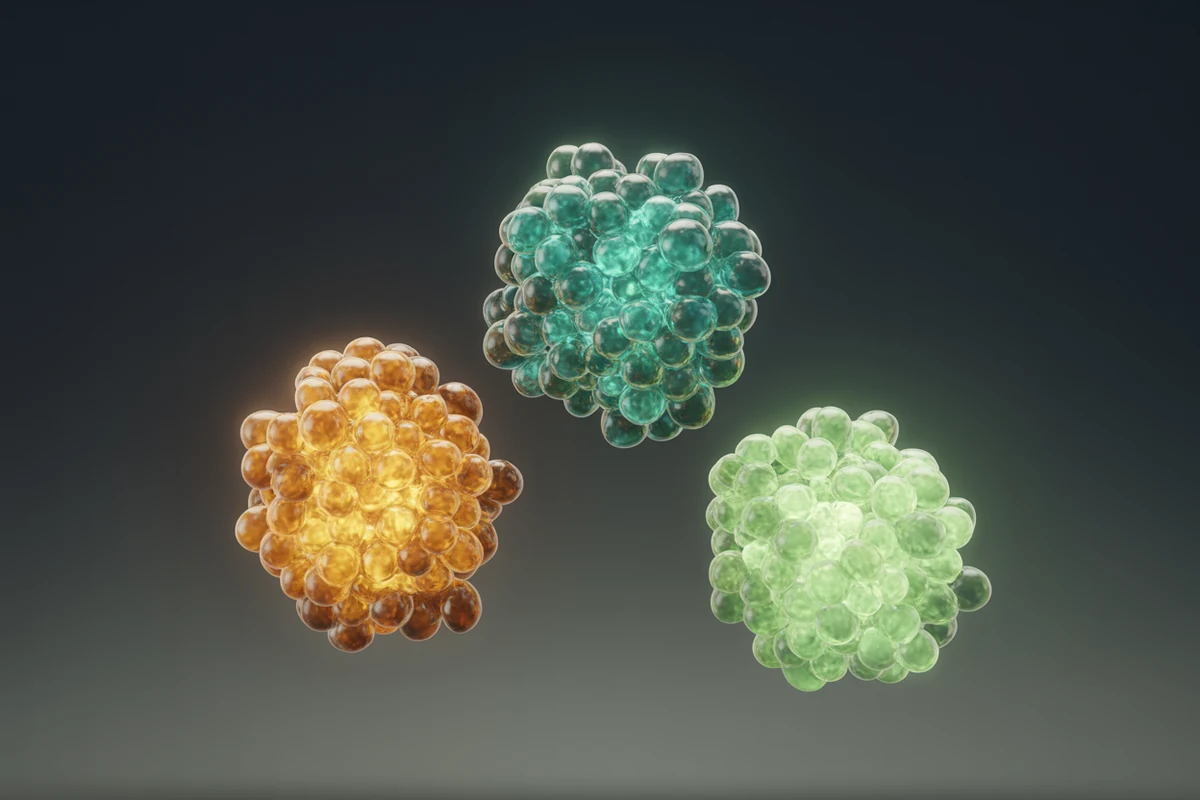
Exosomes are sold as a category, which is the first problem. Ask which source, and the answers diverge sharply: human, plant, or animal — and within animal, salmon. They are not interchangeable, and the evidence for one does not transfer to another.
The Sources Actually in Circulation
Dr. Chris Croley, Empire's Chief Medical Officer, describes exosomes as extracellular vesicles — “little messengers that communicate from one cell to another” — and the products as a way of borrowing that signalling system.
He lists what is out there: “We can get human-derived, plant-derived, animal-derived.” Among animal sources he notes products derived in the US from salmon testicles — distinct from PDRN, and an actual exosome rather than a polynucleotide.
Melissa Pulcini-Buttine PA compresses the clinical implication into four words: “Source-dependent, manufacturer-dependent. There's so many factors into choosing exosomes for patients.”
That is the correct posture. “We use exosomes” is about as informative as “we use injectables.”
The Question Nobody Has Answered
Here is where Croley makes an observation more useful than any product comparison.
Almost everything in this category shortens healing after an aggressive procedure. “We can decrease the healing, I think, with a lot of different types,” he says. “Almost all of them will move that healing time. It'll make it really short.”
Then the question: “What I find interesting is what are the results like six weeks, eight weeks down the road? Are we really causing more tissue regeneration?”
Faster healing is easy to observe and easy to sell. Whether the tissue ends up meaningfully better months later is a different claim, measured differently, and largely unevidenced in the comparisons clinics actually make.
And there is a confounder sitting underneath the whole category. “A lot of these exosomes are mixed with other things,” Croley says. “They have peptides, they're mixed in hyaluronic acid serums, they're suspended in different things. And it's like, what is really that product? What is causing that accelerated healing? We do think it's exosomes. They tell us it's the exosomes — but how do we know that?”
He notes that some topical products with no exosomes at all also speed healing. If your comparator is untreated skin rather than the vehicle alone, you have not isolated anything.
Be Critical of Your Own Results
The methodological suggestion in this conversation is worth adopting.
Ready to put this into practice?
Explore Empire's hands-on, CME-accredited Functional & Regenerative Medicine courses — live patients, expert faculty, and ongoing mentorship.
Croley describes wanting a split-face comparison: one half with one brand, one half with another, or the same on a scalp where follicle counts can be measured with a quantitative camera. His honesty about his own practice is the point: “Personally, I know the ones that we use in our practice, I think the results are better. Objectively, the patients are happy with it. But I haven't measured it formally. So I always question even all the results.”
He frames that as a discipline rather than a confession: “We don't have magic wands, and we want to really be critical of our own results. Is it truly better? Are we doing what we think we're doing?”
Pulcini-Buttine reaches the same place from the teaching side, noting she is using a salmon-derived exosome mixed with PDRN and seeing good results in herself and in patients — while acknowledging she cannot see what is happening at a cellular level. Her answer is measurement: skin analysis devices, pre-treatment and follow-up imaging, and more data before drawing conclusions.
What to Ask a Supplier
- What is the source? Human, plant or animal — and if animal, which tissue.
- What else is in the vial? Peptides, hyaluronic acid, a carrier — and what the concentration of each is.
- What is the regulatory position of this specific product in the United States, for the route you intend to use? Topical and injected are not the same question, and this is where clinics most often get into trouble — see are exosomes FDA approved.
- What evidence exists for this product, as opposed to for exosomes generally?
- What are the characterisation and sterility data?
- What outcome is claimed — faster healing, or a better result at eight weeks? They require different evidence.
The Honest Position With Patients
Pulcini-Buttine's approach to the whole category is the one that holds up: separate the hype from the science, be honest, and say plainly when something looks promising but is not there yet for your patient population.
Which in practice means being able to say: this speeds recovery, I am confident about that; whether it produces better tissue in two months is not established; here is what is in the product I use and why I chose it. That is a stronger sales position than certainty you cannot support, and it survives the patient who read something different online.
How exosomes compare with the adjacent regenerative options is covered in exosomes vs PDRN vs PRP, and the microneedling combination specifically in exosomes after microneedling.
Empire covers the category in Exosome Therapy Certification.
Frequently Asked Questions
Where do exosomes come from?
Products in circulation are derived from human, plant or animal sources, including salmon-derived products made in the US. They are not interchangeable, and evidence for one source does not transfer to another.
Do exosomes do more than speed healing?
Faster healing after aggressive procedures is widely observed across product types. Whether exosomes produce meaningfully better tissue at six to eight weeks is a separate claim that faculty describe as not well established.
Why is it hard to tell what exosome products are doing?
Because many are supplied mixed with peptides, suspended in hyaluronic acid serums or combined with other carriers — and some products containing no exosomes also speed healing. Without comparing against the vehicle alone, the active component is not isolated.
What should I ask before buying an exosome product?
The source tissue, everything else in the vial, the regulatory position for your intended route, the evidence for that specific product rather than the category, characterisation and sterility data, and precisely which outcome is being claimed.
Disclaimer
This article is educational and intended for licensed clinicians. It is not medical advice and does not establish a clinician-patient relationship. Regulatory status for exosome products in the United States varies by product and route and changes over time; verify the current position for any specific product before use, and practise within your scope and applicable law.




 Claim Your Prize!