







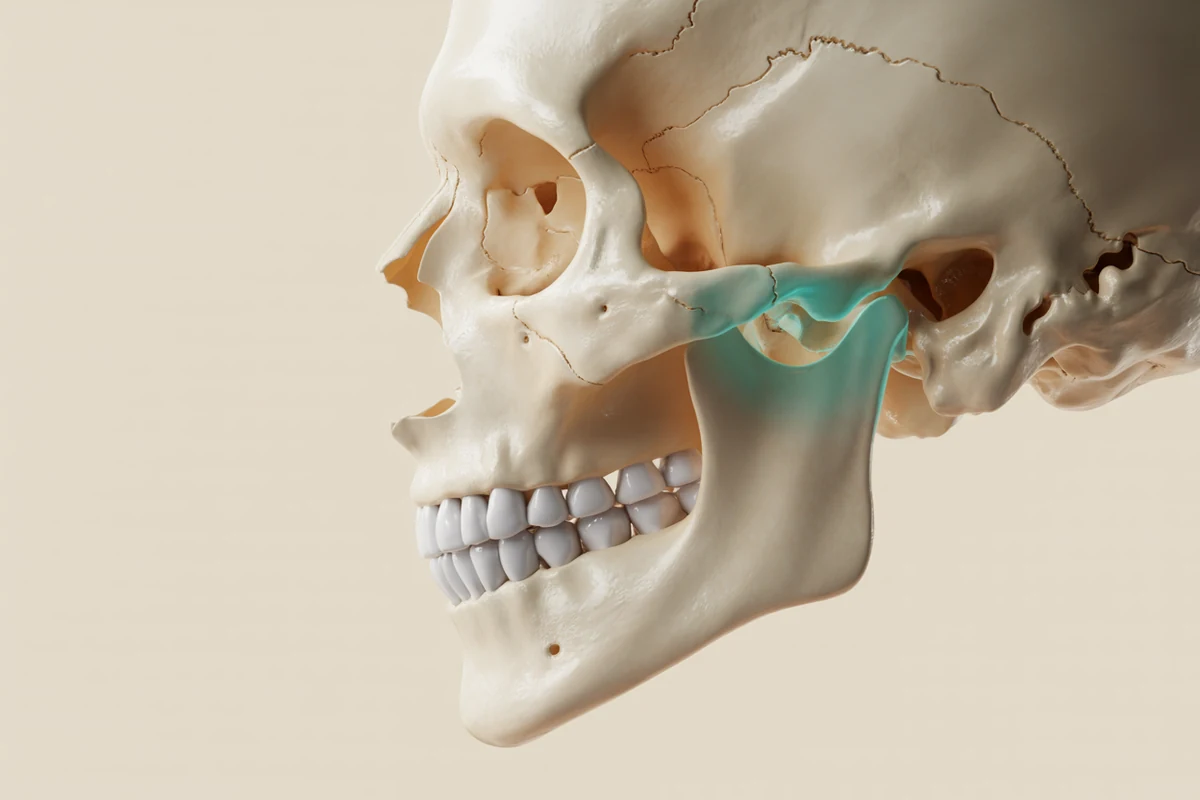
Botox for TMJ is one of the most searched questions in facial aesthetics, and most of what comes back answers it as though it were a single treatment with a single result. It is not. The injection given for jaw pain is the same masseter injection given for jaw slimming, which is why “will this change my face?” is a legitimate question rather than a myth to be reassured away — and why the honest answer depends on which muscles are driving the problem.
This is written for both sides of the chair: the patient deciding whether to ask about it, and the injector deciding whether this particular jaw is a case for neurotoxin at all.
Does Botox Help TMJ? What the Evidence Supports
The first thing worth separating is what “TMJ” means. In everyday use it names the joint, but what people are describing is usually temporomandibular disorder — an umbrella covering two broadly different problems that happen to produce overlapping symptoms.
- Myogenous TMD. The pain is coming from the muscles of mastication: soreness in the jaw and temple, morning tightness, pain that worsens through the day or with chewing, tenderness when you press the muscle itself.
- Arthrogenous TMD. The pain is coming from the joint: clicking, locking, limited opening, pain localized to the joint just in front of the ear.
Botulinum toxin is a muscle drug. It reduces the force a muscle can generate. That mechanism has a plausible route to relief in the first category and no direct route to the second — it does not act on the disc, the capsule, the joint surfaces or inflammation inside the joint.
So the useful framing is not “does Botox work for TMJ.” It is which TMJ. A patient whose masseter and temporalis are tender to palpation and who wakes with a tight jaw is a different candidate from a patient whose joint clicks and catches. The published literature on neurotoxin in temporomandibular disorder is genuinely mixed, and much of the inconsistency across trials comes from pooling those two populations as though they were one.
The defensible position, and the one worth stating to a patient, is this: there is a reasonable mechanistic and clinical case for muscle-driven jaw pain, the evidence is not strong enough to call it a settled first-line therapy, and it is not a treatment for the joint itself.
How Does Botox Help TMJ? The Muscles It Actually Reaches
There are four muscles of mastication per side, all supplied by the mandibular division of the trigeminal nerve. Three elevate the mandible — the masseter, the temporalis and the medial pterygoid — and the lateral pterygoid is the primary depressor.
Only two of those are routinely and safely accessible to an aesthetic or office-based injection:
- The masseter, over the ramus and angle of the mandible. This is the workhorse target and the one most patients mean.
- The anterior temporalis, in the temporal fossa. This is where temple-pattern headache and temporalis-driven pain lives.
The pterygoids sit deep in the infratemporal fossa and are not part of a standard office protocol. That matters for expectation setting: a patient whose pain is genuinely pterygoid-driven is not going to get what they came for from a masseter injection.
The mechanism itself is simple. Reduce the contractile force available to the elevators, and the parafunctional loading that drives myofascial pain — the clenching and grinding that happens largely outside conscious control — is reduced with it. The habit is not cured. The force behind it is turned down.
The clinical consequence of this is covered in more depth in our guides on masseter botox and what else creates lower-face fullness and the masseter injection safe zone.
Is Botox FDA Approved for TMJ?
No. This is worth stating plainly because a great deal of marketing implies otherwise.
The FDA-approved indications for onabotulinumtoxinA (BOTOX) are overactive bladder and detrusor overactivity associated with a neurologic condition, pediatric detrusor overactivity, prophylaxis of headache in adults with chronic migraine, spasticity, cervical dystonia, blepharospasm and strabismus, and severe primary axillary hyperhidrosis. Cosmetic use in the glabellar, lateral canthal and forehead lines is approved separately under BOTOX Cosmetic.
Temporomandibular disorder is not on that list. Neither is bruxism, teeth grinding, jaw clenching or masseter hypertrophy. Every one of those uses is off-label.
Off-label is not the same as improper. A licensed prescriber may use an approved drug outside its labeled indication where that is clinically justified, and a great deal of ordinary medicine works this way. What it does change is three practical things:
- Consent. The off-label status belongs in the consent conversation and in the written consent, explicitly, not buried.
- Coverage. Off-label status is the usual reason a carrier declines to pay.
- Claims. A practice cannot advertise an off-label use as an approved one.
How Many Units of Botox for TMJ?
There is no single correct number, and any clinic quoting one before examining the jaw is quoting a price, not a dose. What the literature does give is a defensible range.
A review of twenty masseter neurotoxin studies found published dosing clustering at 20 to 40 units per side for the masseter, and concluded that doses below 20 units per side are inadequate (Ghatge et al., Bioinformation, 2023). That lower bound is the more useful half of the finding: an underdosed masseter is not a conservative treatment, it is a treatment that will not declare itself and will be read as a failure.
Where the temporalis is involved, a prospective morphometric study used 100 units in total per patient — 30 units into each masseter and 20 units into each anterior temporalis (Val et al., Toxins, 2026). That is a reasonable reference point for a combined protocol in a patient whose headache is temporal rather than purely mandibular.
What should actually move the number:
- Palpable muscle bulk on clench, which varies enormously between patients
- Whether the pain pattern implicates the temporalis at all
- Whether this is a first treatment or a maintenance one in a muscle already partly atrophied
- Whether facial slimming is wanted, tolerated or actively unwanted
That last point is a dosing input, not an afterthought, and it is the one most often skipped.
How Long Does TMJ Botox Last?
Two different clocks run after the same injection, and conflating them is the most common source of disappointed patients.
The symptom clock. Relief of jaw soreness, morning tightness and temple headache typically begins within one to two weeks. This is the clock the TMJ patient cares about, and it is the one they will use to judge whether the treatment worked.
The functional clock. The measurable reduction in mastication force appears at two to four weeks, peaks around three weeks, and lasts approximately 8 to 12 weeks (Ghatge et al., Bioinformation, 2023). Symptomatic relief often outlasts the strictly measurable effect, and in practice many patients return at three to four months.
There is a third clock if slimming is part of the goal, and it is much slower — visible change in facial width accumulates over repeated cycles rather than within one. We cover that separately in the masseter botox results timeline and in how often to retreat.
Does Botox for TMJ Change Your Face Shape?
It can, and anyone who tells a patient it definitely will not is guessing.
Ready to put this into practice?
Explore Empire's hands-on, CME-accredited Aesthetic & Injectable Training courses — live patients, expert faculty, and ongoing mentorship.
The mechanism that relieves the pain is the same mechanism that slims the jaw. A muscle held under reduced load atrophies. Do that once and the change is usually subtle and reversible. Do it repeatedly at intervals that prevent the muscle rebuilding, and the lower face narrows — which is precisely the effect sought by patients who come in asking for jaw slimming rather than pain relief.
Whether that is a benefit or a side effect depends entirely on who is in the chair, which is why it has to be asked about before the first injection rather than discovered at month six:
- Many TMJ patients welcome it. A softer jawline is a bonus they did not expect.
- Some do not. Patients who value a strong or square jaw — and this is not evenly distributed across demographics — can be genuinely unhappy with a change they were never warned about.
- A minority develop the opposite problem. Paradoxical bulging, where the muscle appears to protrude more on clenching after treatment, is an uncommon but recognized outcome. We cover it in paradoxical masseteric bulging.
- Over-slimming can unmask laxity. Reducing lower-face volume in a patient whose skin quality will not retract is a different problem again, covered in masseter botox, jowls and skin laxity.
The practical instruction for clinicians is one sentence in the consultation: ask whether they would be happy if their jaw looked narrower, and record the answer.
How Much Is Botox for TMJ, and Does Insurance Cover It?
Neurotoxin is priced by units, and TMJ protocols use considerably more units than a cosmetic glabella treatment — a combined masseter and temporalis protocol can run to around 100 units. That is the reason the number surprises patients who are benchmarking against what they paid for a forehead treatment. Per-unit pricing varies widely by market and by practice, so a figure quoted in one city tells a patient very little about another.
On coverage, the honest answer is that it is inconsistent and frequently denied. The reason sits in the section above: the use is off-label, and carriers commonly classify off-label neurotoxin for temporomandibular disorder as not medically necessary. Some plans will consider it where there is documented TMD and a record of conservative therapy that failed first; many will not consider it at all.
What to do about that, rather than guess:
- Patients: ask your carrier for the specific medical policy in writing before booking, and ask the practice whether they will submit a claim at all or treat it as cash-pay.
- Practices: settle this before the appointment. A patient who discovers at checkout that a 100-unit treatment is not covered is a complaint, a refund request and a review, in that order.
Botox for TMJ Side Effects
The useful data here comes from a single-center series of 680 patients who received 2,036 sessions of botulinum toxin for masseter hypertrophy between 2011 and 2016. The recorded complications were bruising after 2.5% of sessions, headache after 0.58%, paradoxical bulging after 0.49%, sunken lateral cheek after 0.44%, sagging after 0.20% and smile limitation after 0.15% (Peng and Peng, Journal of Cosmetic Dermatology, 2018).
Two things are worth drawing out of that list.
What is on it is mostly minor and mostly aesthetic. Nothing in that series is a loss of the ability to eat.
What patients actually report is not on it at all. A jaw that tires faster on tough food in the weeks after treatment is common, expected, tracks the same 8 to 12 week window as the rest of the effect, and resolves. It is the drug doing its job in the muscle you treated. It becomes a problem only when nobody warned them — which is the whole argument of our piece on whether masseter botox affects chewing.
The complication that does matter clinically is diffusion beyond the masseter into the medial pterygoid, which is the route to genuinely restricted chewing rather than to a tolerable change (Ghatge et al., Bioinformation, 2023). The defense against it is the same as for every other masseter complication: accurate placement inside the safe zone, and smaller, better-targeted doses rather than larger ones.
Where Botox Sits in a TMJ Treatment Plan
It sits after the reversible things, not instead of them.
Temporomandibular disorder is multifactorial. Occlusion, dentition, posture, sleep, stress and joint pathology all contribute in different proportions in different patients, and none of those are addressed by weakening a muscle. Neurotoxin is best understood as an adjunct that lowers the mechanical load while the rest of the plan does its work.
Before injecting, the questions worth answering:
- Is this muscle pain or joint pain? Palpate the masseter and temporalis. Ask about clicking, locking and limited opening. If the picture is joint-dominant, this is a referral, not an injection.
- Has anything reversible been tried? Dental evaluation, a splint where indicated, physical therapy, behavioral and sleep factors.
- Is there a dental cause sitting underneath this? A cracked tooth and a clenching habit can produce a similar complaint, and one of them will not respond to neurotoxin.
- Does the patient understand it is off-label, temporary and potentially face-changing? All three, in the consent.
- Who is managing the rest of the problem? An injector treating a jaw in isolation, with no dental or medical co-management, is treating a symptom and owning a condition.
Coordination with the patient's dentist is not a formality here. It is often the difference between a treatment that holds and one that is repeated indefinitely against a cause nobody addressed.
Empire teaches masseter assessment, safe-zone placement and dosing as part of Complete Botox Training and Advanced Botulinum Toxin and Filler Training, with the underlying anatomy covered in Anatomical Based Aesthetics Training and the management of what goes wrong in Complication Management for Cosmetic Injectables. Technique is learned under supervision; this article is educational and is not a substitute for training.
The commercial side of the same treatment — units, price and what carriers do — is in masseter Botox cost, and how to read the photographs is in masseter Botox before and after.
Frequently Asked Questions
Does Botox help TMJ pain?
It has a plausible and reasonably supported role in muscle-driven jaw pain, where reducing the contractile force of the masseter and temporalis lowers the parafunctional loading that drives myofascial symptoms. It does not act on the joint itself, so a patient whose problem is clicking, locking or intra-articular pain is unlikely to get what they want from it. The evidence base is mixed rather than settled.
Is Botox FDA approved for TMJ?
No. Temporomandibular disorder, bruxism, teeth grinding, jaw clenching and masseter hypertrophy are all off-label uses of onabotulinumtoxinA. Off-label prescribing by a licensed clinician is lawful and common, but the status must be disclosed in consent and is the usual reason insurance declines to pay.
How many units of Botox are used for TMJ?
Published masseter dosing clusters at 20 to 40 units per side, with doses below 20 units per side considered inadequate. A combined protocol reported in the literature used 100 units in total — 30 units into each masseter and 20 units into each anterior temporalis. The correct number for an individual depends on muscle bulk, whether the temporalis is involved, and whether facial slimming is wanted.
How long does TMJ Botox last?
Symptom relief usually begins within one to two weeks. The measurable reduction in mastication force peaks around three weeks and lasts roughly 8 to 12 weeks. Many patients return for retreatment at three to four months.
Does Botox for TMJ change your face shape?
It can. Repeated treatment causes the masseter to atrophy, which narrows the lower face — the same effect patients seek when they ask for jaw slimming. Whether that is welcome depends on the patient, which is why it should be discussed before the first treatment rather than after.
Does insurance cover Botox for TMJ?
Often not. Because the use is off-label, carriers commonly classify it as not medically necessary. Some plans will consider it with documented TMD and failed conservative therapy. Ask for the specific medical policy in writing before booking.
Can Botox make TMJ worse?
Weakening the elevators does not treat joint pathology, so a patient whose problem is joint-dominant may simply not improve. Specific unwanted outcomes include paradoxical bulging, unwanted facial slimming, and — if product diffuses beyond the masseter into the medial pterygoid — genuinely restricted chewing. Accurate placement and appropriate dosing are the defense against the last of these.
Disclaimer
This article is educational and intended for licensed clinicians and for patients researching their options. It is not medical advice and does not establish a clinician-patient relationship. Use of botulinum toxin for temporomandibular disorder, bruxism and masseter hypertrophy is off-label in the United States. Treatment decisions should be made with a qualified clinician who has examined the patient, and injection technique is learned under direct supervision.


 Claim Your Prize!