







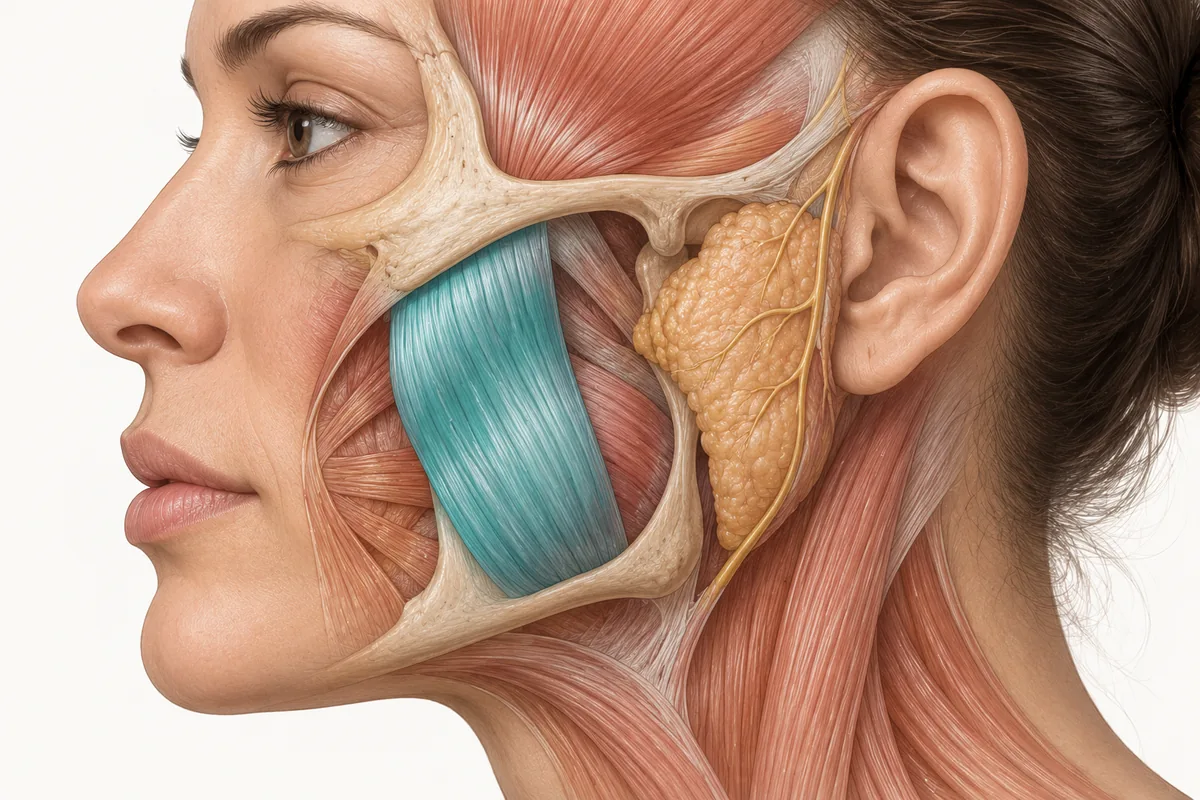
The masseter botox retreatment interval is not an administrative detail. For facial slimming it is arguably the most important variable in the entire plan, because it decides whether each treatment builds on the last one or replaces it. Get the spacing right and atrophy accumulates across cycles. Get it wrong and you are running the same first treatment over and over, charging for it each time, and wondering why the patient's jawline never really changes.
The analogy I use with patients explains the whole thing in fifteen seconds, and it also happens to be biologically accurate.
Why the Masseter Botox Interval Matters: The Gym Analogy
If my biceps are large and I quit going to the gym, they are not going to shrink right away. But if I do not go to the gym for months, they get smaller and smaller and smaller, and it becomes harder for me to build them back up to the size they were initially.
Same thing with the masseter. Dose it with neurotoxin, stop chewing aggressively, stop clenching, and it will shrink — but it will take months for that to occur.
Now run the analogy forward, because that is where the clinical instruction lives. If we stop going to the gym, the biceps may shrink. But if we go back after four to six weeks, it is easier to rebuild than if we do not go back for six months.
That is exactly the situation your patient is in at the end of a treatment cycle. The toxin wears off, the muscle starts loading again, and the question is only how long it gets to load before you intervene. A short window and it makes little headway. A long window and it rebuilds — and you have spent a treatment to get back to where you started.
So: we do not want that masseter to rebuild and really hypertrophy again in the interim. If we stop it from moving and then ten weeks later it starts to move again, and the patient waits another three, four or five months, that muscle is going to recover.
These figures reflect Dr. Croley's clinical practice as taught in Empire Medical Training's hands-on curriculum. Technique is learned under supervision; this article is educational and is not a substitute for training.
How Long Does Masseter Botox Last? What the Published Intervals Show
The literature supports the shape of this argument, with the usual caveats about study quality.
Duration of effect. A review of twenty masseter neurotoxin studies reports that the reduction in mastication force appears at two to four weeks, peaks around three weeks, and lasts approximately 8–12 weeks (Ghatge et al., Bioinformation, 2023). That 8–12 week window is the functional end of the treatment cycle — the point at which the muscle begins loading normally again.
Cumulative effect with repeated treatment. The same review cites a long-term series in which patients were followed over 52 months and received between one and eight injections at intervals ranging from one to nineteen months, with the finding that mean masseter thickness reduced as the number of treatments increased. The review's own recommendation is that repeat treatment at regular intervals is advisable to maintain the result, on the order of two to four sessions per year.
Single treatments are reversible. A single intervention produces a reversible reduction lasting at least three months. That sentence is the whole argument for maintenance in one line: a patient who has one treatment and does not return has bought a temporary result, not a slimmer face.
Dose floor. The same review concluded that doses below 20 units per side are inadequate, with published dosing clustering at 20–40 units per side. Spacing cannot rescue an underdosed treatment; a partially denervated muscle is loading again from the beginning.
How Often Should You Get Masseter Botox? The Schedule I Book
My own cadence follows from the biology and from the fact that patients do not come back unless the appointment exists.
Treatment one. Full baseline photography first — five standardised views plus animation images with the patient clenching. Then treat.
Month three: second treatment. This lands near the end of the 8–12 week effect window. The muscle has completed a cycle under reduced load and is beginning to recover function. Retreating here keeps it unloaded rather than allowing a re-hypertrophy phase.
Month six: formal reassessment. Repeat standardised photography, compare against baseline in the same views and the same head position, and make an evidence-based decision about whether to continue, adjust the dose distribution or stop. This is where I expect to see the majority of the patient's result.
Book month three and month six at the first visit. This is not a scheduling nicety — a result that depends on cadence depends on the appointment being in the diary, and a slimming patient who sees nothing at week two is exactly the patient who quietly does not rebook.
After the first year, most maintained patients settle into something in the range the literature suggests — two to four sessions a year — with the interval titrated to how quickly bulk returns on palpation and photography rather than to a fixed calendar.
Botox for Bruxism and Jaw Clenching Runs on a Different Schedule
This is where cadence advice most often goes wrong, because the two indications get lumped together.
A slimming patient is treated on a structural schedule: intervals chosen to prevent re-hypertrophy, driven by the goal of accumulating atrophy, judged on photographs at three and six months.
A bruxism or clenching patient is treated on a symptomatic schedule: intervals driven by the return of jaw pain, morning soreness, headache or tooth wear. Their effect appears in one to two weeks and they know precisely when it has gone. Retreating them purely to prevent muscle rebuild is treating a goal they do not have — and for some of them, progressive facial slimming is an unwanted side effect rather than a benefit. Our material on botox for jaw clenching and management of bruxism covers that indication.
Where a patient has both, say so explicitly and pick which goal is driving the calendar.
What Legitimately Moves the Masseter Botox Interval
Three months is a starting position, not a law. Four things justify moving it, and it is worth knowing which way each pushes.
Ready to put this into practice?
Explore Empire's hands-on, CME-accredited Aesthetic & Injectable Training courses — live patients, expert faculty, and ongoing mentorship.
Muscle size. A very large masseter has more mass to remove and more capacity to rebuild. These patients generally need the tighter end of the interval and often the additional injection points that a bigger muscle warrants, rather than a longer gap and a larger single dose.
Ongoing clenching load. This is the variable most injectors ignore. The gym analogy has a second half nobody uses: the muscle does not shrink because it is denervated, it shrinks because it is unloaded. A patient who continues to clench hard through a partial block, or whose parafunctional habit is driven by stress, sleep-disordered breathing or an occlusal problem, is training the muscle between treatments. Addressing the habit — an appliance, a dental or sleep opinion where indicated — does more for the durability of the result than shortening the interval.
Observed rate of return. Palpated bulk at the review appointment is real data. A muscle that recruits hard at ten weeks is running faster than the textbook; a muscle still soft at fourteen weeks is running slower. Titrate to the patient in front of you.
Phase of treatment. The first year is an induction phase, where intervals are shorter and the goal is to accumulate atrophy. Once the target contour is reached, the goal changes to holding it, and intervals usually lengthen into the two-to-four-sessions-per-year range. Treating a maintenance patient on an induction schedule wastes product; treating an induction patient on a maintenance schedule wastes the year.
What does not justify moving the interval is the patient's diary. A slimming plan built around a wedding date rather than around the biology will disappoint both of you, and the honest response to "can we speed this up?" is that the timeline is set by muscle remodelling and cannot be compressed by dose.
How to Judge Whether the Masseter Botox Cadence Is Working
At every reassessment, three inputs:
Palpation. Clench, release, clench, release, palpating bilaterally. Has bulk returned on contraction, and is it symmetrical? A masseter that recruits hard at month three is telling you the cycle is closing.
Standardised photographs. Same camera, same distance, same lighting, same head position, same five views, plus the clenching animation view. Head position drift is the single most common reason a genuine result looks like no result. The discipline is the same one behind any structured botox face chart documentation, applied to a muscle whose change is slow enough that memory is useless.
The patient's own report. For slimming patients this is the least reliable of the three early on and the most important later. They will tell you at week two that nothing happened, which is expected. They will tell you at month six whether the result is what they wanted, which is the outcome that matters.
Where Masseter Botox Retreatment Advice Goes Wrong
Three patterns worth naming:
Treating slimming patients on the twelve-week forehead schedule by default, without explaining why. The interval may be roughly right; the framing is wrong, and patients who do not understand the cumulative logic drift to annual treatment and never get a result.
Letting a slimming patient lapse to six months and then repeating the same first treatment. Both of you experience this as maintenance. Neither of you is getting cumulative atrophy.
Escalating dose to compensate for poor spacing. If the result is not accumulating, the first thing to examine is the interval and the distribution — not the total units. Underdosing is real, but so is the reflex of solving a scheduling problem with pharmacology.
What this changes at the chairside
- Give the gym analogy at the first consultation, including the second half. Not just "it shrinks slowly" but "and if you leave it too long between treatments, it rebuilds." That second half is what makes patients keep appointments.
- Book month three and month six before the patient leaves the room. Every time.
- Decide out loud which clock you are on — structural for slimming, symptomatic for bruxism — and write the indication in the notes so the next person treating this patient inherits the plan rather than guessing it.
Masseter treatment planning, documentation and retreatment strategy are covered hands-on in Empire's Cosmetic Neurotoxins Training and Advanced Botulinum Toxin & Filler Training. For the soft-tissue consequences of reducing lower-face structure over time, see our material on facial volume loss.
About the author
Dr. Chris Croley — Chief Medical Officer, Empire Medical Training. The clinical approach described here is what he teaches in Empire's hands-on neurotoxin curriculum.
For the therapeutic side of the same injection — jaw pain, dosing, duration, off-label status and insurance — see Botox for TMJ.
Frequently Asked Questions
How often should masseter botox be repeated for facial slimming?
Dr. Croley treats at approximately three months and reassesses formally at six. Published review guidance recommends repeat treatment at regular intervals on the order of two to four sessions per year, because the reduction in mastication force lasts roughly 8–12 weeks and a single treatment produces a reversible result.
Does the masseter grow back between botox treatments?
It can. Once the toxin wears off at around 8–12 weeks the muscle loads normally again, and a long gap gives it time to rebuild. Long-term series show mean masseter thickness falling as the number of treatments accumulates, which only happens if the intervals are short enough to prevent recovery between cycles.
Why does masseter botox need repeated treatments when forehead botox does not?
Forehead treatment aims at a pharmacologic effect that is simply repeated. Masseter slimming aims at structural atrophy, which accumulates across cycles of reduced loading. One cycle produces a reversible reduction; a visible, durable narrowing is the sum of several.
Is the retreatment interval the same for bruxism as for slimming?
No. Bruxism is treated on a symptomatic schedule, driven by the return of jaw pain or morning soreness, and the patient reports it accurately. Slimming is treated on a structural schedule, chosen to prevent re-hypertrophy and judged on standardised photographs at three and six months.
What happens if a patient stops masseter botox altogether?
The muscle gradually recovers bulk as normal loading resumes, and the slimming effect reverses over time. Patients should be told this before starting, because facial slimming is a maintenance treatment rather than a one-off procedure and the commitment is part of the decision.
Disclaimer
This article reflects the clinical opinions and experience of Dr. Chris Croley, Chief Medical Officer, Empire Medical Training, an independent faculty member contributing to Empire Medical Training's curriculum. The views expressed are the author's own and do not necessarily represent those of Empire Medical Training.
It is professional education, not medical advice, and is no substitute for hands-on training or independent clinical judgment. Licensed clinicians remain responsible for their own patient selection, technique and outcomes, for verifying current product labelling, and for practising within their scope and applicable law. Empire Medical Training accepts no liability for reliance on this content.




 Claim Your Prize!