







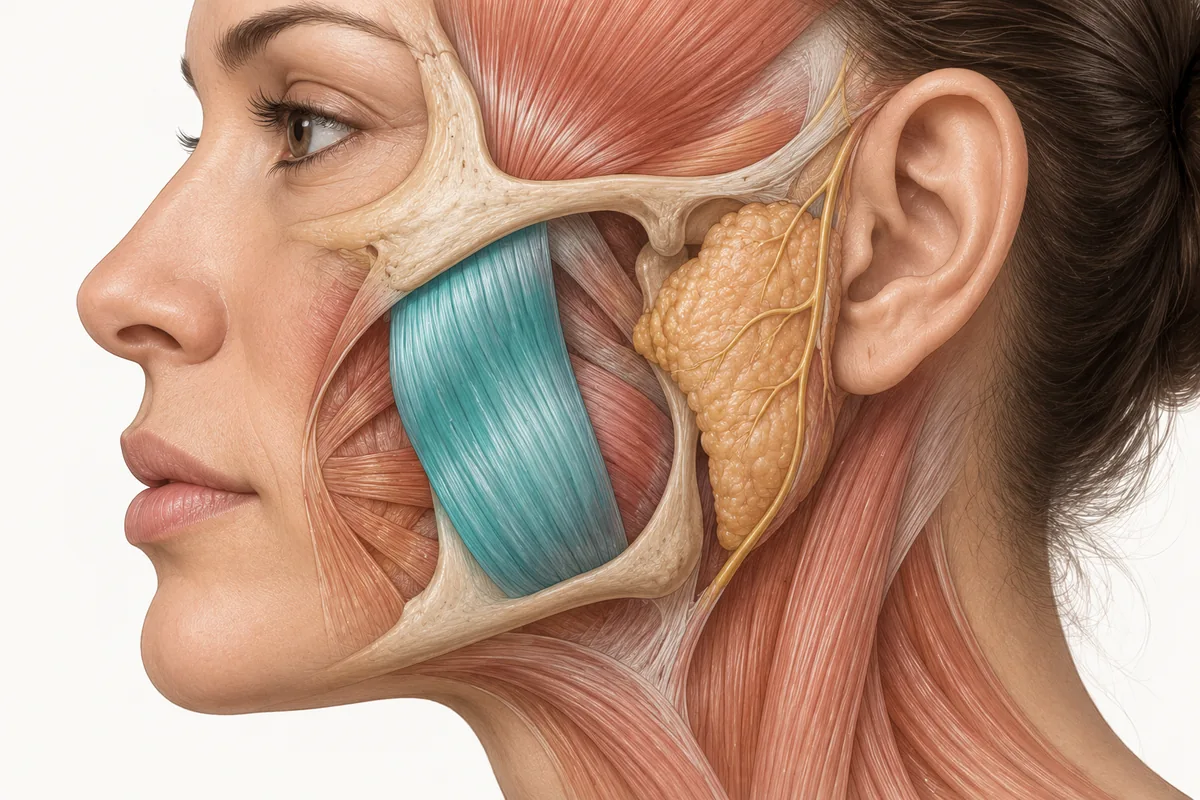
Paradoxical masseteric bulging is the complication that makes patients lose faith in you, because it is visible, it is on their face, and it appears every single time they bite down. The patient came in to make their jaw narrower. Two weeks later a discrete lump appears on the side of their face whenever they clench. Nothing about that conversation is easy.
It is also, in almost every case, a distribution failure rather than a dosing failure — which means it is preventable at the syringe.
What patients and injectors actually see
Paradoxical muscle bulge is observable bulging of part of the masseter after botulinum toxin injection, most often on contraction. Reported incidence across the literature ranges enormously, from 0.5% to 18.8% in one review and from 0.15% to 27.3% in another, with the variability attributed to differences in injection technique, anatomical heterogeneity and how "bulging" was defined and looked for (Ozsoy and colleagues, Aesthetic Surgery Journal Open Forum, 2024; Sun et al., Journal of Cosmetic Dermatology, 2026).
The large single-centre series gives a useful floor for a competent practice: in 2,036 masseter treatment sessions across 680 patients, paradoxical bulging occurred after 10 sessions — 0.49% (Peng and Peng, Journal of Cosmetic Dermatology, 2018). At the other end, a retrospective analysis that specifically went looking for it found bulging in 22 of 88 injected masseters, 25%. The honest reading is that mild bulging is far more common than passive reporting suggests, and that severe, patient-noticed bulging is genuinely uncommon.
Timing is early. Onset is most often described at around two weeks, with reports as early as within 24 hours; the retrospective case-control series recorded a mean onset of 5.41 ± 1.74 days.
Paradoxical Masseteric Bulging: Some Muscle Still Works
The unifying explanation is uneven distribution of toxin within a compartmentalised muscle. Part of the masseter is denervated and flaccid. Part of it is not. When the patient clenches, the still-innervated portion contracts against — and visibly through — the paralysed portion, and you get a bulge.
My version of how that happens at the chairside is specific. Some providers place the entire dose at a single injection point and let it diffuse throughout the muscle. I am not personally a fan of that, because sometimes you get strange movements — a little bulging where you have affected some of the superficial fibres but not the deep fibres throughout. Then when the patient clenches, that muscle bulges.
The anatomy behind it is the muscle's internal architecture. Within the superficial head there is a substantial internal tendon — the deep inferior tendon — which divides the superficial head into superficial and deep bellies and physically obstructs the spread of toxin. Toxin deposited on one side of that structure does not reliably cross it, and the part of the muscle it never reached goes on contracting.
Which part gets missed varies with the patient's own internal architecture, and that is the practical point: the failure is always the same one — toxin did not reach all of the functional muscle — and so is the fix.
These figures reflect Dr. Croley's clinical practice as taught in Empire Medical Training's hands-on curriculum. Technique is learned under supervision; this article is educational and is not a substitute for training.
Who Is at Risk of Paradoxical Masseteric Bulging
The retrospective case-control analysis of 22 affected versus 66 unaffected masseters identified several factors that reached significance, and they are clinically usable:
- Thicker masseters. Affected muscles measured 13.30 ± 0.171 mm versus 10.32 ± 0.169 mm in controls (p<0.001). The big muscle you were most keen to treat is the one most likely to bulge.
- Thicker internal tendon. Deep inferior tendon thickness 0.85 mm versus 0.60 mm (p<0.001), with compartment-type and transverse-type tendon morphology carrying higher risk than longitudinal type.
- Higher dose. The bulging group had received more toxin, 40.0 U versus 35.0 U (p<0.001) — which reads counterintuitively until you recognise that bigger doses were given to bigger muscles.
- A felt fascial penetration during needle insertion. 72.7% of bulging cases versus 15.1% of controls (p<0.001). That tactile pop as the needle crosses restrictive fascia is a signal worth registering rather than ignoring.
(Sun et al., Journal of Cosmetic Dermatology, 2026.)
Read together: the at-risk patient is the one with the large, thick, heavily compartmentalised masseter — exactly the patient who most wants slimming and most benefits from it.
Preventing Masseteric Bulging: Distribution, Depth, Dose
Four things, in order of how much they matter.
Divide the dose. I prefer to split the dose across approximately three injection points rather than depositing it at one, with the bulk placed low — on the jawline but on the anterior surface — and the remainder at the midpoint of the muscle. For a genuinely prominent masseter, male or female, two further injection points can be added. The published technique that goes with the bulging literature is the same shape: three injection points to the inferior half of the masseter.
Treat both planes. This is a deep muscle, and a very common error is to treat it superficially. The published technique is explicitly dual-plane: three points to the inferior half, ensuring toxin is placed in both the deep and the superficial plane. Practical depth estimates put superficial placement at roughly 5–10 mm and deep placement at roughly 15–20 mm, individualised to the patient (Yoshida, Toxins, 2026). Check your needle length before you draw up — the short needle that suits upper-face work cannot reach the deep belly of a thick masseter, and the habits behind standard botox injection sites mapping do not transfer here.
Do not underdose. Suboptimal outcomes in the case series were associated with inadequate injection-point distribution, insufficient dosing, or failure to address the dominant compartment. A review of the masseter literature concluded that doses below 20 units per side are inadequate (Ghatge et al., Bioinformation, 2023). Underdosing a large muscle does not produce a smaller result — it produces a partially treated muscle, which is the precondition for bulging.
Ready to put this into practice?
Explore Empire's hands-on, CME-accredited Aesthetic & Injectable Training courses — live patients, expert faculty, and ongoing mentorship.
Assess for dominance before you inject. Where clinical examination or ultrasound suggests that one part of the muscle is doing more of the work than the rest, the recommendation is to deviate from the standard three-point pattern to ensure adequate dose reaches it. Most aesthetic practices do not have ultrasound at the chairside, but every practice has hands: palpate through a clench-release-clench-release cycle and map where the muscle actually recruits, rather than assuming a uniform slab.
Managing Masseteric Bulging: It Is Fixable, and Quickly
This is the reassuring part, and it is worth telling an affected patient early.
In a published ultrasound-guided case series, all six patients received secondary injections targeting the specific portion of muscle still contracting, at doses of 10–15 units, and all achieved satisfactory improvement. In the retrospective analysis, supplementary ultrasound-guided injections of 5–15 units resolved the bulging within one week. Reports elsewhere describe more superficial supplementary injection into the unaffected superficial lobe resolving the complaint within about ten days.
So the management pathway is: identify precisely which part of the muscle is still contracting by having the patient clench repeatedly while you observe and palpate; place a small supplementary dose into that specific portion at the correct depth; review at one to two weeks. Do not simply repeat the original treatment pattern, because the original pattern is what missed the compartment.
If you have access to diagnostic ultrasound, this is one of the few aesthetic scenarios where it earns its cost outright. If you do not, precise clinical localisation during clenching is the substitute, and it works.
What to say, and when to say it
Put bulging on the consent form and mention it verbally at the first masseter consultation, alongside the temporary reduction in chewing force. It is uncommon, it is visible, and it is correctable — that is a manageable sentence before treatment and a very difficult one afterwards. Our guidance on what to include in botox consent forms covers the documentation side.
Then make the review appointment count. Two weeks is when most bulging declares itself, and a two-week check on your first several masseter patients will teach you more about your own distribution technique than any amount of reading. Ask them to clench while you watch. A patient who has been told what to look for and who has an appointment in the diary experiences a correctable finding. A patient who discovers it alone in a mirror experiences a disaster.
Masseter distribution and depth are taught hands-on in Empire's Cosmetic Neurotoxins Training and Advanced Botulinum Toxin & Filler Training. For the therapeutic indication in the same muscle, see botox for jaw clenching and management of bruxism.
About the author
Dr. Chris Croley — Chief Medical Officer, Empire Medical Training. The clinical approach described here is what he teaches in Empire's hands-on neurotoxin curriculum.
Frequently Asked Questions
What causes paradoxical masseteric bulging after botox?
Uneven distribution of toxin within a compartmentalised muscle. Part of the masseter is denervated while another part remains functional, and on clenching the still-working portion contracts against the paralysed portion and becomes visible. Internal tendinous structures within the muscle obstruct spread and are strongly implicated.
How soon after masseter botox does bulging appear?
Most commonly around two weeks, though a retrospective series recorded a mean onset of 5.4 days and onset within 24 hours has been reported. A two-week review appointment with the patient clenching is the practical way to catch it early.
How common is paradoxical masseteric bulging?
Reported incidence varies widely, from 0.15% to 27.3% across studies, reflecting differences in technique, anatomy and how actively it was sought. In a single-centre series of 2,036 treatment sessions it occurred after 0.49%, while a study looking for it prospectively found it in 25% of injected muscles.
Can paradoxical masseteric bulging be corrected?
Yes, and usually quickly. Small supplementary doses of 5–15 units placed into the specific portion of muscle still contracting — ideally under ultrasound guidance — have been reported to resolve the bulging within about one week. Repeating the original injection pattern is not the fix, because that pattern is what missed the compartment.
Does dividing the dose prevent masseter bulging?
Dividing the dose across multiple points in the inferior half of the muscle, in both the deep and superficial planes, is the technique associated with lower rates. Single-point boluses relying on diffusion are the pattern most often implicated, because an internal tendon can prevent the toxin from reaching all functional parts of the muscle.
Disclaimer
This article reflects the clinical opinions and experience of Dr. Chris Croley, Chief Medical Officer, Empire Medical Training, an independent faculty member contributing to Empire Medical Training's curriculum. The views expressed are the author's own and do not necessarily represent those of Empire Medical Training.
It is professional education, not medical advice, and is no substitute for hands-on training or independent clinical judgment. Licensed clinicians remain responsible for their own patient selection, technique and outcomes, for verifying current product labelling, and for practising within their scope and applicable law. Empire Medical Training accepts no liability for reliance on this content.




 Claim Your Prize!