







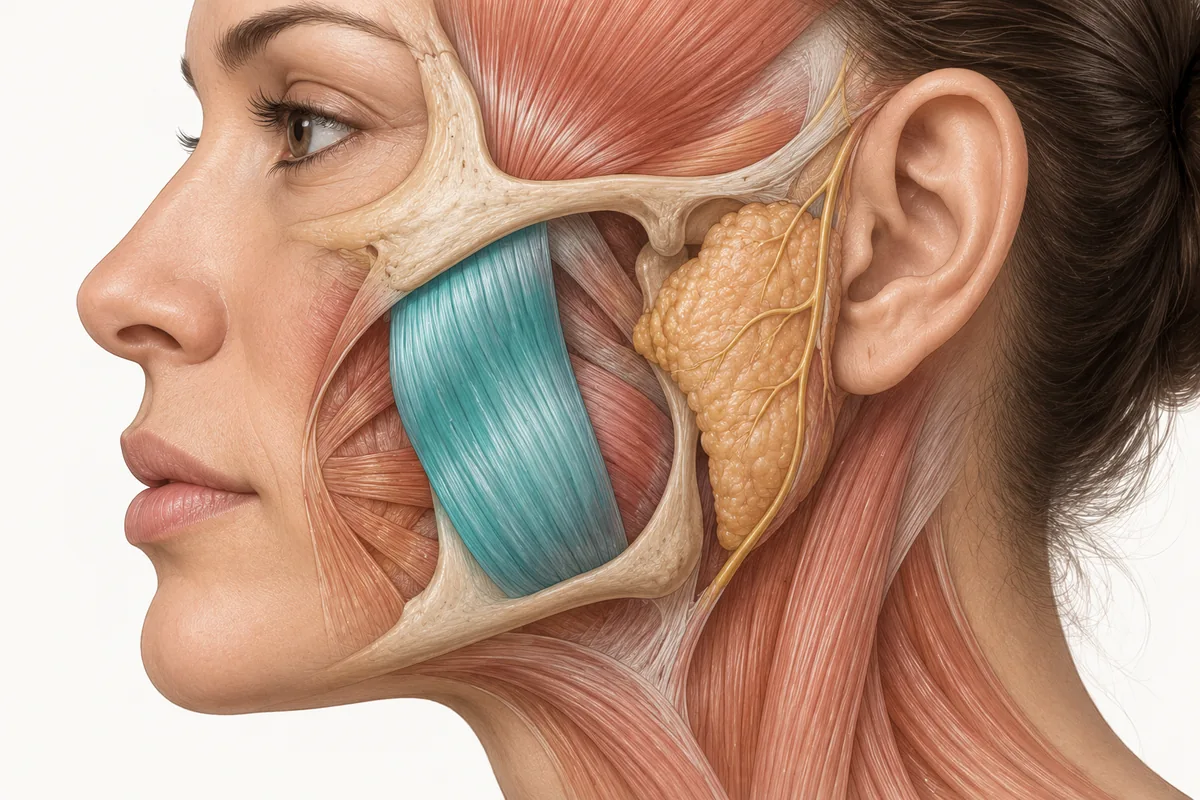
Does masseter botox affect chewing? It is the first question almost every masseter patient asks, and it deserves a better answer than a reassuring one. The answer that holds up is anatomical: patients do not lose the ability to chew, because the masseter is not doing the job alone.
Whenever people worry about treating the masseter and patients being unable to chew, I want to dispel the idea that this muscle is the whole of mastication. It is not. And the way to dispel it is with the anatomy, so that what you tell the patient is grounded in something rather than offered as comfort.
Does Masseter Botox Affect Chewing? The Anatomy Says No
There are four muscles of mastication per side, all innervated by the mandibular division of the trigeminal nerve, CN V3. Three of them elevate the mandible.
- Masseter. Origin from the inferior and anterior zygomatic arch; insertion onto the outer surface of the mandibular ramus, angle and coronoid process. Elevates the mandible and approximates the teeth. Innervated by the masseteric nerve, a branch of V3.
- Temporalis. A large fan-shaped muscle arising from the temporal fossa up to the inferior temporal line and inserting on the coronoid process. Its anterior and middle fibres elevate the mandible; its posterior fibres retract it. Innervated by the deep temporal branches of V3.
- Medial pterygoid. Superficial head from the maxillary tuberosity, deep head from the medial surface of the lateral pterygoid plate, inserting on the medial surface of the ramus near the angle. Assists elevation and protrusion and contributes to the side-to-side grinding motion. Innervated by the medial pterygoid nerve.
- Lateral pterygoid. Upper head from the greater wing of the sphenoid, lower head from the lateral pterygoid plate, inserting on the pterygoid fovea of the condylar neck, the articular disc and the capsule. It is the primary depressor and assists protrusion and lateral excursion.
(Anatomical descriptions: Anatomy, Head and Neck, Mastication Muscles, StatPearls, NCBI Bookshelf.)
That list is the whole argument. When you chemodenervate the masseter you are reducing the contribution of one of three elevators on that side, and you are leaving the temporalis, the medial pterygoid and the entire opposite side working normally. You have not disabled mastication. You have de-tuned one contributor to it.
Note also what you have not touched: jaw opening. The lateral pterygoid is the depressor and it sits deep in the infratemporal fossa, nowhere near a correctly placed masseter injection. Patients who ask whether they will be able to open their mouth are worrying about a muscle you are not treating.
Masseter Botox Side Effects: What the Complication Data Shows
It is worth putting the chewing question next to the things that genuinely do go wrong, because the scale is instructive.
In a single-centre series of 680 patients who received 2,036 sessions of botulinum toxin for masseter hypertrophy between 2011 and 2016, the recorded complications were bruising after 2.5% of sessions, headache after 0.58%, paradoxical bulging after 0.49%, sunken lateral cheek after 0.44%, sagging after 0.20% and smile limitation after 0.15% (Peng and Peng, Journal of Cosmetic Dermatology, 2018). Nothing in that list is a loss of the ability to eat.
What patients do report, in the weeks after treatment, is that the jaw tires a little faster on tough food. That is the drug doing its job in the muscle you treated, it tracks the same 8–12 week window as the rest of the clinical effect, and it resolves (Ghatge et al., Bioinformation, 2023). It is not a complication. It becomes a problem only when the patient was not told to expect it.
These figures reflect Dr. Croley's clinical practice as taught in Empire Medical Training's hands-on curriculum. Technique is learned under supervision; this article is educational and is not a substitute for training.
How Long Masseter Botox Side Effects Last, and Why They Resolve
Two mechanisms do the work.
Redundancy. Elevation is shared. The temporalis in particular is a large and powerful elevator with a completely independent nerve supply from the masseteric nerve, and it is entirely unaffected by a correctly placed masseter injection. Patients adapt quickly because the system they are adapting with is already there.
Reversibility. Chemodenervation is temporary. Motor function returns as the neuromuscular junction recovers, which is why anything the patient notices tracks the same 8–12 week window as the rest of the treatment's clinical effect rather than persisting.
The practical consequence is that the mastication question is a counselling problem, not a safety problem — in the appropriately selected patient.
When Masseter Botox Can Affect Chewing: Two Patients to Screen
The redundancy argument holds for the ordinary patient. Two situations still warrant a longer conversation before you treat:
- Compromised dentition or an unstable occlusion. A patient whose chewing is already marginal is better served by coordinating with their dentist before an aesthetic slimming plan proceeds, not after.
- Diffusion beyond the masseter. Diffusion into the medial pterygoid is the specific concern, because that is the route to genuinely restricted chewing rather than to a tolerable change (Ghatge et al., Bioinformation, 2023). The answer is the same as it is for every other masseter complication: smaller, more accurately placed doses inside the safe zone.
Neither is an absolute contraindication. Both change the consent conversation.
Does Masseter Botox Help TMJ? Masseter-Only vs Masseter-Plus-Temporalis
Everything above describes masseter-only treatment, which is what aesthetic slimming is.
Combined masseter and anterior temporalis injection is a separate, recognised therapeutic approach for bruxism and myofascial pain. The prospective morphometric study cited elsewhere in this cluster used 100 U of onabotulinumtoxinA in total per patient — 30 U into each masseter and 20 U into each anterior temporalis (Val et al., Toxins, 2026). That is a legitimate choice in a patient whose pain is temporalis-driven and whose headache is temporal rather than mandibular.
It is a different treatment with a different consent conversation. If you are treating both muscles bilaterally, say so explicitly to the patient, and consider staging rather than treating all four sites at maximal dose in one sitting — particularly in a first-time patient whose response you have not yet observed.
The principle to carry away is the one the anatomy gives you: how much reserve the patient keeps is a function of how much of the masticatory apparatus you deliberately leave alone.
When a Patient Calls About Chewing After Masseter Botox
Expected decrement and genuine complication feel similar to a worried patient and different to you. Four questions sort them:
Ready to put this into practice?
Explore Empire's hands-on, CME-accredited Aesthetic & Injectable Training courses — live patients, expert faculty, and ongoing mentorship.
When did it start, and is it getting worse or better? The expected decrement appears with the rest of the clinical effect, peaks around two to four weeks and improves from there. Something that begins abruptly weeks later, or that is progressively worsening, is not the ordinary pharmacology.
Is it weakness or restriction? "My jaw tires on a bagel" is reduced force and is expected. "I cannot open my mouth fully" is trismus, which is a different problem — difficulty in mouth opening appears among injection-site-related complications and is generally attributed to inaccurate placement or diffusion rather than to the treatment working as intended.
Is it symmetrical? Bilateral, symmetrical mild weakness after bilateral treatment is consistent. Unilateral weakness after bilateral treatment means the sides were not treated equivalently, and is worth mapping before the next cycle.
Is there pain, swelling, clicking or a change in the bite? Those point toward the temporomandibular joint rather than toward chemodenervation, and toward an examination rather than reassurance. A pre-existing joint problem unmasked by altered muscle balance is a real scenario and needs a proper assessment, not a phone call.
For the ordinary expected decrement, the answer is reassurance plus a timeline: it is the treatment working, it is at its most noticeable now, and it improves over the following weeks. For anything in the other three categories, see the patient.
How to Explain Masseter Botox Side Effects at the Consultation
The script I use is short and it does not oversell:
There are four muscles that chew on each side of your jaw, and we are only weakening one of them. You are not going to lose the ability to eat. What you may notice for the first couple of months is that your jaw tires a little faster on something tough — a bagel, a steak, a lot of chewing gum. That is the treatment working, and it passes.
Three features make that script defensible. It names the anatomy, so the reassurance is grounded. It predicts a real, specific, mild symptom rather than promising nothing will change — which means that if the patient does notice it, you were right rather than wrong. And it puts a time limit on it.
Document the conversation. The mastication decrement is expected, common and temporary, which is exactly the profile of a finding that belongs in writing before treatment rather than in a phone call afterwards. Our guidance on what to include in botox consent forms applies directly.
Where this sits alongside the rest of the masseter conversation
For the bruxism or clenching patient, reduced masticatory force is not a side effect at all — it is the therapeutic goal, and the material on botox for jaw clenching and management of bruxism covers that indication. For the facial-slimming patient it is a cost paid in exchange for a contour change that will not be visible for months. Different patients, different framings, same physiology.
It is also worth remembering that the masseter is an unusual neurotoxin target for most injectors. It is a deep, thick muscle of mastication rather than a thin muscle of facial expression, and the familiar map of botox injection sites in the upper face does not prepare you for it. Depth, dose distribution and the boundaries of the safe zone all behave differently here, and getting them wrong is what generates the complications that a patient will actually notice.
Masseter assessment and injection are taught hands-on in Empire's Cosmetic Neurotoxins Training, and the underlying muscle anatomy is worked through in Anatomical Based Aesthetics Training.
About the author
Dr. Chris Croley — Chief Medical Officer, Empire Medical Training. The clinical approach described here is what he teaches in Empire's hands-on neurotoxin curriculum.
For the therapeutic side of the same injection — jaw pain, dosing, duration, off-label status and insurance — see Botox for TMJ.
Frequently Asked Questions
Does masseter botox affect chewing?
Patients retain the ability to chew. There are four muscles of mastication per side and three of them elevate the mandible, so treating the masseter reduces the contribution of one elevator while the temporalis, the medial pterygoid and the whole opposite side continue working normally. What patients may notice for a few weeks is that the jaw tires faster on tough food.
How long does the change in chewing last after masseter botox?
Review data place it at roughly 8–12 weeks, tracking the duration of the treatment's other clinical effects. Patients typically describe the jaw tiring faster on tough foods early on, with normal function returning as neuromuscular transmission recovers.
Which muscles still chew after the masseter is treated?
The temporalis and the medial pterygoid remain fully functional elevators on the treated side, and the entire contralateral set is unaffected if only one side is treated. The lateral pterygoid, the primary jaw depressor, is untouched, so mouth opening is not impaired.
Can masseter botox cause difficulty opening the mouth?
Difficulty in mouth opening is listed among injection-site-related complications, and is generally attributed to inaccurate placement or diffusion beyond the masseter rather than to the treatment itself. Keeping injections within the recommended safe zone and away from the muscle borders is the published prevention strategy.
Should patients with dental problems have masseter botox?
They need coordination rather than an automatic no. A patient with compromised dentition, an unstable occlusion or existing temporomandibular dysfunction has less functional reserve to give away, and the masticatory assessment belongs with their dentist or an appropriate specialist before an aesthetic slimming plan proceeds.
Disclaimer
This article reflects the clinical opinions and experience of Dr. Chris Croley, Chief Medical Officer, Empire Medical Training, an independent faculty member contributing to Empire Medical Training's curriculum. The views expressed are the author's own and do not necessarily represent those of Empire Medical Training.
It is professional education, not medical advice, and is no substitute for hands-on training or independent clinical judgment. Licensed clinicians remain responsible for their own patient selection, technique and outcomes, for verifying current product labelling, and for practising within their scope and applicable law. Empire Medical Training accepts no liability for reliance on this content.


 Claim Your Prize!