







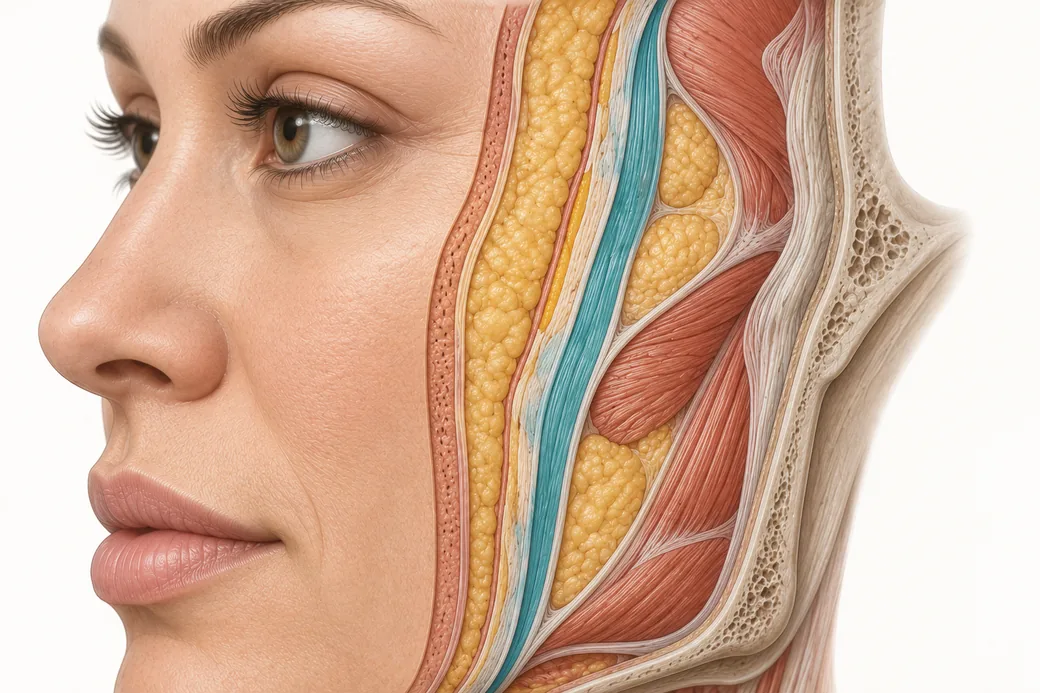
If every injector remembered one rule, I would make it this one: the product belongs in the plane of the problem.
That sentence is the whole of injection plane selection. It is not a technique, it is a constraint — and it sits above technique, because it decides whether the technique had a chance of working before you ever picked up a syringe. Everything I teach about depth reduces to it, and every depth error I have seen an injector make is a violation of it.
The rule matters because getting it wrong has exactly two outcomes, and they are not equally survivable.
The two failure modes
Failure mode one: you lose the product. You place the right product, in the right quantity, for the right diagnosis — in the wrong layer. The deficit is at the level of deep structural volume and the product went into subcutaneous fat, or the finding lives in the dermis and the product went underneath it. Nothing dangerous happens. Nothing good happens either. The patient comes back at two weeks with no change, and the honest answer is that you treated a layer the problem was not in.
This failure mode is expensive and demoralising and it is where most of the "the product didn't work" conversations come from. It is also where the wrong lesson usually gets learned: the injector concludes the product was weak, buys a firmer one, and repeats the error with more material.
The superficial variant of the same error is worse cosmetically. Product intended for a structural plane that ends up too superficial does not disappear — it becomes visible. Edge, palpable ridge, a bluish cast where a hyaluronic acid product sits high in thin skin, or a product that migrates because it was placed in a layer that moves. Our clinician overview of filler dissolution is the downstream conversation; the upstream cause is very often a plane error rather than a product defect.
Failure mode two: you are in a dangerous plane. The arteries and veins of the face do not wander randomly through the tissue. They travel in identifiable layers, and the layer they occupy changes as they travel. That means depth is not just a determinant of result — it is a determinant of risk, and the two are decided by the same decision. Intravascular injection is a plane event before it is anything else.
I am not going to restate the vascular map or the regional danger-zone anatomy here; that material is covered in its own reference and it deserves the space. What belongs on this page is the structural point: the same millimetre that costs you a result in one region costs you a vessel in another, and you do not get to know which without knowing the layer you are in. Empire's overview of the worst-case vascular outcome exists precisely because this failure mode is not theoretical.
So: wrong plane means either nothing, or something you will remember for the rest of your career. There is no benign version.
Stating the rule properly
The short form — the product belongs in the plane of the problem — is the version you keep in your head at the chairside. Here is the version that survives scrutiny.
Identify the layer the deficit lives in. Deliver the correction into that layer. Choose a product whose properties suit that layer.
Three clauses, in that order, and the order is not negotiable. The first clause is diagnosis and it is the step most often skipped. If you cannot name the layer — bone-level projection, deep structural volume, superficial compartment position, dermal quality, muscular movement — you are not ready to pick a depth, because you do not yet have a target. Assessment runs deep to superficial for exactly this reason.
The second clause is placement. The third is product selection, and it comes last on purpose. Product is a solution to a problem that the first two clauses have already defined.
Five corollaries that do the actual work
1. The plane is a property of the problem, not of the product. Products have properties that suit them to planes; they do not carry a plane with them. Two injectors using the same syringe on the same face can be treating two different problems, and only one of them is correct. When a colleague asks "what depth do you use for this product," the question is upside down.
2. Depth is relative. Planes are absolute. A measurement in millimetres means nothing without a region attached. The distance from skin surface to periosteum over the temple, over the malar eminence, over the chin and over the vermilion are not remotely comparable, and neither is the number of distinct layers you pass through on the way. This is why "inject at 4 mm" is not a usable instruction anywhere, and why a plane has to be identified by what it is — subcutaneous, sub-SMAS, supraperiosteal, intradermal — rather than by how far down it happens to sit in one particular face.
Add that facial tissue thickness varies between individuals as well as between regions, and the futility of a fixed number becomes obvious. The plane is the instruction. The millimetre is an observation.
3. Vector is the second half of the rule. Do not chase a surface defect with the wrong depth — and do not chase it with the wrong vector either. A correctly-planed injection delivered along a vector that fights the anatomy still produces an unnatural result, because you have added support in a direction the face does not use. Descent has a direction. Support should oppose it. The plane says how deep; the vector says along what line, and a plan needs both.
4. Correct plane plus wrong product still fails. Rheology matters within a plane. A soft, low-cohesivity product placed correctly in a deep structural plane may simply not do structural work. A firm product placed correctly in a mobile superficial compartment may be palpable or may distort on animation — and superficial midfacial compartments genuinely do move, by an average of 3.7 mm cranially on smiling in ultrasound measurement of living faces (Schelke L, et al. Journal of Cosmetic Dermatology. 2021;20(12):3849–3856). The rule constrains product choice; it does not make it for you.
5. Neuromodulator obeys the same rule. The plane rule is usually taught as a filler rule and it is not one. A neuromodulator's target is a specific muscle, which occupies a specific depth in a specific region. Too superficial and you get diffusion into the dermal plexus and a weaker or patchier effect than intended; too deep, or in the wrong plane at a border, and you reach a muscle you did not intend to treat. Every unintended ptosis, every asymmetric smile, every unexpected lip weakness is a plane-and-vector event. Our reference on injection sites for botulinum toxin is the regional map; the rule is what makes the map usable.
How you actually know what plane you are in
This is the part that no diagram can teach you, and it is the honest weakness of learning anatomy from illustrations. A cross-sectional drawing tells you the layers exist and in what order. It does not tell you what the transition between two of them feels like through a needle hub.
What you have available at the chairside:
Bone contact. The most reliable landmark you have. Touching periosteum is unambiguous, which is why supraperiosteal placement is the easiest plane to be confident about and why it is often where a structural correction belongs.
Resistance change. Tissue layers differ in density, and the transitions are palpable through both a needle and a cannula — the give when you pass from dermis into subcutaneous fat, the firmer fascial layer, the different feel of a compartment septum. This is a trained perception, not an innate one, and it is the single most transferable skill from dissection to the living face.
Cannula behaviour. A cannula that advances freely is in a plane. A cannula that will not advance is in a septum or a fascial layer, and forcing it is how you cross a boundary you did not choose. The direction of least resistance is information.
Surface response. Blanching, dermal distension, immediate contour change and the shape of the bleb all tell you something about where product is going. So does the absence of the response you expected.
Imaging. Ultrasound is increasingly available and genuinely resolves the question, both before injection for vascular mapping and after for locating product. It is not universal, and I would not build a practice that depends on it — but if you have access to it, the plane rule is the reason to use it.
And when you do not know: do not inject. There is no version of this rule that includes proceeding while uncertain about your layer. Withdraw, re-establish a landmark you trust, and start again.
This reflects Melissa Pulcini-Buttine's clinical practice as taught in Empire Medical Training's hands-on curriculum. Technique is learned under supervision; this article is educational and is not a substitute for training.
Documenting the plane
Most aesthetic records document product, lot, volume and region. Fewer document plane, and it is the field that would most often explain a result — good or bad — when you look back at the chart six months later.
Write the layer down. "Supraperiosteal, medial maxilla, 0.4 mL" is a record you can learn from. "0.4 mL cheek" is not. When a result underperforms, the note tells you whether to change the plane or change the product. When a result is excellent, it tells you what to repeat. And when a patient presents to you having been treated elsewhere, the absence of that field is exactly why you cannot reconstruct what was done.
What changes on Monday
Ask the layer question out loud before the product question. Not "what am I going to use" but "where does this problem live." If the answer is not immediate, the assessment is not finished.
Stop quoting depths in millimetres, to yourself or to anyone you are teaching. Name planes.
Add plane to your chart template. It costs one field and it is the field that makes your own results reviewable.
And when a treatment underperforms, put plane at the top of the differential rather than the bottom. Underdosing is the comfortable explanation. Wrong layer is the more common one.
Planes are learned in tissue. Empire's Anatomical Based Aesthetics Training and Special Anatomical Cadaver Aesthetics Training teach facial anatomy layer by layer, and Complete Dermal Filler Training covers filler placement across the face under supervision.
About the author. Melissa Pulcini-Buttine, PA, has practised as a physician assistant for two decades and has taught anatomy and physiology for approximately fourteen years. She is a faculty member at Empire Medical Training and the founder of an aesthetics practice in Greenwich, Connecticut.
Related guides in this cluster
Part of Facial Muscle Anatomy for Neurotoxin.
 Clinical GuideMost Neurotoxin Complications Are Diffusion, Not Misplacement — Rethinking Root CauseMost neurotoxin complications come from diffusion into an adjacent muscle, not from injecting the wrong site. Here is how to tell which
 Clinical GuideThe Crow's Feet Trap — How Chasing Lateral Cheek Lines Reaches the ZygomaticusA zygomaticus botox complication after crow's feet treatment has one usual cause — chasing lateral cheek lines too low and too deep. Th
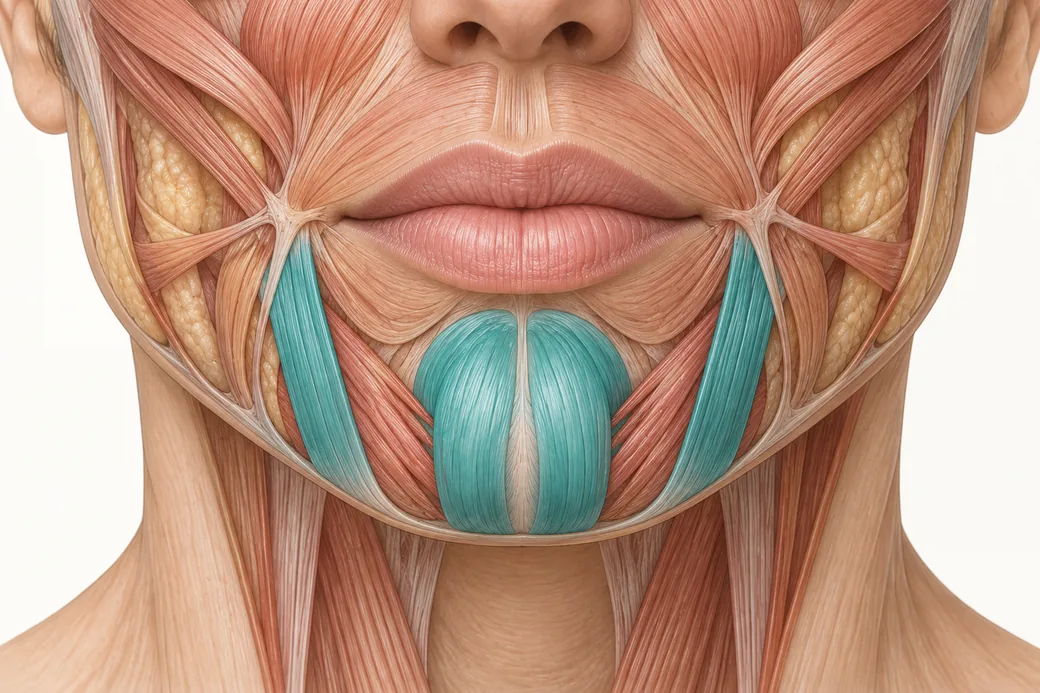 Clinical GuideDepressor Anguli Oris, DLI and Mentalis — Three Overlapping Muscles, Millimetres ApartDepressor anguli oris anatomy is a depth problem, not a map problem. The DAO, DLI and mentalis overlap in layers, and confusing them al
Train with Empire
This guide is clinical education. The technique behind it is taught hands-on, on live patients, with faculty beside you.
Explore Botox Training & Certification →Disclaimer
This article reflects the clinical opinions and experience of Melissa Pulcini-Buttine, PA, an independent faculty member contributing to Empire Medical Training's curriculum. The views expressed are the author's own and do not necessarily represent those of Empire Medical Training.
It is professional education, not medical advice, and is no substitute for hands-on training or independent clinical judgment. Licensed clinicians remain responsible for their own patient selection, technique and outcomes, for verifying current product labelling, and for practising within their scope and applicable law. Empire Medical Training accepts no liability for reliance on this content.
 Claim Your Prize!