







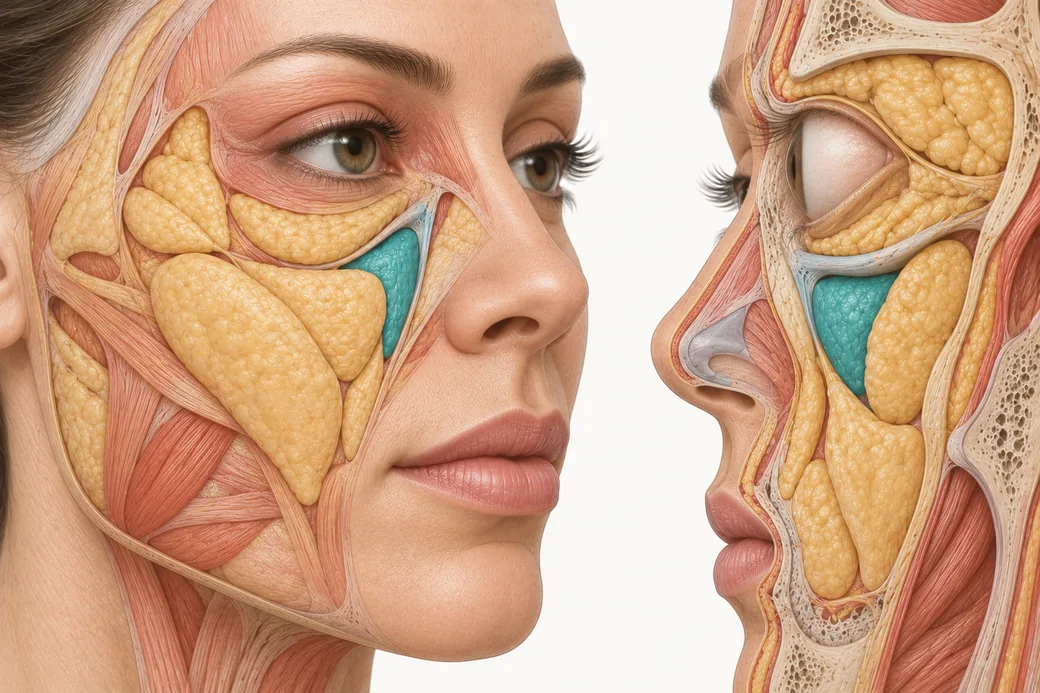
The G prime filler rule that most injectors carry in their heads is short and roughly correct: firm products go deep, soft products go superficial. Maritza Mejia teaches it in almost exactly those terms. "Knowing the G prime and the thickness of the filler is a must," she says. "Thick filler goes into the deep fat pad, the one that is attached on bone. It doesn't move and it gives you volume. Soft fillers, or low G prime, are more for the superficial fat pads. It helps for fine lines and also for the areas that you move, so that way it doesn't create filler migration."
That rule is the right one to carry. What is worth adding to it is a second layer of detail that rarely reaches injectors: the G′ numbers printed on product slides are not measured to a common standard, so the figures you are handed to apply the rule are frequently not comparable between brands. This resource covers what G prime actually measures, why cross-brand comparisons of it are frequently meaningless, what the fat compartment anatomy supports, and what the published literature identifies as the drivers of filler migration.
What G prime actually is
G prime (G′) is the elastic or storage modulus: the component of a gel's response to deformation that is stored elastically and returned, measured by oscillatory rheometry. Its partner, G double prime (G″), is the viscous or loss modulus — energy dissipated rather than stored. The ratio of the two, tan delta (G″/G′), describes where a product sits on the spectrum from solid-like to liquid-like behavior.
In plain terms: G′ describes how hard a gel resists being deformed and how readily it springs back. A high-G′ product behaves more like a firm solid under load. A low-G′ product deforms and flows more readily. The mechanistic argument for matching product to plane follows directly — tissue at different depths applies different mechanical loads, so a gel intended to hold projection against the weight of the overlying face and against constant mimetic movement plausibly needs different mechanical properties from a gel intended to sit quietly in a mobile superficial plane and integrate.
Two other properties matter and are routinely conflated with G′:
Cohesivity is the gel's tendency to hold together as a mass rather than disperse — a different property from elasticity, measured by different assays.
Swelling factor is how much water the gel takes up after placement, which determines how much the final volume differs from the injected volume. A product's behavior at week four is a function of swelling, not of G′.
The foundational comparative work here is real and worth reading rather than reading about. Kablik and colleagues published a comparative physical-properties analysis of HA fillers in Dermatologic Surgery in 2009 (35 Suppl 1:302–12). Sundaram and colleagues compared calcium hydroxylapatite against HA products on elasticity and viscosity in the same journal in 2010 (36 Suppl 3:1859–65), and Sundaram and Cassuto published a broader biophysical characterization of HA fillers in Plastic and Reconstructive Surgery in 2013 (132(4 Suppl 2):5S–21S). Pierre, Liew and Bernardin's "Basics of dermal filler rheology" (Dermatologic Surgery, 2015;41 Suppl 1:S120–6) is the clearest primer, with the caveat that two of its three authors were employed by a filler manufacturer at the time — a disclosure worth knowing when you read its framing.
Why the G prime number on the slide may not mean what you think
This is the single most important thing for a physician-facing audience to understand about rheology, and it is almost never mentioned in product training.
G′ is not an intrinsic property you can read off a product like molecular weight. It is a measurement, and it depends heavily on how the measurement was made. Lorenc, Öhrlund and Edsman examined this directly in the Journal of Drugs in Dermatology in 2017 (16(9):876–82). Measuring the same products while varying rheometer settings — oscillation frequency, strain percentage, plate gap, geometry, temperature, relaxation time — they found the measured G′ of a single product varied by roughly 1.6 to 7.4 times depending on the conditions used. Their conclusion was that a substantial part of the apparent difference between competing products reported in industry literature is attributable to measurement settings rather than to real differences between the gels, and they called for a standardized protocol.
The practical consequence is blunt. A table comparing Product X at one G′ value against Product Y at another, drawn from two manufacturers' separate white papers, is not evidence of anything unless both were measured under identical, disclosed conditions. Most such tables do not disclose conditions. Treat any cross-brand G′ comparison without stated frequency, strain and temperature as marketing, not data.
What a standardized measurement looks like is illustrated by Fagien, Bertucci, von Grote and Mashburn, who measured eighteen HA products under one protocol — a frequency sweep from 10 to 0.1 Hz at 0.1% strain and 25°C — and published the results in Plastic and Reconstructive Surgery in 2019 (143(4):707e–720e; open access). Their finding is instructive in its own right: the expected relationships between G′ and swelling behavior held within a given crosslinking technology and HA concentration, but did not hold reliably across different manufacturing platforms. In other words, even measured properly, G′ is not a single scale on which all fillers can be ranked against each other.
The same skepticism applies to cohesivity claims. Cohesivity assays are not standardized across the industry, so cross-brand cohesivity numbers carry the same problem.
The compartment anatomy the rule is built on
The anatomical half of the rule is on firmer ground. Rohrich and Pessa established through cadaver dissection that facial subcutaneous fat is not a continuous blanket but a set of discrete compartments separated by septae — "The fat compartments of the face: anatomy and clinical implications for cosmetic surgery," Plastic and Reconstructive Surgery, 2007;119(7):2219–27. That paper is the anatomical basis for compartment-directed injection generally.
The ageing behavior of those compartments is what makes depth-matched filler selection rational. Gierloff and colleagues used computed tomography on cadaver heads across age cohorts and documented that midfacial fat compartments do not deflate uniformly — deep and superficial compartments change differently with age ("Aging changes of the midfacial fat compartments: a computed tomographic study," Plastic and Reconstructive Surgery, 2012;129(1):263–73). That differential loss is the reason a face can simultaneously need deep structural restoration and superficial quality work, which is the entire premise of a layered plan. The compartment-level view of that process is covered in our facial volume loss overview.
Specific deep spaces have since been characterized in the same way. Surek, Vargo and Lamb defined the deep pyriform space and its relationship to the angular artery and deep medial cheek fat in Plastic and Reconstructive Surgery in 2016 (138(1):59–64) — a paper worth reading before anyone injects deep to the pyriform aperture, for the vascular reason as much as the volumizing one.
The useful distinction for product selection is therefore not "deep versus superficial" in the abstract, but:
Deep, bone-adjacent, relatively immobile compartments — where the injectate is placed against a fixed surface, is loaded in compression by the tissue above it, and is being asked to restore projection and support. This is where Maritza places firm product: "the one that is attached on bone. It doesn't move and it gives you volume."
Superficial, mobile compartments and the dermis above them — where the tissue moves constantly with expression, where the injectate sits close enough to the surface that its mechanical properties can become visible as a contour irregularity, and where the goal is integration and hydration rather than projection. This is where soft product belongs — "for fine lines and also for the areas that you move."
How the rule gets applied in practice
Depth-matched product selection is the working convention across the specialty, and the product design itself reflects it. Fagien's 2019 standardized dataset shows that products intended for supraperiosteal placement do carry higher G′ as a group — manufacturers build the mechanical properties to suit the plane they studied the product in, which is why the rule holds up as a first pass at selection.
The guardrail sits on top of it rather than against it. Use the product in the plane its manufacturer studied it in. That indication is specific to the actual gel in your hand, it accounts for cohesivity and swelling as well as elasticity, and it is the placement that will be reviewed if the case is ever examined. Where a cross-brand G′ table and the manufacturer's own indicated plane point in different directions, follow the indication — and then follow the anatomy in front of you and what you can feel under your fingers.
Filler migration, from the product side
Migration is the outcome the plane-matching rule is most often invoked to prevent, so it is worth knowing what the published literature identifies as its drivers.
The most useful synthesis is Wollina and Goldman's "Filler Migration after Facial Injection — A Narrative Review" (Cosmetics, 2023;10(4):115). Note that Cosmetics is not PubMed-indexed; it is a real peer-reviewed, DOI-resolvable journal, but that is worth knowing when you weigh it. Its findings, honestly characterized:
- Migration is reported disproportionately in the lips, nose, nasolabial region and glabella relative to the cheeks.
- The tear trough carries its own specific risk of orbital migration.
- Contributing factors cited across the case literature include injection depth, injected volume and overfilling, product viscosity and cohesivity, hydrophilicity and water uptake, injection technique, anatomical site, and patient-specific inflammatory response.
- The review is assembled from case reports and case series, not controlled comparative studies, and it frames causation as multifactorial and incompletely understood.
Imaging adds some direct observation. Master's "Hyaluronic Acid Filler Longevity and Localization: Magnetic Resonance Imaging Evidence" (Plastic and Reconstructive Surgery, 2021;147(1):50e–53e) demonstrates MRI as a practical way to localize filler and assess its persistence over time — though it is a small case-based paper, not an imaging cohort.
Note what sits at the top of that list. The strongest and most consistent associations in the case literature are with the variables you fully control at the chair — how deep you placed it, how much you placed, and where. Placement that is too superficial for the product, volume beyond what the compartment can accommodate, and repeated topping-up of an already-full area are the recurring themes. Product properties appear on the list alongside them, but they are chosen once; depth and volume are chosen at every pass. An injector who studies a G′ table and then over-fills a superficial plane has optimized only half the problem.
Maritza's framing captures the practical version of this: soft product in mobile areas "so that way it doesn't create filler migration — it just helps you hydrate the area." The operative safeguard is matching the product to the plane and respecting how much that plane will take, not the number on the slide. For the patient-facing complications side of lip work specifically, see our guide to common lip filler reactions and how to avoid them; for the reversal question, dissolving filler covers the management pathway.
What to change on Monday
- Stop comparing G′ across brands unless the rheometer conditions are disclosed and identical. Ask the representative for frequency, strain and temperature. If they cannot supply them, the number is not usable for comparison.
- Check the indicated plane for the specific product before you draw it up, and apply the firm-deep and soft-superficial convention inside it rather than across brands.
- Treat depth and volume as your primary migration controls, because they are the variables with the strongest observational support and complete operator control.
- Record the plane, not just the product and volume. A chart entry reading "1 mL to left midface" cannot be learned from. "0.6 mL supraperiosteal deep medial cheek, 0.4 mL superficial, cannula" can.
- Do not treat filler as the answer to a quality problem. Where the diagnosis is skin quality or laxity rather than volume, the product category is different; our comparison of biostimulators and fillers covers that fork.
Product selection, plane and compartment anatomy are learned with a needle in your hand and a trainer watching where it goes. Empire Medical Training's Complete Dermal Filler Training covers filler technique hands-on, and Anatomical Based Aesthetics Training covers the underlying facial anatomy that drives these decisions.
Product-selection specifics attributed to Maritza Mejia reflect her clinical practice as taught in Empire Medical Training's hands-on curriculum. Technique is learned under supervision; this article is educational and is not a substitute for training.
About the author. Maritza Mejia, FNP, is a family nurse practitioner, a faculty member at Empire Medical Training, and the founder of Long Island Beauty Bar, New York.
Related guides in this cluster
Part of Treatment Planning and Layering.
 Clinical GuideThe Collagen Stimulator Landscape: Skin Boosters vs Biostimulators vs Fillers, ComparedSkin boosters vs biostimulators vs fillers, compared by goal, plane, onset and failure mode — a four-category clinical matrix for injec
 Clinical GuideChoose by Tissue Diagnosis, Not by Trend: A Collagen Biostimulator Decision TreeA collagen biostimulator decision tree for injectors — four tissue findings, four products, and the five-point compass behind every sel
 Clinical GuideThe Biostimulator Results Timeline: Why Three Months, and How to Set It at ConsultationThe biostimulator results timeline injectors should set at consultation: why day-zero fullness is water, when collagen shows, and the s
Train with Empire
This guide is clinical education. The technique behind it is taught hands-on, on live patients, with faculty beside you.
Explore Anatomical-Based Aesthetics Training →Disclaimer
This article reflects the clinical opinions and experience of Maritza Mejia, FNP, an independent faculty member contributing to Empire Medical Training's curriculum. The views expressed are the author's own and do not necessarily represent those of Empire Medical Training.
It is professional education, not medical advice, and is no substitute for hands-on training or independent clinical judgment. Licensed clinicians remain responsible for their own patient selection, technique and outcomes, for verifying current product labelling, and for practising within their scope and applicable law. Empire Medical Training accepts no liability for reliance on this content.
 Claim Your Prize!