







Pain management in aesthetic procedures is usually treated as something you improvise at the chair. The patient flinches, you reach for ice. That is not a plan — it is a reflex, and it arrives after the pain has already been encoded. Anesthesia is the one specialty that is organised entirely around the opposite habit: you decide what the patient will feel before the first instrument is opened, and you build the plan in tiers so that you are never stuck with only one option.
I am a board-certified anesthesiologist, and the framework below is the one I teach injectors. It is deliberately called a ladder rather than a menu, because the rungs are ordered by physiologic cost. Every step up buys you more analgesia and charges you something — a prescription, a controlled-substance log, a driver, a monitoring requirement, a toxicity calculation. The clinical skill is not knowing the top of the ladder. It is knowing how far up you actually have to climb, and refusing to climb further than the procedure justifies.
The four tiers
| Tier | Modalities | What it costs you | Typical procedures |
|---|---|---|---|
| 1. Non-pharmacologic | Ice, forced chilled air, vibration, sound, virtual reality, squeeze ball, manual pressure, breathing and pacing | Nothing but chair time and staff habit | Neurotoxin, superficial filler, light microneedling, PRP facial |
| 2. Oral | Acetaminophen, non-opioid sodium-channel analgesia, benzodiazepine or clonidine anxiolysis, sublingual ketamine | A prescription; sometimes a driver; for two of these, a controlled-substance record | Long sessions, anxious patients, radiofrequency microneedling, threads, aggressive laser |
| 3. Inhaled | Nitrous oxide / oxygen, self-administered | Equipment, gas handling, scavenging, staff training, possible state permitting | Procedures where the patient needs to be able to leave and drive |
| 4. Regional and local | Infiltration, and trigeminal field blocks — supraorbital / supratrochlear, infraorbital, mental, plus the scalp block | A maximum-dose calculation, and a LAST recognition plan | Lip filler, full-face filler, scalp PRP and scalp microneedling, anything where infiltration alone will not carry the volume |
Read the cost column as the real content of the table. A patient who needs a driver has to arrange a person, and a meaningful fraction of them will simply not book. A patient given nitrous oxide walks out and drives. That difference decides more schedules than any pharmacology.
Two rules govern how you move between tiers.
The rungs are additive, not alternative. Oral acetaminophen does not stop you using ice. Nitrous oxide does not stop you placing an infraorbital block. In practice the strongest plans stack tiers 1 and 2, or 1 and 4, and reserve tier 3 for the middle of the day when the schedule is tight.
Anxiolysis and analgesia are different problems. A great deal of what presents as pain in an aesthetic suite is anticipatory anxiety, and anxiety is not treated by a bigger needle-numbing strategy. If a patient's distress begins in the parking lot, the intervention belongs at tier 2 and it is anxiolytic, not analgesic. If the distress begins when the needle enters, it is nociceptive and the answer is tier 1 or tier 4. Mis-sorting these is the commonest reason a comfort plan fails.
Matching the rung to the procedure
Procedures are not equally painful, and they are not painful for the same reasons.
Neurotoxin. Small-gauge needle, small volume, short session. The entire problem is a few seconds of sharp cutaneous nociception plus anticipation. This is a tier 1 procedure and should stay there. Reaching for sedation for a fifteen-minute toxin appointment adds risk, adds a driver requirement, and adds nothing the ice and a firm hand would not have delivered. If you want a structural view of where those injections land, our post on Botox injection sites covers the target map.
Lip filler. Disproportionately painful for the amount of product involved, because the vermillion and the wet-dry junction are densely innervated and because the patient is watching the syringe approach their mouth. Tier 1 plus a regional approach — either infiltration or an infraorbital and mental block — is the standard answer. The comfort plan here also has a downstream effect on complications, because a patient who is holding still is a patient you are injecting accurately; our review of common lip filler reactions makes the accuracy argument from the other direction.
Radiofrequency microneedling, aggressive laser resurfacing, thread lifting. These are the genuinely uncomfortable ones. They are long, they are repetitive, and the discomfort is thermal or traction rather than a single needle stick, so distraction alone stops carrying it after about ten minutes. These are the procedures where tier 2 and tier 3 earn their place.
Scalp PRP and scalp microneedling. Distinct category. The scalp is exquisitely sensitive, you cannot ice it effectively through hair, and the treatment area is large. This is a block problem, not a distraction problem.
Why the non-pharmacologic tier deserves most of this article
Here is the observation that surprises people. In an aesthetic practice, tier 1 handles the majority of the case mix. Neurotoxin, superficial filler, light microneedling and PRP facials are the bulk of most schedules, and every one of them is a tier 1 procedure. If your non-pharmacologic technique is weak, you will feel pressure to escalate on cases that never needed escalation — and escalation is where the risk lives.
So the rest of this pillar is about doing tier 1 properly, which almost nobody does.
Cold
An ice pack held on the area before injection is the single highest-yield thing in the room and it is routinely done badly.
The mechanism is not mysterious. Cooling slows conduction velocity in peripheral nerve fibres, and small-diameter thinly myelinated and unmyelinated fibres — the A-delta and C fibres that carry sharp and burning nociception — are affected at temperatures the skin tolerates comfortably. Cold also recruits cutaneous cold receptors, which contributes a competing non-painful afferent signal, and it produces local vasoconstriction, which is the reason cold is also used to reduce bruising rather than only pain.
Done badly, it looks like this: a pack is waved at the face for fifteen seconds, then removed, then the injector spends forty seconds selecting a needle. By the time the skin is punctured it has rewarmed. Cold is a dose, and the dose has a duration and a decay.
What to change on Monday:
- Apply cold to the specific point you are about to inject, not to the general region.
- Give it long enough to matter — on the order of a couple of minutes on the area, not seconds.
- Inject immediately on removal. The staff member holding the pack should hand it off as the needle is uncapped.
- Move the pack ahead of you. For a multi-site session, cold the next site while you inject the current one.
- Stop when the skin is white or the patient reports it is painful. Cold injury is real, and cold that hurts is not analgesia.
One caveat worth stating plainly: cold distorts tissue turgor and blanches landmarks. If you are working to a vascular landmark you have palpated, mark first and cool second.
Forced chilled air
The device most aesthetic practices encounter is a forced chilled-air unit — the Zimmer Cryo family is the one most commonly seen in the United States. It blows a stream of chilled air at the treatment field continuously, which solves the decay problem that ruins an ice pack: the cooling is still being delivered at the moment of injection and throughout the pass.
Its real advantages are practical rather than pharmacologic. The patient can hold the hose themselves, which gives them a task and a measure of control. It is hands-free for the injector. It works on hair-bearing scalp where an ice pack does not. And it pairs naturally with laser and radiofrequency work, where the cooling is doing thermal-protection duty as well as analgesic duty.
I use it as a routine adjunct rather than as a reason to skip anything else. Chilled air is a tier 1 modality with tier 1 limits — it will not carry a thread lift.
Vibration, and what gate control actually says
Vibration is the tier 1 intervention that looks like a gimmick and is not.
The physiology is gate control theory, described by Melzack and Wall in 1965. Large-diameter, fast-conducting A-beta mechanoreceptor afferents and small-diameter nociceptive afferents converge in the dorsal horn. Activity in the large fibres inhibits transmission of the nociceptive signal at that level — the "gate" is partially closed before the pain signal ever reaches the brain. Vibration is an efficient way to drive A-beta input hard.
This is worth stating precisely, because the folk version — "the body can only feel one thing at a time" — is not what is happening and leads to bad placement. The gate is a spinal and brainstem segmental mechanism. That has a practical consequence: the vibration should be applied in the same or an adjacent innervation territory as the injection, and ideally proximal to it, between the injection site and the central nervous system. A vibrating device on the collarbone while you inject the glabella is comfort theatre. A vibrating device held against the ipsilateral cheek or jaw while you inject the lip is doing physiology.
Practical placement:
- Lip and perioral work: against the chin, the lateral cheek, or the patient holds it against the cheek themselves.
- Forehead and glabella: against the temple or the lateral brow.
- Scalp: proximal on the scalp itself, or against the mastoid region for occipital work.
- Body and neck: immediately adjacent and proximal to the site.
Be honest about the evidence when a patient or a colleague asks. The strongest randomised evidence for vibratory devices is in venipuncture and paediatric immunisation, not in aesthetic injection. The mechanism is well established; the aesthetic-specific outcome literature is thin. That is a reason to use it as an adjunct, not a reason to abandon it.
Sound, virtual reality and the attentional route
Distraction works through a different pathway than the gate — it is a top-down, attentional and descending-modulatory effect rather than a segmental one. Pain requires attention to be experienced at full intensity. Take the attention and you reduce the intensity, without touching the afferent signal at all.
Music is the cheapest version and the most under-used. It works better when the patient chooses it, because choice is itself part of the effect. Headphones are better than a room speaker, because they exclude the sounds that generate anticipatory anxiety — the click of a laser handpiece, the tear of a needle wrapper.
Virtual reality is the strongest version and the evidence for it is real, most convincingly in burn wound care, where immersive VR has produced clinically meaningful reductions in reported pain during genuinely severe procedures. If VR works in a burn dressing change, it will work in a thread lift. The practical barriers in an aesthetic suite are specific: the headset occupies the face, which is exactly the field you need. VR is therefore most useful for body work, scalp work with the headset repositioned, and the waiting-and-anticipation phase before a facial procedure rather than during it.
Squeeze balls and stress objects belong in the same category and should not be dismissed. They give the patient something to do with the motor drive that anxiety generates, which is why patients who are given one stop moving their head.
The firm practitioner hand
This is the pearl I most want injectors to take away, and it is free.
When I treat a patient, my non-injecting hand is firmly on them. Not hovering, not tentative — firm, deliberate, stabilising contact on the tissue adjacent to the injection.
It is doing four things at once.
Gate control again. Sustained pressure is heavy A-beta mechanoreceptor input in precisely the right territory. It is the same mechanism as the vibration device, delivered by the hand you already have on the patient.
Tissue stabilisation. A field held under firm tension is a field where the needle goes where you aimed, at the depth you chose. Comfort technique and accuracy technique are the same technique here.
Signalling control. A tentative hand communicates hesitancy, and hesitancy raises anticipatory anxiety, which raises reported pain. A firm hand communicates that the operator is in control of the situation. Perceived control is one of the better-supported psychological modulators of procedural pain.
Proprioceptive anchoring. The patient knows where you are. A large part of procedural distress is not knowing when the next stimulus is coming; a hand that stays in contact removes that uncertainty even when you say nothing.
The related habit is what you do with your voice. Tell the patient what is happening immediately before it happens, in the same tone every time, and never break the rhythm to react to your own difficulty. "Cold, then a pinch" delivered identically eleven times is a comfort intervention.
What tier 1 does not include
Topical anesthetic creams are a legitimate part of most aesthetic comfort plans and sit between tiers 1 and 2. They are covered separately rather than here, because the topical protocol is its own decision with its own onset time, occlusion question and — for large body surface areas — its own systemic absorption ceiling.
Building the plan before the patient arrives
The ladder is only useful if it is decided in advance. What this looks like operationally:
- At booking, the procedure determines the tier. Long or thermal procedures get a tier 2 or 3 conversation at booking, not on the day, because anything requiring a prescription or a driver has to be arranged before the patient leaves the house.
- At intake, screen for what closes rungs. Current antihypertensives change the anxiolytic choice. Pregnancy or attempts to conceive close the inhaled rung. A history of substance use disorder changes the tier 2 conversation entirely. Weight is recorded because tier 4 requires a number.
- Before the injection, the maximum local anesthetic dose is calculated and written down, not estimated, whenever you will be infiltrating or blocking.
- During, tier 1 runs continuously regardless of what else you are doing. Cold, contact, vibration and sound are not replaced by the higher tiers; they are the floor underneath them.
- After, you ask a specific question rather than a general one. "Was that better or worse than you expected?" produces usable information. "Are you okay?" does not.
Where the rest of this cluster goes
This pillar frames the ladder. The companion pieces take the rungs apart:
- Tier 2, oral: the timing logic behind pre-procedure acetaminophen; the arrival of non-opioid sodium-channel analgesia in aesthetic practice; benzodiazepine versus clonidine for anxiolysis and why the driver requirement decides it; and sublingual ketamine, where it fits and what it costs you in regulatory exposure.
- Tier 3, inhaled: nitrous oxide as a practice differentiator, and methoxyflurane as the analgesic the United States does not have.
- Tier 4, local and regional: calculating the maximum lidocaine dose; recognising local anesthetic systemic toxicity before the cardiac signs appear; why lidocaine rather than bupivacaine or ropivacaine in an office; the trigeminal map; and the four office blocks and their gaps.
Empire Medical Training teaches comfort technique inside the hands-on curriculum rather than as a separate subject, because it is not separable from injection technique. Injectors who want the procedural context for the tier 1 material will find it in Complete Botox Training and Complete Facial Aesthetic Training; the tier 2 and tier 3 material matters most for the longer, more uncomfortable procedures covered in Advanced PDO Thread Lift Training, Complete Cosmetic Laser Training and Platelet Rich Plasma Training.
These approaches reflect Dr. Jennifer Thomas-Goering's clinical practice as taught in Empire Medical Training's hands-on curriculum. Prescribing and sedation practice are scope- and state-dependent. Technique is learned under supervision; this article is educational and is not a substitute for training.
Dr. Jennifer Thomas-Goering, DO, MBA is a board-certified anesthesiologist, clinical lead instructor and executive committee member at Empire Medical Training, and founder of an aesthetics practice in Ann Arbor, Michigan.
Every guide in this cluster
 Clinical GuideBenzodiazepine or Clonidine? Choosing an Oral Anxiolytic for the Long Aesthetic AppointmentBenzodiazepine vs clonidine for pre-procedure anxiolysis — the mechanisms, the respiratory and scheduling differences, and the screenin
 Clinical GuideSublingual Ketamine in the Aesthetic Suite: Where It Fits, and What It Costs YouSublingual ketamine is the wrong tool for toxin and the right one for higher-discomfort work. The pharmacology, the FDA position, and t
 Clinical GuideNitrous Oxide in the Aesthetic Practice: Self-Titration, Contraindications and Same-Day DrivingNitrous oxide in aesthetic practice is the one non-controlled, self-limiting option. Titration range, contraindications, and the equipm
 Clinical GuideCalculating the Maximum Lidocaine Dose: The Arithmetic Every Injector Should Do ColdHow to calculate a maximum lidocaine dose from weight and concentration, with worked examples — and why the number is a safety ceiling,
 Clinical GuideRecognising Local Anesthetic Systemic Toxicity Before the Cardiac SignsLocal anesthetic systemic toxicity announces itself in the nervous system first. The prodrome, the facial-block trap, and what to do in
 Clinical GuideWhy Lidocaine and Not Bupivacaine or Ropivacaine in the OfficeLidocaine vs bupivacaine and ropivacaine for office blocks: the margin of safety in milligrams, and the cardiotoxicity the manufacturer
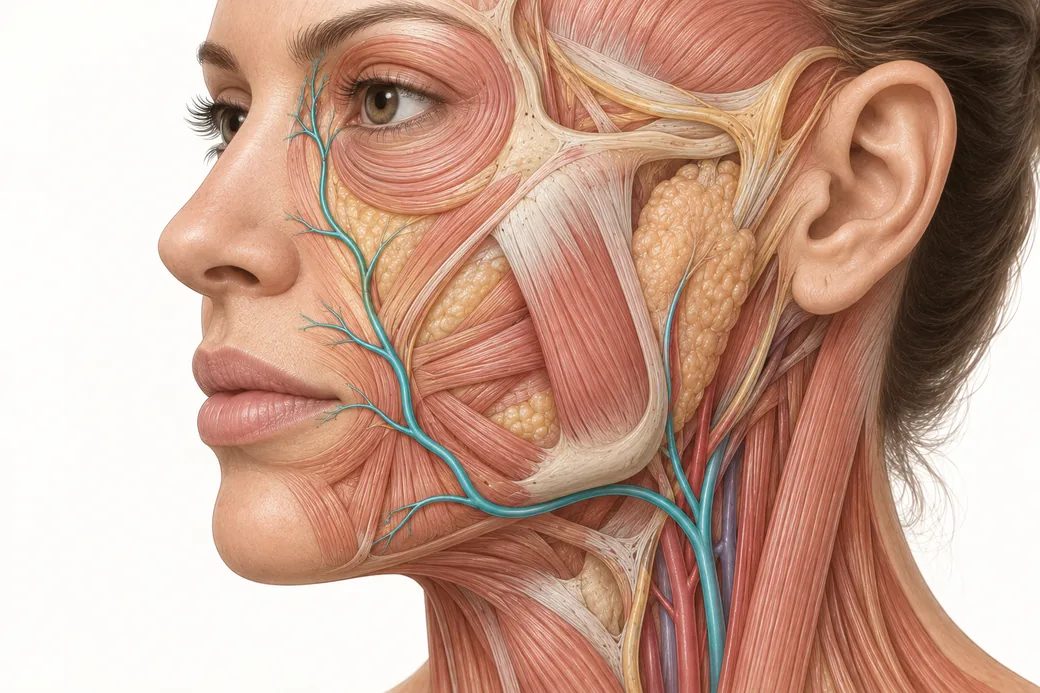 Clinical GuideThe Trigeminal Nerve Map: V1, V2, V3 and What Each Territory Buys YouA working trigeminal nerve map for injectors — what V1, V2 and V3 each cover, where the boundaries fail, and how the map decides which
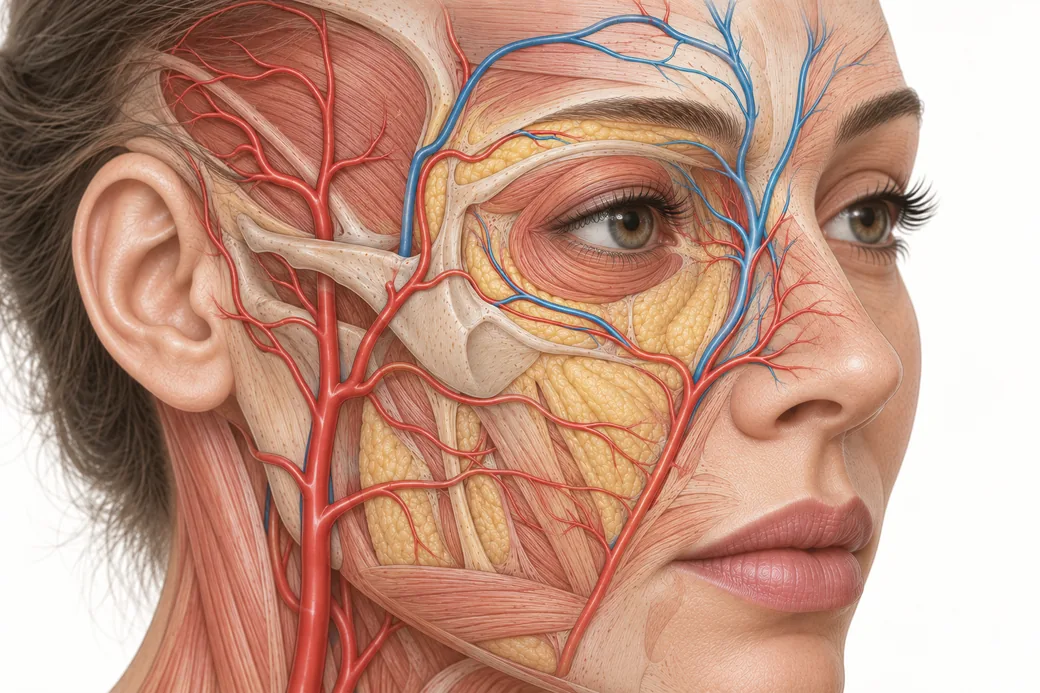 Clinical GuideThe Four Office Blocks and Their Gaps: Supraorbital, Infraorbital, Mental and the Greater Auricular ExceptionFacial nerve blocks an aesthetic practice can actually place — supraorbital, infraorbital and mental technique, the greater auricular e
Train with Empire
This guide is clinical education. The technique behind it is taught hands-on, on live patients, with faculty beside you.
Explore Complete Dermal Filler Training →Disclaimer
This article reflects the clinical opinions and experience of Dr. Jennifer Thomas-Goering, DO, MBA, an independent faculty member contributing to Empire Medical Training's curriculum. The views expressed are the author's own and do not necessarily represent those of Empire Medical Training.
It is professional education, not medical advice, and is no substitute for hands-on training or independent clinical judgment. Licensed clinicians remain responsible for their own patient selection, technique and outcomes, for verifying current product labelling, and for practising within their scope and applicable law. Empire Medical Training accepts no liability for reliance on this content.
 Claim Your Prize!