







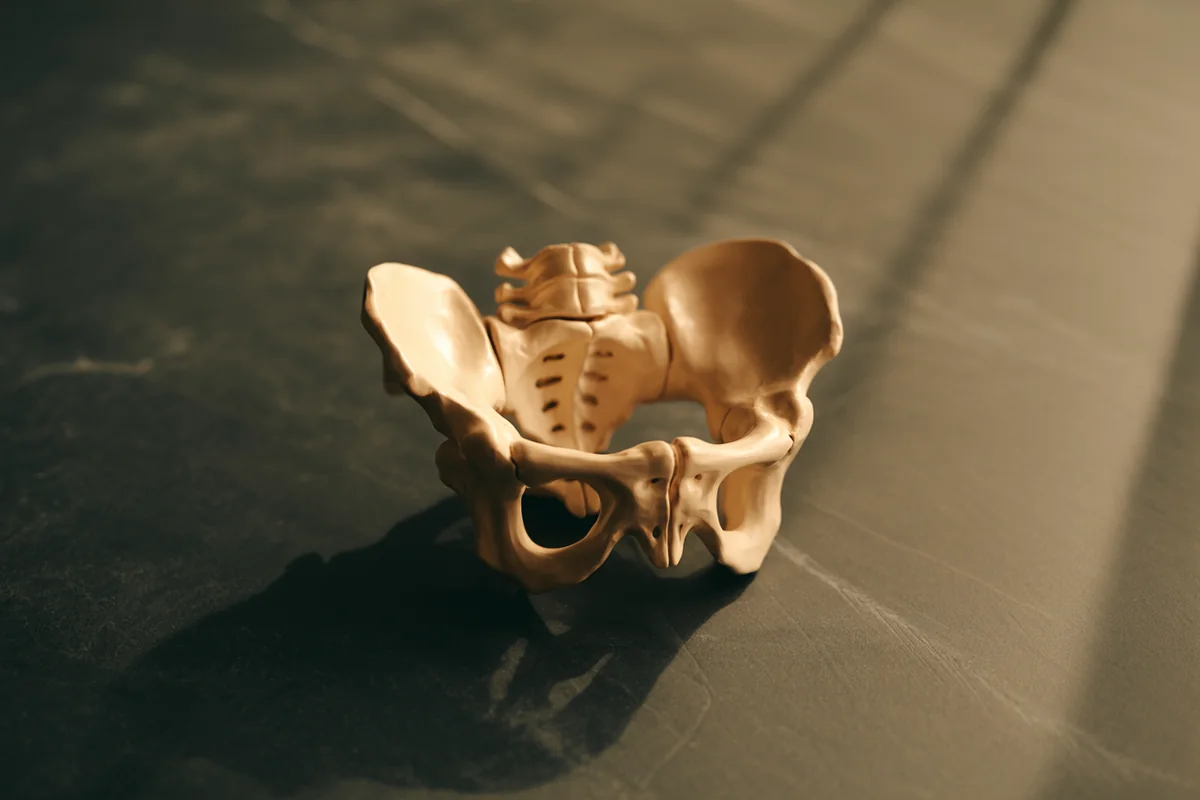

Piriformis syndrome is one of the most searched explanations for buttock and leg pain and one of the least common causes of it. Both of those things are true at once, and holding them together is what makes the diagnosis useful rather than a label applied to any sciatica without a disc to blame.
The starting point is that sciatica itself is not a diagnosis. As Dr. Larry Smith puts it, “sciatica is not a diagnosis, it is a finding” — it names leg pain from irritation of the sciatic nerve without saying what is irritating it. “It may be from a disc, could be from the piriformis, can be from degenerative arthritis.” Piriformis syndrome is one entry on that list, and the anatomy explains both why it happens and why it is rare.
This reference covers the anatomical variation behind the syndrome, how often it actually accounts for sciatica, how it is distinguished from myofascial and radicular pain, and what can be injected. It sits under our clinical reference to joint and extremity injection.
Where the sciatic nerve runs, and where the piriformis meets it
Dr. Robert Stall traces the course precisely, because the whole syndrome turns on one relationship along it.
The sciatic nerve originates from the anterior or ventral rami of the L4 to S3 spinal nerves. It passes inferiorly and exits the pelvis through the greater sciatic foramen. There, it passes deep to the piriformis muscle — underneath it.
It does not travel alone. Stall lists the structures accompanying it through that space: the posterior femoral cutaneous nerve, the pudendal nerve, the internal pudendal artery and vein, and the inferior gluteal nerve, artery and vein. The nerve continues into the thigh and terminates at the apex of the popliteal fossa, dividing into its two terminal branches, the tibial nerve and the common peroneal nerve.
In the ordinary arrangement, the muscle contracts and the nerve, lying beneath it, is untroubled.
The anatomical variation that causes piriformis syndrome
The syndrome depends on an anatomical variant rather than on an injury.
Stall describes it directly: there is a variation “in which the sciatic nerve pierces the muscle belly of the piriformis” rather than passing deep to it. In patients who have that arrangement, the muscle no longer lies over the nerve — it surrounds part of it. Contraction of the piriformis can then entrap the sciatic nerve, and it is that mechanism, in his framing, which gives rise to the so-called piriformis syndrome.
Estimates of how common the variant is range, in his summary of the literature, from 6.4% up to 16% of the general population depending on which source is consulted.
That figure is worth pausing on, because it also sets a ceiling. Most people with the variant never develop symptoms from it. Having the anatomy is a precondition, not a diagnosis.
How often piriformis syndrome actually explains sciatica
This is the number that should govern how readily the diagnosis is reached for.
Piriformis syndrome, Stall notes, is believed to contribute to anywhere from 0.3% to as much as 6% of clinical sciatica.
Even at the high end of that range, roughly nineteen out of twenty patients presenting with sciatica have something else causing it. The common alternatives are the ones Smith lists — disc, degenerative arthritis — along with spinal stenosis and lumbar facet or sacroiliac referral. Working through those first is not diagnostic caution for its own sake; it is playing the odds correctly.
Distinguishing piriformis pain from myofascial pain and radicular pain
Three different problems produce pain in the same region, and the pattern of radiation separates them more reliably than the location of tenderness does.
Dr. Gisele J. Girault gives the rule that does most of the work. In myofascial pain, she teaches, “you don’t get radiation beyond the buttocks or beyond the upper thigh. And that really kind of lets you know that it’s really more of a myofascial issue as opposed to a radicular or sciatic type issue.”
So the distribution sorts the possibilities:
- Pain confined to the buttock and upper thigh points toward myofascial pain — gluteal, sacroiliac or piriformis muscle pain, with trigger points the patient can usually localise precisely and which reproduce their pain on pressure
- Pain radiating past the knee in a dermatomal pattern points toward a radicular cause — a nerve root problem, not a muscle problem
- Pain radiating down the posterior lateral thigh is the pattern Girault associates with a piriformis-type problem on trigger point mapping
Smith lists the piriformis among the muscles whose strain contributes to low back pain in the first place — alongside the paraspinous muscles, quadratus lumborum, longissimus, the glutes and the hamstrings — which is why muscle and nerve explanations so often coexist in the same patient rather than competing.
Smith’s note on coding is a useful reality check on how the finding is recorded: sciatica “is an ICD-10. It’s in the code book” — lumbago with sciatica, left or right — which means a coded diagnosis of sciatica confirms the symptom was documented, not that its cause was identified.
What is injected, and what the injection is aimed at
Because the target is a nerve compressed by a muscle, the approaches used are those that reach the sciatic nerve and the sacral plexus rather than the piriformis alone.
Stall teaches infiltration of the sciatic nerve and sacral plexus via the parasacral and infragluteal techniques, and is careful about what they are for: these approaches “can help with a variety of causes of pain in the low back, buttock and posterior thigh including piriformis syndrome.” The technique is not specific to the diagnosis, which is an honest reflection of how uncertain the diagnosis often is.
Where the presentation is myofascial, Girault’s approach is trigger point injection into the point the patient localises, which reproduces their pain on palpation. That technique is covered in trigger point injections.
For the same buttock and posterior thigh region approached from the manual therapy side, see manipulation for sciatica, which sets out which causes of leg pain manipulation can reach and the threshold at which a patient should be referred instead.
When the leg pain needs investigating rather than treating
The reason the odds matter is that the more common causes of sciatica include some that are time-sensitive.
Progressive weakness, foot drop, numbness in the saddle region, or any change in bladder or bowel control are not features of a muscle compressing a nerve in the buttock and should be evaluated urgently. The red flags that stop conservative management are set out in contraindications and red flags.
Where the question is whether a nerve is genuinely failing and at what level, electrodiagnostic testing answers a physiological question that imaging cannot: a disc bulge on an MRI is extremely common in people with no symptoms, while a nerve study shows whether the nerve is actually conducting.
For clinicians
Sciatic and sacral plexus infiltration is proximity work around a large nerve and its accompanying vessels, learned under supervision on live anatomy. This reference carries no needle depths or trajectories for that reason. Empire teaches the gluteal and posterior thigh approaches alongside trigger point technique across the pain management academy.
Learn blocks with your hands, not from a page
Empire’s Pain Management Training (THE Pain Show) is accredited for 25.25 AMA PRA Category 1 Credits™, jointly provided by AKH, Inc, and Empire Medical Training. For narrower peripheral work, Joint, Extremity and Non-Spinal Injection Training carries 6.75 credits for the complete in-person hybrid program, and Advanced Musculoskeletal Ultrasound Guided Injections builds the guidance skills above.
Explore THE Pain Show Claim Your Prize!