







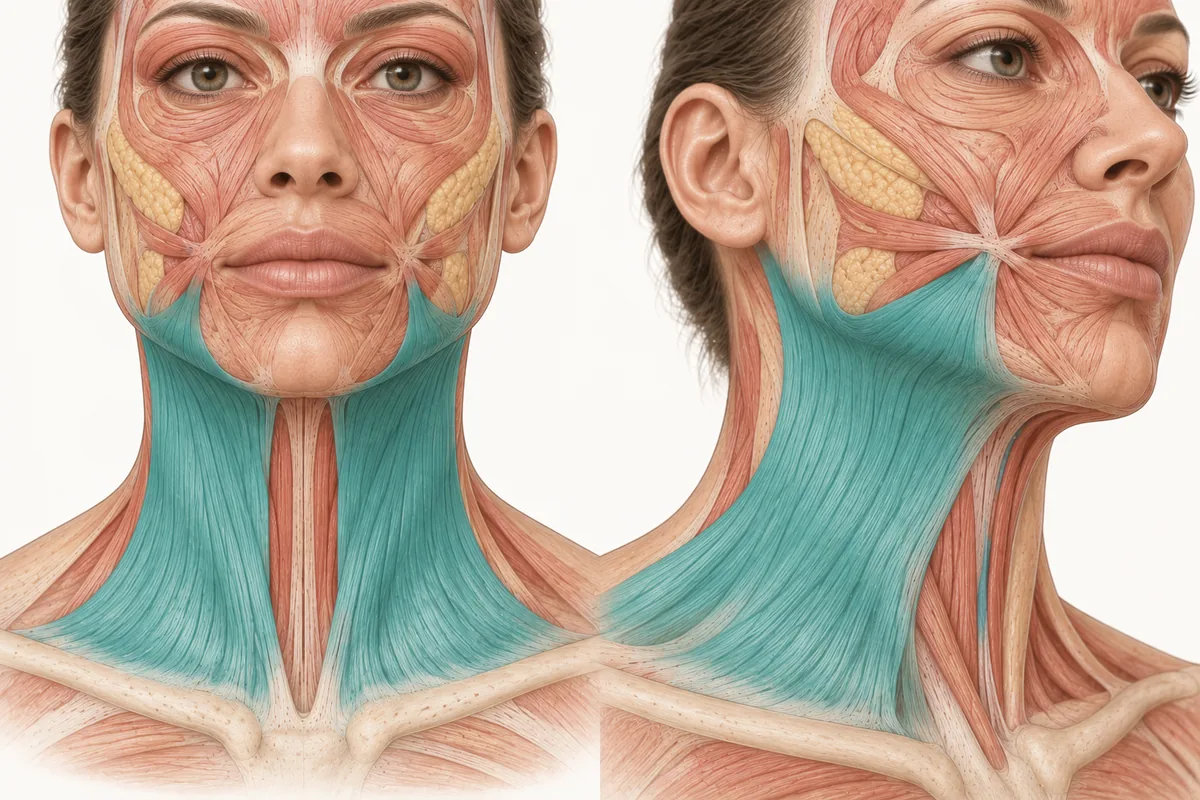
Knowing who should not get deoxycholic acid is worth more to your practice than knowing how to inject it. The injection technique is learnable in a weekend. Negative selection is the skill that takes years to acquire and it is the one that decides whether your submental cases end in gratitude or in a refund conversation.
You have to be very selective. The drug works in fat compartments — that is the whole of its mechanism and the whole of its limitation. Every poor outcome I have seen or been asked to salvage traces back to a neck that looked full for a reason that was not supraplatysmal fat.
Maritza Mejia, FNP — family nurse practitioner; faculty member, Empire Medical Training; founder of Long Island Beauty Bar, New York.
The One Absolute Deoxycholic Acid Contraindication
The FDA label carries exactly one contraindication: the drug is contraindicated in the presence of infection at the injection sites. That is it. Everything else in this article is clinical judgement, and clinical judgement is where the failures live — because a label with one contraindication reads, to an under-trained injector, like a label with no barriers.
The label does add explicit cautions that function as near-contraindications in practice:
- Excessive skin laxity. The label directs careful consideration, because reduction of submental fat may produce aesthetically undesirable results.
- Pre-existing dysphagia. Swallowing difficulty occurred in trials in the setting of administration-site reactions.
- Antiplatelet or anticoagulant therapy, or coagulation abnormality. Injection-site hematoma or bruising occurred in 72% of treated subjects.
- Prior surgical or aesthetic treatment of the submental area. Altered landmarks and scar tissue can affect both safety and outcome.
- Other causes of submental convexity. The label instructs screening for thyromegaly and cervical lymphadenopathy specifically.
- Anything outside the submental region. Safe and effective use for subcutaneous fat elsewhere has not been established and is not recommended.
That list is the floor. Here is the ceiling.
The Ideal Deoxycholic Acid Candidate, Stated Positively
An ideal candidate has moderate to severe convexity or fullness arising from submental fat, in a neck where that fat is the dominant contributor, with skin that will retract over a smaller volume, without prominent bands, without a ptotic gland driving the silhouette, with realistic expectations and a tolerance for several weeks of visible swelling.
Every "not a candidate" below is a failure of one of those clauses.
Poor candidate 1: skin laxity is the primary problem
This is the commonest miss, and it is the one patients are least equipped to self-diagnose. They point at a fullness under the chin and call it a double chin. Some of those necks are full of fat. Some are envelopes with nothing left to fill them.
Fat reduction in a lax neck removes content from an envelope that is already too large. The drape does not improve. In some patients it declares itself more clearly, and the patient — who came in with a "double chin" and left with a visible crepey fold — will tell you the treatment did that to them.
The published data are actually reassuring on one point and unhelpful on another. In a 12-month open-label study (Beer et al., Journal of Drugs in Dermatology, 2019; PMID 31524342), 82.9% of subjects had unchanged skin laxity at 12 months relative to 12 weeks after the final treatment, and 10.1% had improved laxity. So laxity does not reliably worsen. But it also does not reliably improve, and "unchanged laxity" in a patient whose dominant complaint was laxity is a failed consultation regardless of how the fat responded.
The tell: a thin pinch. If the fold you can lift is essentially skin, this is a drape problem. The hand-off: tightening and lifting modalities. Thread lifting for a double chin is the alternative modality most patients will have heard of and the one worth understanding properly before you refer — including how long a thread lift actually lasts, because that is the first question they will ask you. Energy-based tightening and surgical options belong in the same conversation.
Poor candidate 2: prominent platysmal bands
Platysmal bands are a muscular phenomenon. They are vertical cords produced by the medial edges of the platysma, and they become prominent on animation and on neck extension. No amount of fat reduction addresses a muscular band — and removing the fat that partly camouflaged it can make it more conspicuous.
This is a patient who will look at a technically successful result and see two cords they had not noticed before.
Bands are a neuromodulator problem, not a cytolysis problem, and the relevant technique is chemodenervation of the platysma rather than anything you can do with a fat-reduction agent. Empire's dedicated platysma anatomy and neurotoxin material covers the band explanation properly — the muscle's origin and insertion, why the medial edges cord, and how the lower-face pull is redistributed — and that is where I would send an injector who wants to understand bands rather than just recognise them. For orientation to neurotoxin site selection generally, start with Botox injection sites.
The tell: ask the patient to grimace, or to tense the neck deliberately, and watch the midline. Cords that appear on animation and disappear at rest are bands. The hand-off: neurotoxin, and often neurotoxin first — a patient whose bands are softened may then be a reasonable fat-reduction candidate, in that order.
Poor candidate 3: the fullness is not fat at all
A convex submental region can be produced by at least five things that are not supraplatysmal fat:
Subplatysmal fat. Cadaver data (Larson et al., Aesthetic Surgery Journal, 2014; PMID 24633742) put supraplatysmal fat at an average of 44.7% of neck fat, subplatysmal fat at 30.7%. A subcutaneous injection does not reach the deep compartment, and should not be aimed there.
A ptotic submandibular gland. The same study attributed 24.5% of neck "fat" volume to the submandibular gland. A gland sitting low is firm, lobulated, lateral and inferior to the mandibular angle, and does not lift into a pinch. It is also a structure the label explicitly instructs you not to inject into or within 1–1.5 cm of.
A low or anteriorly positioned hyoid. A high hyoid gives you a crisp cervicomental angle almost regardless of fat; a low one blunts the angle almost regardless of how much fat you remove. This is skeletal and it is not modifiable by injection. It belongs in the consent conversation as a ceiling on the achievable result.
Thyromegaly or cervical lymphadenopathy. The label names both. These are medical findings that require a medical answer before they require an aesthetic one.
Retrognathia or a deficient chin projection. A recessed mandible shortens the perceived neck and creates apparent submental fullness at any fat volume. The answer is projection, not subtraction.
The tell: dynamic examination and palpation. Firm, lobulated, discrete, fixed or non-pinchable tissue is not the target. The hand-off: varies by cause — medical work-up, surgical consultation, chin augmentation, or an honest conversation about an anatomical ceiling.
Poor candidate 4: the jowl that is ptosis, not fat
This one deserves its own heading because the drug does work off-label in jowls and the distinction is easy to get wrong.
Ready to put this into practice?
Explore Empire's hands-on, CME-accredited Aesthetic & Injectable Training courses — live patients, expert faculty, and ongoing mentorship.
A systematic review of serious adverse events with deoxycholic acid injection (Shridharani et al., Aesthetic Surgery Journal Open Forum, 2024; PMID 39247122) makes the point sharply: surgery is preferable for jowling caused by compartment displacement — that is, ptosis — whereas fat-reducing treatments are contraindicated for jowling caused by subcutaneous tissue atrophy. Reducing fat in a jowl that is descending rather than expanding, or in a face that is deflating, accelerates the appearance it was meant to fix. And the prospective jowl study from the same group (PMID 32221205) enrolled only patients with pinchable jowl fat and relatively minimal laxity.
The tell: is the jowl full, or has it fallen? Is the midface deflating? The hand-off: lifting or volumising, not subtracting.
Poor candidate 5: the expectation, not the anatomy
Some patients are anatomically ideal and clinically unsuitable.
The patient who wants weight loss. This is not a weight loss treatment, and the pharmacokinetics say so — a maximum single dose produces a transient rise in a bile acid the patient already circulates, back to baseline within 24 hours, with no systemic lipolytic effect.
The patient who wants one session. Trial subjects received up to six treatments at intervals of no less than one month, and ≥2-grade improvement was achieved by only 13.4%–18.6%.
The patient who cannot accept visible swelling. In the pivotal trials, 87% of treated subjects had injection-site oedema or swelling, and swelling lasting more than 30 days occurred in 20%. A patient with a wedding in three weeks is not a candidate this month.
The patient with pre-existing dysphagia, or on anticoagulation they cannot pause safely, or with an active infection in the field.
Referring a Deoxycholic Acid Patient On Is a Clinical Skill
Declining to treat is not the end of a consultation. Done badly it is a rejection; done well it is the most trust-building thing that happens in the room. The way I structure it:
Name what you found, in their language. "The fullness here is mostly loose skin rather than fat." Patients almost never resent an explanation. They resent being told no without one.
Explain why the drug cannot fix it — mechanistically, briefly. "This medication dissolves fat cells. It has no effect on skin. If I use it here I will take away something you do not have much of and leave the skin exactly as it is."
Say what would work. Even if you do not offer it. Especially if you do not offer it.
Offer the sequenced plan where one exists. Bands first, then fat. Tightening first, then reassess. Many "no" patients are "not yet" patients, and sequencing converts them.
Document the decision and the reasoning. The note that says why you did not treat is as protective as the note that says why you did.
Refer by name, not by category. "You need a surgeon" is a dead end. A named colleague who returns the patient to you for the injectable part of their plan is a referral relationship.
The practices that grow are not the ones that treat everybody. They are the ones patients trust to tell them the truth about what their neck actually is.
These figures reflect Maritza Mejia's clinical practice as taught in Empire Medical Training's hands-on curriculum, together with the current FDA prescribing information and the published literature cited above. Technique is learned under supervision; this article is educational and is not a substitute for training.
Injectors who want to work through candidate selection on live patients under faculty supervision can find that in Empire's Kybella and Mesotherapy Training. For the laxity-dominant and mixed necks that fail the fat test, the Neck & Hands Rejuvenation Master Course and Advanced PDO Thread Lift Training cover the modalities you will be referring to — or adding.
Frequently Asked Questions
What is the only absolute contraindication to deoxycholic acid injection?
The FDA label lists one: the presence of infection at the injection sites. Everything else — excessive skin laxity, pre-existing dysphagia, anticoagulant therapy, prior submental surgery, thyromegaly, cervical lymphadenopathy — appears as a caution or a screening instruction requiring clinical judgement rather than as an absolute bar.
Can deoxycholic acid make loose skin look worse?
It generally does not worsen measured laxity — a 12-month study found 82.9% of subjects unchanged and 10.1% improved. But reducing fat in a neck whose dominant problem is laxity removes what was filling the envelope, and patients frequently perceive the remaining drape as a new problem. The label directs careful consideration in patients with excessive skin laxity for this reason.
Does deoxycholic acid treat platysmal bands?
No. Bands are produced by the medial edges of the platysma muscle and are a chemodenervation problem, not a fat problem. Reducing submental fat can make pre-existing bands more visible by removing the tissue that partly camouflaged them. Patients with prominent bands are usually treated for the bands first and reassessed for fat afterwards.
How do you tell a ptotic submandibular gland from submental fat?
The gland is firm, often lobulated, sits below and behind the mandibular angle rather than in the midline, and does not lift into a pinch. Fat is soft, compressible, and folds between the fingers. The distinction matters because the label instructs that the drug not be injected into or within 1–1.5 cm of salivary glands.
Should patients with a low hyoid be treated?
They can be, if genuine pinchable submental fat is present — but the hyoid position sets a ceiling on the achievable cervicomental angle that no amount of fat reduction changes. This belongs in the consent conversation before treatment, not in the explanation afterwards, and it is often the reason a technically good fat reduction produces a disappointed patient.
Disclaimer
This article reflects the clinical opinions and experience of Maritza Mejia, FNP, an independent faculty member contributing to Empire Medical Training's curriculum. The views expressed are the author's own and do not necessarily represent those of Empire Medical Training.
It is professional education, not medical advice, and is no substitute for hands-on training or independent clinical judgment. Licensed clinicians remain responsible for their own patient selection, technique and outcomes, for verifying current product labelling, and for practising within their scope and applicable law. Empire Medical Training accepts no liability for reliance on this content.



 Claim Your Prize!