







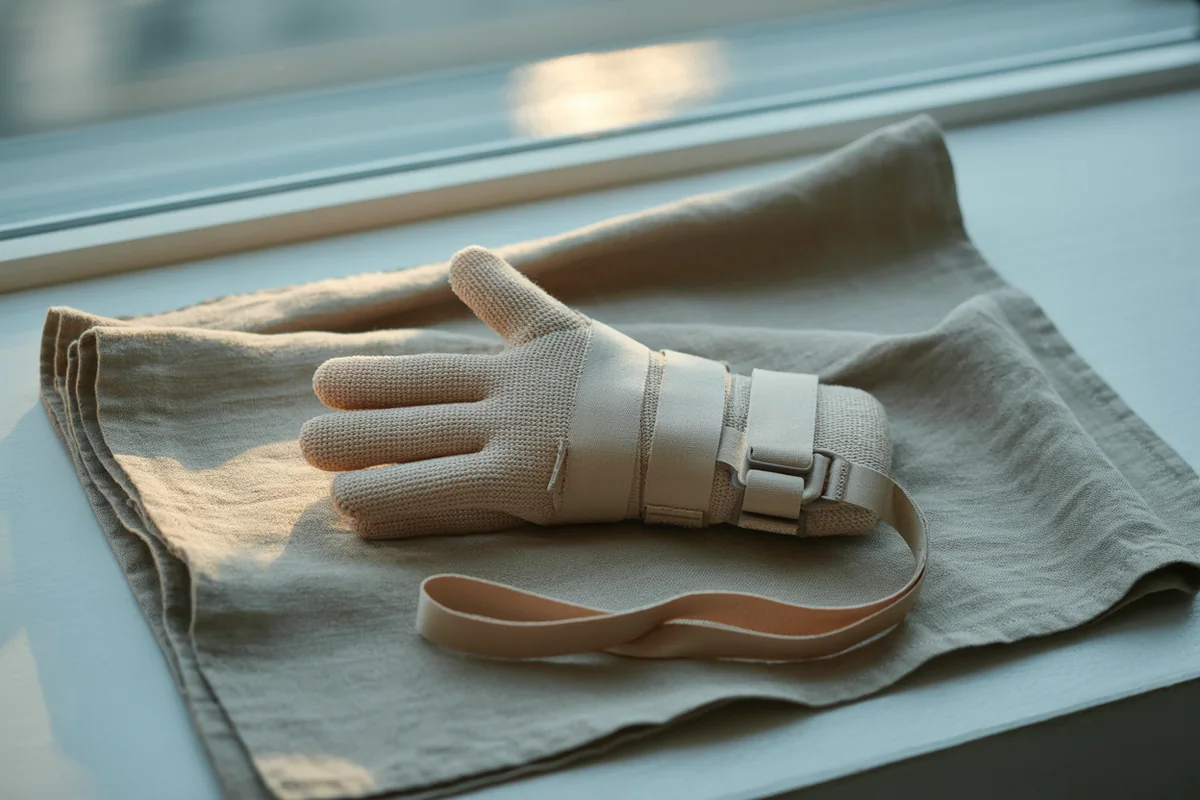

De Quervain’s tenosynovitis is usually described as a tendon problem, and anatomically it is: thickening and irritation of the sheath containing the abductor pollicis longus and extensor pollicis brevis tendons as they pass through the first dorsal compartment at the radial side of the wrist. Thumb movement and ulnar deviation reproduce the pain, which is what Finkelstein’s test is designed to provoke.
What this reference adds is a different treatment target for the same condition. In perineural injection therapy, the site treated is not the tendon sheath but the sensory field of the nerve supplying that skin — an approach Dr. Robert Stall teaches, and one that explains why some patients respond to a first attempt and others need a second nerve treated entirely.
This reference sits under our clinical reference to regenerative pain medicine.
Treating the sensory field rather than the structure
The organising idea behind perineural injection therapy is that injection sites are chosen by symptom distribution relative to a nerve’s territory, and Stall is careful to distinguish that territory from the one most clinicians think in.
A sensory field is one nerve or nerve trunk and the skin it supplies. A dermatome is the area of skin supplied by a single spinal nerve. They are not the same map, and the difference matters because treatment is directed at a peripheral nerve rather than at a root.
Crucially, Stall notes that in the sensory fields “there is anatomical variation between individuals in terms of what the sensory area or sensory field is.” Individual variation is not a footnote in this model — it is the reason the same diagnosis can require different nerves to be treated in different patients.
The technique itself, and the evidence behind sterile 5% dextrose as the injectate, are covered in perineural injection therapy.
The radial nerve is the first target
Stall is specific about which branch is used. For de Quervain’s tenosynovitis, the branch treated is the posterior antebrachial cutaneous branch of the radial nerve.
That choice follows the anatomy of the complaint: the radial side of the wrist and the base of the thumb fall within the radial nerve’s cutaneous territory, so a friction or impingement point along that nerve can present as pain in exactly the distribution a first-compartment problem occupies.
Stall also maps where along the radial nerve those points tend to sit — the entry and exit points of the radial tunnel, with a more distal point representing potential impingement by the pronator quadratus. The same nerve is one of the two implicated in lateral elbow pain, which is why the two conditions are so often taught together and occasionally coexist in the same arm.
When the radial nerve does not resolve it
This is the part of the teaching with the most practical value, because it converts a treatment failure into a next step rather than a dead end.
Stall’s instruction is explicit: “if patients with de Quervain’s tenosynovitis do not respond to treatment of the radial nerve, treat the musculocutaneous nerve. Some patients have anatomical variation in their cutaneous innervation.”
The musculocutaneous nerve is responsible for cutaneous innervation of the lateral forearm. It enters the arm passing inferior to the coracoid process and through the coracobrachialis muscle, and it can become entrapped where it passes through that muscle. Stall also identifies a friction point over the lateral aspect of the upper arm, a few centimetres proximal to the elbow crease, between the biceps and the brachioradialis.
In a patient whose cutaneous innervation is arranged so that the musculocutaneous nerve covers territory the radial nerve covers in most people, treating the radial nerve addresses the wrong field — and the failure is a mapping error rather than a failure of the technique.
Assessing both nerves before treating either
Stall’s recommendation is to identify the possibility in advance rather than discover it after a course of treatment has failed.
His phrasing is about time: in order to avoid treatment delays, assess the brachial plexus impingement manoeuvres to evaluate both the radial and musculocutaneous nerves for evidence of impingement before committing to one.
For a condition that is often months old by the time it is treated, a patient who has already tried splinting and activity modification has limited patience for a course of injections aimed at the wrong nerve. Examining both first costs one visit and can save several.
Where this sits alongside conventional treatment
Nothing in this approach displaces the standard management of de Quervain’s. Thumb spica splinting, activity modification and corticosteroid injection of the first dorsal compartment remain the usual first line, and the compartment injection has a good record in this diagnosis specifically.
The perineural approach is relevant in two situations: where the conventional injection has been tried without durable benefit, and where the clinician prefers to avoid repeated corticosteroid around a superficial tendon sheath — a legitimate concern given the subcutaneous fat atrophy and skin depigmentation that can follow steroid injection at this site.
Stall lists de Quervain’s among the upper extremity conditions perineural injection therapy is used for, alongside shoulder, elbow and hand pain, trigger fingers, and the entrapment neuropathies including carpal tunnel and ulnar nerve entrapment. In the one head-to-head comparison he cites, at the elbow rather than the wrist, sterile 5% dextrose injection was found more effective than corticosteroid for ulnar nerve entrapment — a result that is the reason the approach is worth knowing about at other entrapment sites too. The ulnar case is covered in cubital tunnel syndrome.
For clinicians
Perineural injection is a palpation-driven technique in which finding the treatment points is most of the skill, and it is learned hands-on under supervision. This reference carries no injection volumes or depths for that reason. Empire teaches perineural injection therapy and the upper extremity nerve maps across the pain management academy.
Learn blocks with your hands, not from a page
Empire’s Pain Management Training (THE Pain Show) is accredited for 25.25 AMA PRA Category 1 Credits™, jointly provided by AKH, Inc, and Empire Medical Training. For narrower peripheral work, Joint, Extremity and Non-Spinal Injection Training carries 6.75 credits for the complete in-person hybrid program, and Advanced Musculoskeletal Ultrasound Guided Injections builds the guidance skills above.
Explore THE Pain Show Claim Your Prize!