







 Medically reviewed by
Mark Tager, MD
Integrative & Functional Medicine Physician; Author, ‘Feed Your Skin’
Medically reviewed by
Mark Tager, MD
Integrative & Functional Medicine Physician; Author, ‘Feed Your Skin’ Omega-3 fatty acids occupy an unusual place in clinical nutrition. They are fats — a category long over-vilified for its association with cardiac disease — yet the body genuinely needs them, cannot manufacture them, and uses them to build the membranes of nearly every cell, including the skin cells a clinician sees every day. For providers working in aesthetics and healthy aging, omega-3s are one of the clearest examples of how a dietary input translates into a visible, clinical outcome: a stronger skin barrier, calmer inflammation, and better tissue repair.
This guide is part of Empire's Precision Nutrition resource center and draws on the clinical reasoning Dr. Mark Tager teaches in his course curriculum. It is educational content for clinicians, not medical advice, and nothing here is a protocol, dose, or substitute for individualized clinical judgment.
Why omega-3s are “essential”
The word essential in nutrition is precise, not promotional. An essential fatty acid is one the body cannot synthesize on its own, so it must be supplied in the diet. Omega-3 and omega-6 fatty acids both meet that definition. As Dr. Tager frames it in the course, fats in general have been over-vilified, largely because of their association with cardiac disease — but the body needs fat. Fats are a major source of energy, they enable absorption of the fat-soluble vitamins, and they are a key fuel for the brain.
What makes omega-3s clinically interesting is where they end up. These fats wrap around and protect nerve cells — the basis of nerve myelination — and they are essential for the integrity of the skin, where they help with barrier protection and tissue repair. In other words, they are not stored away as inert energy; they become structural and functional components of the tissues a clinician is trying to support. That is the throughline of this entire guide.
EPA, DHA, and ALA: the three that matter
Omega-3 is not a single molecule but a family. Three members carry most of the clinical weight:
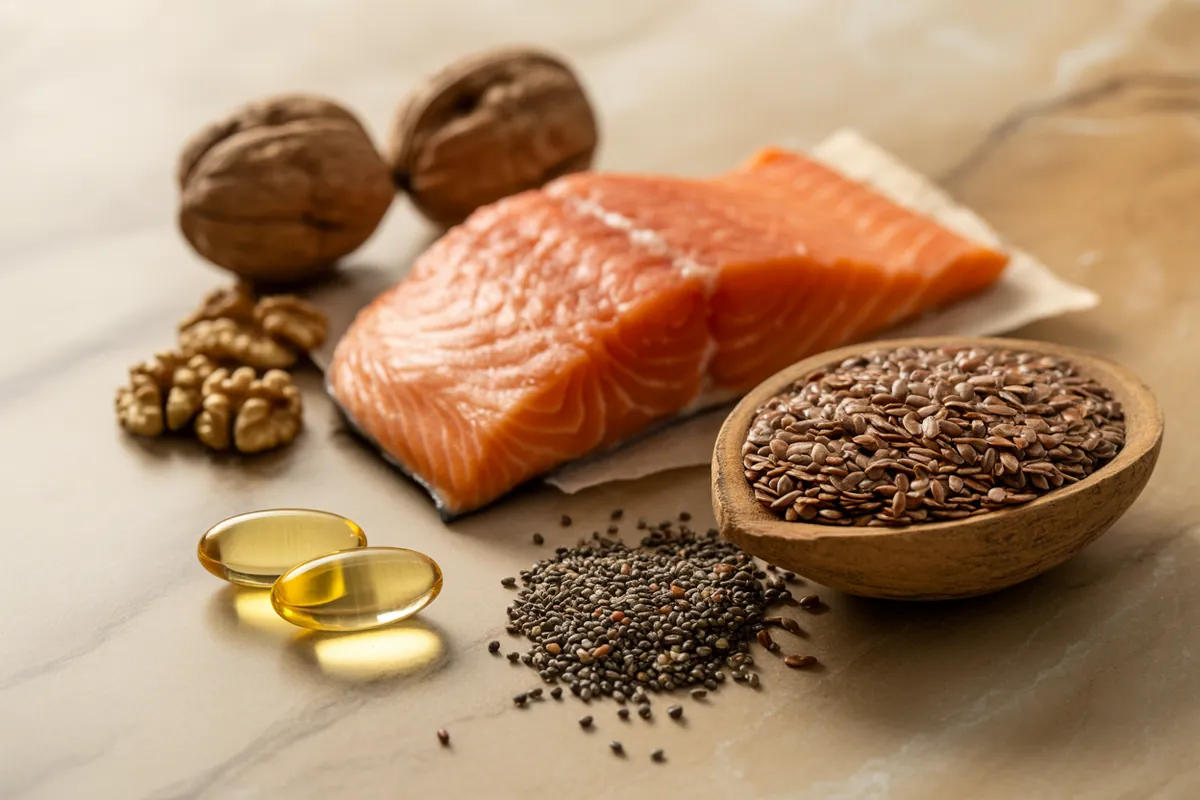
- ALA (alpha-linolenic acid) — the plant-derived omega-3, found in ground flaxseed, chia seeds, and walnuts. It is the form most people get from a non-fish diet.
- EPA (eicosapentaenoic acid) — a longer-chain marine omega-3, central to the pathways that resolve inflammation.
- DHA (docosahexaenoic acid) — the other major marine omega-3, heavily concentrated in neural tissue and a structural mainstay of cell membranes.
The practical wrinkle is conversion. The body can elongate ALA into EPA and DHA, but it does so inefficiently, and some patients carry genetic variants that further limit their ability to produce these longer-chain polyunsaturated fatty acids — a point that overlaps with nutrigenomics and personalized nutrition. This is why marine sources (fatty fish) and, when appropriate, supplementation tend to dominate the conversation about EPA and DHA, even though plant ALA is valuable in its own right. Dr. Tager's clinical point is blunt: it is important to have the right type of omega-3 as well as the right amount.
Omega-3s and the skin barrier
If there is one image worth keeping from this topic, it is Dr. Tager's: the omega-3 fatty acids make up a big part of the glue holding the epidermis together — the outer layers of the skin. Incorporated into the lipid matrix of cell membranes and the stratum corneum, they help the barrier hold water in and keep irritants out. Clinically, that shows up as reduced transepidermal water loss and better-hydrated, less reactive skin.
The course points to a plausible mechanistic story supported by small human studies: daily flaxseed oil consumption has been associated with improvements in transepidermal water loss and skin sensitivity, and a balanced omega-6 to omega-3 hemp seed oil has been studied in individuals with atopic dermatitis with reported improvement. These are modest, mechanistically coherent signals — not a promise that fish oil will transform anyone's skin — and they sit alongside the dermatologic clue Tager teaches: dry, flaky skin can indicate a fatty-acid imbalance or deficiency, and the dry-hair, dandruff, and nail findings that point the same direction. For the broader picture of how diet shapes the skin, see our overview of nutrition for skin health.
There is also a useful “inside-and-outside” framing for aesthetic practice. Essential fatty acids fortify the barrier from within, while topical barrier lipids such as ceramides — large molecules that stay within the stratum corneum — reinforce it from the surface. Combining the two is, in Tager's words, a good one-two punch, particularly post-procedure.
Resolving inflammation, not just suppressing it
Omega-3s do more than sit in membranes; they are substrate for the molecules that resolve inflammation. EPA and DHA are converted into specialized pro-resolving mediators that help bring an inflammatory response to an orderly close. This is conceptually different from simply blocking inflammation with a drug — it is about supporting the body's own off-switch.
That matters for the skin because so much of what ages and irritates it is low-grade, chronic inflammation, a process Tager threads through the whole curriculum alongside glycation and barrier dysfunction. Practically, he counsels education before supplementation: before recommending anti-inflammatory OTCs or herbal agents like curcumin or fish oil, first teach patients which foods to limit — refined carbohydrates and the rest of the pro-inflammatory pattern. Omega-3s are one lever within a larger anti-inflammatory diet, and food-first sequencing is the honest order of operations. Because inflammatory tone is also shaped in the gut, this connects naturally to gut health and the short-chain fatty acids the microbiome produces.
The omega-6 to omega-3 ratio, handled honestly
Here is where clinical nutrition needs candor. Both omega-3 and omega-6 are essential; one is not “good” and the other “bad.” As Tager puts it, that framing is a gross oversimplification — we need both, and what really matters is the balance. The problem is that modern diets have tipped heavily toward omega-6, driven by industrialized plant oils — corn, soybean, sunflower, safflower, cottonseed, grapeseed, and sesame oils — that became cheap, shelf-stable, and heavily marketed as “heart healthy.” The result is that patients can present with omega-6 to omega-3 ratios of ten, fifteen, or more.
A high ratio is associated with a more pro-inflammatory state, so improving the balance is a reasonable clinical goal. The honest caveat — and the place where a lot of nutrition content overclaims — is that no single exact target ratio is firmly established as the one number to chase. The defensible move is directional, not numerical: raise omega-3 intake and reduce refined seed-oil intake. Tager's metaphor is apt — if the body were a car, this is an “oil change,” shifting the balance of fats toward healthier oil rather than fixating on a precise reading. A consumer fingerstick omega-3 index can give a patient a tangible number to track, but it is a motivational and monitoring tool, not a diagnostic mandate.
Food sources: a Mediterranean foundation
Food first is the rule, and the pattern Tager recommends is unmistakably Mediterranean. He encourages patients to eat more foods rich in essential fatty acids and gives concrete, repeatable habits rather than abstractions:
- Fatty fish — salmon, mackerel, sardines, and anchovies are the richest sources of EPA and DHA.
- Extra-virgin olive oil — used on bread instead of butter and applied generously to salads; rich in monounsaturated fat that helps lower LDL cholesterol.
- Avocados — a whole-food contributor to a healthy fat profile.
- Ground flaxseed, chia, and walnuts — plant ALA sources, with ground flax sprinkled onto oatmeal or salads as an easy daily habit.
The Mediterranean diet earns its reputation here precisely because it is built on these fats: monounsaturated fat from olive oil and omega-3s from fish, which together support a healthier lipid profile and a calmer inflammatory baseline. This is the substrate; supplements come second.
Supplement quality, oxidation, and drug interactions
When diet alone does not close the gap, supplementation is reasonable — but omega-3 supplements demand more scrutiny than most. The defining problem is oxidation. Fats subjected to oxidation turn rancid, and if the omega-3 oils are not well protected in their packaging and storage, they degrade. A rancid fish oil is worse than no fish oil, and patients cannot always tell. This is the strongest argument for professional-grade products that carry meaningful quality controls.
Tager teaches a clear quality checklist without selling a brand. Look for third-party verification from organizations such as ConsumerLab, NSF, or U.S. Pharmacopeia (USP), and for a certificate of analysis performed by an independent lab confirming identity, purity, and composition — so that if the label says a given amount of EPA and DHA, that is genuinely what is in the bottle. (In the interest of disclosure, Dr. Tager openly notes that he consults for a supplement company; the course, and this guide, teach a vendor-neutral framework rather than endorsing any product.)
Safety also includes the prescriber's pharmacology lane. High-dose fish oil can have a mild blood-thinning effect. Tager's standing instruction is to stop fish oil — along with vitamin E and anything else that can interfere with coagulation — before any procedure with bleeding risk, the same way one would manage aspirin and other NSAIDs. By the same logic, high-dose omega-3 warrants caution alongside anticoagulants such as warfarin, and these decisions belong to the treating clinician. And as with all supplementation, more is not automatically better — the goal is to correct an inadequacy intelligently, not to megadose. Where IV-delivered antioxidant support enters the picture, see our overview of glutathione IV therapy.
Putting omega-3s to work in practice
For a clinician, omega-3s are an ideal entry point into precision nutrition because the conversation is concrete and the patient can feel the logic. Tager's own scripting connects a visible finding to a mechanism to an action: noticing the dryness, the irritation, the breaking-down barrier, then explaining that omega-3s are the most important element for skin barrier protection, then asking whether the patient is already taking them and recommending a professional-grade source if not. It is education, not a hard sell.
The discipline is to stay in the lane nutrition occupies: it supports but does not replace medical diagnosis and treatment. Persistent or severe symptoms — unintended weight loss, signs of significant deficiency, or anything suggesting a systemic problem — warrant a proper medical work-up, not a supplement. Used within those bounds, omega-3s are one of the most evidence-grounded, low-drama tools in the precision nutrition toolkit. The full clinical assessment, individualization, and program-building — including how to evaluate fatty-acid status and integrate it with the rest of a plan — is what Empire's Precision Nutrition training is built to teach. You may also want to round out the foundation with micronutrients — vitamins and minerals.
Bring precision nutrition into your practice
Empire Medical Training's Precision Nutrition Master Training, developed by integrative and functional medicine physician Dr. Mark Tager, MD, teaches the science of fats, the skin barrier, and inflammation — plus assessment, supplementation, and the business models to offer it. Learn to translate nutrition into visible clinical results.
Explore the Precision Nutrition Training → Claim Your Prize!