






 Medically reviewed by
Mark Tager, MD
Integrative & Functional Medicine Physician; Author, ‘Feed Your Skin’
Medically reviewed by
Mark Tager, MD
Integrative & Functional Medicine Physician; Author, ‘Feed Your Skin’ Nutrigenomics is the part of precision nutrition that explains why a single “healthy diet” never fits everyone equally. Two patients can eat the identical meal and handle it differently — absorbing, transporting, and metabolizing the same nutrients along slightly different routes — because their genes are not identical. For clinicians working in skin health and healthy aging, this is the bridge between a generic recommendation and a genuinely individualized plan. It is also a field rife with over-promising, so the goal of this guide is to teach the real science honestly: what genomic testing can tell you, what it cannot, and where it is routinely over-read.
This guide sits within Empire's Precision Nutrition resource center and is written for clinicians. It is clinical education, not medical advice, and nothing here is a treatment protocol, a testing recipe, or a substitute for individualized clinical judgment.
Nutrigenetics vs. nutrigenomics
The science has two halves that are easy to confuse. As Dr. Mark Tager frames it in Empire's course, nutrigenetics is how genetic variations impact our response to nutrition — the way your particular genome shapes how you absorb, transport, and metabolize what you eat. Nutrigenomics is the mirror image: how food and nutrients impact gene expression. In casual use, “nutrigenomics” has become the umbrella term for both, and we use it that way here, but the distinction matters clinically because the two halves answer different questions. One asks what does this patient's biology need more or less of? The other asks how is what this patient eats changing how their genes behave?
That second question is the more hopeful one. Some genes are fixed at the moment of conception and set for life — eye color, certain hereditary diseases. Those are deterministic. But many genes that produce important proteins and run countless metabolic processes are turned on or off by diet, environment, and lifestyle. That is the practical promise of the field: nutrition is not just something a fixed genome processes, it is an input that can change which genes are active.
SNPs explained simply
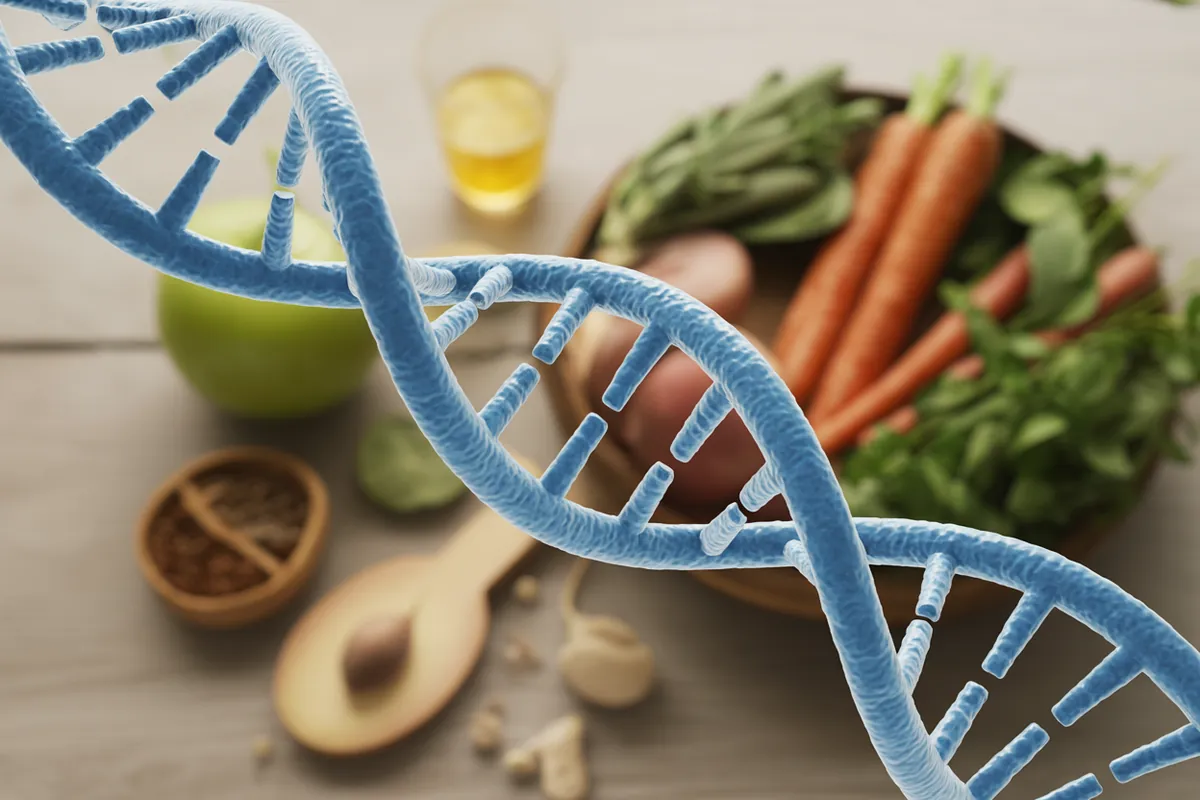
The unit of all of this is the SNP — the single nucleotide polymorphism (pronounced “snip”). A SNP is a single substitution of one nucleotide — adenine, cytosine, guanine, or thymine — for another at one spot on a strand of DNA. A SNP might swap a thymine for a cytosine, or the reverse. That is the entire change: one letter.
Here is the part that keeps SNPs in perspective: most SNPs are completely normal and have no effect on health. Each of us carries somewhere between three and four million of them, and collectively they are a large part of what makes every genome unique. Only a subset matter functionally — the SNPs that change our ability to make a particular protein or enzyme. It is the specific combination of those consequential SNPs that shapes how an individual metabolizes different nutrients. This is the genetic basis behind consumer services like 23andMe and ancestry profiles: they read a panel of these single-letter variants to estimate lineage and flag predispositions.
Tager uses a GPS analogy that translates well for patients. Your DNA is the set of maps your GPS relies on — it lays down the roads. A consequential SNP is like a traffic event on one of those roads: the route still exists, but you may be sent on a detour, needing a little more or a little less of a given nutrient to arrive at the same destination. Based on a patient's genes, in other words, they may genuinely need more or less of a specific vitamin, mineral, or macronutrient than the next person — not because something is broken, but because their internal map routes nutrients differently.
MTHFR, methylation, and folate
The most commonly cited example — and the one most often mishandled — is MTHFR. Dietary folate has to be converted into l-methylfolate, the biologically active form that works at the cellular level. That conversion depends on an enzyme called methyltetrahydrofolate reductase, which the MTHFR gene encodes. A meaningful share of the population — Tager notes more than forty percent in the United States — carries genetic variations that make this step of methylation run less efficiently, so folic acid or folate is not converted to its active form as readily.
This is a clean illustration of nutrigenomics in action: a single-letter difference changes an enzyme's efficiency, which changes a nutrient need. But it is exactly the kind of finding that gets over-read into a sales pitch. An MTHFR result is not a prescription. Whether a given patient meaningfully benefits from a different form of folate depends on their diet, their labs, their symptoms, and clinical context — not on the gene result in isolation. The specific way to weigh an MTHFR finding against the rest of a patient's picture, and which nutrient forms map to which variants, is taught as a clinical framework in Empire's Precision Nutrition training rather than reduced to a one-size protocol here.
Epigenetics: turning genes up and down
If SNPs are the fixed letters in the genome, epigenetics is the volume knob on top of them. The prefix epi means “on top of” or “in addition to,” and epigenetics governs how genes behave and function without changing the underlying sequence. It is the intersection of genetics, nutrition, and environment — the mechanism by which diet, micronutrients, exercise, stress, and sleep can change patterns such as methylation across the genome and thereby shift how specific genes and biological processes operate.
This is the most clinically empowering idea in the field. As Tager puts it, one of the most powerful reasons to move a patient toward a healthier diet, regular exercise, and better stress management is to turn on the genes that support health and keep potentially harmful genes quiet. Genetics may load the gun, but lifestyle — through epigenetics — has a real say in whether it fires. Research even points to transgenerational epigenetic inheritance, where diet, sleep, stress, and environmental exposures can leave epigenetic marks that influence children and grandchildren. The takeaway for the exam room is the opposite of fatalism: a predisposition is a starting position, not a sentence.
What this means for skin and healthy aging
Tager's lens is aesthetic and functional, and skin is where nutrigenomics becomes tangible. Genetic variants help shape how prone a patient is to pigmented spots, the tendency toward lines and wrinkles, how well they protect collagen from breakdown, and whether their skin is more likely to be affected by glycation or oxidative stress. The operative word, deliberately, is likely. These tests are predictive, not diagnostic, and because their outputs are subject to epigenetics, the predicted outcome can be altered by what the patient actually does.
A concrete example: a patient whose SNPs predispose them to break down collagen more readily — via the enzymes called matrix metalloproteinases, or MMPs — is a patient who should be more diligent with sun protection, more attentive to dietary support for connective tissue, and sure they have the minerals the body needs to build collagen. The genetic finding does not doom their skin; it tells you where to be more vigilant. That is the right way to use a result: as a reason to personalize counseling and follow-up, not as a verdict. For the collagen mechanism itself and where supplement evidence is genuinely modest, see our overview within the peptide therapy resources on collagen and GHK-Cu, and for the oxidative-stress angle the work on glutathione.
Where consumer genomic testing falls short
This is the section the marketing skips. Nutrigenomics is genuinely promising and useful for individualizing care, but its clinical utility today is still limited and easily over-interpreted. Several honest caveats belong on every clinician's radar:
- Predispositions are not destiny. A SNP describes a tendency, not a diagnosis. Avoid genetic fatalism — and avoid letting a patient read a report as a fixed fate.
- Direct-to-consumer testing is rising, often without guidance. A growing number of patients order tests at home and read results online before talking to a clinician. The professional's value is interpretation in context, not the raw data.
- Actionability is the bar that matters. The SNPs worth reporting are the ones that are well researched and that a patient can actually do something about. Many variants are interesting but not actionable, and a responsible panel says so.
- A gene report is not a supplement order form. The single most common abuse of this field is upselling a stack of products off a genetic readout. That is precisely what a vendor-neutral framework is meant to prevent.
The useful clinical question, the one Tager poses of any specialty test, is whether it will identify a correctable nutrient gap, shed light on a real predisposition, better predict the clinical course, guide a treatment recommendation, or improve compliance through better counseling. If a test does none of those, it does not belong in the plan.
Disclosure and the vendor-neutral stance
Honesty about conflicts is part of teaching this responsibly. Dr. Tager openly discloses that he consults for supplement companies — most notably Designs for Health, where he helped develop a nutrigenomics-driven program and an associated genetic skin test. We name this plainly because it is exactly the kind of relationship that, undisclosed, distorts nutrition advice across the industry.
Empire's course, and this guide, deliberately teach a vendor-neutral framework rather than a brand. The point of nutrigenomics is to learn how to read a SNP panel, weigh it against diet and labs, separate actionable variants from noise, and counsel honestly — skills that transfer to whatever test or product line a clinician chooses. No brand is being sold here. If a result leads to a supplement recommendation, that decision should rest on the patient's whole clinical picture and follow the same conservative principles that apply across nutraceutical supplementation: correct documented need, prefer food first, and respect that more is not better.
Bringing nutrigenomics into a precision plan
Nutrigenomics is one input, not the whole assessment. In a precision plan it sits alongside a careful history, a focused physical exam, and conventional and specialty labs — the full workup covered under nutritional assessment and lab testing. A simple cheek-swab genomic test can fit easily into the flow of an aesthetic visit, while more involved options such as stool and microbiome panels demand more interpretation and a longer patient engagement; that gut-axis testing connects naturally to the gut health work that underlies so much of nutritional status.
Where genomics earns its place is in personalizing the nutrients that genetics actually touches — the absorption, transport, and metabolism of the vitamins and minerals a patient most needs. A vitamin D transport variant, for instance, can mean a given patient moves less vitamin D to its target cells and therefore needs more to reach the same level. But the dosing logic, the panel selection, and the way to package all of this into a real practice workflow are the substance of the paid curriculum — not a turnkey recipe to hand out for free.
Learn precision nutrition the right way
Empire Medical Training's Precision Nutrition Master Training — developed by Mark Tager, MD — teaches a vendor-neutral framework for nutrigenomics, assessment, and intelligent supplementation, so you can individualize care without over-promising. Available in person and via livestream.
Explore the Precision Nutrition Training → Claim Your Prize!