







A patient calls three days after lip filler. There are blisters. The skin looks angry. Everything you have been taught about vascular occlusion is now competing for attention with everything you know about cold sores, and the two conditions can look alike enough at a glance to matter.
Getting this differential right prevents two opposite errors: treating a herpetic reactivation as an occlusion, and — far worse — reassuring yourself that a genuine occlusion is just a cold sore.
Why the lips are where this happens
Perioral injection is a recognised trigger for herpes simplex reactivation. The mechanical trauma, the local inflammation and the stress response are enough to reactivate latent virus in a patient who carries it, and a large proportion of the adult population does.
So in the one region where vascular occlusion is most feared, you also have the highest background rate of a condition that produces blistering, pain and skin change on a similar timeline. They are not rare coincidences. Both are common.
The history question that prevents most of this
The single most useful intervention happens before the needle, and it is one question.
Ask every lip filler patient whether they have a history of cold sores. As Dr. Jennifer Thomas-Goering puts it, we know that injection is a stressor around the mouth, so you need that backstory.
A positive history changes three things:
- It allows you to discuss antiviral prophylaxis before treatment rather than after a breakout.
- It gives you a far stronger prior when the day-three call comes.
- It lets you warn the patient specifically, so they call you with useful information rather than a panicked description.
Patients frequently do not volunteer this. It does not occur to them that a cold sore relates to a cosmetic treatment, and some withhold history they fear will make them ineligible. Ask directly.
What else can look like this
Herpetic reactivation is not the only mimic, and the presentations can overlap in ways that are genuinely confusing.
I have seen a patient develop what looked like a shingles-type reaction — a cold sore breakout that then kicked off a further eruption. Blistering that is not part of an occlusion at all, in a patient who is understandably alarmed.
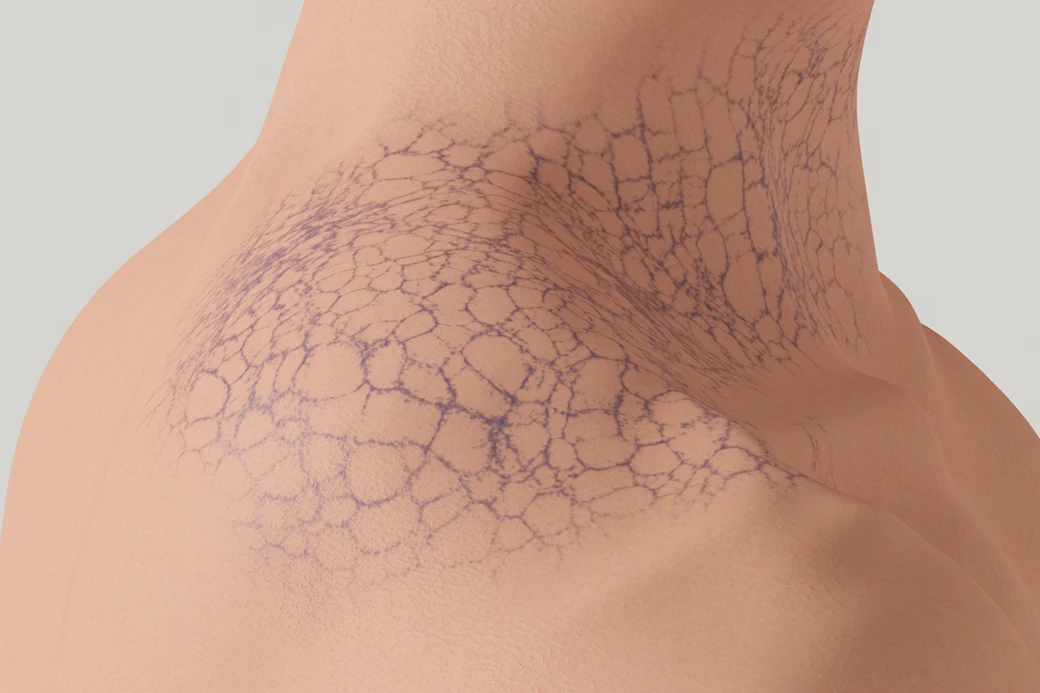
The other common mimic runs in the opposite direction, and it is the dangerous one. Early ischemic skin change is frequently described by patients as an acne breakout: small pustular-looking lesions appearing in a patch, in an area that may not correspond to where you injected. Melissa Pulcini-Buttine describes the pattern that should raise the alarm — as blood supply fails, the skin can take on an almost lacy, reticulated appearance. A patient reporting sudden unexplained “acne” after filler is describing something that needs to be seen, not reassured.
The discriminating features
No single sign is definitive, and the safest reading treats them together.
Points toward herpetic reactivation: known cold sore history; prodromal tingling or burning before lesions; grouped vesicles on an erythematous base; distribution around the vermilion border or perioral skin; lesions that crust over in the expected way; intact capillary refill in the surrounding skin.
Points toward vascular compromise: pain out of proportion, or pain in an area you did not inject; skin colour change — dusky, mottled or the lacy reticulated pattern; delayed capillary refill; change extending across a vascular territory rather than a nerve distribution; progression over hours; skin change in a region remote from the injection site but downstream of it.
The territorial logic is the most useful discriminator. Herpes follows a nerve. Ischemia follows an artery. If the distribution matches a vascular territory rather than a dermatome, treat it as vascular until proven otherwise.
What to do when you are not sure
You will sometimes be unsure, and the correct action under uncertainty is not a coin flip.
- See the patient. Not a photograph. Photographs distort colour, and colour is most of this assessment.
- Assess perfusion properly — capillary refill, temperature, the whole territory rather than the lesions.
- Treat the vascular possibility as live while you evaluate. The cost of treating a cold sore as a possible occlusion is an unnecessary but harmless examination. The cost of the reverse is tissue.
- Remember they can coexist. A patient with a genuine herpetic flare can also have a compromised vessel. Finding one explanation does not exclude the other.
- Document what you saw, including the distribution and the perfusion findings.
What belongs in consent and aftercare
Because this is predictable, it belongs in the paperwork rather than in an emergency phone call.
Tell lip filler patients with a cold sore history that treatment can trigger a flare, what it will look like, and what you plan to do about it. Then tell every lip patient what the concerning findings are — pain outside the treated area, colour change, skin change anywhere you did not inject — and that the instruction is to call rather than to wait and see.
A patient who has been told what a lacy or mottled pattern means does not spend two days treating it as a breakout.
Related guides in this cluster
Part of Vascular Occlusion: Recognition and Response.
 Clinical GuideThe Expected Filler Injection Response — Building the Baseline That Lets You Recognize IschemiaThe expected filler injection response — erythema, edema, ecchymosis — and how a trained normal baseline makes early ischemia recogniza
 Clinical GuideThe Golden Triangle — Why the Filler Deposit Site Isn't Where You Put the Needle InThe filler deposit site sits at the needle tip, not the entry point — about half an inch away, further with a cannula. Why that gap dec
 Clinical GuideImmediate, Early and Late — The Three Windows of Vascular Occlusion OnsetVascular occlusion onset is not one moment. Organize the picture into immediate, early and late windows — detection runs days past the
Train with Empire
This guide is clinical education. The technique behind it is taught hands-on, on live patients, with faculty beside you.
Explore Complete Dermal Filler Training →Disclaimer
This article reflects the clinical opinions and experience of Michelle Langston, APRN, MSN, FNP-BC, HNB-BC, an independent faculty member contributing to Empire Medical Training's curriculum. The views expressed are the author's own and do not necessarily represent those of Empire Medical Training.
It is professional education, not medical advice, and is no substitute for hands-on training or independent clinical judgment. Licensed clinicians remain responsible for their own patient selection, technique and outcomes, for verifying current product labelling, and for practising within their scope and applicable law. Empire Medical Training accepts no liability for reliance on this content.
 Claim Your Prize!