







The forehead is the most requested Botox® treatment area and the least forgiving one. Every other cosmetic target on the face — crow’s feet, bunny lines, the chin — tolerates a certain amount of imprecision. The forehead does not. There is exactly one muscle holding the eyebrows up, and it is the same muscle that creates horizontal forehead lines. Relax it carelessly and the brows come down with it.
That single anatomical fact drives everything about forehead Botox injection sites: how high you inject, how far laterally you go, how many units you place, and why the forehead should almost never be treated in isolation. This guide covers frontalis anatomy, the injection pattern most experienced injectors converge on, typical unit ranges, the frontalis–glabella balance that separates a good result from a heavy brow, and the specific errors that produce brow ptosis.
Forehead Anatomy: Why This Area Is Different
The upper face is a tug-of-war between one elevator and several depressors.
The frontalis is the only brow elevator in the face. It is a broad, thin, paired sheet of muscle running vertically from the galea aponeurotica at the top of the scalp down to insert into the skin and muscle of the brow region. When it contracts, it pulls the eyebrows up — and the skin above it buckles into the horizontal lines patients come in asking about. Those lines are perpendicular to the direction of pull, which is why they run side to side.
Working against it are the depressors:
- Corrugator supercilii — pulls the brows medially and down, creating the vertical “11” lines.
- Procerus — pulls the medial brow down, creating the horizontal crease across the bridge of the nose.
- Depressor supercilii — assists in medial brow depression.
- Orbicularis oculi — the sphincter around the eye; its upper fibers depress the brow, particularly laterally.
Here is the consequence that every injector has to internalize. If you weaken the frontalis and leave the depressors at full strength, you have removed the only thing holding the brow up while leaving everything that pulls it down intact. The brow drops. The patient reads it as “heavy,” “tired,” or “my eyes look smaller,” and they are not wrong.
This is why forehead lines and glabellar lines are usually treated in the same session. It is not upselling — it is muscle balance. Our Botox face chart maps how these muscle groups relate across the whole face.
Frontalis Shape Varies More Than People Expect
Textbook diagrams show a symmetric rectangle. Real foreheads do not cooperate. The frontalis has a medial gap of variable width where the two bellies separate, and the muscle can be narrow and tall, wide and short, or asymmetric between sides. Some patients have frontalis fibers extending well laterally toward the temporal fusion line; others have a muscle that effectively stops mid-pupil.
You cannot map this from a photograph. You map it by having the patient raise their eyebrows, watching where the lines actually form, and palpating the contracting muscle. The lines tell you where the muscle is. Inject the lines you see on animation, not the pattern you memorized.
Forehead Botox Injection Sites: The Pattern
Most experienced injectors use a horizontal row or a staggered two-row pattern across the frontalis, typically four to eight points, placed intradermally to superficially intramuscularly. The frontalis is a thin, superficial muscle — deep injection is unnecessary and increases the chance of unwanted spread.
Three placement rules govern the pattern:
- Stay at least 2 cm above the orbital rim — and above the brow. This is the single most important rule in forehead injecting. Product placed low in the frontalis weakens the fibers that are actively holding the brow up, and it sits close enough to the depressors and the levator complex to cause trouble. Most injectors keep their lowest row roughly two fingerbreadths above the brow, adjusted upward in patients with a low or heavy brow at baseline.
- Respect the lateral limit. Injecting too far laterally in the frontalis weakens the fibers that hold the tail of the brow up, and the medial frontalis keeps lifting unopposed. The result is the peaked, arched “Spock brow” or “Mephisto” look. Keeping lateral points inside the mid-to-lateral pupillary line, and often stopping short of the temporal fusion line entirely, protects against it.
- Match the pattern to the animation, not the ruler. If lines form high, inject high. If the patient has a tall forehead with lines only in the upper third, a low row of injections does nothing useful and costs you brow height.
Typical Injection Site Layouts
A few patterns recur in practice. None of them is a rule — each is a starting point to be adapted:
- Single horizontal row (4–5 points): Suits a short forehead or a patient with a low brow, where there simply isn’t safe vertical real estate for two rows. Points spread across the mid-frontalis, well above the brow.
- Staggered two-row / V or inverted-V (6–8 points): Suits a tall forehead with lines across a broad vertical zone. Points are offset between rows to distribute effect rather than stack it.
- Conservative lateral tapering: Lower unit amounts at the outermost points, higher medially. This preserves a natural lateral brow position and lets a little lateral movement remain, which most patients prefer to a completely frozen upper face.
The Glabella (“11 Lines”) Pattern
Because it is treated in the same session, the glabellar pattern belongs in any discussion of forehead injection sites. The classic approach uses five points: one in the procerus at the midline (roughly at the level of the medial brows), one in each corrugator near its medial origin, and one in each corrugator further laterally along the muscle’s course. Injections here go deeper than the frontalis, because the corrugators sit deeper.
The critical safety consideration in the glabella is depth and direction. Injecting too close to the orbital rim, or angling toward it, allows product to migrate through the orbital septum onto the levator palpebrae superioris — the muscle that lifts the upper eyelid. That produces true eyelid ptosis, which is a very different problem from a heavy brow. Our guide to what ptosis is and how to avoid it covers the distinction and the management options.
How Many Units for Forehead Botox?
Typical ranges reported in practice and in the product labeling:
Ready to put this into practice?
Explore Empire's hands-on, CME-accredited Aesthetic & Injectable Training courses — live patients, expert faculty, and ongoing mentorship.
- Frontalis (horizontal forehead lines): commonly 8–20 units total, spread across the injection points. Many injectors deliberately start at the low end — around 10–12 units total — for a first-time patient.
- Glabellar complex (“11 lines”): commonly around 20 units across five points, with a working range of roughly 10–25 units.
- Crow’s feet (lateral orbicularis oculi), if treated in the same session: commonly around 12 units per side, with a range of roughly 5–15 units per side.
These are typical ranges, not prescriptions. Actual dose depends on assessed muscle strength, forehead height, baseline brow position, line depth, prior treatment history, and what the patient actually wants their face to do. Men typically require more units than women in the frontalis and glabella, because male facial musculature is generally bulkier and stronger — but a small-framed man with a weak frontalis needs less than a strong-browed woman, so the variable is muscle, not sex.
Dosing is a large enough subject that it has its own guide. For how dose is actually decided, why more is not better, and how dose relates to duration, see Botox dosages for the forehead and frontalis area.
Why the Low-Dose Start Wins
A conservative first pass with a two-week follow-up is the most defensible approach in the forehead, for a simple reason: you can always add units, and you can never take them out. If 12 units achieved the result, you have a happy patient and an untouched brow. If it did not, you touch up at day 14 with full information about how that specific patient responds. The alternative — 25 units on a first visit — means that if the brow drops, both of you wait three to four months.
Forehead Botox Complications and How Sites Cause Them
Nearly every forehead complication traces back to placement rather than the drug.
- Brow heaviness / brow ptosis — injecting too low in the frontalis, over-dosing the frontalis, or treating the frontalis without treating the depressors. The brow descends, the upper lid looks hooded, the patient looks tired.
- Eyelid ptosis — usually a glabellar error: product too deep, too close to the orbital rim, or migrating onto the levator. Genuine lid droop, distinct from brow heaviness.
- Spock brow / peaked brow — medial frontalis treated, lateral frontalis untouched. The unopposed lateral fibers arch the brow tail up. Usually correctable with 1–2 units placed laterally.
- Asymmetry — uneven placement, uneven dosing, or an underlying baseline asymmetry that was present before treatment and never documented. Photograph patients at rest and on animation before you inject. See what to do about uneven Botox results.
- Frozen forehead — not a complication so much as a preference mismatch, but it drives dissatisfaction. Ask what the patient wants before assuming they want zero movement.
Male patients deserve a specific note here. The male brow sits lower and flatter at baseline, and there is less vertical margin before a treated frontalis produces visible heaviness. Higher, more conservative frontalis placement and an emphasis on preserving a flat brow shape matter more than in female patients — see the most common Botox areas for men.
Patient Selection: Who Should Not Get Forehead Botox
Some foreheads should be treated lightly, and some should not be treated at all:
- Patients with pre-existing brow ptosis or significant dermatochalasis who are unconsciously using the frontalis to hold their eyelids out of their visual field. Relaxing that muscle can be functionally disabling. Watch for constant, effortful brow elevation at rest.
- Patients with a very low or heavy brow at baseline — minimal margin for error.
- Patients whose forehead lines are static, etched in at rest and unchanged on animation. Botox addresses dynamic lines. Static lines need resurfacing, filler, or a combination approach; Botox alone will disappoint.
- Patients seeking a brow lift from frontalis treatment — this is backwards. A chemical brow lift comes from treating the depressors, not the elevator.
For how injection sites map across the rest of the face, see our overview of Botox injection sites.
Frequently Asked Questions
Where are the forehead Botox injection points?
Injection points sit in the frontalis muscle across the mid-forehead, typically four to eight points arranged in a single row or a staggered two-row pattern, kept at least 2 cm above the orbital rim and inside the lateral pupillary line. Exact placement follows where the patient’s lines form on animation, not a fixed template.
How many units of Botox for the forehead?
Frontalis treatment commonly uses 8–20 units total, with many injectors starting around 10–12 units for a first-time patient and adding at a two-week follow-up if needed. The glabella typically adds another 10–25 units. Ranges vary by assessed muscle strength, and men generally require more.
What is the Botox injection pattern for 11 lines?
The classic glabellar pattern uses five points: one midline in the procerus and two in each corrugator — one near the medial origin, one further laterally along the muscle. Injections are placed deeper than frontalis injections, angled away from the orbital rim to avoid affecting the levator and causing eyelid ptosis.
Which Botox areas on the forehead can be treated?
Three zones are treated in the upper face: the frontalis for horizontal forehead lines, the glabellar complex (procerus and corrugators) for vertical “11” lines, and the lateral orbicularis oculi for crow’s feet. The frontalis and glabella are usually treated together to keep the elevator and depressors in balance.
Can Botox in the forehead cause droopy eyebrows?
Yes — and it is the most common forehead complication. The frontalis is the only brow elevator, so weakening it too much, too low, or without balancing the depressors lets the brow descend. Keeping injections high, dosing conservatively, and treating the glabella in the same session are the main preventive measures.
What is the best Botox placement for a tall forehead?
A tall forehead usually has lines distributed across a broader vertical zone and tolerates a staggered two-row pattern, since there is more safe distance above the brow. A short forehead typically gets a single row placed as high as the lines allow.
Learn Forehead Injection Technique Hands-On
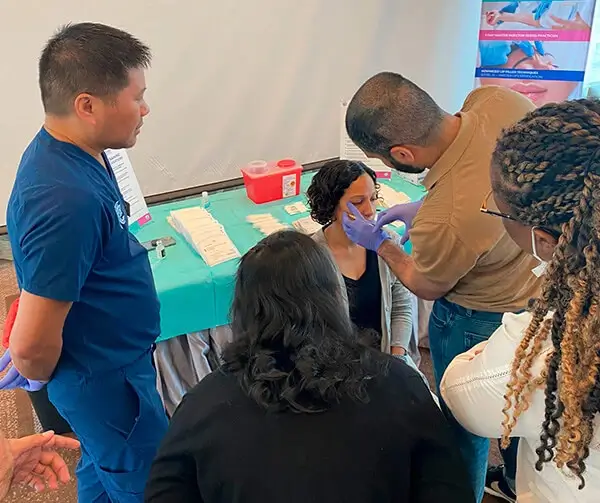
Reading about injection sites is not the same as feeling a frontalis contract under your fingers and deciding, on a live patient, how high to place your lowest row. Empire Medical Training’s Botox Training & Certification course combines didactic instruction in facial anatomy with supervised hands-on injection practice, covering frontalis and glabellar technique, dose selection, brow-position assessment, and complication avoidance — taught by board-certified physicians with decades of clinical experience.



 Claim Your Prize!