






Botox® is not an acne treatment. That is the honest answer, and it is worth stating before anything else, because a lot of what circulates online about Botox for acne oversells a narrow, off-label technique with thin evidence behind it. Botulinum toxin type A does have a documented effect on sebaceous gland activity when it is injected intradermally — but “has an effect on oil production” and “treats acne” are very different claims.
This guide covers what the science actually supports, what it does not, whether Botox causes acne or breakouts, whether it does anything for acne scars (largely no), and whether you can safely get Botox while you have an active breakout. It is written for patients trying to separate marketing from medicine, and for clinicians who need to answer this question in a consultation without overpromising.
Does Botox Help Acne? The Short Answer
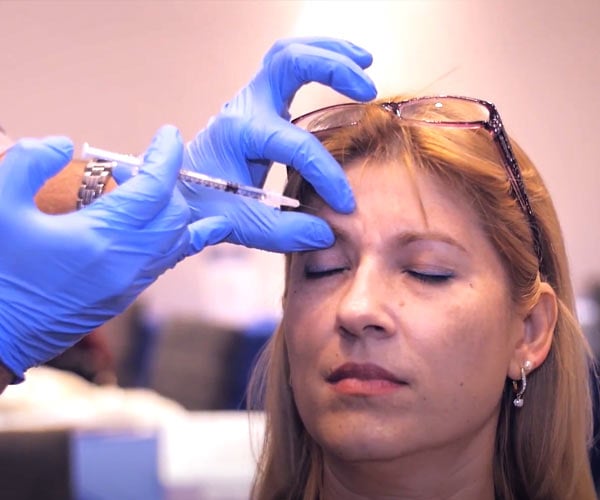
Standard Botox — the intramuscular injections used for frown lines, forehead lines, and crow’s feet — does essentially nothing for acne. It is placed into muscle, well below the sebaceous glands, in a handful of discrete points. It is not a skin treatment.
A different technique, usually called microbotox, mesobotox, or intradermal botulinum toxin, places highly diluted toxin in many tiny superficial blebs across the skin rather than into muscle. At that depth, the toxin can reach the cholinergic receptors on sebaceous glands and reduce sebum output. Small studies and clinical reports describe reduced oiliness and smaller-looking pores after this technique.
That is the entire basis for the “Botox for acne” claim. Here is what it is not:
- It is not FDA-approved for acne, sebum control, or pore size. Every use described here is off-label.
- It is not supported by large randomized trials. The evidence base is small studies, case series, and split-face reports — not the kind of data behind established acne therapy.
- It is not comparable to real acne treatment. Topical retinoids, benzoyl peroxide, topical and oral antibiotics, hormonal therapy, and isotretinoin all have decades of controlled evidence. Botulinum toxin has none of that for this indication.
If you have acne, the answer is a dermatologist, not an injector.
Why the Sebum Mechanism Is Real but Limited
The mechanism is not made up, which is why the claim persists. Botulinum toxin type A blocks the release of acetylcholine from nerve terminals. That is how it relaxes muscle, and it is also how it reduces sweating in FDA-approved hyperhidrosis treatment — eccrine sweat glands are cholinergically innervated, so blocking acetylcholine turns down sweat output.
Sebaceous glands also carry cholinergic receptors, and acetylcholine appears to contribute to sebocyte activity. Deliver toxin superficially enough to reach those glands, and sebum production drops in the treated field.
But three limits matter, and they are usually left out:
- Sebum is one factor in acne, not the cause. Acne is driven by follicular hyperkeratinization, Cutibacterium acnes colonization, inflammation, and hormonal signaling as well as sebum. Reducing oil alone does not resolve an inflammatory acne process, and it does nothing about the follicular plugging that starts a comedone.
- The effect is local and temporary. It applies only to the treated field and fades as the toxin wears off, on a timeline similar to cosmetic treatment — roughly three to four months.
- The evidence is thin. Reduced oiliness in a small study is not the same as fewer inflammatory lesions over time, which is the outcome acne patients actually care about. That outcome has not been established.
The fair way to describe intradermal toxin is as a skin quality technique — oil control, pore appearance, fine surface texture — that may indirectly benefit some oily-skinned patients. It is not therapy for acne vulgaris.
Does Botox Help Acne Scars?
Largely no, and this deserves a blunt answer because the question comes up constantly.
Most acne scarring is atrophic — icepick, boxcar, and rolling scars, which are depressions caused by lost collagen and tethered fibrous bands. Botulinum toxin does not build collagen, does not release tethering, and does not add volume. There is no mechanism by which it would fill a depressed scar.
The treatments with real evidence for atrophic acne scarring work through entirely different mechanisms:
- Fractional and ablative laser resurfacing — controlled injury that drives collagen remodeling. See our overview of cosmetic laser treatment.
- Microneedling, with or without radiofrequency.
- Subcision — mechanically releasing the fibrous bands that tether rolling scars.
- Chemical peels and TCA CROSS for icepick scars.
- Dermal fillers, which can lift selected depressed scars by restoring volume — a genuinely different tool with a genuinely different mechanism.
There is one narrow, adjacent use worth distinguishing so it is not confused with acne scars: botulinum toxin has been studied as an adjunct for hypertrophic and keloid scarring, and for reducing muscle tension across a healing surgical wound. The rationale is mechanical — less tension on the closure may mean a less prominent scar. That evidence is also mixed and it applies to raised scars and fresh surgical wounds, not to the atrophic pitting left behind by acne. Our guide to keloid remedies covers that category separately.
Can Botox Cause Acne or Breakouts?
“Botox cause acne” and “acne after Botox” are among the most common searches on this topic, so the mechanism deserves a clear answer: there is no established mechanism by which Botox causes acne. The drug acts on nerve terminals. It does not stimulate sebum production, alter hormones, or drive follicular plugging.
What people are usually seeing when they report a breakout after treatment is one of the following:
- Injection-site reaction. Small red papules at injection points are common in the first day or two and are a needle response, not acne. They resolve on their own.
- Folliculitis. Occasionally, a needle puncture or post-treatment handling of the skin produces localized folliculitis that looks like a cluster of pimples. This is an infection-type reaction, not acne vulgaris.
- Timing coincidence. Acne fluctuates with hormonal cycles, stress, and skincare changes. A breakout in the week after treatment is frequently unrelated to the treatment.
- Products and touching. Makeup applied over injection sites, or repeatedly touching and massaging the area — which you are advised not to do anyway — can irritate follicles. Our do’s and don’ts after Botox guide covers post-treatment handling.
If new lesions appear at injection points specifically, are painful or spreading, or come with warmth and swelling, that warrants a call to your injector rather than a tube of acne cream. Infection after injection is rare but it is the reaction that needs prompt evaluation.
Ready to put this into practice?
Explore Empire's hands-on, CME-accredited Aesthetic & Injectable Training courses — live patients, expert faculty, and ongoing mentorship.
Can You Get Botox If You Have Acne?
Usually yes. Acne is not, in itself, a contraindication to botulinum toxin treatment. The considerations are practical and local:
- Do not inject through an active inflamed lesion or an infected area. Active infection at the intended injection site is a genuine contraindication. A competent injector will map around inflamed lesions or reschedule if the area is significantly involved.
- Severe cystic acne across the treatment field is a reason to defer. The skin should be settled before elective cosmetic injection.
- Disclose everything you are taking or applying. Retinoids, benzoyl peroxide, and antibiotics do not preclude treatment, but your injector should know about them.
What About Botox and Accutane?
Isotretinoin (Accutane) is not a formal contraindication to botulinum toxin, and the two act on completely unrelated pathways. The caution is about skin condition, not drug interaction: isotretinoin leaves skin dry, fragile, and more easily irritated, and it has historically been treated as a reason to delay resurfacing and ablative procedures because of wound-healing concerns.
Botulinum toxin injection is not resurfacing. Many clinicians treat isotretinoin patients without incident. Still, this is a decision for your prescribing dermatologist and your injector together, not one to make from a blog post — including this one. Raise it at the consultation.
What This Means for Clinicians
If you inject, this topic will come to you as a patient question, and the way you answer it is a competence signal.
Two failure modes are worth avoiding. The first is selling microbotox as an acne treatment. It is off-label, thinly evidenced, and setting a patient up to expect clear skin from a neuromodulator is how you generate a refund request and a bad review. The second is dismissing the mechanism outright, which is also inaccurate — sebum reduction from intradermal toxin is a real, documented effect.
The defensible position is precise: intradermal botulinum toxin may reduce oiliness and improve pore appearance in the treated field for a few months. It is not acne therapy. If a patient’s primary complaint is acne, refer to dermatology, and treat the aesthetic concern separately if one exists.
Technique matters here as much as the counseling. Intradermal work is a different skill from standard intramuscular injection — different dilution, different depth, different distribution — and getting depth wrong means either no effect or unintended muscle weakness, particularly around the mouth and lower face. It is not something to attempt from a video.
Frequently Asked Questions
Can you get Botox with acne?
In most cases yes. Acne is not a contraindication to botulinum toxin. Your injector should avoid placing needles through actively inflamed or infected lesions, and may recommend deferring if you have severe cystic acne across the treatment area. Tell them what you are taking or applying.
Does Botox cause acne?
There is no known mechanism by which it would. Botulinum toxin acts on nerve terminals and does not affect sebum, hormones, or follicular plugging. Small red bumps in the first day or two are injection-site reactions, not acne, and resolve on their own.
Does Botox help with hormonal acne?
No. Hormonal acne is driven by androgen signaling on sebaceous glands and follicular keratinization. Botulinum toxin does not affect hormones. Hormonal acne is treated with therapies that target that pathway — combined oral contraceptives, spironolactone, or isotretinoin in appropriate patients — under dermatologic care.
Does Botox help with pimples?
Not in any direct way. It does not kill bacteria, unclog follicles, or reduce inflammation in an existing lesion. Intradermal toxin may reduce overall oiliness in a treated area, which is not the same as treating a pimple.
Is there such a thing as Botox for acne before and after?
Photos circulate, but they should be read carefully. Most reflect microbotox for skin quality and oil control rather than acne clearance, and many patients pictured are on concurrent acne therapy. There is no controlled evidence establishing lesion-count reduction from botulinum toxin, so before-and-after images are not a substitute for that data.
Is Botox for acne FDA-approved?
No. Botox is FDA-approved for specific cosmetic and therapeutic indications, and acne is not among them. Any use for acne, sebum control, or pore appearance is off-label and should be consented as such.
How long would the oil-control effect last?
Where it occurs, it fades with the toxin, on a timeline comparable to cosmetic treatment — roughly three to four months, limited to the treated field. It is not a durable change to your skin.
Learn to Inject Botox Safely — and Counsel Patients Honestly
Knowing what botulinum toxin will not do is as clinically important as knowing what it will. Patient selection, dilution, depth, off-label consent, and the discipline to refer rather than oversell are all learnable skills — and they are what separate an injector patients return to from one they complain about.
Empire Medical Training has trained healthcare professionals in aesthetic medicine since 1998. Our Botox Training & Certification course is CME-accredited and hands-on, with live-patient injection under expert supervision, covering facial anatomy, dosing, injection depth, patient selection, and complication management.

 Claim Your Prize!