







 Medically reviewed by
Mark Tager, MD
Integrative & Functional Medicine Physician; Author, ‘Feed Your Skin’
Medically reviewed by
Mark Tager, MD
Integrative & Functional Medicine Physician; Author, ‘Feed Your Skin’ Few concepts in precision nutrition connect food to skin as directly as oxidative stress. It is the mechanism that ties a patient's diet to the visible markers of aging — fine lines, loss of firmness, pigment changes — and it is one of the few places where a thoughtful nutrition plan can do real, mechanistic work. This guide explains what oxidative stress is, how dietary antioxidants counter it, and where the evidence is genuinely strong versus where the supplement industry has overpromised.
It is written for clinicians who want an accurate, practical overview. It is clinical education, not medical advice, and nothing here should be read as a treatment protocol, a dosing recommendation, or a substitute for individualized clinical judgment.
What is oxidative stress?
Free radicals are generated continuously — both by the body's own internal metabolism and by external stimuli such as UV light, pollution, and smoking. In normal amounts the body neutralizes them. Problems begin when free radicals outweigh the body's protective mechanisms. When free radicals overwhelm those defenses, the result is oxidative stress.
Over time, this oxidative damage accumulates, and it contributes to aging through several mechanisms at once. As Dr. Mark Tager teaches in Empire's curriculum, the picture is concrete: DNA becomes altered, cellular proteins are damaged, cell membranes are disrupted, and transcription factors are affected. Each of these is a distinct injury, and together they degrade the machinery a cell needs to maintain and repair itself.
This is why oxidative stress is not an abstraction. It is a measurable biological process with a direct line to the skin and to the broader trajectory of how a patient ages.
Oxidative stress, MMPs, and collagen breakdown
For a skin-focused practice, the most important consequence is what oxidative stress does to collagen. Collagen accounts for roughly thirty percent of the protein in the body — the stronger-than-steel matrix that holds tissue together while allowing it to flex. Protecting it is much of the game in skin aging.
Oxidative stress works against that goal directly. Among its downstream effects, it encourages the matrix metalloproteinases — the MMPs — to break down collagen more quickly. These are the enzymes responsible for collagen turnover; when oxidative load pushes them into overdrive, the structural protein that keeps skin firm is degraded faster than the body rebuilds it. The clinical signature is the familiar one: laxity, lines, and thinning.
This matters for individualization. Some patients are genetically more prone to collagen breakdown because of variations affecting their MMPs — a point covered in our guide to nutrition for skin health. Those patients benefit from being especially diligent about sun protection, antioxidant intake, and supplying the raw materials the body needs to make collagen. It is also worth noting that oxidative stress is not the only insult to collagen: glycation, where excess sugar attaches to the collagen molecule and makes it brittle, is a parallel pathway covered in glycation, sugar, and skin aging.
The 5,000 phytochemicals: eat the rainbow
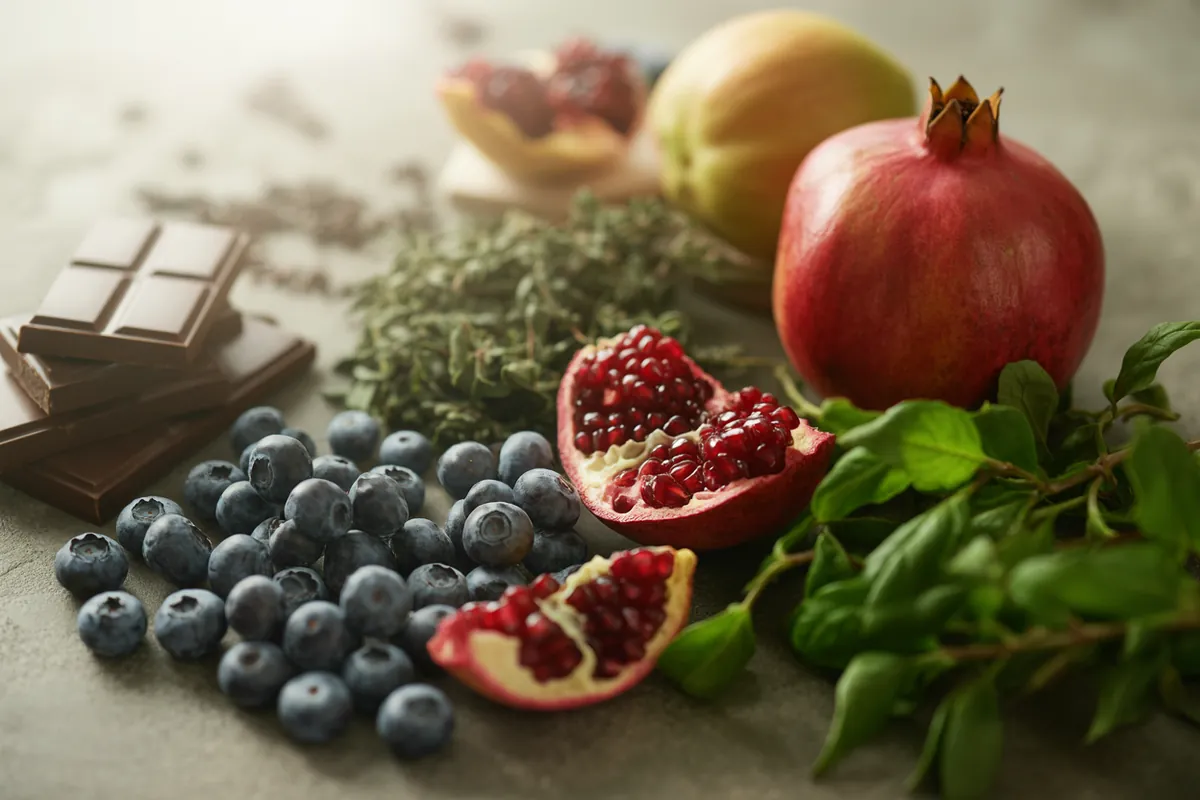
The body's first and best line of defense is on the plate. As Dr. Tager frames it, looking out at the many colored hues of vegetables and fruits means appreciating the roughly five thousand phytochemicals in those foods — the dietary antioxidants that help protect the body from oxidative stress. The colors are not incidental; the pigments themselves are the antioxidants.
Different colors deliver different families of protective compounds, each with unique properties:
- Flavonoids — a large group found in fruits, vegetables, tea, wine, and cocoa. This family includes the genistein in soybeans, the deeply colored red and blue anthocyanins in berries, grapes, and red cabbage, and the catechins in cacao and green tea.
- Carotenoids — the colorful antioxidants that give plants their orange, yellow, and red hues: beta-carotene in carrots, sweet potatoes, and squash; lutein and zeaxanthin in leafy greens and corn (which support eye health); and lycopene in tomatoes and watermelon (associated with heart-health benefits).
- Polyphenols — a broad group found across plant foods, tea, coffee, and dark chocolate, present in tea, wine, berries, and pomegranates, with both antioxidant and anti-inflammatory effects.
- Vitamin C — a potent antioxidant in citrus, strawberries, bell peppers, and broccoli that helps neutralize free radicals and supports skin health, and contributes to healthy collagen synthesis.
- Vitamin E — the fat-soluble antioxidant present in nuts, seeds, and green leafy vegetables.
The practical takeaway is simple and powerful: recommend a colorful variety of plant foods, because that variety assures a broad spectrum of antioxidants, each with its own benefit. The easiest way to get there is to increase the daily intake of a variety of fruits and vegetables — starting with quality and color, then focusing on quantity. Vibrant, colorful foods, organic and seasonal and locally sourced where possible, do more than any single pill can. This food-first principle anchors the broader anti-inflammatory diet as well, since oxidative stress and inflammation travel together.
Glutathione: the body's master antioxidant
Beyond what comes in from food, the body runs its own internal antioxidant system. The most important player is glutathione — what many clinicians call the master antioxidant. The critical clinical fact is that most glutathione is produced directly in the body, not absorbed intact from the diet.
That changes how a provider thinks about supporting it. Rather than trying to "eat glutathione," the more reliable lever is to supply the raw materials the body needs to make it: foods high in sulfur, an important mineral, help the body produce its own. This is a recurring theme in functional nutrition — support the body's own machinery rather than trying to bypass it.
Because oral glutathione absorption is limited, some clinics turn to intravenous delivery. Glutathione IV therapy is a distinct intervention with its own evidence base, indications, and safety considerations; it is not a substitute for a phytochemical-rich diet, and it should be evaluated on its own merits rather than assumed to be a skin-brightening shortcut.
Why more is not better: the supplement trap
Here is where clinicians need to be candid with patients, because the antioxidant story has been heavily oversold. The protective signal in the research comes from antioxidant-rich whole foods — the rainbow of phytochemicals eaten together — not from high doses of isolated antioxidants in a capsule. When researchers have tried to bottle the benefit as a single high-dose nutrient, the results have ranged from disappointing to genuinely harmful.
The most instructive example is beta-carotene. In whole foods it is a valuable carotenoid; but in large clinical trials, high-dose beta-carotene supplements raised the risk of lung cancer in smokers rather than lowering it. The isolated, high-dose form behaved in the opposite way from the food it was extracted from. That single finding should permanently retire the assumption that "if a little is good, more must be better."
Vitamin E tells a related cautionary tale. It is a powerful antioxidant in food, but the existing studies on oral vitamin E supplementation — typically with the alpha-tocopherol form most common in supplements — do not consistently show health or skin benefits, and high-dose vitamin E has raised its own safety concerns. The natural vitamin E in food is a family of eight related compounds; a high dose of one isolated form is not the same thing.
For transparency: Dr. Tager openly discloses that he consults for supplement companies. The framework taught in Empire's course — and reflected in this guide — is deliberately vendor-neutral. The goal is to teach the science of when and why, not to sell a brand.
Reducing the oxidative load, not just adding antioxidants
Because oxidative stress is a balance between damage and defense, the smartest strategy works both sides of the equation. Adding dietary antioxidants is half the job; the other half is lowering the burden of free radicals being generated in the first place.
Several dietary and lifestyle inputs raise oxidative load directly. Cooking meats at high temperatures generates advanced glycation end products that increase oxidative stress in the body. Fats subjected to oxidation — rancid or heavily processed oils — carry oxidized products into the diet. And external stressors like UV exposure and smoking are major free-radical sources, which is why sun protection and smoking cessation are antioxidant strategies in their own right. A genuine "detox" approach, in this clinical sense, means supporting the body's own detoxification pathways through whole food — not buying a commercial cleanse. (Worth noting: many marketed "detox" juices are high in fructose, which works against the goal.)
Putting it to work in practice
Translating this science into a patient program is the work of the clinician, and it is where individual assessment matters. Patients differ in how much oxidative stress they carry and in how genetically susceptible their skin is — the extent to which a given patient will be affected by oxidative stress, glycation, or accelerated MMP activity can be assessed and then addressed specifically. That assessment, and the structured way to build a plan from it, is what Empire's Precision Nutrition Master Training teaches in depth.
The throughline is consistent with everything above: lead with a colorful, food-first diet; support the body's endogenous antioxidant systems, including glutathione, through real food; reduce the modifiable sources of oxidative load; and reserve isolated high-dose supplements for documented, specific needs rather than reaching for them by default. Nutrition supports skin health and healthy aging — it does not replace medical diagnosis or treatment, and red flags such as unexplained weight loss or signs of significant deficiency warrant proper medical work-up.
Master the nutrition of healthy aging
Empire Medical Training's Precision Nutrition Master Training, developed by integrative physician Dr. Mark Tager, MD, teaches the mechanisms of oxidative stress, the phytochemical families, food-first protocols, and evidence-honest supplementation — so you can build a skin-health and healthy-aging practice on real science. Available in person and via livestream.
Explore the Precision Nutrition Training → Claim Your Prize!