







 Medically reviewed by
Mark Tager, MD
Integrative & Functional Medicine Physician; Author, ‘Feed Your Skin’
Medically reviewed by
Mark Tager, MD
Integrative & Functional Medicine Physician; Author, ‘Feed Your Skin’ Glycation is one of Dr. Mark Tager's signature mechanisms for explaining why skin loses its glow and resilience with age — and why a patient's diet shows up on their face. In the simplest terms, glycation is what happens when sugar sticks to your structural proteins. It is a slow, cumulative process, it is largely driven by what people eat, and it is one of the few pathways of skin aging a clinician can actually slow down through nutrition rather than only treat at the surface.
This guide situates glycation within the broader field of precision nutrition and is written for clinicians who want an accurate, practical overview they can translate into patient conversations. It is clinical education, not medical advice, and nothing here is a treatment recommendation, protocol, or substitute for individualized clinical judgment.
What is glycation?
Glycation is the non-enzymatic process of a glucose molecule attaching to a protein and, in doing so, changing that protein's configuration and function. The phrase “non-enzymatic” is doing important work. Most chemistry in the body is carefully orchestrated by enzymes that put the right molecule in the right place. Glycation is the opposite — it is a haphazard, uncatalyzed reaction that happens simply because sugar and protein are sitting next to each other in a high-glucose environment. The more sugar circulating, the more often it occurs.
A familiar clinical example makes the concept concrete. When glucose attaches to the heme protein in red blood cells, it creates hemoglobin A1c — the very marker clinicians already use to gauge average blood sugar. Hemoglobin A1c is glycation that we measure. The same reaction is happening to proteins throughout the body, including the structural proteins of the skin; A1c simply gives us a convenient window onto how much of it is going on.
From glycation to AGEs
Glycation is the process; advanced glycation end-products (AGEs) are the damaging endpoint. After a sugar binds loosely to a protein, the bond rearranges and matures over time into stable, often effectively irreversible compounds. These AGEs are the molecules that actually do the harm, and the name is unintentionally apt: they are products of aging, and they accelerate it.
AGEs are destructive on more than one front. Beyond the structural cross-linking discussed below, they participate in the same web of oxidative stress and inflammation that ages tissue. In Dr. Tager's framing, inflammatory and oxidative pathways and glycation are interconnected — the dietary AGEs from high-heat cooking, for example, raise oxidative stress in the body, and oxidative stress in turn encourages matrix metalloproteinases (MMPs) to break down collagen more quickly. Glycation rarely acts alone; it travels with the other mechanisms of skin aging.
How AGEs cross-link and stiffen collagen and elastin
This is where glycation becomes visible on the face. Roughly thirty percent of the protein in the body is collagen — the framework Dr. Tager describes as stronger than steel yet flexible, the matrix that holds us together and lets us bend. Collagen and its partner protein elastin give skin its firmness and its snap-back. They are also unusually long-lived proteins, which is precisely what makes them vulnerable: the longer a protein lingers before being replaced, the more time glucose has to find it and stick.
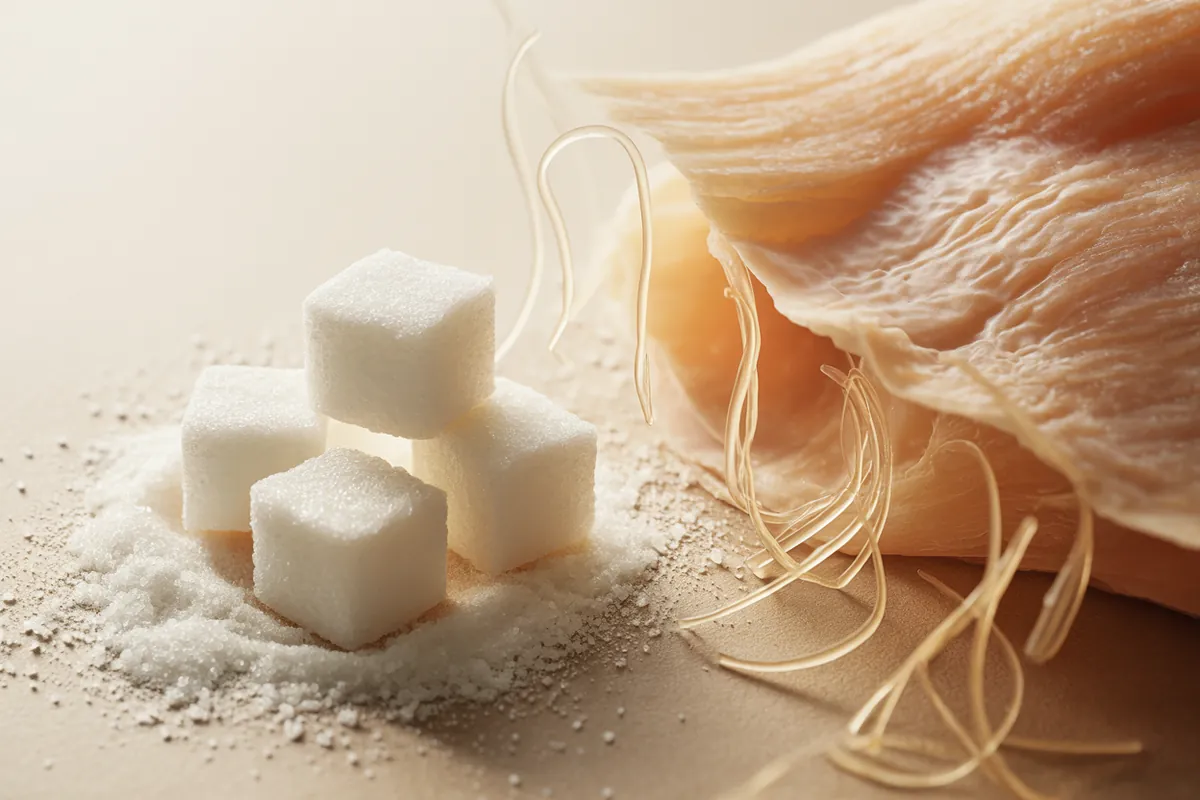
When excess glucose attaches to collagen, it changes the molecule and makes it more brittle. As AGEs accumulate, they form abnormal cross-links — bridges that tie neighboring collagen and elastin fibers together where they should be able to glide and flex independently. Cross-linked collagen is stiffer, more rigid, and less able to be remodeled and repaired by the body's normal turnover. The functional result is the loss of elasticity, the dullness, and the lines and wrinkles we recognize as aged skin. A useful way to picture it: healthy collagen is a supple net; glycated collagen is a net whose strands have been spot-welded together and can no longer spring back.
Dietary drivers: refined sugar, hidden sugars, and high-heat cooking
Patients accumulate AGEs by two routes: the glucose their own bodies generate from a high-sugar diet, and AGEs that are preformed in food before they ever eat it. Both are dietary, and both are modifiable.
The first route is blood-sugar driven. High intake of added sugars — sodas, sweets, and many processed foods — pushes glucose up, and elevated glucose is the raw material for glycation. Dr. Tager is emphatic that much of the sugar people consume is hidden in foods marketed as healthy. Added sugar lurks in breakfast cereals, instant oatmeal, yogurt, granola, protein bars, nut butters, smoothies, packaged fruit in light syrup, pasta sauces, salad dressings, ketchup, and barbecue sauce. He also flags the irony of “detox” juicing: those juices are high in fructose, which is simply another sugar. Helping a patient see where sugar is actually hiding is often more useful than telling them to “eat less sugar.”
The second route is the cooking method. High-temperature cooking — especially grilling and frying — generates dietary AGEs directly. Dr. Tager notes that the advanced glycation end-products from cooking meats at high temperatures increase oxidative stress in the body. The practical implication is not just what a patient eats but how it is prepared: gentler, wetter, lower-temperature methods such as steaming, poaching, braising, and stewing form far fewer AGEs than searing, charring, grilling, and deep-frying. This is one of the cleanest, lowest-friction changes a clinician can recommend.
- Lower the glycemic load — reduce refined and hidden added sugars and refined carbohydrates that spike glucose.
- Hunt for hidden sugars — read labels on “healthy” staples like granola, yogurt, sauces, and smoothies.
- Soften the cooking — favor steaming, poaching, and stewing over grilling and frying to cut preformed dietary AGEs.
- Eat plant-centric and colorful — a broad spectrum of fruits and vegetables brings the antioxidants that help offset glycation-linked oxidative stress.
The blood-sugar and A1c connection
Because glycation tracks with circulating glucose, a patient's blood sugar is, in effect, a dial on their rate of skin aging. This is what makes hemoglobin A1c so useful beyond diabetes screening. As Dr. Tager teaches, an elevated A1c will tip you off to excessive glycation and give you a natural opening to discuss excess sugar consumption, insulin resistance, and diet with the patient — using an objective number rather than a lecture.
It is also a motivational lever. Many patients who are unmoved by abstract talk of cardiometabolic risk pay close attention when the same elevated glucose is reframed as something affecting how their skin looks and ages. This is the heart of Dr. Tager's “Feed Your Skin” orientation: beauty is a powerful motivator, and the appearance angle can move patients toward dietary changes that also serve their long-term metabolic health. The clinical caution is to keep cause and effect honest — A1c reflects average glucose, glycation is one of several aging pathways, and the win is a lower-glycemic pattern, not a single number to chase.
How a lower-glycemic, antioxidant-rich pattern helps
The encouraging part of the glycation story is how directly diet addresses it. Because the process is fueled by glucose and preformed dietary AGEs, the two highest-yield levers are lowering glycemic load and changing how food is cooked — the same moves described above, now framed as protection rather than avoidance.
Layered on top of that is the antioxidant defense. Glycation and oxidative stress are intertwined, so a diet rich in the phytochemicals that act as antioxidants helps the body cope with the oxidative burden that accompanies AGE formation. Dr. Tager's guidance is refreshingly concrete: build the plate around a colorful variety of plants — the flavonoids in berries, onions, apples, and tea; the carotenoids that give carrots, tomatoes, and leafy greens their orange, yellow, and red hues; the broad family of polyphenols — starting with quality and color, then quantity. This is the food-first position, and it is deliberate. As covered in our companion guide on antioxidants and oxidative stress, high-dose isolated antioxidant supplements are not a substitute for a colorful diet and can in some cases be useless or even harmful; more is not better.
This connects glycation to the rest of the nutrition picture. The same lower-glycemic, plant-forward, anti-inflammatory pattern that slows glycation is the foundation of an anti-inflammatory diet and of nutrition for skin health generally. And while protecting the collagen you have is the priority, supporting collagen synthesis matters too — the evidence for collagen supplements on skin elasticity is emerging and modest rather than definitive, and they are best understood as one input alongside adequate protein, not a way to undo glycation.
Putting glycation to work in practice
For a clinician, glycation is valuable precisely because it is teachable, measurable, and modifiable. It gives you a mechanism patients can picture, a lab (A1c) that anchors the conversation in fact, and a short list of dietary changes that move the needle. That combination is unusually motivating — the patient who shrugs at “eat healthier” often leans in when you explain that sugar is literally stiffening the collagen in their face.
The judgment lives in the details: which labs to order and how to interpret them, how to assess and individualize a patient's dietary pattern, how to sequence dietary change before reaching for supplements, and how to fold glycation into a broader precision-nutrition program rather than treating it in isolation. Those assessment protocols, lab-interpretation skills, and program-building frameworks are exactly what Empire's Precision Nutrition training teaches — the curriculum is the product, and this guide is the science behind it.
Bring precision nutrition into your practice
Empire Medical Training's Precision Nutrition Master Training, developed by integrative and functional medicine physician Dr. Mark Tager, MD, teaches the science of glycation, oxidative stress, and skin aging — plus the assessments, lab interpretation, and program-building to translate it into patient care. Available in person and via livestream.
Explore the Precision Nutrition Training → Claim Your Prize!