







 Medically reviewed by
Sherry Wehner, MD
Board-Certified Pathologist & Dermatopathologist; Aesthetic & Wellness Medicine
Medically reviewed by
Sherry Wehner, MD
Board-Certified Pathologist & Dermatopathologist; Aesthetic & Wellness Medicine Allergy blood testing measures allergen-specific IgE antibodies in a serum sample, and for many patients it is the most useful tool a clinician has. It does not require stopping medications, it can be performed when the skin can't be reliably tested, and it can screen a wide allergen panel from a single draw. But it shares the central caveat of all allergy diagnostics: a positive result tells you the patient is sensitized, not necessarily that they are clinically allergic. The number on the report is a starting point for clinical reasoning, never a diagnosis on its own.
This guide sits within Empire's broader Allergy Testing & Treatment resource center, written for clinicians who want a practical overview of when and how to use blood testing. It is clinical education, not medical advice, and nothing here substitutes for proper training, clinical judgment, or current laboratory guidance.
How allergy blood testing works
Allergy is an IgE-mediated hypersensitivity reaction. When a sensitized patient encounters an antigen they react to, that antigen binds IgE antibodies sitting on mast cells, triggering degranulation and the release of histamine and other mediators — the itching, redness, and swelling we associate with allergic disease. Skin testing demonstrates this cascade in vivo by provoking a small, controlled wheal-and-flare. Blood testing measures the same IgE antibodies in vitro, in a tube, without exposing the patient to the allergen at all.
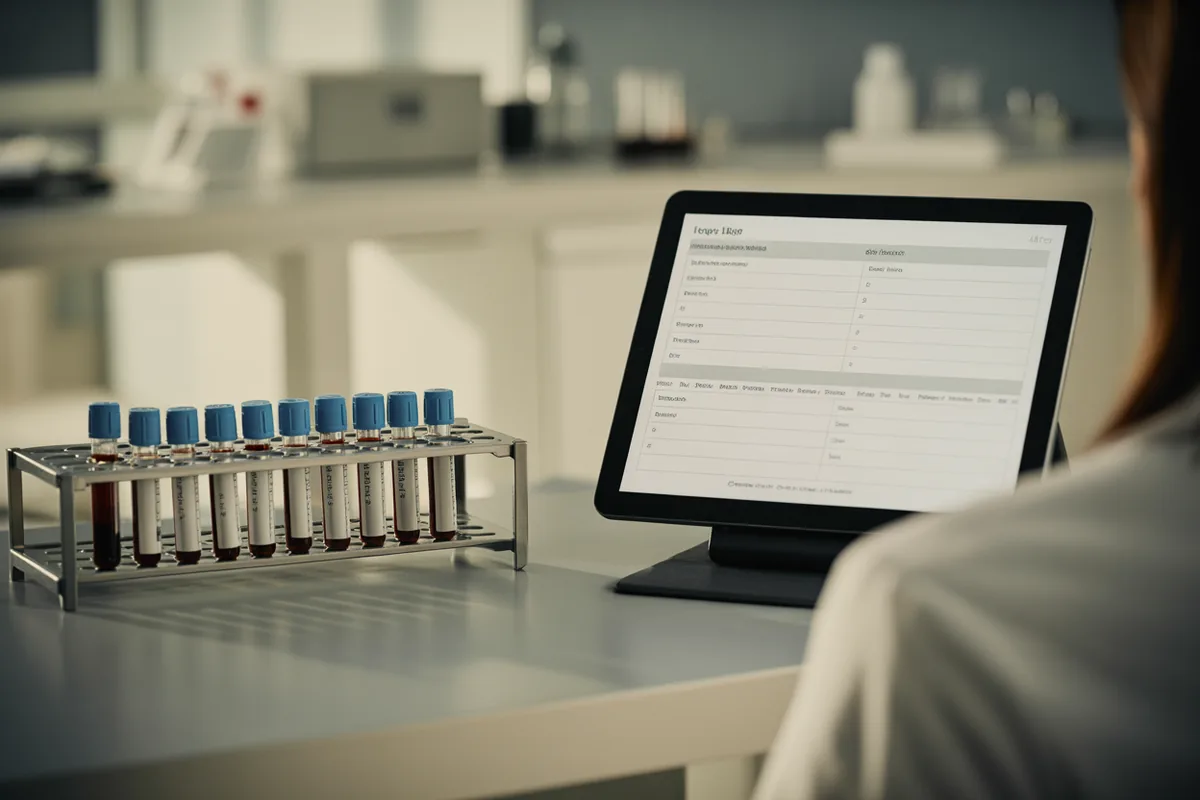
The serum sample is exposed to a panel of allergens bound to a solid phase. If the patient carries IgE against a given allergen, that antibody binds, and a labeled detection antibody quantifies how much is present. The result is reported as an allergen-specific IgE level for each item tested. Because the assay never touches the patient, antihistamines and skin disease — the things that derail skin testing — have no effect on the result.
One practical advantage is breadth: a single blood draw can screen far more antigens than a skin panel. The trade-off is that the in-vitro test is generally less specific than skin testing — it carries both false positives and false negatives — which is why interpretation against the history matters so much.
Specific IgE: ImmunoCAP and the older “RAST” term
The test most clinicians mean when they say “allergy blood test” is the allergen-specific IgE assay. You will still hear it called RAST (radioallergosorbent test) — the original technique used a radiolabeled marker — but that method has largely been retired. Modern laboratories run fluorescent enzyme immunoassays, the most widely used of which is branded ImmunoCAP. When a patient or an older chart references “RAST testing,” they almost always mean a contemporary specific-IgE assay; the terminology lingers even though the chemistry has moved on.
Specific-IgE testing is well suited to the same indications as skin testing — suspected allergic rhinitis, conjunctivitis, eczema, asthma, and IgE-mediated food or insect allergy — and it can test a large list of common allergens from one sample. The key conceptual point is that the assay detects sensitization: the presence of IgE directed at an allergen. Sensitization is necessary for IgE-mediated allergy, but it is not sufficient to diagnose it. Plenty of people carry specific IgE to pollens or foods they tolerate without any symptoms.
Total IgE and what it adds
Laboratories frequently measure a total serum IgE level alongside specific-IgE testing. Total IgE reflects the overall quantity of IgE antibody circulating, and it tends to run elevated in allergic patients — but it is a nonspecific marker and far from diagnostic on its own. It is normal in some allergic patients and elevated in plenty of non-allergic conditions: parasitic infection, certain immunodeficiencies, allergic bronchopulmonary aspergillosis, and various other disease states can all raise total IgE.
The practical takeaway is that total IgE is supporting context, not an answer: a normal level does not rule out allergy, and an elevated one does not confirm it. The diagnostic work is done by the allergen-specific result interpreted against the patient's history.
When blood testing is preferred over skin testing
Skin prick testing is usually the first-line choice for environmental allergens because it is cheap, fast, and gives visible results in about fifteen minutes. But there are well-defined situations where the skin test simply cannot be trusted — or cannot be done safely — and blood testing becomes the better tool:
- Patients who cannot stop antihistamines. Antihistamines suppress the wheal-and-flare and produce false negatives on skin testing. Some patients can't tolerate stopping them for the required several days, or are on long-acting agents or tricyclic antidepressants that interfere. Blood testing is unaffected by these medications.
- Severe eczema or other widespread skin disease. If extensive eczematous dermatitis (or a condition like ichthyosis) covers the forearms and back, there is no clean skin to test and the results can't be read reliably.
- Dermatographism. In this relatively common condition, simply scratching the skin produces a wheal, so every prick looks positive. The skin test is uninterpretable; blood testing sidesteps the problem entirely.
- History of anaphylaxis or systemic reaction. A patient with a history of anaphylaxis is a more complex case often best co-managed with or referred to a board-certified allergist; when testing is pursued, the in-vitro nature of blood testing avoids exposing the patient to allergen.
- Very young children. For children under about two years of age, a single blood draw can be more practical than a multi-site skin panel.
For a side-by-side view of how the two modalities differ in practice, see the comparison below, and the companion guide on skin testing for allergies.
Skin testing vs blood testing: a comparison
Neither test is a stand-alone diagnosis, and the two are best understood as complementary. The table below summarizes the practical trade-offs Dr. Wehner emphasizes in Empire's training.
| Feature | Skin prick test | Blood test (specific IgE) |
|---|---|---|
| What it measures | IgE-driven wheal-and-flare response in the skin (in vivo) | Allergen-specific IgE antibody in serum (in vitro) |
| Speed & cost | Results in ~15 min; inexpensive; visible to patient | Lab turnaround; generally higher cost; requires a draw |
| Affected by antihistamines? | Yes — must be stopped several days prior | No — medications do not interfere |
| Usable with eczema / dermatographism? | No — results become uninterpretable | Yes — skin condition is irrelevant |
| Number of allergens | Limited by available skin sites | Large panels possible from one sample |
| Specificity | More specific, especially for environmental allergens | Generally less specific; more false positives/negatives |
| Best first-line use | Most environmental and many food workups | When skin testing can't be done or trusted |
In short: skin testing is the default workhorse, and blood testing is the reliable alternative for the patients in whom skin testing fails — and either way, the result is the beginning of a clinical conversation, not the end of one.
What the numbers mean — and don't
A specific-IgE report gives a quantitative value for each allergen, and the temptation is to read it as a severity score. It isn't. Higher levels correlate with a higher likelihood that the patient is clinically allergic to that allergen, but they do not predict how severe a reaction would be. A patient with a modest level can have a serious reaction, and a patient with a high level may be tolerating the allergen with no symptoms at all.
This is why a positive result is never self-interpreting. The clinically essential step is correlation with the history: does the pattern of positives match what the patient actually reacts to and when their symptoms appear? A positive IgE to cat dander is meaningful in a symptomatic cat owner and largely irrelevant in someone with no exposure and no complaints. Testing without a clinical question — broad “fishing” panels on asymptomatic patients — predictably turns up incidental positives that confuse more than they clarify.
For environmental allergens in particular, the specific-IgE result also feeds downstream decisions. In skin-tested patients, a defined number of positive environmental allergens is what qualifies a patient for further evaluation and immunotherapy planning — and the exact reimbursement and qualification thresholds, which differ by payer and modality, are covered in Empire's course rather than reproduced here.
Specific IgE is not IgG “sensitivity” testing
This distinction matters enough to state plainly, because it is a common and consequential source of confusion. An allergy blood test measures allergen-specific IgE — the antibody that actually drives IgE-mediated allergic reactions. It is not the same as a direct-to-consumer IgG “food sensitivity” panel, which measures a different antibody entirely.
IgG food panels are not validated to diagnose food allergy, and major allergy organizations such as the AAAAI do not recommend them for that purpose. A positive IgG result frequently reflects nothing more than ordinary exposure to a food — in other words, it can be a marker of tolerance, not reaction. Selling or acting on these panels as if they were allergy tests is both clinically wrong and a real liability. When a patient describes vague, delayed symptoms that suggest a food intolerance rather than a true allergy, the validated practical tool is a structured elimination-and-reintroduction approach, not an IgG panel.
For the full picture of where true IgE-mediated food allergy ends and non-IgE intolerance begins, see food allergies vs food sensitivities, and the cross-cluster guides on food sensitivities and elimination diets and gut health.
Limitations and clinical correlation
Blood testing is a strong tool used in the right context, but its limits are real and worth naming. It is generally less specific than skin testing, so it produces both false positives and false negatives. It detects sensitization only, which must be reconciled with the clinical history before it means anything. And because large panels are so easy to order, it invites over-testing — the more allergens you screen without a clinical question, the more incidental positives you generate.
The discipline that makes blood testing useful is the same discipline that makes all allergy testing useful: test to answer a specific clinical question, interpret the result against the patient in front of you, and remember that a number on a report is evidence, not a verdict. Patients with anaphylaxis history, uncontrolled asthma, or systemic reactions belong with a specialist, and any clinician offering testing must do so with proper training, the right setting, and emergency readiness in place.
Done well, allergy blood testing fills a genuine gap — reaching the patients skin testing can't — and feeds directly into a treatment pathway, from avoidance counseling through immunotherapy for appropriate candidates. The clinical reasoning behind that pathway, including how testing data informs immunotherapy decisions, is exactly what structured training is for.
Add allergy testing to your practice the right way
Empire Medical Training's Allergy Test & Treatment training is a CME-accredited program covering skin and blood testing, result interpretation, immunotherapy, and the practical side of building allergy care into your practice — taught by Dr. Sherry Wehner, MD. Available in person and via livestream.
Explore the Allergy Training → Claim Your Prize!