







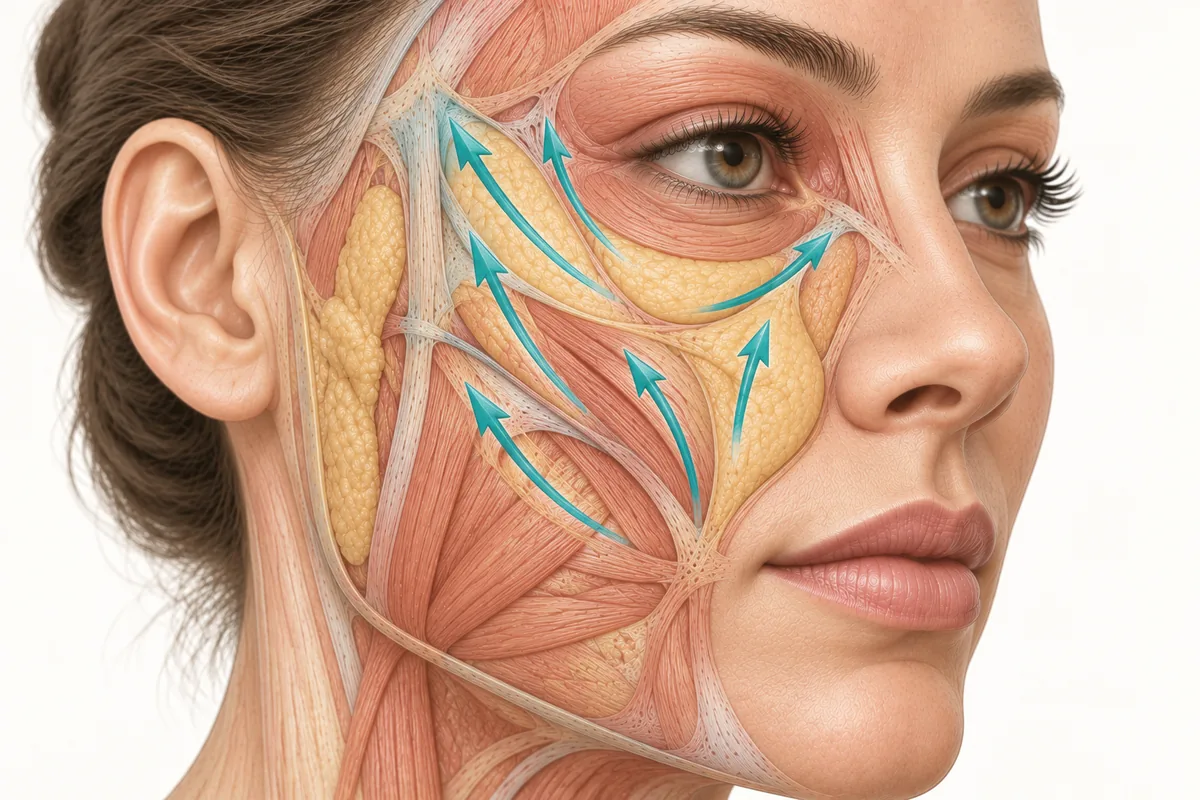
Ask most injectors where the thread lift insertion point goes and they will point at a region. Ask them why it is there and the honest answer is that it looks right. Tatiana Sarmiento, faculty at Empire Medical Training, does something different with the nasolabial vector: she draws two reference lines across the face and puts the entry point where they cross. The mark is not a judgement. It is the output of a construction, and that difference is worth more to a developing injector than any individual landmark.
This article is about that method: why a constructed point beats a judged one, what a reference line has to satisfy to be usable, how to test your own construction, and the direction pair Sarmiento takes from the resulting point. The specific anatomical references she uses are taught where they should be — hands-on, against a real face, with someone checking your marks before you cut a channel.
These techniques reflect Tatiana Sarmiento's clinical practice as taught in Empire Medical Training's hands-on curriculum. Technique is learned under supervision; this article is educational and is not a substitute for training.
Why Eyeballing the Thread Lift Insertion Point Fails
Marking by eye fails in four specific ways, and each of them is invisible to the person doing it.
Faces are asymmetric and the visual system corrects for it without asking. Every face has a higher side, a fuller side and a more descended side. Looking at a patient, you perceive a normalised face — the brain smooths the difference, because that is what it is built to do. Marks placed by eye inherit that correction: they are placed symmetrically on a face that is not symmetric, which means they are placed asymmetrically relative to the tissue they are meant to move.
The same injector marks the same face differently on different days. Lighting, patient position, head tilt, where you are standing and how tired you are all move an eyeballed mark by a few millimetres. In a procedure where the entry point defines the origin of every vector, a few millimetres of drift changes the line across the whole treated region.
An eyeballed mark cannot be audited. When a result is asymmetric, there is no way to determine whether the plan or the execution was at fault, because the plan was never recorded in a form that could be checked.
It cannot be taught. "You'll get a feel for it" is the end of the instruction, which means the skill transfers slowly, inconsistently, and only by watching.
A construction removes all four problems at once, not because geometry is more accurate than an experienced eye, but because geometry is explicit. It can be repeated, compared, corrected and handed to someone else.
What a Thread Lift Insertion Point Construction Is
The structure is simple. You draw two lines across the face, each defined by fixed anatomical references. Where they intersect is the entry point.
That is it — and the power is in the constraints, not the complexity. A construction with two well-chosen lines is more reliable than one with five poorly chosen ones, because every additional line adds another opportunity for a reference to drift.
The four properties a reference must have
Not every landmark can serve as the endpoint of a construction line. A usable reference has to satisfy all four of the following, and most of the landmarks injectors reach for instinctively fail at least one.
1. It must be fixed. The reference cannot move with expression, with speech, with jaw position or with head posture. Bony and cartilaginous landmarks are ideal. Soft-tissue points are acceptable only where they are stable — and "stable" here means stable in this patient, not stable in a textbook.
2. It must be identifiable on both sides independently. A construction that is built on one side and mirrored to the other has smuggled the symmetry assumption back in, which was the problem it was meant to solve. Each side gets its own construction from its own landmarks, and the two entry points will not be mirror images. That is the construction telling you something true about the face.
3. It must be findable without instrumentation. If a reference requires imaging, a measuring device or a particular lighting setup, the method will be abandoned under clinical time pressure. Practical constructions use points you can see or palpate in ten seconds.
4. It must not be on the tissue you are treating. This is the one that is most often violated and it is the most consequential. If a reference point sits on tissue that has descended — or will descend further — then the construction drifts with the pathology. You end up defining your entry point relative to the problem instead of relative to the skull, so the sicker the face, the further off the mark. References belong on structures that have not moved and will not.
Why intersections beat measurements
The obvious alternative to a construction is a measurement: so many centimetres from a named point. Intersections are better for one reason that matters clinically — they scale.
Two lines drawn between fixed landmarks on a large face are further apart than the same two lines on a small face, and their intersection sits proportionally in the same place on both. A fixed measurement does not do this. Applied to a small face it lands too far out; applied to a large one, too far in. Since the anatomy you are trying to reach occupies a proportional position rather than an absolute one, proportional construction is the better instrument.
Ready to put this into practice?
Explore Empire's hands-on, CME-accredited Aesthetic & Injectable Training courses — live patients, expert faculty, and ongoing mentorship.
Sarmiento's construction does include one small linear offset in addition to the two lines — a short measured displacement that fine-tunes the intersection. That is a legitimate hybrid, and it is worth understanding what it costs: the measured component is the part of the construction that does not scale with face size. It is the element to reconsider first when the method is applied to a patient markedly outside the average, and it is the element that most needs to come from supervised instruction rather than from a written description.
From the Insertion Point: the Thread Direction Pair
The construction produces an origin. The treatment is what you do from it, and Sarmiento takes two directions from the nasolabial entry point rather than one:
- One vector directed toward the oral commissure.
- One vector directed toward the jaw.
The pair is the point. A single thread from the entry point produces a line of correction; two divergent threads produce a controlled lifting field with a soft transition into untreated tissue — the same divergence principle that governs the V configuration in the midface. Her own description of the objective is "controlling the lifting effect that you're going to do to this patient," and control is precisely what a direction pair buys over a single vector: the correction is spread across two lines of tissue rather than concentrated on one, and the balance between them is adjustable to the individual pattern of descent.
Validating Your Own Thread Lift Construction
A construction is only as good as its worst reference, and you can test yours without treating anyone.
Mark the same patient twice, an hour apart, without looking at the first marks. Wipe, re-mark from the landmarks, then compare. Meaningful drift means at least one reference is not as fixed or as reproducible as you assumed.
Mark each side blind to the other. Construct the left, cover it, construct the right, then reveal both. Two marks that are perfect mirror images on an asymmetric face suggest you were unconsciously copying rather than constructing.
Cross-check against a manual reposition test. With the patient upright, reposition the tissue with a fingertip along the planned vectors. If the correction you can produce by hand from a point does not match what your construction predicted, either your reference lines or your reading of the descent direction is wrong.
Photograph the marks, every time. Standardised pre-procedure photography with the construction visible is the only way to review a result against its plan afterwards, and the only way to determine whether a poor outcome came from the plan or the execution. Injectors already comfortable with mapped documentation in toxin practice — the same habit that makes a face chart and consistent injection site mapping work — will find the discipline transfers directly.
The transferable lesson
Most of what separates a reproducible injector from an inconsistent one is not manual skill. It is whether the plan exists in a form that can be checked before it is executed.
Constructing an insertion point is a small instance of a large principle: replace judgement with a rule wherever a rule is available, and spend your judgement on the parts that genuinely require it. Where the tissue is descending, which thread family the job needs, whether this patient should be treated at all — those require judgement, and they require all of it. Where the entry point goes, given a decision you have already made, does not.
The landmarks themselves are learned against real anatomy, under supervision, with someone watching your hands. That is what Empire's Advanced PDO Thread Lift Training is for, and the anatomical fluency underneath it is built in Anatomical Based Aesthetics Training and the cadaver-based programme. An article can give you the method. It should not give you the coordinates.
Frequently Asked Questions
Why construct a thread lift insertion point instead of marking by eye?
Because an eyeballed mark is unreproducible, unconsciously symmetrised on an asymmetric face, impossible to audit after a poor result, and difficult to teach. A construction built from fixed anatomical references produces the same point on the same patient every time, reveals genuine asymmetry rather than hiding it, and can be checked by a supervisor before the procedure begins.
What makes an anatomical landmark suitable as a reference point?
It must be fixed — not moving with expression, speech or jaw position — identifiable independently on each side, findable by sight or palpation without instrumentation, and located off the tissue being treated. That last condition is the one most often broken: a reference sitting on descended tissue drifts with the pathology, so the more advanced the laxity, the further the construction strays.
Should both sides of the face be marked the same way?
Both sides should be constructed by the same rule, but the resulting marks will not be mirror images, because faces are not symmetric. Constructing one side and mirroring it reintroduces the assumption the method exists to remove. Mark each side independently from its own landmarks and treat any difference as information about the patient.
How many vectors are taken from the nasolabial insertion point?
Tatiana Sarmiento takes two — one directed toward the oral commissure and one toward the jaw. The divergent pair spreads correction across two lines of tissue rather than concentrating it on one, which gives a softer transition into untreated tissue and allows the balance between the two directions to be matched to the individual pattern of descent.
Disclaimer
This article reflects the clinical opinions and experience of Tatiana Sarmiento, Faculty, Empire Medical Training, an independent faculty member contributing to Empire Medical Training's curriculum. The views expressed are the author's own and do not necessarily represent those of Empire Medical Training.
It is professional education, not medical advice, and is no substitute for hands-on training or independent clinical judgment. Licensed clinicians remain responsible for their own patient selection, technique and outcomes, for verifying current product labelling, and for practising within their scope and applicable law. Empire Medical Training accepts no liability for reliance on this content.



 Claim Your Prize!