







Search for “microblading for hair loss” and you will find pages describing it as a solution that “actually works” where other options failed. That framing is misleading in a specific and important way. Microblading and its scalp-focused cousin, scalp micropigmentation, are cosmetic camouflage: they deposit pigment to create the visual impression of hair. They do not regrow hair, slow hair loss, or treat the condition causing it.
That is not a criticism — camouflage is a legitimate and often excellent option. But it only works as one when everyone involved understands what it is. This guide covers the difference between the two techniques, who each suits, how long results last, the risks, and how they compare with interventions that address hair loss itself.
Microblading vs. Scalp Micropigmentation: Not the Same Thing
These two terms get used interchangeably, and they should not be.
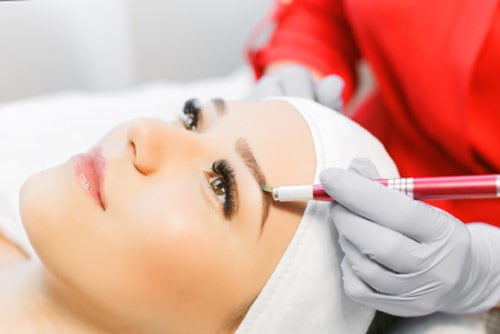
Microblading uses a hand-held tool with a row of fine needles to deposit pigment in linear strokes that mimic individual hairs. It was developed for eyebrows, and that is where it excels: a small, relatively flat area where hair-stroke replication reads convincingly at conversational distance.
Scalp micropigmentation (SMP) uses a machine and a fine needle to deposit thousands of tiny dots, each replicating a hair follicle emerging from the scalp — essentially a pointillist rendering of stubble or density. It was developed specifically for the scalp.
The distinction matters because the scalp is not an eyebrow. It is curved, large, oily, and covered in follicles at varying stages. Hair-stroke work on a scalp tends to blur and spread over time, reading as drawn lines rather than hair — which is why SMP has become the dominant technique for scalp work.
Microblading’s remaining scalp role is narrow: the hairline itself, particularly softening a hard or receded frontal edge, and temple work — small areas where stroke realism matters and the strokes can follow an existing growth pattern. Some practitioners combine both, using strokes at the hairline and dots for density behind it.
What These Techniques Can and Cannot Do
Be precise about this, because the entire consultation depends on it.
What they do: reduce the visual contrast between scalp and hair; create the appearance of density where hair has thinned but not disappeared; redefine or soften a receded hairline; camouflage a widening part, temple recession, or a scar, including donor-site scarring from a previous transplant; and create the appearance of a closely shaved head on someone fully bald.
What they do not do: regrow hair, slow or reverse ongoing loss, treat androgenetic alopecia or any other underlying condition, or add any physical thickness. The hair on the head afterward is exactly the hair that was there before.
The mechanism explains both the appeal and the limits. Thinning hair is conspicuous largely because of contrast: pale scalp visible through darker hair. Pigmenting the scalp collapses that contrast, and the same amount of hair suddenly looks like more — a genuine visual effect achieved without touching a follicle, which is why it works instantly and why it does nothing for the condition.
Who These Techniques Suit
Good candidates generally include:
- Diffuse thinning with hair still present. The sweet spot. Existing hair provides texture and dimension; pigment supplies the background. The result reads as density.
- Patients who accept a shaved or very short look. For men with advanced male-pattern loss, SMP imitating a close buzz is one of the most convincing applications available — because stubble genuinely is a field of dots.
- Scar camouflage — blending strip-harvest or FUE donor scarring into surrounding density.
- Widening parts and temple recession in women. Female pattern loss frequently preserves the frontal hairline while thinning behind it, which suits camouflage well.
- Patients with realistic expectations who understand they are buying an appearance, not a treatment.
Poorer candidates:
- Large, completely bald areas on someone who wears longer hair. Pigment on bare scalp has no texture, dimension, or shadow. Under direct light it reads as what it is — and the mismatch against longer hair elsewhere makes it more obvious, not less.
- Actively, rapidly progressing loss. Pigment is placed against today’s hair pattern. If that pattern is moving quickly, today’s convincing hairline becomes next year’s stranded island of pigment sitting in front of nothing.
- Undiagnosed hair loss — covering up an unexamined symptom is not neutral. See below.
- Keloid-prone skin or a history of poor healing.
- Patients who want their hair back. They are asking for something this cannot give them, and taking their money anyway is how you produce a disappointed patient.
Get the Diagnosis First
Hair loss is a symptom, not a diagnosis — the point most content on this topic skips. Androgenetic alopecia is by far the most common cause, but not the only one. Alopecia areata is autoimmune. Telogen effluvium follows physiological stressors and is often self-limiting, meaning some patients who camouflage it would have recovered anyway. Thyroid disease, iron deficiency, and certain medications all cause hair loss. Scarring alopecias are the serious one: they destroy follicles permanently and progressively, and pigmenting over an active, undiagnosed scarring process while it advances underneath is a genuinely bad outcome.
Work out why the hair is falling out, address what can be addressed, let things stabilize, then consider camouflage for what remains. Camouflaging first means the diagnosis may never happen — the prompt to investigate has been covered up.
Ready to put this into practice?
Explore Empire's hands-on, CME-accredited Functional & Regenerative Medicine courses — live patients, expert faculty, and ongoing mentorship.
How Long Results Last — and How They Fade
Neither technique is permanent, and both fade. Pigment is placed relatively superficially and the body gradually breaks it down and clears it.
Microblading strokes on the scalp often need refreshing within roughly a year, sometimes sooner. SMP generally holds longer — commonly a few years. Variation is wide, and not random: the main drivers are sun exposure (the largest factor, and the scalp is the most sun-exposed skin on the body), skin oiliness, pigment formulation and placement depth, and individual immune clearance.
Fading is not only about intensity — it is about how pigment ages, which is the risk patients understand least. Hue shifts over time, and the classic failure is a blue, grey, or reddish cast where black or brown was intended. Strokes blur and spread, turning a hair-stroke hairline into a soft smudge. This is a maintenance commitment, not a one-time purchase, and the honest consultation says so.
Risks and Complications
These are needle-based procedures depositing foreign material into skin. The risks are real, if generally modest:
- Infection from inadequate sterile technique or poor aftercare.
- Allergic reaction to pigment — uncommon but difficult to manage, because the antigen is distributed through the dermis and cannot simply be removed.
- Granuloma formation, and keloid or hypertrophic scarring in predisposed patients.
- Color migration and hue shift — the most common source of dissatisfaction, and not fully preventable.
- Poor design. An age-inappropriate hairline is a real complication, not a matter of taste. A hairline drawn where a 20-year-old’s would be, on a 55-year-old face, does not read as hair.
- MRI considerations. Some pigments contain metallic oxides, and reports exist of pigmented areas causing discomfort or artifact during MRI. Patients should disclose scalp pigmentation before imaging.
Correction is harder than placement. Removal requires laser tattoo removal or similar approaches with inconsistent results — some pigments respond, others darken paradoxically when treated. That asymmetry is the argument for conservative design and an experienced practitioner.
How This Compares to Actual Hair-Loss Interventions
Camouflage is not a competitor to hair-loss treatment — it addresses a different problem, and the two are frequently combined. The interventions that act on hair itself include:
- Topical minoxidil — the long-standing over-the-counter option; requires continuous use, and benefit regresses on discontinuation.
- Finasteride — a prescription 5-alpha-reductase inhibitor for androgenetic alopecia in men, with a side-effect profile requiring a real conversation with a prescribing clinician, and important restrictions in women of childbearing potential.
- Platelet-rich plasma (PRP) — injection of the patient’s own concentrated platelets into the scalp, typically as a series. The evidence base is developing and preparation protocols vary between systems.
- Hair transplantation — surgical relocation of follicles; the only intervention that puts hair where there was none, and the most invasive.
- Low-level laser therapy — devices marketed for hair growth, with a mixed evidence base.
All prescribing and treatment decisions belong with a qualified clinician who has evaluated the patient. Nothing here is a recommendation for any individual.
The useful framing: treatment protects the hair a patient has; camouflage improves how it looks. Many patients are best served by both. Camouflage alone, on an actively progressing and untreated process, is the combination most likely to disappoint.
Frequently Asked Questions
Does microblading for hair loss actually work?
It works as camouflage, and can work well. It does not work as a hair-loss treatment, because it does not do anything to hair. It deposits pigment that makes existing hair look denser by reducing the contrast with the scalp beneath. If the goal is to look like you have more hair, it can deliver. If the goal is to have more hair, it cannot.
Does microblading cause hair loss?
It is not a recognized cause in the ordinary case. The theoretical concern is trauma-related: needle work is a minor injury, and scarring from a poorly performed procedure could damage follicles in the treated area. Appropriately performed pigmentation on a healthy scalp is not expected to cause hair loss — but patients with a scarring alopecia or inflammatory scalp condition should be evaluated before any needle work.
Which is better for the scalp — microblading or scalp micropigmentation?
For most scalp applications, SMP. The dot technique replicates emerging follicles more convincingly across the curved, oily surface of a scalp, and holds up better over time. Microblading’s hair strokes retain a role at the hairline and temples, where stroke realism matters and the area is small.
Can it be removed if I do not like it?
With difficulty and without a guarantee. Removal typically requires laser tattoo removal, results vary by pigment, and some pigments darken paradoxically when lasered. Placement is far easier than removal — which is the case for conservative design and an experienced, careful practitioner.
Train in Aesthetic Procedures With the Judgment to Match
The recurring failure in this corner of aesthetics is not technical — it is a consultation problem. A patient asks for their hair back, a provider sells them pigment, and the mismatch surfaces months later. Knowing what a procedure does, who it suits, and when to say no is the difference between a satisfied patient and a difficult one.
Empire Medical Training has trained healthcare professionals in aesthetic medicine since 1998, with CME-accredited, hands-on programs built around patient selection and clinical judgment rather than technique alone. Our Empire Clinical Fellowship covers a broad procedural skill set for clinicians building an aesthetic practice, and our Cosmetic Laser Training covers energy-based treatment, including the skin-type and patient-selection considerations that determine outcomes. See also our guides to becoming a cosmetic laser technician and the nurse esthetician role.




 Claim Your Prize!