







Most new injectors plan their training in what feels like a sensible order: learn the foundational treatments first, get comfortable injecting, and take the anatomy class later, once it will make sense.
Empire faculty who teach that anatomy class think the order is exactly backwards, and they are unusually united about it.
The Order Students Choose, and Why They Choose It
Michelle Langston hears the same reasoning repeatedly.
“Students look at it and they say, I'm going to take all these classes first, and then take the anatomy class, because then I'll know what it means,” she says. “I'm like, oh no, let's take it back.”
The instinct is understandable. Anatomy sounds advanced. It sounds like the class you earn. And there is a quiet assumption underneath that you need context before the detail will stick.
Her counter is that the sequence inverts what each class can do for you: “You want to take that class first so that you have seen it, touched it, felt it, injected it, and then peeled back the layers — so that when you take those other classes, you're armed with that knowledge.”
What Changes When Anatomy Comes First
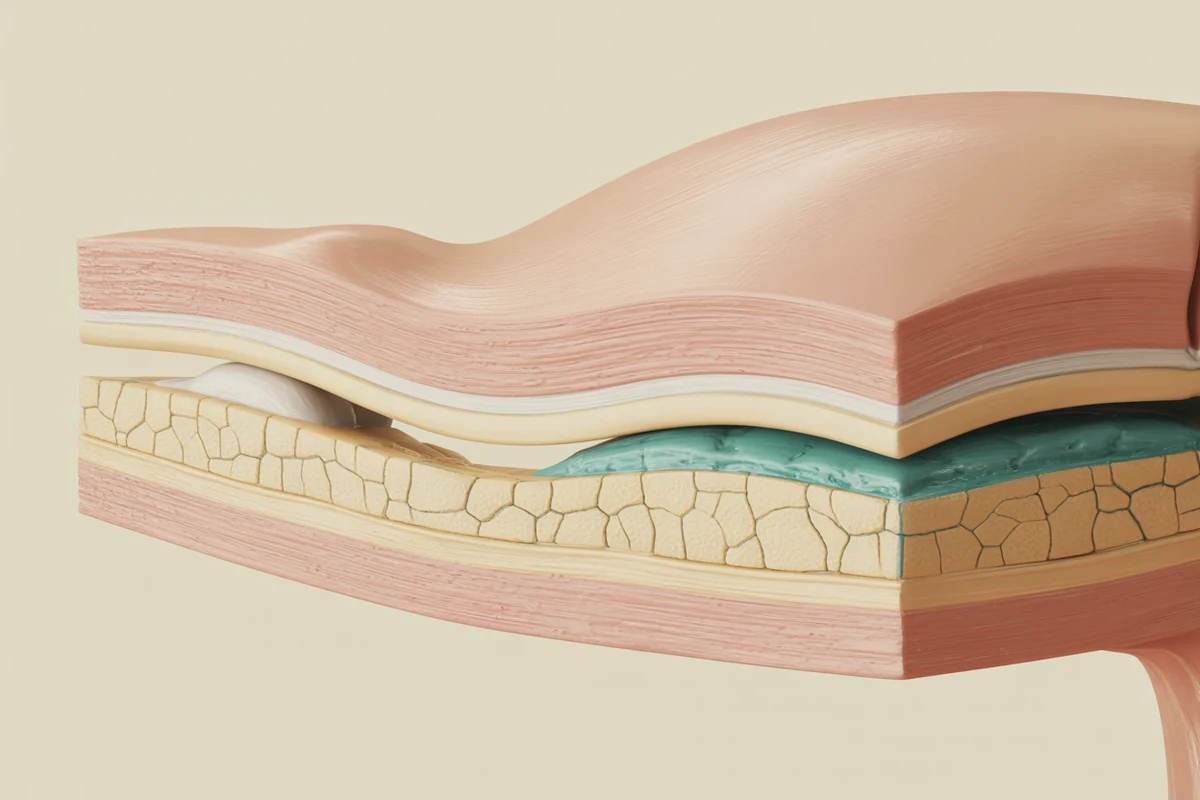
The difference is between learning a pattern and understanding a plane.
Take anatomy last and the foundational classes teach you where to place product. You learn points, doses and patterns, and they work, because they are correct for most people. What you do not have is the reasoning underneath them, which means you cannot adapt when a patient does not match the pattern.
Take anatomy first and every subsequent class lands differently. Langston makes the point about advanced work specifically: if a student has not taken facial anatomy, then when they reach advanced filler, contouring, microneedling and biostimulator work, “if they don't understand what plane they're in, I think they're cheating themselves a little bit.”
Melissa Pulcini-Buttine PA, who has taught anatomy for fourteen years, is blunter still: “I personally don't think anyone should be injecting without taking that class. And I'm going to stand on that.”
It Replaces Fear With Knowledge
There is a second argument, and it is about confidence rather than competence.
New injectors carry a lot of anxiety about complications, and anxiety is a poor operating state. Langston frames the class as the remedy: “We can replace that fear with knowledge.”
Pulcini-Buttine sees it as the most rewarding thing about teaching it. Students are not just learning layers and vessels, she says — they come to understand why they are injecting where they are injecting, and watching that confidence grow is her favourite part of the class.
Confidence built on understanding behaves differently from confidence built on repetition. It survives the patient who does not look like the diagram.
Ready to put this into practice?
Explore Empire's hands-on, CME-accredited Aesthetic & Injectable Training courses — live patients, expert faculty, and ongoing mentorship.
Why a Textbook Is Not a Substitute
Dr. Jennifer Thomas-Goering explains what cadaver work gives you that reading cannot.
“You can't appreciate anatomy flipping through the pages,” she says. “You can't see where those blood vessels are deep or where they become more shallow. A video's nice, but I'm a very tactile learner. So I really need to be touching the face and doing the dissections.”
Depth is the variable that matters most and the one a diagram represents worst. A page shows you a vessel's path. It does not give you the felt distance between a safe plane and a lumen, and that distance is what technique is actually controlling.
The variation is the other thing dissection teaches. Pulcini-Buttine, despite teaching the subject, keeps taking the class: the more heads she dissects, the more she appreciates how much the facial artery differs from person to person. Landmarks turn out to be probabilities rather than certainties — the lesson behind a patient who had occlusions at three different practices.
Take It Again After a Year
The recommendation that surprises people most is that anatomy is not a box to tick once.
“Not only foundational,” Pulcini-Buttine says. “After you are injecting for a year, I think you should take it again, because you're going to learn different things.”
The reason is that you arrive with questions the second time. A year of injecting produces specific puzzles — the patient whose result was asymmetric, the region that always bruises, the plane you were never quite sure about — and dissection answers those in a way it cannot answer questions you have not yet had.
A Sensible Order
Drawn from what faculty actually recommend:
- Facial anatomy, early. Ideally within the first three to six months, before or alongside your foundational injecting classes.
- Foundational neurotoxin and dermal filler. The bread and butter, and now with reasoning attached.
- Complete facial aesthetics, covering skin — Tatiana Sarmiento's point being that clinicians arriving from hospital practice often have no grounding in skin types, skincare or hyaluronic acid molecular weight.
- Consultation skills. Langston puts the winning consultation among her first five for a reason.
- Complication management.
- Anatomy again, a year in.
Empire teaches the anatomy layer, including cadaver dissection, in Anatomical Based Aesthetics Training, with foundations in Complete Botox Training and Complete Dermal Filler Training.
Frequently Asked Questions
Should I take facial anatomy before or after learning to inject?
Faculty who teach it recommend before, or early alongside foundational classes. Taking it first means every subsequent class is understood as reasoning rather than memorised as a pattern, which is what allows you to adapt when a patient does not match the standard.
Is a cadaver anatomy course worth it for injectors?
Faculty argue it teaches two things a textbook cannot: depth as a felt distance rather than a printed figure, and the sheer extent of anatomical variation between patients. Both directly affect injection safety.
Should experienced injectors retake anatomy?
Faculty who teach the subject still take it, on the basis that a year of clinical experience produces specific questions that dissection can answer, and that variation becomes more apparent the more specimens you see.
What should a new injector take first?
A commonly recommended order is facial anatomy early, then foundational neurotoxin and dermal filler, then complete facial aesthetics covering skin, then consultation skills and complication management — with anatomy revisited after about a year.
Disclaimer
This article is educational and is not medical or legal advice. Scope of practice and training requirements vary by state. Injection technique is learned under direct supervision, and clinicians remain responsible for practising within their scope and applicable law.




 Claim Your Prize!