







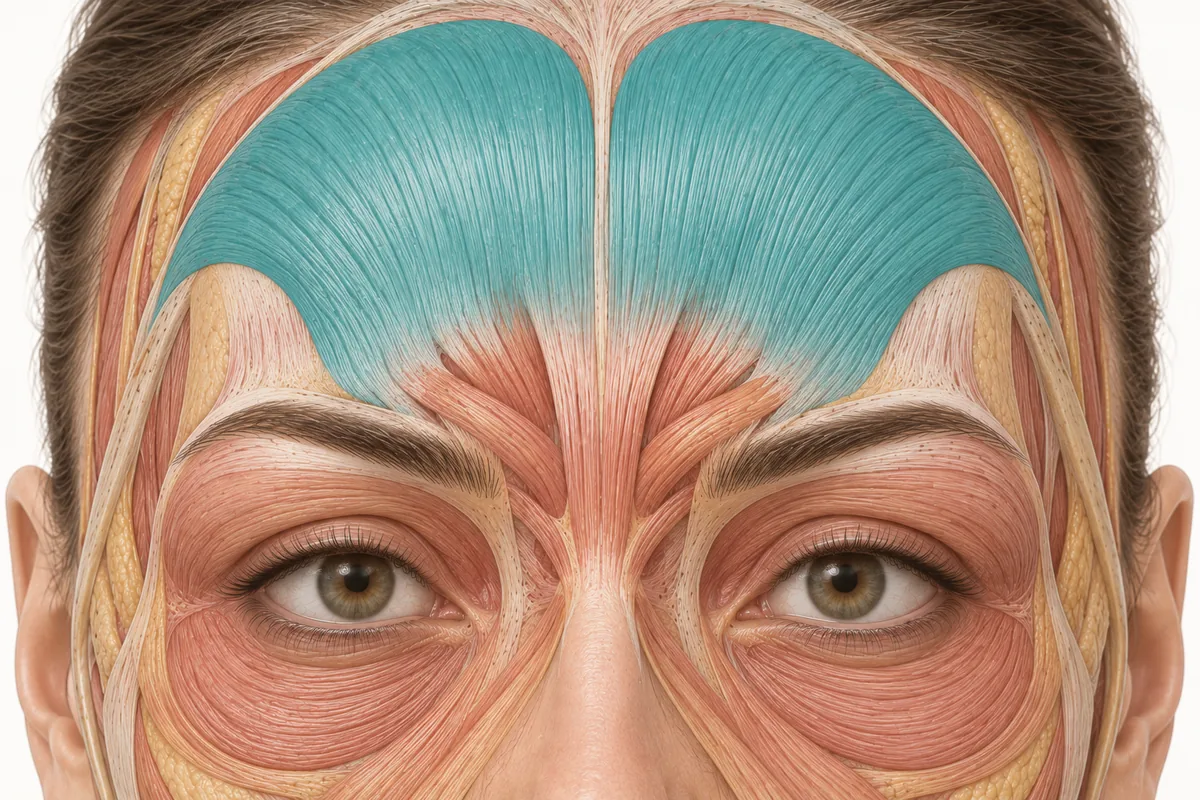
A patient tells you that the last three times her elevens were treated, her brow dropped. Repeated brow ptosis after botox is one of the few pieces of consultation history that carries genuine diagnostic weight, and most injectors waste it — either by quietly attributing it to whoever went before, or by promising to be more careful. Melissa Pulcini-Buttine, PA treats it as a finding instead:
"Prior toxin history is very important. If the patient comes in and they said the last three times that I had my elevens treated I had eyebrow ptosis, you need to start to think about anatomy. So yes, it could be the injector hitting the wrong muscle. But if it happened three times with three different injectors, I would start to think about that patient's variety in anatomy and why that may be happening."
This piece is about turning that instinct into an intake procedure: what to ask, what the answers discriminate between, and what the plan becomes when the answer points at the patient rather than at the technique.
Repeated Brow Ptosis After Botox Is a Finding
The reasoning is simple and it is worth making explicit.
Technique error is operator-specific. Anatomy is patient-specific. If an outcome recurs across different operators, the patient-specific explanation gains ground, because the operator-specific one would have had to fail independently three times in the same direction.
The published critique of templated approaches points the same way: standard on-label patterns were built around registration trials rather than real-world practice, and a single injection pattern applied to every patient fails to address individual anatomical variation, with brow ptosis and unnatural brow shape among the documented consequences (Aesthetic Surgery Journal Open Forum 2025;7:ojaf032). A patient who reliably gets brow descent from the standard glabellar pattern is telling you something true about her own anatomy.
So the intake question is not "was it the injector or the patient." It is what this patient's anatomy needs that a standard pattern does not supply.
The intake, question by question
Seven questions. None take long, and the first three do most of the work.
1. How many episodes, and with how many different injectors? One episode is an event. Three episodes with one injector is a technique pattern. Three episodes with three injectors, using approaches the patient describes differently, is an anatomical signal.
2. Which areas were treated each time? Melissa's example is specific — "my elevens treated" — and that specificity is diagnostic. Brow descent after glabella-only treatment has a different mechanism from brow descent after forehead treatment. The first suggests the glabellar points reached medial frontalis fibres; the second suggests the frontalis was doing load-bearing work. If the patient has only ever had glabellar treatment and still gets ptosis, that narrows the field considerably.
3. What exactly dropped? Patients say "my eye drooped" for two entirely different complications with different muscles, mechanisms and timelines. The brow ptosis versus true eyelid ptosis differential is covered in its own resource in this cluster and the intake should establish which one occurred, because a history of true lid ptosis changes the plan in a different direction.
4. When did it appear, and how long did it last? Onset within a few days and resolution over roughly the toxin's course is consistent with a direct muscular effect. A drop the patient describes as arriving later in the first week points elsewhere. Duration that substantially outlasted the rest of the treatment's effect is worth probing.
5. Do you have photographs? Ask for phone photographs from the affected period and from before it. Patients almost always have them, and they resolve in seconds arguments that history-taking cannot settle.
6. What was used, and roughly how much? Product and dose if known, and whether it changed between episodes. If the ptosis occurred at widely different doses, dose is not the variable.
7. Did anything else change? Heaviness on reading, difficulty keeping the eyes open at the end of the day, awareness of raising the brows to see. These are compensation symptoms and they change the interpretation of everything above.
What Patient Anatomy Means in Repeated Brow Ptosis
Vague appeals to anatomical variation are not useful. There are four specific, documented findings that produce this history, and each implies something different about the plan.
The compensated brow. The most common and most important. Ageing of the upper face — widening of the bony orbital aperture, loss of fat support, increased tone in the brow depressors — contributes to brow descent with or without upper lid dermatochalasis. Those changes can obstruct the upper outer quadrant of the visual field, producing compensatory activation of the frontalis in many patients who present for cosmetic forehead treatment. The patient does not know she is doing it. Relax that muscle and you have not caused brow descent; you have removed the compensation holding it up. From the patient's side the distinction is invisible, and she reports a complication.
A corrugator tail that runs where the pattern does not expect. The lateral tail's orientation and extent vary between patients and between sides. A standard lateral glabellar point placed on a patient whose tail runs differently can sit high enough to reach frontalis fibres — producing medial brow depression from what was supposed to be a depressor treatment.
Muscle depth that is not the standard depth. High-frequency ultrasound of 127 adults found relative side-to-side asymmetry coefficients reaching 40 percent for upper facial muscle thickness and depth, with some muscles reaching 50 percent, and moderate correlation between BMI and the depth of the forehead muscles (Toxins 2025;17(12):595). A depth that reliably reaches the corrugator in most patients will overshoot or undershoot in others.
Pre-existing asymmetry that became visible. More than 88 percent of people have asymmetric brow positions at baseline. Some patients reporting post-treatment asymmetry are reporting a baseline state that became noticeable once movement stopped masking it.
What the plan becomes
When the history points at the patient, five things change — and none of them is "be more careful."
Ready to put this into practice?
Explore Empire's hands-on, CME-accredited Aesthetic & Injectable Training courses — live patients, expert faculty, and ongoing mentorship.
Test for compensation before anything else. Ask the patient to close the eyes, relax completely, then open without raising the brows. A brow that drops on relaxation was being held up by effort. In that patient, frontalis treatment is not a routine part of the plan; it is a discussion with a named trade-off.
Find the line of convergence dynamically. Have the patient elevate the brows maximally while you rest an index finger on the central forehead without pressure, and locate the level at which the contracting skin pushes the finger neither up nor down. That level is this patient's boundary, and it replaces every fixed measurement from the orbital rim.
Stage the treatment. This is the patient for whom a two-visit approach is correct rather than cautious. Treat the depressors, review at two weeks, and decide about the frontalis with the depressor effect already visible. Melissa's standing rule is that the frontalis and the glabellar complex are an antagonist pair and should be planned together; staging the execution across two visits respects the pair while removing the compounding.
Change the restraint, not the courage. If frontalis treatment is indicated, limit by dose and height across the full width of the muscle rather than by leaving a territory untreated. Partial-width treatment produces compensatory recruitment in the untreated fibres, which is a different and equally unwelcome outcome. Dose selection for this region is covered in botox dosages for the forehead and frontalis area.
Document the baseline in animation. Photographs at rest and at maximal elevation, both sides, before anything is injected. In a patient with a history of this complaint, an animated baseline is the difference between a finding and an allegation.
The conversation about the previous injectors
There is a right answer to "so my last injector did it wrong?" and it is not yes and not no.
The accurate version is that the brow is a balance between one elevator and several depressors, that where that balance sits differs substantially between people, and that a pattern which suits most patients can be wrong for a particular one. Then say what you are going to do differently — the finger test, the compensation test, the staged approach — because a patient who has had the same disappointing outcome three times has usually been told "I'll be careful" three times, and hearing a specific method is what makes the visit different.
It is also worth naming the possibility before treating rather than after. If this patient is compensating, the honest statement is that relaxing the forehead may reveal a brow position her own muscle has been holding up, that this is a property of her anatomy rather than an error, and that it is temporary. Empire's guidance on what to include in botox consent forms covers the documentation; the conversation itself is what prevents the complaint.
When Brow Ptosis After Botox Really Is Technique
Do not over-rotate. Several patterns point back at execution rather than anatomy, and missing them is its own failure.
A single episode with one injector, with no recurrence, is an event. Episodes that occurred with one injector and not with others, at similar doses, point at that injector's pattern. A patient who describes the marks as having been placed noticeably close to the brow is describing a placement problem. And a history of true eyelid ptosis rather than brow descent is a different complication with a different cause and belongs to a different analysis entirely.
The value of the intake is not that it always exonerates the previous clinician. It is that it tells you which variable to change.
Reading history as anatomical evidence is the same skill as reading movement, applied to a longer timescale. Empire's anatomical based aesthetics training and cosmetic neurotoxins training both work through the structural reasoning this kind of consultation depends on.
The clinical reasoning above reflects Melissa Pulcini-Buttine's practice as taught in Empire Medical Training's hands-on curriculum. Technique is learned under supervision; this article is educational and is not a substitute for training.
Melissa Pulcini-Buttine, PA is a physician assistant of two decades and has been a professor of anatomy and physiology for approximately fourteen years. She is a faculty member at Empire Medical Training and the founder of an aesthetics practice in Greenwich, Connecticut.
Frequently Asked Questions
When does repeated brow ptosis indicate the patient's anatomy rather than injector error?
When it has recurred across different operators. Technique error is operator-specific; anatomy is patient-specific, so an outcome that repeats across injectors points at the patient. The published critique of templated on-label patterns points the same way: a single injection pattern applied to every patient does not address individual anatomical variation, and brow ptosis is among the documented consequences.
What is a compensated brow and why does it matter?
A brow held up by chronic, unconscious frontalis recruitment, usually secondary to brow descent, upper lid dermatochalasis or age-related loss of support obstructing the upper outer visual field. Relaxing the frontalis removes the compensation rather than causing a new problem, but the patient experiences and reports it as a complication.
How do I test for frontalis compensation in the consultation?
Ask the patient to close the eyes, relax completely, then open them without raising the brows. A brow that drops on relaxation was being held up by effort. Ask also about heaviness when reading, difficulty keeping the eyes open late in the day, and awareness of lifting the brows to see.
Why is measuring a fixed distance above the orbital rim not enough?
Because the level that matters is the patient's own line of convergence — the height at which frontalis movement reverses direction — and it is found dynamically, not measured. Melissa Pulcini-Buttine identifies it with the patient elevating the brows, on both sides, before anything is marked, and treats it as the boundary for that patient rather than applying a population distance.
What should I change for a patient with this history?
Test for compensation, identify the line of convergence dynamically rather than by measurement, stage treatment across two visits by treating the depressors first and reviewing at two weeks, limit any frontalis treatment by dose and height rather than by leaving territory untreated, and photograph an animated baseline before injecting.
Disclaimer
This article reflects the clinical opinions and experience of Melissa Pulcini-Buttine, PA, an independent faculty member contributing to Empire Medical Training's curriculum. The views expressed are the author's own and do not necessarily represent those of Empire Medical Training.
It is professional education, not medical advice, and is no substitute for hands-on training or independent clinical judgment. Licensed clinicians remain responsible for their own patient selection, technique and outcomes, for verifying current product labelling, and for practising within their scope and applicable law. Empire Medical Training accepts no liability for reliance on this content.



 Claim Your Prize!