







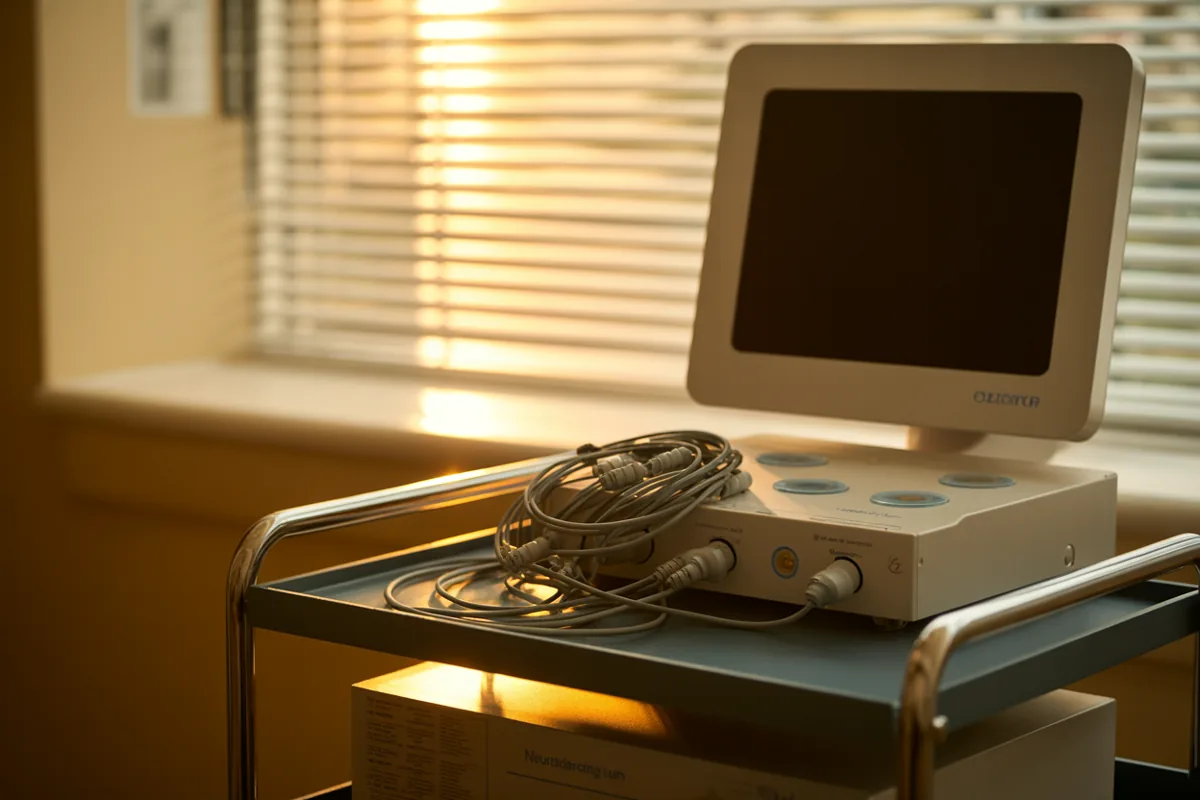
The question clinicians ask about electrodiagnostic testing is almost always a money question: does adding nerve conduction studies and needle electromyography to an outpatient practice make financial sense? No article can answer that for you. What it can do is put the real codes, the real inputs to Medicare payment and the real rules in front of you, so the arithmetic is yours to run on your own volume and locality.
One framing point first: electrodiagnostic testing has a documented history of billing scrutiny, so add it because the questions already exist in your charts, not because a purchase needs justifying. Empire’s post on the pain management procedures with the highest return in a medical clinic makes the general service-line case.
Two different studies, two different code families
Nerve conduction studies assess the nerve itself: stimulate at one point, record at another, and read velocity, amplitude and latency to separate demyelinating from axonal processes. Needle electromyography assesses muscle and its innervation with a needle electrode, at rest and during contraction. The coding follows that split.
Nerve conduction studies are reported with a single code chosen by the total number of studies performed: 95907 for one to two, 95908 for three to four, 95909 for five to six, 95910 for seven to eight, 95911 for nine to ten, 95912 for eleven to twelve, 95913 for thirteen or more. Per AANEM’s Recommended Policy for Electrodiagnostic Medicine (updated January 2023), one study means one sensory conduction test, one motor conduction test with or without an F-wave, or one H-reflex test. Each study type on each nerve counts once even if you stimulate several sites along it — extra units for “inching” are inappropriate — bilateral counterparts may be counted separately, and only one code from 95907–95913 may be reported per patient per day.
Needle EMG has two tracks, and confusing them is the most expensive error in this family. The limb codes 95860 (one extremity), 95861 (two), 95863 (three) and 95864 (four), and the limited code 95870, are used only when no nerve conduction studies are performed the same day. When both are done the same day, the needle examination is reported with the 2012 add-on codes — 95885 (limited, four or fewer muscles, per extremity), 95886 (complete, per extremity) or 95887 (non-extremity muscles) — in addition to the nerve conduction code. AANEM defines a complete limb study as muscles innervated by three or more nerves or four or more spinal levels, a minimum of five muscles per limb: what separates 95886 from 95885. Confirm descriptors against a current CPT codebook.
What CY2026 Medicare Pays for NCV and EMG Testing
Two facts sit next to every number below. CY2026 has two Physician Fee Schedule conversion factors: $33.5675 for services furnished by a qualifying alternative payment model participant and $33.4009 for everything else (CY2026 final rule, 90 FR 49266), so no sentence beginning “Medicare pays” is correct in 2026 unless it names which factor. And CMS’s relative value file publishes no national payment column for these codes: the dollar figures below are arithmetic — CMS’s CY2026 total relative value units multiplied by the non-qualifying-APM factor, all geographic indices set to 1.000. The relative values are verified CMS data; the products are ours.
| CY2026 code | What it reports | Total RVU | Global, national unadjusted | Professional component (modifier 26) |
|---|---|---|---|---|
| 95907 | NCS, 1–2 studies | 2.82 | $94.19 | $53.44 |
| 95908 | NCS, 3–4 studies | 3.54 | $118.24 | — |
| 95909 | NCS, 5–6 studies | 4.25 | $141.95 | — |
| 95910 | NCS, 7–8 studies | 5.53 | $184.71 | $106.21 |
| 95911 | NCS, 9–10 studies | 6.59 | $220.11 | $132.60 |
| 95912 | NCS, 11–12 studies | 7.63 | $254.85 | — |
| 95913 | NCS, 13 or more studies | 8.98 | $299.94 | $187.71 |
| 95885 | Needle EMG add-on, limited, per extremity | 1.93 | $64.46 | $18.37 |
| 95886 | Needle EMG add-on, complete, per extremity | 2.99 | $99.87 | $45.43 |
| 95887 | Needle EMG add-on, non-extremity | 2.64 | $88.18 | $37.07 |
| 95860 | Needle EMG, one extremity, no same-day NCS | 3.58 | $119.58 | $51.44 |
| 95870 | Needle EMG, limited, no same-day NCS | 2.59 | $86.51 | — |
Read the table with its labels attached. The year is CY2026 and the conversion factor is $33.4009, the non-qualifying-APM factor, with the qualifying-APM factor about half a percent higher. Every amount is a national, unadjusted allowed amount before geographic practice cost adjustment, so it is not what a clinician in any particular locality is paid. And an allowed amount is not a deposit: Medicare pays 80 percent of it, the beneficiary owes the coinsurance, and any sequestration reduction applies on top. Commercial, Medicaid and workers’ compensation schedules sit above or below these numbers. For a CMS-stated figure, query the CMS Physician Fee Schedule Look-Up Tool for your locality.
NCV and EMG Billing: Facility vs Non-Facility
Every code here carries CMS professional/technical indicator 1: the study splits into a professional component (modifier 26) and a technical component (modifier TC), the unmodified code being the global service. CMS also flags the facility setting “NA” on the global and technical-component lines, so there is no facility global payment — the global code is priced as an office service.
Resist both shortcuts: facility and non-facility do not pay the same, and non-facility does not simply pay more. The setting changes who bills what. An office lab that owns the equipment and interprets bills the global code and receives the whole amount; in a hospital, the interpreting physician bills with modifier 26 and the facility is paid separately for the technical side. For 95913 in CY2026 that is roughly $188 professional against roughly $300 global — not a discount, but the technical component no longer being yours to bill.
Who May Perform and Supervise NCV and EMG Studies
Published advice goes wrong here in both directions. In CMS’s CY2026 file, nerve conduction codes 95907–95913 carry physician supervision indicator 09, “concept does not apply” on the global, modifier-26 and modifier-TC lines: Medicare’s general, direct and personal supervision levels are not assigned to those codes, so it is false to write that the Physician Fee Schedule requires direct supervision of nerve conduction studies.
Direct supervision is still the standard to work to, because it is AANEM’s standard and it reaches your claims through coverage policy rather than a supervision indicator. AANEM accepts nerve conduction studies performed by a physician or by a trained individual under direct supervision — the physician in close physical proximity to the laboratory while testing is underway and immediately available to assist and direct. Medicare’s office-setting definition is presence in the office suite and immediate availability throughout, and CMS states that services furnished without the required supervision are not reasonable and necessary: that language in your contractor’s policy is the hook. CMS also states diagnostic tests cannot be billed as “incident to” services.
On needle EMG, two standards genuinely conflict, and you should know both. AANEM’s position is that the needle examination must be performed by a physician specially trained in electrodiagnostic medicine, because the test is performed and interpreted simultaneously; AANEM states that it, the AMA, the American Academy of Neurology, AAPM&R and the Department of Veterans Affairs hold that only physicians should perform needle EMG, and names physical therapists, chiropractors and physician assistants among those it considers untrained for it. CMS assigns supervision indicator 6A to the technical component of those codes, contemplating the work being done by a physical therapist certified by the American Board of Physical Therapy Specialties as a qualified electrophysiologic clinical specialist where state law allows, with only that therapist able to bill. Neither erases the other: the CMS indicator is not AANEM approval, and AANEM’s position is not a Medicare prohibition. How they interact in your state turns on your practice act — the architecture set out in our overview of whether physician assistants can perform pain management injections. Scope is state- and facility-specific, and no article substitutes for the practice act or your privileging file.
The Cost Lines That Decide In-House NCV and EMG
Capital equipment is the visible cost and usually the smallest part of the picture. Add consumables per study, the time of a competent technologist (or your own) to set up, position, control limb temperature and recognize artifact, and billing staff who have worked unit-based, edit-heavy codes. Interpretation time is the real constraint, and a coverage requirement rather than a preference: policy requires interpretation on site and in real time. Confirm in writing with your malpractice carrier that the service is covered, and remember that equipment amortizes over studies you perform and collect on, not studies you could bill — the reasoning behind Empire’s post on building revenue around conservative and interventional pain care.
Ready to put this into practice?
Explore Empire's hands-on, CME-accredited Pain Management & Interventional Therapies courses — live patients, expert faculty, and ongoing mentorship.
The edit rules that cause the denials
Start with the bundling trap. Medicare’s National Correct Coding Initiative bundles 95907–95913 against each of the limb EMG codes 95860, 95861, 95863 and 95864 at modifier indicator 0. When a limb needle EMG code and a nerve conduction code are billed for the same day, the nerve conduction code is denied and no modifier can override it. The same applies to 95867–95870. Report the needle examination with 95885, 95886 or 95887 instead. NCCI also pairs every nerve conduction code against every lower one at indicator 0, which is how the one-code-per-day rule is enforced.
Then the unit caps. Medically unlikely edits allow one unit per day for 95907–95913, for 95887 and for each of 95860–95869, four units for 95885, 95886 and 95870, and two for 95905. The nerve conduction codes and the add-on EMG codes carry MUE adjudication indicator 2, which CMS describes as a claims-processing restriction that may not be overridden on reopening or redetermination — those denials are not appealable in the ordinary way, while the limb EMG codes carry indicator 3 and can be.
The rest is coverage policy, and it is contractor-specific: the verified electrodiagnostic policies are Novitas LCD L35081 and Palmetto GBA LCD L35048, and a rule in one jurisdiction is not the rule in another, so read your own. L35081 requires the two studies to be performed and interpreted together, on site and in real time. It covers nerve conduction studies without needle EMG only for patients on anticoagulants, significant lymphedema in the affected limb, and carpal or tarsal tunnel evaluations with specified diagnosis codes — the exception rather than the normal practice pattern. It does not cover point-of-care devices incapable of real-time waveform display and analysis, or template-driven devices applied routinely to all patients. Studies beyond the CPT Appendix J maximums are denied, and the contractor treats two studies per twelve-month period per diagnosis per provider as suitable for most conditions, three for motor neuron disease and plexopathy. Documentation must carry the indication, the nerves and muscles tested, the findings, a diagnostic impression and the normal value range for your device.
Behind those parameters sits AANEM’s table of the maximum studies needed to diagnose 90 percent of cases — seven nerve conduction studies and one limb of needle EMG for unilateral carpal tunnel, ten and three for polyneuropathy — which AANEM says is not an absolute threshold and is not additive across two diagnoses.
The sequence that answers the question honestly
Work it in order: count the questions already in your charts, build interpretive competence before buying anything, verify scope and payer policy for your setting, set the documentation standard on day one, and only then run the economics. Electrodiagnostic data earns its place when it changes the interventional plan, and our reference on interventional pain management procedures maps where that decision sits.
Frequently asked questions
Is NCV and EMG testing profitable to add to a practice?
It depends on variables no article can know: your volume of appropriate clinical questions, your contracted rates by payer, your setting, and whether you have the interpretation time. The table gives you the Medicare side of the arithmetic; practices where it works are already referring out studies they could do themselves.
What do nerve conduction studies and needle EMG pay?
Using CMS’s CY2026 relative values and the CY2026 non-qualifying-APM conversion factor of $33.4009, national unadjusted allowed amounts compute to about $94 for 95907 (one to two studies) and about $300 for 95913 (thirteen or more), with the complete needle EMG add-on 95886 at about $100. Those are computed figures, not amounts CMS publishes; they precede geographic adjustment, and Medicare pays 80 percent of the allowed amount.
Who can perform NCV and EMG studies?
AANEM holds that needle EMG must be performed by a physician trained in electrodiagnostic medicine, and that nerve conduction studies may be done by a trained individual under direct physician supervision. CMS does not mirror that: indicator 09 on the nerve conduction codes means supervision levels are not assigned, while 6A on the needle EMG technical component contemplates a certified physical therapist where state law allows. Verify your practice act, contractor policy and privileges.
What causes electrodiagnostic claims to be denied?
Most often the bundling edit: a limb EMG code billed on the same day as a nerve conduction code denies the nerve conduction code, with no modifier override. After that, unit caps under medically unlikely edits, some not appealable; utilization above the contractor’s twelve-month parameters; interpretation not done on site and in real time; and non-covered device categories.
What training is required to offer electrodiagnostic testing?
No single national credential authorizes it. Authorization comes from your state scope of practice and your facility privileges; training establishes the competence those bodies evaluate. Our guides on choosing an accredited pain management CME program and how CME training and a fellowship differ explain what a certificate does and does not establish.
Where to build the competence first
If your charts say the clinical need is real, the training comes before the equipment. Empire’s NCV and EMG Training is built for clinicians adding electrodiagnostics to an outpatient practice; the course page carries the current format, dates and agenda along with the Certificate of Completion it awards. Profession-specific overviews cover physicians adding EMG and NCV testing and chiropractors evaluating electrodiagnostic testing, and the pain management training academy lists the rest of the curriculum.
Be clear-eyed about what training does. A certificate documents that you completed instruction; it does not authorize you to perform or bill a study. That authority comes from your license, your state’s scope rules and your privileges.




 Claim Your Prize!