







“Certification” is not a protected word in pain management education. The same term appears on a multi-day accredited conference, on a single-procedure hands-on workshop, and on recorded lectures that end with a downloadable PDF. Only some hold up when a credentialing committee asks what you trained in and how anyone knows you can do it.
The differences are documentable. Below are the checks worth running before you commit the tuition. The last reframes the rest: a CME certificate is a record of education, not a permission slip.
1. Is the Pain Management CME Accreditation Real?
Start with the accredited provider, not the brand on the brochure. For an activity to be certified for AMA PRA Category 1 Credits™, the provider must be accredited either by the Accreditation Council for Continuing Medical Education (ACCME) or by a recognized state medical society — the AMA’s own requirement for its credit system, current as of September 17, 2026. So the question is short and answerable: which accredited organization certifies this activity?
Many legitimate programs answer with a joint providership, where an accredited provider certifies an activity another organization develops and delivers. Empire’s Pain Management Training program, THE Pain Show, is accredited for 25.25 AMA PRA Category 1 Credits™, jointly provided by AKH, Inc, and Empire Medical Training. If you are not a physician, a different accreditor may matter, and your board decides what it accepts; Empire’s guide to pain management certification for nurses covers how that differs by profession.
2. Does the credit designation read exactly right?
Credit wording is prescribed rather than decorative, and sloppiness is diagnostic. The correct designation is AMA PRA Category 1 Credits™. Copy claiming an activity is “AMA approved,” offering unnamed “CME units,” or inventing a credit type with the vendor’s own initials is not using the designation the credit system defines.
Then check how the figure is attached. A credit figure belongs to one activity in one format, and the same curriculum delivered differently is a different number. Empire’s Joint, Extremity and Non-Spinal Injection Training carries 6.75 credits in person and approximately 4.5 by livestream. A program quoting one figure for every way you can attend has not done that work.
3. Does the Pain CME Program Include Hands-On Work?
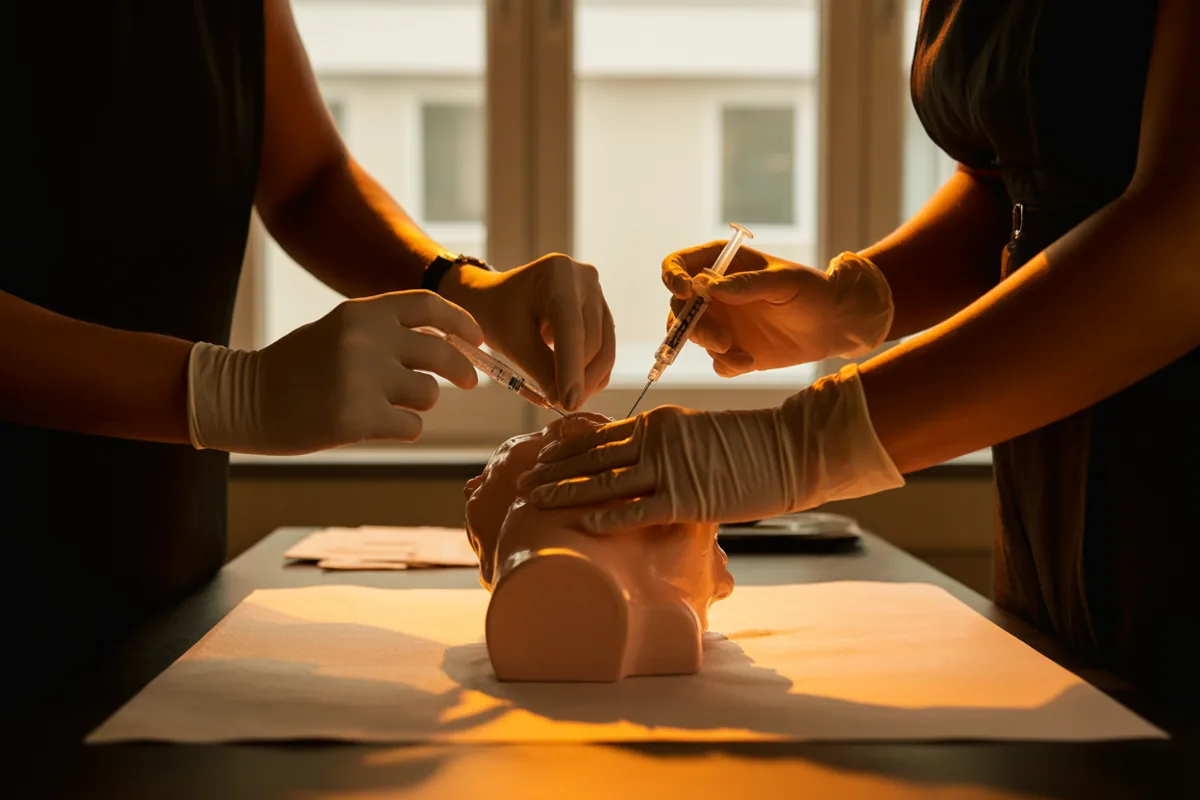
Didactic teaching does real work: indications, patient selection, the evidence for and against a procedure, and documentation. What it does not do is transfer psychomotor skill. If you are buying the course to start performing an injection you do not currently perform, the hands-on design is the specification to read hardest, and livestream carries a lower credit figure for a reason: it is not supervised time with a needle in your hand.
Ask what you will work on, how many stations there are, the faculty-to-participant ratio, whether you inject or observe, and whether ultrasound is in your hands or demonstrated from the front of the room. Ask which procedures have a hands-on component, because a course can cover twenty topics didactically and put four on a table. Empire’s trigger point injection training guide and its walk-through of joint injection training for knees, shoulders and hips show how specific this gets.
4. Who Teaches the CME, and Do They Perform These Procedures?
Faculty should be identifiable before you register: named, with a practice you can look up, and actively performing what they teach. Ask whether the faculty on the marketing page are the ones scheduled for your date, and whether the program says plainly that faculty can vary. Ask for the faculty disclosure statement too.
5. Is the curriculum published before you pay?
The full agenda should be published in advance: topics, hours for each, which segments are didactic and which are hands-on, and what the program does not cover, which is what weak programs omit. A course listing thirty procedure names without saying which are taught in depth is asking you to buy the headline.
Transparency also lets you sequence your own training. A broad accredited conference maps the field; single-procedure workshops build depth once you have decided. Empire’s reference guide to interventional pain management procedures sets out the procedure classes and where their evidence and guidelines conflict — a better starting point than any course catalog, ours included. The course list sits on the pain management training academy page.
6. Is anything assessed, or is the certificate for attendance?
Ask what the certificate is issued for. A document recording participation is not evidence of measured performance. Pre- and post-testing, case-based exercises and an observed technique check are all things a program can do; find out which this one does.
Honestly, most procedural CME in pain management documents participation rather than certified competence, and for most of these procedures there is no external skills examination to sit. So plan what CME does not cover: keep your own procedure log from the first case forward, and arrange local proctoring with a colleague who already performs the procedure. Accrediting bodies generally expect a period of focused evaluation when a clinician first exercises a new privilege, and a proctoring record is what satisfies it.
7. Does it teach the regulatory layer, and is that layer current?
Pain practice is regulated in three places at once — federal registration conditions, state licensure requirements and payer rules — and the content moves. A program that skips this is selling half of what you need; one that teaches it out of date is worse.
Ready to put this into practice?
Explore Empire's hands-on, CME-accredited Pain Management & Interventional Therapies courses — live patients, expert faculty, and ongoing mentorship.
The federal obligation comes first. The Consolidated Appropriations Act, 2023 created a one-time, eight-hour training requirement for all DEA-registered practitioners except those who are solely veterinarians, on the treatment and management of patients with opioid or other substance use disorders. It took effect June 27, 2023, is satisfied at your first applicable registration or renewal, and is attested by checkbox on DEA Forms 224 and 224a; the provision now sits at 21 U.S.C. § 823(m), formerly § 823(l). Not every eight-hour course qualifies: the training must come from the bodies DEA lists and cover the required content. Empire’s MATE Act compliance post has the mechanics.
State CME is second, and it differs in kind as well as amount: some states impose a one-time career requirement, some one every renewal cycle, some a longer interval, and at least one has no general mandate. Florida requires DEA-registered prescribers to complete a two-hour board-approved controlled-substance prescribing course at each biennial renewal, and its topic list was amended effective July 1, 2026 to add pain treatment for patients with sickle cell disease (Fla. Stat. § 456.0301, as amended by ch. 2026-6; checked September 17, 2026). Confirm your own requirement with your board, and see pain management CME requirements by state for the states we verified. The federal obligation and a state requirement are legally separate; one course can often count toward both, but satisfying one does not satisfy the other.
Third, use telemedicine as the freshness test. The baseline is the Ryan Haight Act in-person evaluation requirement at 21 U.S.C. § 829(e). As of September 17, 2026 the flexibilities for prescribing controlled substances by telemedicine sit under a temporary rule running through December 31, 2026 (90 FR 61301), and the special registration framework DEA proposed in January 2025 (90 FR 6541) was not finalized, so there is nothing to apply for. Materials calling the flexibilities permanent, or special registration open, date the whole module. Empire’s telehealth pain management piece is date-stamped for that reason, and this may change again.
8. What a Pain Management CME Certificate Establishes
This is the criterion most course marketing gets wrong, so here it is without hedging: completing an accredited course does not qualify you to perform a procedure as a legal matter. Authorization comes from two other places — your state scope of practice, which sets what your license permits, and facility privileges, which set what you may do inside an institution. A certificate is evidence you put in front of both, not a decision by either.
The privileging side is concrete. Under the Medicare hospital Conditions of Participation the governing body must ensure the criteria for medical staff selection are individual character, competence, training, experience and judgment (42 CFR 482.12(a)(6)), and privileges are granted by that body on the medical staff’s recommendation, under bylaws describing what a candidate must meet (42 CFR 482.12(a)(2); 482.22(c)(4)). Federal regulation does bar a hospital from making privileges depend solely on certification, fellowship or specialty-society membership (42 CFR 482.12(a)(7)) — but read that precisely. It forbids those as the only criterion. It does not entitle anyone to a privilege, and a hospital remains free to weigh fellowship training as one factor in a multi-factor evaluation. Many do. Appraisal is periodic (42 CFR 482.22(a)(1)), so competence is something you keep demonstrating.
On board certification the answer is clean: CME cannot confer subspecialty board eligibility in pain medicine. The American Board of Psychiatry and Neurology requires 12 months of ACGME-accredited pain medicine training, and the American Board of Physical Medicine and Rehabilitation requires satisfactory completion of 12 months of an ACGME-accredited pain medicine fellowship, both checked September 17, 2026. No CME activity meets that condition. Empire’s comparison of CME-accredited pain training and a pain medicine fellowship sets out what each path is for.
So what does documented CME contribute? A dated, verifiable record from an accredited provider that you completed training in a named procedure, with hours and content stated — one line in a credentialing file, and a line committees look for. The American Academy of PAs describes institutional review of privilege requests as verifying credentials and reviewing documentation of additional relevant training, previous privileges and procedure logs, CME, or skills assessment under direct observation (AAPA issue brief, September 2019). CME fills that item and none of the others. Before you add a procedure, confirm in writing with your malpractice carrier that it is covered, and ask what documentation they require.
Frequently asked questions
What is the best pain management CME course?
No program is best for every clinician, and an answer that does not ask about your license, your setting and what you intend to perform is a sales answer. The best program for you names its accredited provider, publishes its agenda before you pay, matches its hands-on design to what you plan to offer, and dates its regulatory content.
What does accredited actually mean for a CME program?
For AMA PRA Category 1 Credits™ it means the activity was certified by an organization accredited by the ACCME or by a recognized state medical society, the AMA’s stated requirement as of September 17, 2026. Accreditation says the activity met a provider standard; it says nothing about whether you are authorized to perform a procedure.
Is a pain management certificate the same as board certification?
No, and the two are not on the same ladder. A course certificate or CME transcript documents education you completed. Subspecialty board certification in pain medicine is granted by a certifying board and conditioned on 12 months of ACGME-accredited fellowship training at both ABPN and ABPMR.
How many pain management CME credits do I need?
That depends on what the credits are for, and there are at least two answers. Your renewal total and any pain or controlled-substance topic requirement are set by your state board. The federal DEA training obligation is a separate one-time eight hours tied to your registration. One course can often count toward more than one, but assuming that satisfying one satisfies another is the expensive mistake.
Does online or livestream CME count?
Frequently yes. DEA states that training meeting the federal requirement may be delivered in classroom settings, in seminars at professional society meetings, or as virtual offerings, and state boards commonly accept accredited online activities — confirm the format rules with your board. Format matters most for procedural skill: livestream versions of a hands-on program carry a lower credit figure and no supervised injection time.
How Empire answers these criteria
Empire builds its pain curriculum to survive these checks. THE Pain Show is accredited for 25.25 AMA PRA Category 1 Credits™, jointly provided by AKH, Inc, and Empire Medical Training — a named provider, the correct designation, and a figure tied to one specific program. For depth in one area, Joint, Extremity and Non-Spinal Injection Training carries 6.75 credits in its complete in-person hybrid form and approximately 4.5 by livestream. The agenda, the hands-on segments and the faculty for each date are published on the course pages — which is the point of this post: verify them yourself, on every program you consider, ours included.
And keep the distinction that matters most. What Empire provides is accredited education and the documentation of it. What authorizes you to perform a procedure is your state scope of practice and your facility’s privileging decision — neither of which any course can issue.




 Claim Your Prize!