







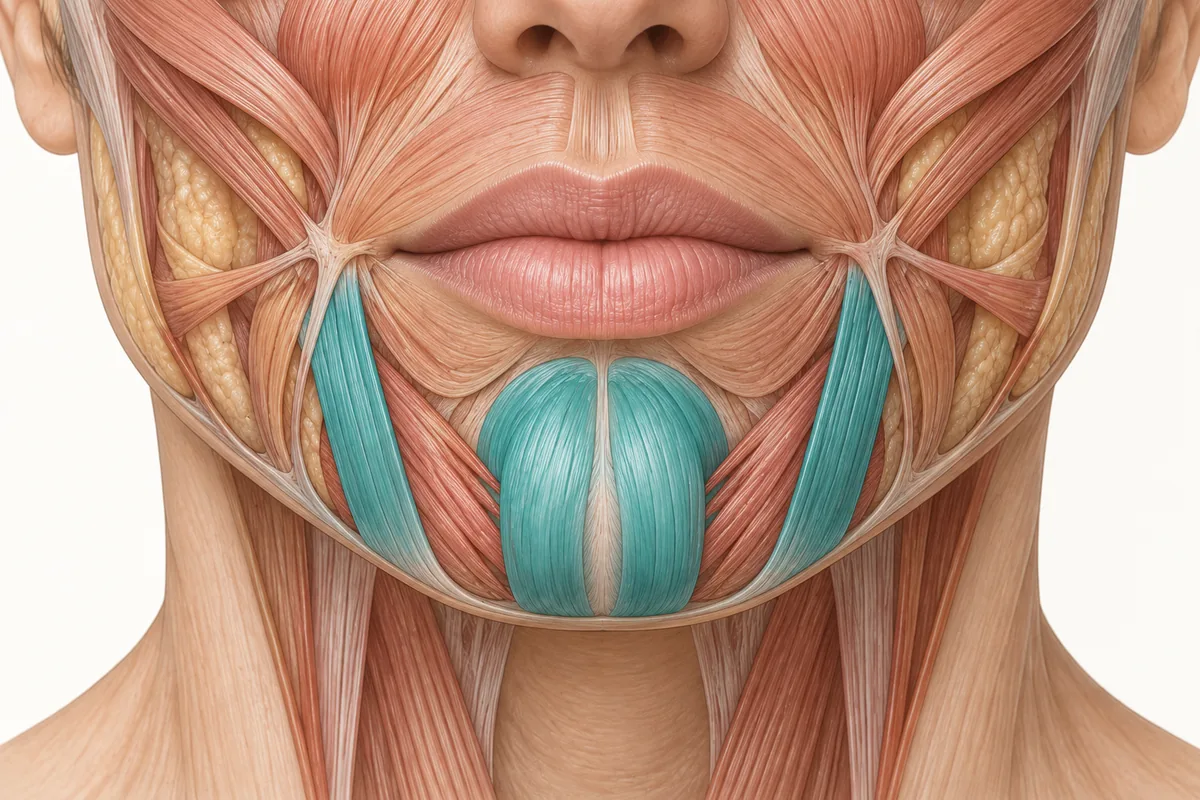
The mentalis follow-up visit is not a courtesy appointment and it is not quality assurance. In the chin, more than in any other region treated with neurotoxin, it is where the treatment is actually decided — because the first appointment cannot tell you which part of the muscle is driving the problem, and the second one can. Melissa Pulcini-Buttine, PA describes the moment plainly: "If they come back at their two-week checkup and they have more dimpling and still pulling here, I could go very superficial and help with the chin dimpling."
That sentence contains a two-visit model rather than a touch-up. This piece is about how to run the second visit deliberately: what to capture at visit one so that visit two is informative, what the residual pattern is actually telling you, and what the reassessment legitimately changes. It is not a chin injection guide — Empire already covers the region for readers who want the site overview, in botox chin dimpling and the best chin botox injection sites.
Why Mentalis Botox Specifically Needs a Two-Week Check
Most regions produce a result at two weeks that is a scaled version of what you intended. The chin frequently produces something different in kind, and there are three anatomical reasons.
The mentalis has motor territory in two places. Mapping of the muscle's motor endplates finds them in both the superior and inferior portions, with a predominance in the superior location: the superior endplates concentrated within a relatively delimited area and the inferior ones distributed more widely through the caudal portion of the muscle. They lie approximately between 25 and 50 percent of the distance from the inferior border of the lower lip vermilion to the median inferior border of the mandible (Toxins 2026;18(8):332). A treatment weighted to one portion can produce a substantial effect and still leave a working segment. That residual segment is not a failure; it is information, and it only becomes visible once the treated portion has fully set.
The muscle does two visible things. Mentalis activity produces chin tension and the pebbled, orange-peel dimpling patients complain about, and the two do not necessarily resolve together. A patient can lose the tension and retain the dimpling, which tells you something specific about where the remaining activity is.
The neighbours constrain what could safely be done at visit one. The mentalis intermingles laterally with the depressor labii inferioris, and Melissa's reasoning about the second pass is explicitly shaped by that: "Why am I going to stay superficial? Because this DLI, which I do not want to hit, is a very deep muscle." The safe second move is not simply more of the first move. It is a different move, chosen because of what lies beneath.
What the Residual Chin Dimpling Pattern Tells You
At the review, the question is not "did it work." It is "what is still moving, and where."
Dimpling with no tension. The bulk of the muscle has responded and a segment closer to the skin is still producing the surface irregularity. This is the presentation Melissa's superficial second pass addresses, and it is the commonest reason a chin needs two visits.
Tension with no dimpling. The reverse distribution. Worth documenting, because it changes how you weight the first treatment next cycle rather than what you do today.
Neither improved. Now the differential opens. Either the treatment did not reach functional muscle, or the presenting problem was never primarily muscular. Chin surface irregularity has a volume component in a meaningful number of patients, and treating a volume problem with toxin produces exactly this result. Facial volume loss is the relevant reading, and the honest reassessment includes asking whether the original diagnosis was right rather than adjusting the dose of a treatment aimed at the wrong target.
Improved but the patient is unhappy. A separate finding again, and one the review visit exists to surface. Often the complaint has migrated: with the dimpling gone, the patient is now looking at a fixed crease that was always there. A crease that persists at complete rest has a dermal component that toxin does not address, which is the distinction covered in dynamic vs static wrinkles.
Something moved that should not have. Any asymmetry of lower lip depression, any change in the smile, any report of difficulty with speech or drinking. This is the finding that reorders the visit entirely, and it is the reason the review is booked rather than offered.
What to Capture at the First Mentalis Botox Visit
A review visit is only as good as the baseline it is compared against. Four things, none of them time-consuming.
Animated photography, not resting. Photograph the chin at rest, in forced chin elevation or lower-lip pursing, and in a full smile. The resting photograph is the least useful of the three and it is the one most practices take alone. Without an animated baseline you cannot distinguish a new asymmetry from the one the patient walked in with.
The patient's complaint in their own words. "Golf ball chin," "it puckers when I talk," "my chin looks tense" and "there's a line there" are four different presenting problems with four different two-week questions.
Which portion you treated and at what weighting. Not just the total. The review is a comparison between what you treated and what is still working, and that comparison is impossible from a units-only note.
Whether there was baseline asymmetry. Nearly every face has some. Recorded at visit one it is a finding; discovered at visit two it is an accusation.
Booking the Mentalis Botox Follow-Up Properly
Two practical points make the difference between a review system and an optional appointment.
Ready to put this into practice?
Explore Empire's hands-on, CME-accredited Aesthetic & Injectable Training courses — live patients, expert faculty, and ongoing mentorship.
Book it at the time of treatment, not afterwards. A review the patient has to request is a review that only unhappy patients attend, which means you only ever see the failures and never learn the distribution of your own results. Booked prospectively, it becomes a data source.
Book it at two weeks, not at one. Neurotoxin continues to set in for up to a fortnight, so a chin assessed at day five is a moving target, and a second pass placed then is dosing an effect that has not finished arriving. The general timing rule for corrective intervention is covered elsewhere in Empire's neurotoxin material; the chin-specific reason to respect it is that the superior and inferior portions of the mentalis may not reach full effect at the same moment, and the residual pattern — the entire point of the visit — is not readable until both have.
There is a reasonable counter-argument worth acknowledging. A published frontalis protocol reporting a touch-up rate of around nine percent concluded that routine two-week reassessment appointments might not be necessary for that region (Toxins 2025;17(12):594). That may well be right for the forehead. It does not transfer to the chin, where the second pass is not a correction of an error but a planned response to information that only exists after the first treatment has set.
What the Two-Week Mentalis Botox Visit Legitimately Changes
Three things, in decreasing order of frequency.
The distribution within the muscle. Adding to the portion still working, at a depth chosen by what lies beneath it rather than by what was used the first time. This is Melissa's superficial second pass, and its logic is entirely about the DLI sitting deep to the region in question. The technique itself is learned under supervision — it is the kind of manoeuvre where the difference between adequate and excessive is not describable in a sentence.
The plan for next cycle. The most undervalued output of the visit. What you learn at two weeks should change the first treatment three months later, so that the same patient eventually needs one visit rather than two. An injector who runs review visits and never changes their initial approach is collecting data and discarding it.
The diagnosis. If nothing moved, the reassessment is the appropriate moment to revisit whether this was a muscular problem at all.
What the Follow-Up Does Not Change
It does not change the dose upward simply because the patient wants more effect. The chin's constraint is anatomical rather than pharmacological: the mentalis is the only elevator of the lower lip and provides its primary vertical support, and its lateral fibres run into the DLI's territory. "More" is not a free parameter here in the way it is across a broad forehead.
And it does not become an immediate-correction visit when a functional asymmetry appears. If the lower lip is not depressing symmetrically, the review visit's job is to document it accurately, explain the timeline honestly — it resolves on the toxin's own schedule over months — and discuss whether balancing the intact side is appropriate. That is a conversation, not a same-day procedure.
Working through region-by-region reasoning of this kind, with the anatomy visible rather than inferred, is the substance of Empire's advanced botulinum toxin and filler training and anatomical based aesthetics training.
The clinical reasoning above reflects Melissa Pulcini-Buttine's practice as taught in Empire Medical Training's hands-on curriculum. Technique is learned under supervision; this article is educational and is not a substitute for training.
Melissa Pulcini-Buttine, PA is a physician assistant of two decades and has been a professor of anatomy and physiology for approximately fourteen years. She is a faculty member at Empire Medical Training and the founder of an aesthetics practice in Greenwich, Connecticut.
Frequently Asked Questions
Why does the chin need a two-week review more than other regions?
Because the mentalis has motor territory in both its superior and inferior portions, a treatment weighted to one can produce a substantial effect and still leave a working segment. That residual segment is only visible once the first treatment has fully set, and what it tells you determines the second move. The information does not exist at the first appointment.
What does residual dimpling at two weeks actually indicate?
Most commonly that the bulk of the muscle has responded while a segment closer to the skin continues to produce the surface irregularity. Tension without dimpling indicates the reverse distribution. No change at all reopens the diagnosis, because chin surface irregularity has a volume component in a meaningful proportion of patients.
Can the review be done at one week instead?
No. Neurotoxin continues to set in for up to a fortnight, so a chin assessed earlier is a moving target, and the superior and inferior portions of the mentalis may not reach full effect simultaneously. The residual pattern — the entire purpose of the visit — is not readable until the first treatment has finished arriving.
What should be photographed at the first visit?
The chin at rest, in forced chin elevation or lower-lip pursing, and in a full smile. The animated images are the ones with diagnostic value at review, and they are the ones most often omitted. Any baseline asymmetry should be recorded at visit one, where it is a finding rather than something discovered later.
Disclaimer
This article reflects the clinical opinions and experience of Melissa Pulcini-Buttine, PA, an independent faculty member contributing to Empire Medical Training's curriculum. The views expressed are the author's own and do not necessarily represent those of Empire Medical Training.
It is professional education, not medical advice, and is no substitute for hands-on training or independent clinical judgment. Licensed clinicians remain responsible for their own patient selection, technique and outcomes, for verifying current product labelling, and for practising within their scope and applicable law. Empire Medical Training accepts no liability for reliance on this content.



 Claim Your Prize!