







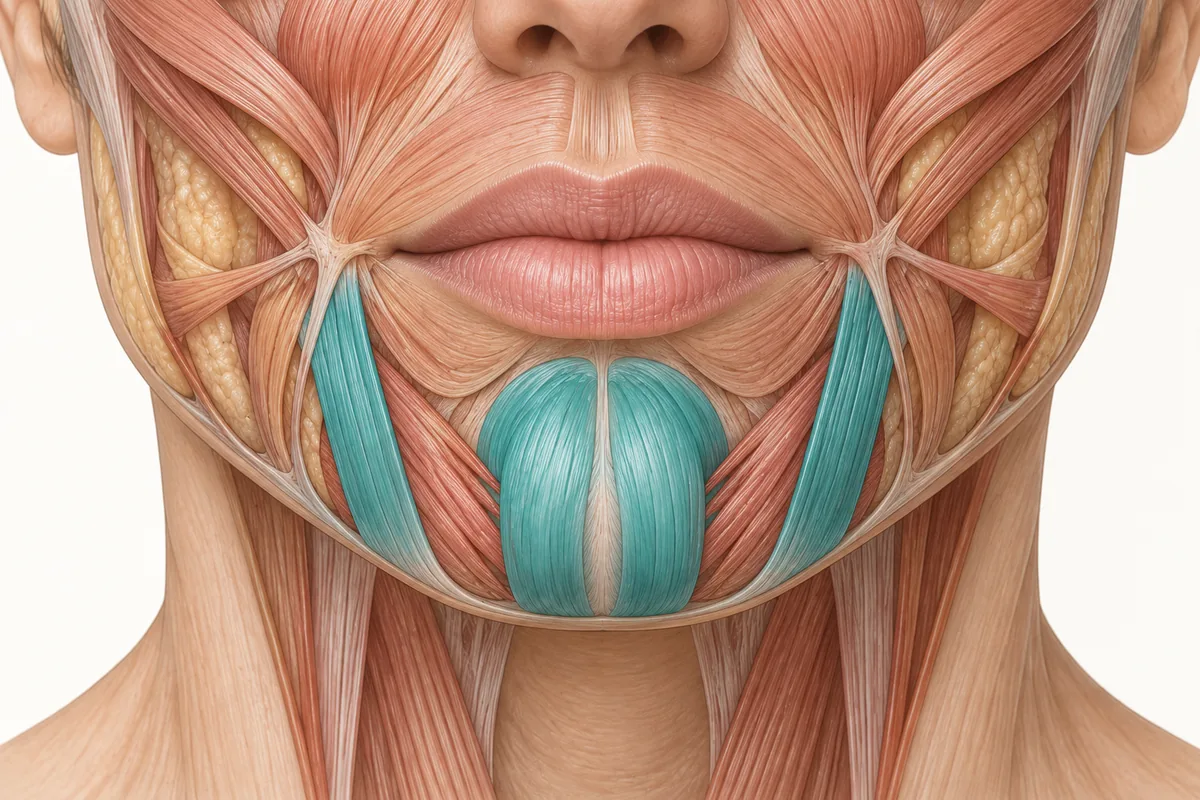
A patient points at her chin and describes the pebbled, orange-peel texture she sees in the mirror. Deciding whether chin dimpling is botox or filler territory is not a preference question or a technique question — it is a diagnosis, and a large share of injectors skip it. The default assumption is mentalis overactivity, and Dr. Chris Croley's correction to that default is one of the more commercially inconvenient things a faculty member can say:
"I want to remind you that many times we see a dimple chin for volume loss, not because of muscle overactivity. And so sometimes treating this with volume is the key, not neurotoxin."
That is the whole of what this transcript says about the chin — two sentences. What follows builds the diagnostic method out of the general assessment approach Dr. Croley teaches throughout his complication material and applies it to this specific decision. Where the reasoning is his and where it is an application of his method to a region he did not walk through in detail is flagged plainly, because the honest version is more useful than a confident one.
Two Mechanisms Produce the Same Dimpled Chin
Muscular. The mentalis arises from the incisive fossa of the mandible and inserts into the skin of the chin. When it contracts it elevates and protrudes the lower lip and puckers the overlying skin. A hypertonic or habitually recruited mentalis produces the irregular, dimpled chin surface during contraction. This is a dynamic finding, and it is the finding neurotoxin was made for.
Volumetric and structural. Loss of soft tissue and bony support over the chin, combined with dermal thinning, leaves the skin without an underlying scaffold. The same pebbled appearance results — but from a contour and support deficit rather than from contraction. This is a static finding, present when nothing is moving.
Mixed. Both, commonly, particularly in older patients. A chin that has lost volume also gives a hyperactive mentalis less tissue to work against, so the two findings compound each other visually.
The appearance in the mirror does not distinguish them. The examination does.
The Exam That Decides Between Chin Botox and Filler
Dr. Croley's general diagnostic sequence is consistent across every complication he discusses and it is the right tool here: "We observe the patient at rest, and with animation. We diagnose the problem."
Those two examinations answer two different questions, and in the chin they answer the whole question.
At rest. Genuinely at rest — lips lightly apart, patient not speaking, not holding a posed expression, not actively achieving a lip seal. This is harder to obtain than it sounds; patients hold their lower face in speaking position by habit. Wait for it. Photograph it.
Is the dimpling present?
With animation. Ask for the specific mentalis action rather than a generic expression: protrude and elevate the lower lip, or purse as though sipping. A smile will not reliably recruit the mentalis.
Does the dimpling appear, or worsen?
Reading the two answers together
| At rest | With animation | Interpretation | Modality |
|---|---|---|---|
| Absent | Appears or markedly worsens | Dynamic — mentalis-driven | Neurotoxin candidate |
| Present | Essentially unchanged | Static — volume and support deficit | Not a neurotoxin problem |
| Present | Worsens further | Mixed | Sequence the two; see below |
This is a direct application of the constraint Dr. Croley states about the drug itself: "We can only treat the muscle that's moving. Anywhere that's not moving... we can't really do anything different with that side." If the dimpling is fully present in a still face, there is no movement to remove, and no dose of any product will change it.
What Else to Examine in an Orange Peel Chin
Four findings refine the read.
Palpate for soft tissue thickness over the chin. A thin, unsupported soft tissue envelope with the mandible readily palpable beneath points toward the volume side of the differential.
Assess chin projection and the labiomental crease. Reduced projection and a deepened labiomental crease are structural findings and travel with the volumetric pattern.
Assess skin quality. Dermal thinning and photodamage contribute to surface irregularity independently of both muscle and volume, and will not respond fully to either injectable.
Check lip competence at rest. This one changes management, not just diagnosis. If the patient recruits the mentalis to achieve a lip seal — a recognised pattern in some facial morphologies — then that contraction is doing a functional job, and weakening it has consequences beyond the aesthetic one. This finding should be established before any toxin is placed, not discovered afterwards.
What Happens When You Treat Chin Dimpling With the Wrong Tool
Both errors are worth understanding, because they fail in different ways and on different timescales.
Toxin for a volume problem. Nothing improves. The patient is disappointed at two weeks, and the injector's instinct is that the dose was too low. A second, larger dose follows. Now a muscle that was never the problem is substantially weakened, and mentalis overshoot carries its own consequences — chin flattening, and in more pronounced cases chin ptosis and reduced lip competence. The clinician has created a complication while failing to treat the complaint.
Volume for a muscular problem. Product is placed into a field that contracts vigorously over it. The result is typically underwhelming at rest and can look distorted with animation, and the patient has an outcome she cannot wait out the way she could wait out a toxin effect.
The asymmetry between those two errors is worth noting when you are uncertain. A toxin error decays. A volume error does not decay on the same timescale.
Ready to put this into practice?
Explore Empire's hands-on, CME-accredited Aesthetic & Injectable Training courses — live patients, expert faculty, and ongoing mentorship.
Chin Dimpling the Patient Has Not Complained About Is Not a Problem
Dr. Croley makes a passing observation about the dimpled chin that deserves more weight than its length suggests: "A lot of patients like that."
Some patients read a chin dimple as a feature. The clinician's aesthetic assessment and the patient's complaint are not the same document, and treating a finding the patient has not raised is how you lose a patient who was happy when she arrived.
Ask what she is unhappy about, in her words, and treat that.
When a Dimpled Chin Needs Both Botox and Filler
The mixed presentation is common and the transcript gives no protocol for it. What follows is an application of Dr. Croley's general principles — be conservative, prioritise which muscles matter most, reassess at two weeks — to this decision, rather than a chin-specific sequence he taught.
Identify the dominant component from the examination. Which finding accounts for more of what the patient objects to — the appearance at rest, or the change with animation?
Address that component first, conservatively. Dr. Croley's standing rule applies to every decision in this space: "I want you to always be conservative. You can always add more. It's hard to take this away."
Reassess at two weeks before adding the second modality. Correcting one component frequently reduces the apparent severity of the other, and a patient who is satisfied after one intervention does not need the second. If you treat both simultaneously and the result is wrong, you will not know which one caused it.
Sequence with the reversibility asymmetry in mind. Toxin effects decay on a predictable timescale; volumetric changes do not. Where the dominant component is genuinely unclear, the component whose treatment resolves on its own carries less downside if the read was wrong.
How to Explain Dimpled Chin Botox in the Room
The conversation is short and it does the work of setting expectations before anything is injected.
"There are two different things that cause this, and they need different treatments. One is the chin muscle contracting — that responds to a muscle relaxer. The other is loss of support underneath the skin — that doesn't respond to a muscle relaxer at all, no matter the dose. I'm going to look at your chin completely relaxed and then while you move it, and that tells us which one we're dealing with."
Patients understand this immediately, and it reframes a "no" into a diagnosis. It also protects you: the patient who is told at the outset that her dimpling is structural will not return at two weeks disappointed that the toxin did nothing.
Where this sits alongside Empire's other chin content
This piece answers a prior question: is this a neurotoxin problem at all? Once you have established that it is, the treatment-side questions — how the mentalis is approached and dosed — are covered in the chin dimpling discussion and the chin injection site reference.
If the examination points the other way, the reasoning moves into the volumetric literature — the general principles in facial volume loss, and the choice of agent in biostimulators versus fillers.
What changes on Monday
Add one step to your chin assessment: a genuine at-rest photograph, taken before you ask the patient to do anything. Most injectors photograph the chin in animation because that is where the finding is dramatic, which means their record contains only the half of the examination that cannot distinguish the two diagnoses.
Then ask the mentalis-specific animation rather than a generic expression, and write both findings in the note. Two lines — "dimpling absent at rest, marked on lip protrusion" — is a defensible diagnosis. "Chin dimpling, treated" is not.
This approach reflects Dr. Chris Croley's clinical practice as taught in Empire Medical Training's hands-on curriculum. Technique is learned under supervision; this article is educational and is not a substitute for training.
Deciding between modalities rather than defaulting to the one you are most comfortable with is the skill that separates a treatment plan from a menu. Empire teaches that decision-making across the face in Complete Facial Aesthetic Training.
Frequently Asked Questions
Is chin dimpling always caused by mentalis overactivity?
No. Dr. Croley's specific caution is that a dimpled chin is often caused by volume loss rather than muscle overactivity, and that volume is sometimes the answer rather than neurotoxin. The appearance is identical in the mirror; only examining the chin at rest and then with animation distinguishes the two mechanisms.
How do I tell muscular chin dimpling from volume loss?
Examine at rest with the patient genuinely relaxed, then with the mentalis specifically recruited by protruding or pursing the lower lip. Dimpling absent at rest and appearing with animation is dynamic and a neurotoxin candidate. Dimpling present at rest and unchanged with animation is structural and will not respond to toxin at any dose.
What happens if I treat a volumetric chin with neurotoxin?
Nothing improves, which commonly leads to a larger second dose. That escalation can weaken a muscle that was never the problem, risking chin flattening, chin ptosis and reduced lip competence. The patient ends up with an unresolved complaint and an introduced complication.
Can chin dimpling be both muscular and volumetric?
Frequently, particularly with age, and the two compound each other. Identify the dominant component from the examination, treat that conservatively first, and reassess at two weeks before adding the second modality — correcting one often reduces the apparent severity of the other, and treating both at once makes an unsatisfactory result impossible to attribute.
Disclaimer
This article reflects the clinical opinions and experience of Dr. Chris Croley, Chief Medical Officer, Empire Medical Training, an independent faculty member contributing to Empire Medical Training's curriculum. The views expressed are the author's own and do not necessarily represent those of Empire Medical Training.
It is professional education, not medical advice, and is no substitute for hands-on training or independent clinical judgment. Licensed clinicians remain responsible for their own patient selection, technique and outcomes, for verifying current product labelling, and for practising within their scope and applicable law. Empire Medical Training accepts no liability for reliance on this content.



 Claim Your Prize!