







Ask Melissa Pulcini-Buttine, PA, to name the anatomy mistake that causes the most trouble in aesthetic injecting and she does not describe an unusual vessel or an exotic complication. She describes a habit.
"Injecting the crease instead of actually reading the vascular map. Before that needle touches the skin, you should be analysing the whole vascular map. Where am I, and what is attached to this?"
Chasing the crease is the error pattern behind a specific and recognisable triad — wrong plane, wrong pressure, wrong volume — and what makes it worth writing about is that it is not an error of knowledge. The injectors who do it can pass an anatomy exam. They can name the supratrochlear artery and describe its origin. They do it anyway, because the crease is visible and the anatomy is not, and because everything in the encounter rewards attention to the thing that can be seen.
The crease is the complaint. It is not the target.
Start with the conceptual error, because everything else follows from it.
A patient arrives and points at a line. The consultation photograph frames that line. The consent discussion is about that line. The follow-up appointment will be judged on that line, by the patient, in a mirror.
At no point in that sequence does anything direct attention to what is underneath it. So the line becomes the target by default — not by a decision an injector would defend if asked, but by the accumulated gravity of a process organised entirely around appearance.
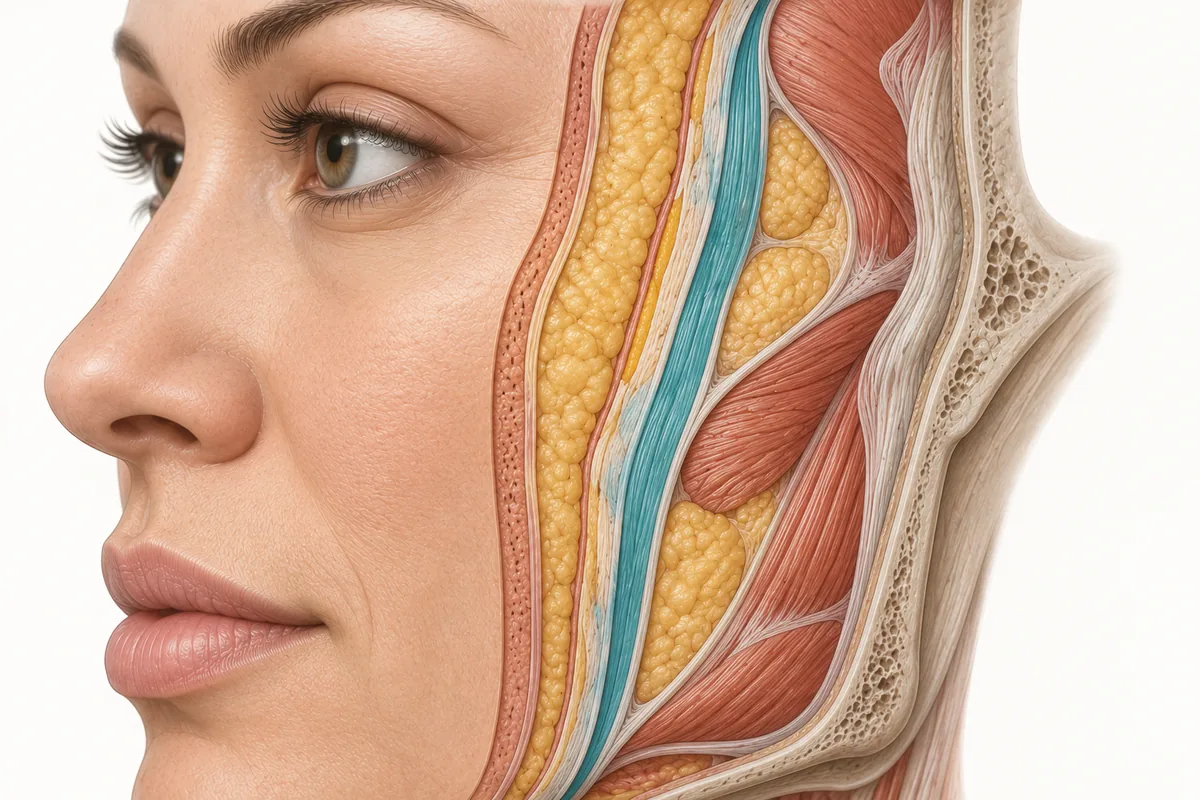
The problem is that a crease is a surface expression of something. It is not a thing in itself. A glabellar line is what corrugator and procerus activity have written into the skin over a decade. A nasolabial fold is a ligamentous and volumetric structure that happens to cast a shadow. A forehead line is frontalis contraction plus dermal change. Each has a cause that sits somewhere specific, at a particular depth, in a particular tissue.
Treat the cause and the line changes. Treat the line and you are injecting into the place where the evidence of the problem is, which is rarely the place where the problem is — and, in the territories that matter most, is frequently the place where a vessel is. Distinguishing the movement from what the movement has etched is the substance of dynamic vs static wrinkles, and a fold driven by volume loss is a different anatomical problem again, discussed in facial volume loss.
How Chasing the Crease Produces Wrong Plane, Pressure and Volume
Melissa names the three consequences in one breath — "wrong plane, wrong pressure, wrong volume" — and they are not three independent errors. They are one error expressing itself three times.
Wrong plane
If your target is the line, your depth is set by the line. You inject where the crease is, which means at the depth of the visible feature, which means in whatever plane happens to lie beneath it.
But depth should be determined by the structure you are trying to affect, not by the structure you are trying to erase. And in the central face those two answers diverge sharply. The plane immediately beneath a glabellar furrow or a low forehead line is not a neutral space — it is the plane in which the supratrochlear and supraorbital vessels are running, at a height that varies enormously between patients. Choosing your depth from the surface feature is choosing it from the one piece of information that carries no data about what is underneath.
The same logic applies in toxin, differently expressed. Following a forehead line downward toward the brow — because that is where the line is — puts product into the inferior frontalis, where the muscle performs its lift. The line was the map; the map led somewhere costly. Dosing the frontalis from muscle function rather than from line position is covered in Botox dosages for the forehead and frontalis area.
Wrong pressure
This one is subtler and it is the mechanically dangerous member of the triad.
When the target is the crease, the completion criterion becomes visual. You inject until the line looks better. That sounds harmless and it is not, because it converts pressure from a variable you control into a variable that responds to feedback.
The line does not lift. You press a little harder. It still does not lift — a deep static line often will not, on the day — so you press harder still. Nothing in that sequence feels like an escalation, because each increment is small and each is motivated by the perfectly reasonable desire to deliver the result you promised.
Melissa's instruction is the direct counter: "Inject slowly. Don't press too much." What makes it difficult to follow is not that injectors disagree with it. It is that a visual endpoint supplies continuous pressure to violate it.
Wrong volume
Identical mechanism, different variable. With an appearance-based endpoint, the volume delivered is whatever the appearance requires. There is no predetermined amount, because the amount was never decided — it was outsourced to the mirror.
And here is the part that should worry any injector who recognises the pattern in themselves: an appearance-based endpoint removes every internal signal to stop. Resistance that does not feel right gets reinterpreted as the product meeting a fibrous line. Blanching gets read as pressure blanch, which it sometimes is. Pain gets attributed to a sensitive patient. Each of these signals is ambiguous in isolation, and an injector who is committed to a visual result will resolve each ambiguity in the direction of continuing.
That is the actual causal chain. Not recklessness — a stopping problem created by choosing the wrong endpoint.
The Glabella Is Where Chasing the Crease Costs Most
Melissa is explicit that the glabella is where she sees the pattern do real damage, and the region combines every aggravating factor.
Deep static glabellar lines are among the most resistant features on the face. They frequently do not fully correct in one session, and sometimes do not fully correct at all. That resistance is exactly the stimulus that invites more pressure and more volume — in a territory supplied by branches of the ophthalmic artery, where the margin for error is smallest and the worst outcome is visual. The regional anatomy of why that is true is set out separately in the glabellar risk reference in Empire's vascular anatomy cluster.
For toxin in the same region Melissa states the principle flatly: "We're really not chasing wrinkles in this area." The treatment is aimed at muscle activity and at the balance between elevators and depressors. The line is a readout, not a destination.
The Assessment Question That Replaces the Crease
Melissa's substitute is a single question asked before the needle moves: "Where am I, and what is attached to this?"
In practice it expands into four, and they take under a minute.
What is causing this line? Dynamic muscle activity, volume loss, structural or ligamentous change, or dermal and textural change. The answer determines the modality, the plane, and — importantly — whether an injectable is the right answer at all. A textural line treated with volume is a line that will not respond no matter how much is delivered, which is precisely the scenario that generates the escalation described above.
What is underneath it? Which vessels, from which carotid system, at what likely depth, communicating with what. The honest answer usually includes a range rather than a position, because arterial course varies substantially between individuals — the full argument for treating published anatomy as a distribution rather than a map is made separately in the risk-spectrum discussion.
Ready to put this into practice?
Explore Empire's hands-on, CME-accredited Aesthetic & Injectable Training courses — live patients, expert faculty, and ongoing mentorship.
What is my endpoint, in anatomical terms, decided now? A volume, a number of points, a plane. Written or at least said aloud before you start. This is the single most effective intervention against the whole pattern, because it supplies a stopping rule that does not depend on what the mirror says.
What is my abort condition, decided now? Resistance, blanching, disproportionate pain, a patient reporting something odd. Deciding in advance what will make you stop is the only reliable way to stop, because in the moment every one of those signals is ambiguous and you will be motivated to resolve the ambiguity favourably.
If you reach your predetermined endpoint and the crease is still there, that is information rather than failure. The available responses are a different modality, a second session, or an honest conversation about what this particular line can and cannot do. What is not on the list is more product at higher pressure into a territory that has already told you it is not cooperating.
A Practical Note About Consultation Mirrors
One concrete contributor deserves naming because it is so easily removed.
Handing a patient a mirror during treatment converts an anatomical endpoint into a negotiation. The patient will point at the residual line, because that is what patients do and it is entirely reasonable of them. The injector now has to defend a stopping decision to someone who cannot see the anatomy and who is, at that moment, the person whose satisfaction the whole encounter is organised around.
Very few injectors win that negotiation. Most add a little more.
Set the expectation before you begin — what you are treating, what the endpoint is, what will still be visible afterwards and why — and review the result at the end or at follow-up rather than mid-procedure. This costs nothing and removes the most common live pressure toward the triad.
"Technique does not erase anatomy"
Melissa's summary line deserves unpacking, because it is doing more work than it appears to.
"We could teach anyone technique," she says. "But that does not replace the foundational structure of knowing your anatomy."
Technique is a set of motor skills. It is demonstrable, transferable, and learnable quickly — which is precisely why so much training is organised around it. You can watch someone do it and copy them. You can get visibly better in a weekend.
Anatomy is not a skill. It is a model — an internal representation of what is under the skin that runs continuously while you work and that tells you when the technique you are executing is the wrong technique for this patient.
A clinician with excellent technique and no model does not inject badly. That is what makes it dangerous. They execute the wrong plan precisely, at a confident speed, with a smooth hand, until the day the plan meets an anatomy that does not match the one in the training video.
And Melissa adds the part that makes the model necessary rather than merely useful: it is "not just memorising anything, but really respecting that there's variability between person to person." A memorised map is a second kind of technique. What replaces the crease as a target is not a different diagram. It is the habit of asking what is underneath this face and accepting that the answer is uncertain.
What changes on Monday
Decide your endpoint before the needle moves, in volume and plane, not in appearance.
Decide your abort condition at the same time, and treat it as a rule rather than a judgement call to be made under pressure.
Stop handing the mirror over mid-treatment.
And when a line does not respond, treat that as a diagnostic finding — evidence that you have misidentified the cause — rather than as a signal to deliver more of the same. The crease is telling you something. It is just not telling you to keep going.
This reflects Melissa Pulcini-Buttine's clinical teaching as delivered in Empire Medical Training's hands-on curriculum. Technique is learned under supervision; this article is educational and is not a substitute for training.
The model this article argues for is built by dissection rather than by diagrams. Empire teaches it in anatomical based aesthetics training and special anatomical cadaver aesthetics training, with combined toxin and filler decision-making covered in complete facial aesthetic training.
Melissa Pulcini-Buttine, PA — physician assistant of two decades; professor of anatomy and physiology for ~14 years; faculty member, Empire Medical Training; founder of an aesthetics practice in Greenwich, Connecticut.
Frequently Asked Questions
What does "chasing the crease" mean in injecting?
It means treating the visible line as the target rather than as the surface expression of an underlying cause. Because the crease sets the depth, the endpoint and the sense of completion, it produces a recognisable triad of errors — wrong plane, wrong pressure and wrong volume — all arising from the single decision to aim at the appearance rather than the anatomy.
Why does chasing the crease lead to excessive pressure and volume?
Because it makes the endpoint visual. When the stopping rule is "until the line looks better," a resistant line supplies continuous pressure to press harder and deliver more. It also removes the internal signals to stop: resistance, blanching and disproportionate pain all become ambiguous and get resolved in favour of continuing.
How do you set an injection endpoint that is not appearance-based?
Decide before you begin, in anatomical terms: a volume, a number of points, a plane. Decide your abort conditions at the same time. If you reach the endpoint and the line persists, the correct responses are a different modality, a second session or an honest conversation — not more product at higher pressure.
What does "technique does not erase anatomy" mean?
Technique is a set of motor skills that can be taught quickly and copied. Anatomy is a model of what lies beneath the skin that runs while you work and tells you when the technique you are using is wrong for this patient. A clinician with strong technique and no model executes the wrong plan precisely and confidently.
Disclaimer
This article reflects the clinical opinions and experience of Melissa Pulcini-Buttine, PA, an independent faculty member contributing to Empire Medical Training's curriculum. The views expressed are the author's own and do not necessarily represent those of Empire Medical Training.
It is professional education, not medical advice, and is no substitute for hands-on training or independent clinical judgment. Licensed clinicians remain responsible for their own patient selection, technique and outcomes, for verifying current product labelling, and for practising within their scope and applicable law. Empire Medical Training accepts no liability for reliance on this content.



 Claim Your Prize!