







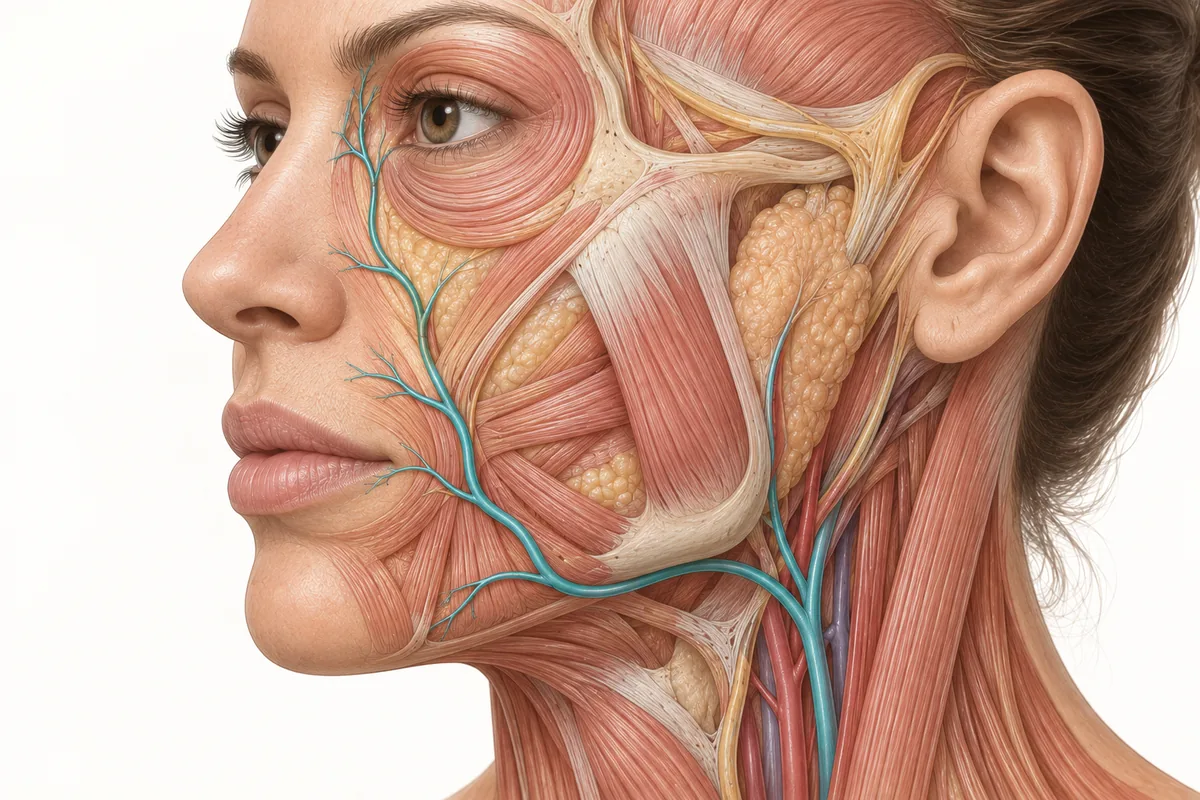
Ask an injector how they keep patients safe and you will very often get an answer about vascular occlusion prevention that is not actually about prevention: we have a protocol, we keep hyaluronidase on site, everyone on the team knows the escalation path.
All of that is necessary. None of it is a safety strategy. It is a rescue plan, and a rescue plan is by definition something that engages only after safety has already failed.
This distinction is not semantic hair-splitting. It determines where a practice puts its learning hours, and the two options are not equivalent in what they buy you.
What a Vascular Occlusion Protocol Is, and What It Is Not
A vascular occlusion protocol is a sequence of actions triggered by a recognised event. Stop. Assess. Escalate. Treat. Reassess. Refer. It is written down, rehearsed, stocked and time-bound, and every injecting practice needs one. Empire's vascular occlusion recognition and response curriculum, taught by Michelle Langston, exists precisely because most practices' versions of this are vaguer than they think.
But look at what the protocol requires in order to run. It requires that an occlusion has already happened. It requires that someone has recognised it. It requires that the recognition happened within a window where action still helps.
Protocols are reactive. A complication occurred and you are responding to it. They are essential, and they sit entirely downstream of the event.
Anatomy is proactive. Knowing what is under the skin, at what depth, connected to what, before the needle moves — that acts on whether the event happens at all.
Those are different points of intervention in the same causal chain, and only one of them reduces incidence.
The Asymmetry Between Prevention and Vascular Occlusion Response
Here is the argument in one number.
In the largest review of filler-associated vision loss — 511 published cases spanning 1906 to 2023 — among the 318 cases reporting visual outcome, 68.2% had no recovery at all. Partial improvement occurred in 25.8%, and complete recovery in 6.0% (Doyon et al., Aesthetic Surgery Journal, 2024;44(10):1091–1104).
Read that as a statement about rescue. These are cases in the published literature, which means they were seen, documented, and in most instances actively managed by clinicians motivated enough to write them up. Roughly two-thirds of them ended in permanent vision loss anyway.
That is what a protocol is worth against the worst version of this complication. It is not nothing — a quarter improved partially and six per cent recovered fully, and those outcomes are real and worth every minute of preparation. But the honest reading is that the rescue has a low ceiling, and every unit of risk you can remove before the needle enters is worth more than every unit you try to reverse afterwards.
Prevention acts on probability. Rescue acts on outcome, and this particular outcome is largely fixed by the time you are acting on it.
Four Things a Vascular Occlusion Protocol Cannot Do
It cannot change incidence. A practice that adds a protocol and changes nothing about its anatomical reasoning has the same occlusion rate it had before. It has better outcomes per occlusion, which matters — and the same number of occlusions.
It cannot compensate for not recognising the event. Most protocols assume detection. Detection is an anatomy problem: an injector who doesn't know that the upper lip and the nasal base sit on the same arterial circuit does not examine the nose after a lip treatment, and the protocol never activates. A protocol is downstream of a recognition capability that the protocol itself does not supply.
It cannot buy back time. In sight-threatening occlusion the window is short. Time is consumed by the delay between the event and its recognition — which is anatomy-dependent — not by the protocol steps.
It can create a false floor. This is the failure mode I watch for most in trainees. Having the protocol on the wall produces a subtle confidence that the worst case is handled. It isn't handled; it is attended to, with a two-in-three failure rate in the published record. The protocol should not be reassuring. It should be the thing you are trying very hard never to need.
What Proactive Vascular Occlusion Prevention Actually Looks Like
Proactive safety is not a mood. It is a specific set of decisions made in the thirty seconds before you inject, and it is teachable.
Survey before you plan. Stop for a second before you insert the needle. Look at the face and think about what vessels are there, where they are travelling, and what they connect to. Not "why am I injecting here" as a treatment-planning question — "what is underneath here" as an anatomical one.
Know the layer, not just the site. Are you deep, middle or superficial, and what occupies that plane in this region? The same millimetre reading puts you in different anatomical situations in different territories.
Adapt the whole approach. Product choice, plane, needle versus cannula, injection speed and volume are all safety variables, and all of them should be chosen in response to the territory rather than applied as a house style. Injecting slowly and in small aliquots is a mechanical intervention: injection pressure exceeding systolic pressure is what drives material retrograde in an artery, and volume determines how far a column can travel. These are not habits. They are levers on a mechanism.
Ready to put this into practice?
Explore Empire's hands-on, CME-accredited Aesthetic & Injectable Training courses — live patients, expert faculty, and ongoing mentorship.
Build margin where the anatomy is least certain. Facial arterial anatomy is probabilistic — one cadaveric series documented eight different termination points and 35 branching-pattern combinations across 102 hemifaces. Where the distribution is widest, the margin should be widest.
Be honest about your own limit. If you are not comfortable with the vessels of a region and with what you would do if something went wrong there, be very cautious there — or do not work there yet. That is a competency judgement, and making it correctly is itself a safety behaviour.
The Manoeuvre Most Injectors Over-Trust: Aspiration
Aspiration deserves a specific mention, because it is the single thing most often cited as the prevention step, and it is the weakest one.
In an in vitro assessment of seventeen filler products, aspiration was positive in only 53% (Casabona, Dermatologic Surgery, 2015). The current consensus position in the aesthetic literature is blunter still: neither a positive nor a negative aspiration should be relied upon as a safety manoeuvre (van Loghem et al., Aesthetic Surgery Journal, 2022;42(1):89–101). Product viscosity, needle gauge, plunger technique and the duration of the pull all affect whether blood appears, and a fast pull-and-release is particularly unreliable.
This is not an argument against aspirating. Melissa Pulcini-Buttine teaches aspiration alongside slow injection and considered product and tool selection as part of an adaptive package. It is an argument against letting a negative aspiration change your behaviour. If a negative flash makes you inject faster, or with a larger bolus, or less carefully, then the manoeuvre has made you less safe rather than more.
The general principle generalises: any single technical safeguard that you trust enough to relax after is a liability. Safety in this work is layered, and no layer is load-bearing on its own.
How Prevention and Protocol Actually Relate
None of this argues against protocols. It argues about their place.
Think of it as a floor and a ceiling. The protocol is the floor — it determines how bad things get when something goes wrong, and you want it as high as you can build it. Anatomy is the ceiling — it determines how often you end up standing on the floor at all.
Practices tend to invest in the floor because it is concrete and purchasable. You can buy hyaluronidase, print a flowchart, run a drill, and demonstrate compliance. Investing in the ceiling means hours of anatomy, cadaveric work and deliberate practice, with no artefact to put on the wall afterwards. It is the harder purchase and the better one, and the two are not in competition for the same budget line — they are answers to different questions.
A useful self-audit: in the last twelve months, how many hours did you spend on complication response training, and how many on facial anatomy? If the first number is larger, your safety investment is inverted relative to where the leverage is.
On the specific pharmacology of dissolving hyaluronic acid, see how filler is dissolved. The recognition criteria, escalation pathway and rescue protocol itself belong in Empire's dedicated vascular occlusion curriculum and are deliberately not reproduced here — a protocol learned from an article is not a protocol.
Where the Ceiling on Filler Safety Gets Built
Anatomy that changes behaviour is anatomy you have handled. Empire Medical Training's Anatomical Based Aesthetics Training and Special Anatomical Cadaver Aesthetics Training are built to put real vascular anatomy, at real depths, with real variability, in front of injectors before they are asked to reason about it under pressure — and the anatomy comes first, not last, in Complete Dermal Filler Training.
Keep the protocol. Rehearse it. Stock it. And then spend most of your learning hours on the thing that determines how often you have to open it.
This article reflects Melissa Pulcini-Buttine's teaching philosophy in Empire Medical Training's hands-on curriculum, supported by the published literature cited above. It is educational, is not a substitute for supervised training, and does not replace your practice's vascular complication protocol.
Melissa Pulcini-Buttine, PA — physician assistant of two decades; professor of anatomy and physiology for ~14 years; faculty member, Empire Medical Training; founder of an aesthetics practice in Greenwich, Connecticut.
Frequently Asked Questions
Isn't having an occlusion protocol enough to keep patients safe?
No. A protocol is reactive — it engages only after an occlusion has occurred and been recognised. It improves outcomes per event without changing how often events occur, and it depends on a recognition capability that anatomy, not the protocol, supplies. Every practice needs one; no practice should treat it as its safety strategy.
How effective is rescue after filler-related vision loss?
Limited. Among 318 published cases reporting visual outcome, 68.2% had no recovery, 25.8% improved partially and 6.0% recovered completely. Preparation and speed are still worth everything they cost, but the ceiling on rescue is low enough that risk removed before injection is worth more than risk reversed afterwards.
Does aspirating before injecting prevent vascular occlusion?
Not reliably. One in vitro assessment found aspiration positive in only 53% of filler products tested, and the consensus position in the aesthetic literature is that neither a positive nor a negative result should be relied upon as a safety manoeuvre. Aspirate if you choose, but never let a negative result make you inject faster or with a larger bolus.
What does proactive injector safety actually involve?
Surveying the vascular territory before choosing an entry point; knowing which anatomical layer you are working in for that specific region; adapting product, plane, tool, speed and volume to the territory rather than applying one house style; widening the margin where anatomical variability is greatest; and being honest about which regions exceed your current competence.
Disclaimer
This article reflects the clinical opinions and experience of Melissa Pulcini-Buttine, PA, an independent faculty member contributing to Empire Medical Training's curriculum. The views expressed are the author's own and do not necessarily represent those of Empire Medical Training.
It is professional education, not medical advice, and is no substitute for hands-on training or independent clinical judgment. Licensed clinicians remain responsible for their own patient selection, technique and outcomes, for verifying current product labelling, and for practising within their scope and applicable law. Empire Medical Training accepts no liability for reliance on this content.




 Claim Your Prize!