







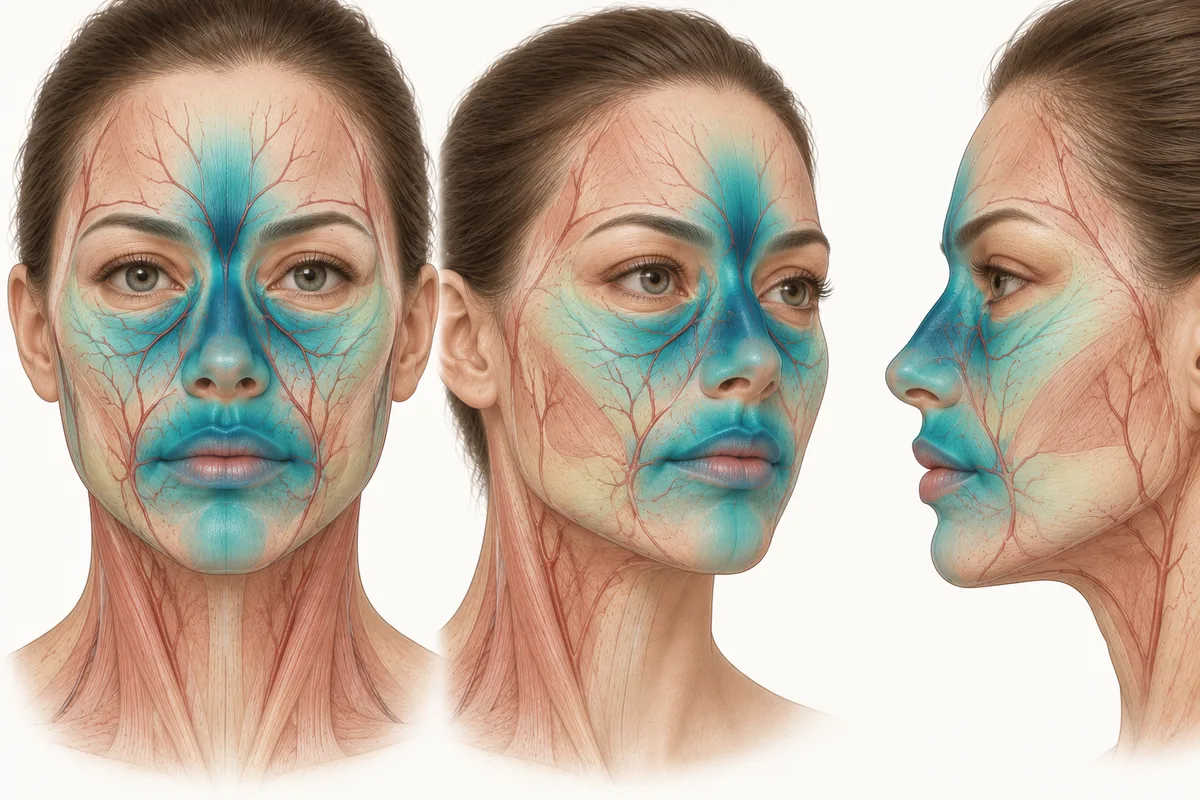
Every injector has seen the diagram. A face in three-quarter view, four or five regions shaded in red, a caption reading facial danger zones. It appears in every introductory course, on every conference slide, in every device rep's deck. It is the single most reproduced image in aesthetic medicine.
It is also, as a teaching instrument, quietly harmful — and the reason is not what is drawn on it. It is what is left blank.
"I don't like to use danger zone," says Melissa Pulcini-Buttine, PA, who has taught anatomy and physiology for roughly fourteen years alongside two decades of clinical practice. "I like to use high risk and low risk. Because I don't want people to get the false sense that there's a 100% safe area. There's just different areas and different risks."
That is not a semantic preference. It is a different model of what risk is, and it changes what an injector does with their hands.
The Problem With a Facial Danger Zone Binary
A map with red zones on it makes an implicit second claim that nobody says out loud: everything not shaded is fine.
No author of such a diagram believes that. But that is how it is read, and more importantly that is how it is used — because the working function of the danger zone map is to tell you where to be careful, and the necessary inference from "be careful here" is "you can relax there." The map does not merely fail to warn about the unshaded regions. It actively reassures about them.
This is the mechanism by which competent injectors get into trouble in territories that were never on anyone's danger list. The complications that surprise people are rarely the glabella or the nose. Those regions arrive pre-loaded with fear. The complications that surprise people happen in the cheek, the jawline, the temple, the chin — places the map painted white.
A binary also produces a specific and unhelpful emotional pattern: paralysis inside the red zone, complacency outside it. Neither state is where good injecting happens. Paralysis makes you tentative, and tentative injectors do things like reposition repeatedly, take longer, and compensate for uncertainty with pressure. Complacency makes you fast. Both degrade the same margin.
Injection Risk Is Not a Property of a Location
Here is the deeper failure. A danger zone map encodes risk as an attribute of place. Stand here, risk is high. Stand there, risk is low.
But vascular risk during an injection is a product of several partly independent variables, and anatomical territory is only one of them:
- The regional anatomy — which vessels are present, at what depth, from which carotid system, with what anastomotic connections.
- The depth you are actually at — which is an estimate, not a measurement.
- The pressure you are generating — a function of syringe size, needle gauge, product rheology and thumb.
- The volume delivered per aliquot and whether you are bolusing or threading.
- The product — its cohesivity, its particle behaviour, its reversibility.
- The device — needle or cannula, and at what gauge.
- This patient's anatomy, which is not the atlas's anatomy.
- Your own knowledge of all of the above, which is the only variable fully under your control.
Multiply those out and the conclusion is uncomfortable but correct: a "low-risk" region injected with a large-bore needle, a fast thumb and a 0.3 mL bolus can carry more real risk than a "high-risk" region injected slowly in small aliquots by someone who knows the vessel. Territory is one input. Behaviour is several, and behaviour is the input you can change.
That is what a spectrum model buys you. A map tells you where you are. A spectrum tells you what you are doing.
Two Axes of Facial Injection Risk: Probability and Consequence
The most useful refinement to the spectrum model is to stop treating "risk" as a single number. Clinical risk has two dimensions, and injectors routinely collapse them.
Probability — how likely is an adverse vascular event given this injection?
Consequence — if it happens, how bad is it?
These vary independently, and the regions injectors find confusing are exactly the ones where the two axes disagree.
The lips, for example, are a relatively high-probability territory. The labial arteries are superficial, variable in depth, and the region is injected in enormous volume across the industry — which is why lip vascular events are among the more commonly reported. But the consequence, while genuinely serious, is usually confined to soft tissue and is generally recoverable with prompt management. The reaction profile of this region is covered in depth in common lip filler reactions and how to avoid them.
The glabella sits differently. The probability of an event in any single injection is lower — it is a smaller territory, injected less often, with fewer passes. But the consequence sits at the extreme end, because the supratrochlear and supraorbital arteries are ophthalmic artery branches, and the ophthalmic artery gives rise to the central retinal artery. The downside is not a scar. It is vision.
An injector working only from a one-dimensional danger map cannot see this distinction, and will treat those two regions as the same kind of problem. They are not. One calls for meticulous technique and a fast recognition-and-response protocol. The other calls for asking whether the injection should happen at all, and for a lower threshold to stop.
Anatomical Variability Is the Operating Condition, Not the Footnote
The final thing a static map cannot represent is the thing that makes facial injection genuinely hazardous: the patient in front of you is not the patient in the diagram.
Melissa returns to this whenever the subject of memorisation comes up. The point of anatomical study, she teaches, is "not just memorising anything, but really respecting that there's variability between person to person, especially in that facial artery."
This is the part injectors find hardest to internalise, because it is epistemically annoying. You study the anatomy, you learn the course of the vessel, and the reward for that work is supposed to be certainty. Instead the reward is a probability distribution. You now know where the artery usually is. You still do not know where it is.
But this is precisely backwards from how it feels. Knowing the distribution is enormously more useful than knowing a single remembered position, because it tells you which way you are likely to be wrong and how much room to leave. The injector who has memorised one position is confident and occasionally catastrophically wrong. The injector who has internalised the range is appropriately uncertain and leaves margin accordingly.
A shaded map cannot express a range. It has one edge, and the edge is drawn in a place that is true on average and false in any given face.
What to Reason With Instead of Facial Danger Zones
Replacing the map does not mean replacing it with nothing. It means replacing a picture with a question set — one you run before the needle moves, in every territory, including the white ones.
Ready to put this into practice?
Explore Empire's hands-on, CME-accredited Aesthetic & Injectable Training courses — live patients, expert faculty, and ongoing mentorship.
Which vessels are in this field, and from which carotid system? External carotid territory and internal carotid territory carry different worst cases. This is the single question that most changes how much caution a region deserves.
What does this territory communicate with? Anastomotic connections mean the consequence of an embolic event is not confined to the field you are treating. Melissa's framing — "where am I, and what is attached to this?" — is a better first question than "is this a danger zone."
What depth am I claiming to be at, and how confident am I? Not what depth you intend. What depth you can actually verify. In regions where a vessel changes plane along its course, the honest answer is "less confident than I would like," and the right response to that is smaller volumes, not faster hands.
What is my pressure doing? Pressure is the variable that converts a misplaced needle tip into a distant embolic event. It is also the variable injectors monitor least.
What is the worst realistic outcome here, and is my response to it ready right now? Not findable. Ready. Hyaluronidase in the room, dose decided, referral pathway known, staff briefed.
Would I be comfortable defending this injection if it went wrong? A useful and slightly brutal test. It surfaces the injections you are doing out of momentum.
None of those questions have a shaded region as an answer. All of them have a degree as an answer, which is what a spectrum is.
This Is Risk Calibration, Not Fear
There is an obvious objection to all of this: if nowhere is safe, why inject at all? Does "no 100% safe zone" not simply produce a frightened clinician?
It does the opposite, and this is the part worth being clear about. Fear is what a binary produces, because a binary offers only two settings and one of them is danger. A spectrum offers proportionality — and proportionality is what lets a clinician act decisively.
Melissa is emphatic that the goal of anatomical teaching is confidence, not caution for its own sake. "There's nothing better that I love than watching my students gain their confidence," she says of the cadaver classes. "It's really knowing their anatomy and practising that's building their confidence."
That is the correct relationship between knowledge and nerve. Confidence built on a memorised map is brittle — it survives right up to the first patient whose anatomy is unusual, then collapses. Confidence built on understanding the structures, the variability and the failure modes is durable, because it already accounts for being surprised.
The injectors who get into the most trouble are not the frightened ones. They are the ones who believed the white space.
What changes on Monday
Stop asking whether a region is a danger zone. Start asking where it falls on both axes — how likely, and how bad — and let that pair of answers set your volume, your speed, your device and your threshold to stop.
Treat every territory as having a risk figure rather than a risk label. Let unshaded regions earn your attention rather than assuming they have already been cleared.
And make the anatomical variability an explicit part of your pre-injection reasoning rather than an asterisk. You are not injecting an atlas.
This reflects Melissa Pulcini-Buttine's clinical teaching as delivered in Empire Medical Training's hands-on curriculum. Technique is learned under supervision; this article is educational and is not a substitute for training.
Injectors who want to build risk reasoning on dissected anatomy rather than on diagrams should look at Empire's anatomical based aesthetics training and special anatomical cadaver aesthetics training, where the variability is visible rather than described. Clinicians building full-face competence across both toxin and filler will find the foundations in complete facial aesthetic training. The separate question of whether neuromodulator carries visual risk is addressed in can Botox cause blindness.
Melissa Pulcini-Buttine, PA — physician assistant of two decades; professor of anatomy and physiology for ~14 years; faculty member, Empire Medical Training; founder of an aesthetics practice in Greenwich, Connecticut.
Frequently Asked Questions
What are the facial danger zones?
The term usually refers to the glabella, nose, temple, nasolabial region and infraorbital area — territories with named arteries close to common injection planes. Melissa Pulcini-Buttine teaches against the term itself, preferring high-risk and low-risk, because a shaded map implies the unshaded remainder is safe. No facial territory is free of vascular risk.
Is the cheek a safe area to inject?
No facial region is safe in absolute terms. The cheek is lower-probability than the glabella or nose, but it contains the infraorbital and transverse facial vessels and communicates with territories where the consequences are worse. Its lower profile on danger zone diagrams is a frequent contributor to complacency rather than evidence of safety.
Why is anatomical variability such a problem for injectors?
Because published arterial courses describe averages, not individuals. The facial artery in particular varies considerably in course and depth between people. An injector who has memorised one position carries false certainty; one who has internalised the range leaves appropriate margin. Variability is the operating condition of facial injection, not a caveat.
Does treating every region as risky make injectors too cautious?
It has the opposite effect. A binary danger model offers only two settings and one of them is alarm. A spectrum model allows proportionality — matching volume, speed, device and stopping threshold to the actual risk profile. Confidence built on understanding anatomy survives the unusual patient; confidence built on a memorised map does not.
Disclaimer
This article reflects the clinical opinions and experience of Melissa Pulcini-Buttine, PA, an independent faculty member contributing to Empire Medical Training's curriculum. The views expressed are the author's own and do not necessarily represent those of Empire Medical Training.
It is professional education, not medical advice, and is no substitute for hands-on training or independent clinical judgment. Licensed clinicians remain responsible for their own patient selection, technique and outcomes, for verifying current product labelling, and for practising within their scope and applicable law. Empire Medical Training accepts no liability for reliance on this content.



 Claim Your Prize!