







 Medically reviewed by
Mark Tager, MD
Integrative & Functional Medicine Physician; Author, ‘Feed Your Skin’
Medically reviewed by
Mark Tager, MD
Integrative & Functional Medicine Physician; Author, ‘Feed Your Skin’ Ask a patient what drives their skin and most will say genetics, sun, or skincare. The often-missed variable is hormones. Dr. Mark Tager frames the skin as a window into the body’s internal state — an inside-out, “beauty from within” orientation — and few systems influence that internal state more than the endocrine system. Estrogen, thyroid hormone, cortisol, and insulin each shape how the skin looks, ages, and heals.
This guide situates that science within Empire’s Precision Nutrition resource center. The frame is deliberate and honest: nutrition does not replace hormones, and it is not hormone replacement therapy. Prescribing and managing hormones is a separate clinical domain that demands dedicated training. What nutrition can do — powerfully — is support the systems that respond to hormones: blood-sugar control, the micronutrient cofactors hormones depend on, healthy estrogen metabolism, and the gut. This is clinical education, not medical advice.
The skin is a hormone-responsive organ
Hormones are chemical messengers, and the skin is full of receptors that listen to them. That is why hormonal life stages — puberty, pregnancy, perimenopause — announce themselves on the skin so reliably. When a hormone rises or falls, the fibroblasts that make collagen, the sebaceous glands, the skin’s barrier lipids, and its blood flow all respond. Understanding that responsiveness is what lets a clinician connect what they see on the skin to what may be happening internally, and then decide where nutrition can genuinely help.
Tager’s clinical insight is also a motivational one: beauty is a powerful motivator. The same patient who shrugs at being told they are pre-diabetic will often change their diet to improve the tone and texture of their skin. Hormones and skin, taken together, give clinicians a relatable, visible entry point into deeper metabolic conversations.
Estrogen: collagen, hydration, and menopausal skin
Estrogen is the hormone most visibly tied to skin quality. It supports collagen and elastin, hydration, skin thickness, and barrier function, and it keeps fibroblasts active. When estradiol is robust, skin tends to be thicker, more resilient, and better hydrated.
The clearest demonstration is what happens when estrogen leaves. Each day, roughly six thousand women in the United States reach menopause — defined as one year since the last menstrual period — and estradiol levels fall steeply beginning around age fifty. As Tager describes it, that decline affects the skin through multiple channels at once: loss of collagen and elastin, changes to fibroblasts, pH shifts, microbiome changes, and diminished blood flow. The result is skin that thins and loses resilience — wrinkles, slackness, crepey texture.
The downstream effects accumulate. With less estrogen on board, there is increased susceptibility to injury, slower wound healing, easy bruising, rashes, and inflammatory flares. Middle-aged women frequently present with acne around the chin and jawline, a hormonal pattern distinct from teenage acne. And the hormonal shift ignites vasomotor changes — the hot flashes, flushing, and redness that feed a vicious cycle of pH and microbiome disruption, irritation, and odor.
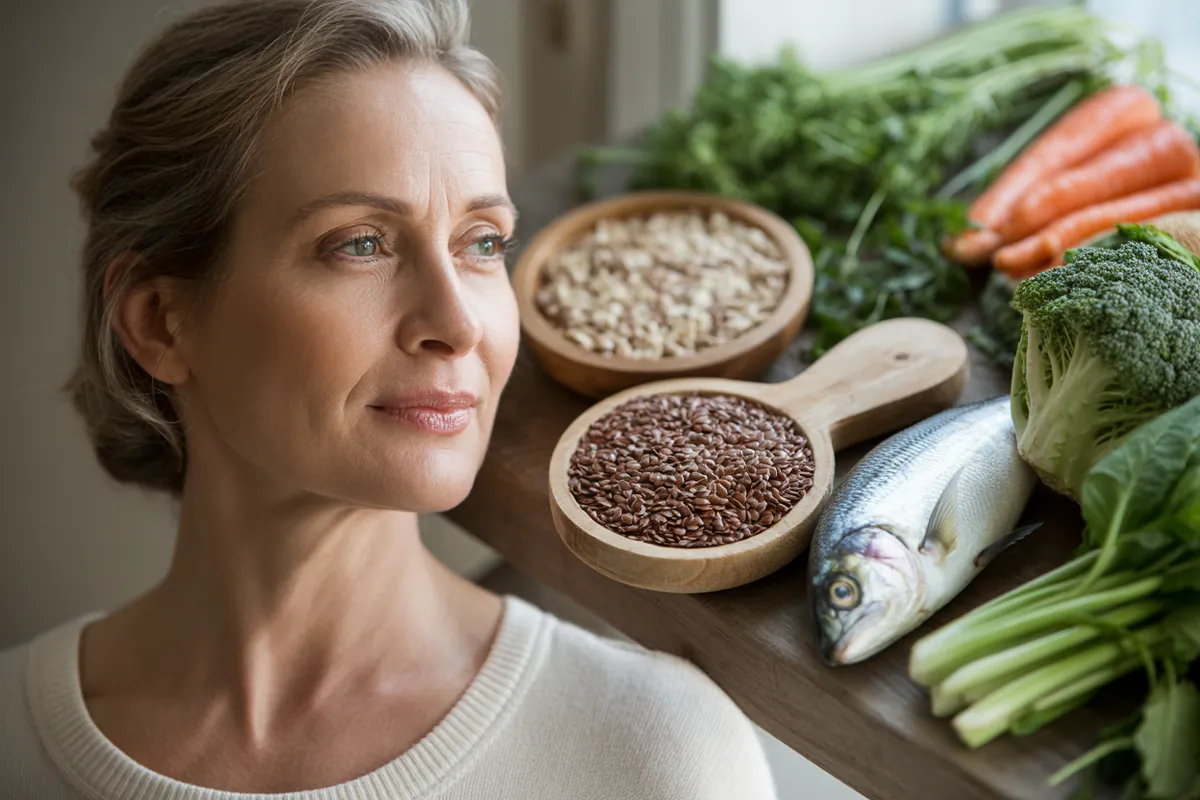
This is precisely where the scope line matters. The first arm of managing menopausal skin is hormonal, and that means hormone replacement therapy — a domain Tager is explicit requires its own specific training and referral. The complementary arm is nutritional. Foods associated with healthy estrogen metabolism — cruciferous vegetables, flax, soy, and others — along with compounds extracted from cruciferous vegetables, have been discussed for their role in supporting estrogen balance and easing vasomotor symptoms. Crucially, the goal is not to mimic hormone therapy with food. It is to give the menopausal skin the substrate it needs — protein for collagen, an anti-inflammatory pattern, and steady blood sugar — while the hormonal question is handled in its own lane.
Thyroid: dryness, hair, and healing
The thyroid sets the body’s metabolic tempo, and the skin reflects it. Tager offers a clean clinical example: the woman who presents with hair loss. Hyperthyroidism typically produces hair loss, while hypothyroidism classically presents with dry skin and, paradoxically in some, hair changes as well. Thyroid status therefore shows up in skin moisture, hair quality and density, and the pace of wound healing.
Because the skin signs are nonspecific, they are best read as prompts for proper evaluation rather than conclusions. Tager notes that working up thyroid is one of the first steps in a “beauty from within” program, with the relevant interpretation taught in the course. The nutritional connection is real but must be stated carefully. Certain micronutrients are cofactors in thyroid function, and supplement choices can interfere with testing — for instance, high-dose biotin, common in hair-and-nail formulas, can interfere with thyroid lab results and certain cardiac markers. That is exactly the kind of drug-nutrient and supplement-test interaction a clinician needs to know before assuming a result is true.
The honest position on thyroid and nutrition: support documented need; don’t megadose on suspicion. Persistent dry skin, hair loss, fatigue, or unexplained weight change deserve a medical work-up, not a supplement bottle.
Cortisol and the stress–skin connection
Cortisol is, in Tager’s words, the stress hormone — it affects stress response, immune function, and metabolism. In acute bursts it is adaptive. The problem is chronic elevation. Sustained cortisol can contribute to weight gain, fatigue, and skin problems, and the mechanisms read like a catalog of accelerated aging.
Chronically elevated cortisol promotes collagen breakdown, impairs the skin barrier, and slows healing. Because cortisol also raises blood sugar, it indirectly feeds the same acne and glycation pathways discussed below — a reason chronic stress so often shows up as breakouts. It is worth noting that vitamin C is a cofactor in the synthesis of adrenal hormones including cortisol and supports collagen gene expression, which is one illustration of how micronutrient status and the stress axis are linked rather than separate stories.
The nutritional contribution here is supportive and realistic. Stabilizing blood sugar, supplying micronutrient cofactors, and supporting the gut all help the body weather stress — but nutrition is not a substitute for genuine stress management. Tager teaches stress reduction itself — mindfulness, breathing, yoga, sleep, social connection — as part of the whole-person picture. Food supports the terrain; it does not erase the stressor.
Insulin, blood sugar, and the glycation link
Of all the hormone-skin connections, the insulin and blood-sugar axis is where nutrition has the most direct leverage — because diet is the primary driver of blood sugar in the first place. Tager links high sugar intake and rapid blood-sugar spikes to inflammation, and notes that diet sodas and certain sweeteners can contribute to type 2 diabetes, acne, and rosacea rather than protect against them.
The deeper mechanism is glycation. Tager describes it precisely: glycation is the non-enzymatic process of a glucose molecule attaching to a protein and changing its configuration and function. When glucose attaches to hemoglobin it forms hemoglobin A1c; when excess glucose attaches to collagen, it changes the molecule, making it more brittle, contributing to lines and wrinkles. Diets high in advanced glycation end products — especially from meats cooked at high temperatures — add to the oxidative-stress burden on the skin.
The practical lever is steady blood sugar. Tager points to soluble fiber, which slows the absorption of sugar and helps prevent spikes — valuable for those with insulin resistance — while also feeding the beneficial gut bacteria. This is the cleanest example of nutrition working with the endocrine system rather than against it. For the full mechanism and dietary strategy, see our companion guide on glycation, sugar, and skin aging.
The gut–hormone connection
Hormones do not act in isolation from the gut. Tager weaves the microbiome through the entire course, and it intersects the hormone story at several points. Soluble fiber feeds the beneficial bacteria that make up the gut microbiome, and a healthy gut influences inflammation, blood-sugar handling, and how the body processes compounds — including the substrates relevant to estrogen metabolism. Leaky gut, or increased intestinal permeability, lets partially digested food particles, toxins, and microbial fragments cross into the bloodstream, triggering immune responses and inflammation that show up on the skin.
Tager explicitly connects gut and hormones, recalling conversations with hormone-and-women’s-health experts about how intertwined the two systems are. For practice, the takeaway is that supporting the gut — fiber, a diverse plant-forward diet, an anti-inflammatory pattern — is part of supporting hormonal skin. For the microbiome in depth, see Empire’s gut health resource center.
How nutrition supports hormone-related skin
Pulling the threads together, nutrition supports hormone-influenced skin along four honest, mechanism-based axes — without ever claiming to be hormone therapy:
- Blood-sugar control. Soluble fiber, lower refined-carbohydrate and added-sugar intake, and a Mediterranean-style pattern blunt the glucose spikes that drive glycation, acne, and inflammation, and improve insulin sensitivity.
- Micronutrient cofactors. Hormone synthesis and metabolism depend on specific vitamins and minerals — vitamin C for adrenal hormones and collagen, among others. The principle is to correct documented need, not to blanket-megadose; fat-soluble vitamins carry real toxicity risk.
- Healthy estrogen metabolism. Cruciferous vegetables, flax, soy, and related foods are discussed for supporting estrogen balance and easing vasomotor symptoms — framed as dietary support, not a hormone substitute.
- The gut–hormone axis. Fiber and a plant-diverse, anti-inflammatory diet support the microbiome that, in turn, influences inflammation, blood sugar, and hormone-related processing.
None of this is a turnkey protocol, and that is intentional. The specific assessments, the lab interpretation, the supplement framework, and how to assemble it all into a patient program are exactly what Empire’s course teaches — and Tager teaches it as a vendor-neutral framework, disclosing openly that he consults for a supplement company while keeping the curriculum brand-agnostic. This guide follows the same rule: no brand selling.
Scope, safety, and red flags
The single most important boundary on this page bears repeating: nutrition supports but does not replace medical diagnosis, treatment, or hormone therapy. Hormone replacement is its own clinical discipline requiring specific training; the nutritional program runs alongside it, not in place of it.
Several findings warrant a medical work-up rather than a dietary tweak: unintended weight loss, persistent fatigue or hair loss suggesting thyroid disease, signs of significant nutrient deficiency, and any concerning constitutional symptom. Watch for drug-nutrient and supplement-test interactions — high-dose biotin distorting thyroid and cardiac labs is a frequent culprit, and supplements such as high-dose vitamin E or fish oil can interact with anticoagulants. The clinician’s job is to support the body’s own systems intelligently, refer when the question is hormonal or diagnostic, and keep every claim honest.
Learn precision nutrition the right way
Empire Medical Training’s Precision Nutrition Master Course, taught by Dr. Mark Tager, covers the role of hormones on skin health inside a complete clinical framework — assessment, the science of estrogen, thyroid, cortisol, and insulin, and how to build a vendor-neutral, evidence-based program that complements hormonal and aesthetic care.
Explore the Precision Nutrition Course → Claim Your Prize!