







 Medically reviewed by
Peter Bongiorno, ND, LAc
Naturopathic Doctor & Licensed Acupuncturist; Integrative & Functional Medicine
Medically reviewed by
Peter Bongiorno, ND, LAc
Naturopathic Doctor & Licensed Acupuncturist; Integrative & Functional Medicine Heavy metal testing is harder to do well than it looks. A patient asks to be “tested for heavy metals,” and the honest answer is a question back: which metal, and which question are we trying to answer? A recent exposure and a decade-old body burden are not the same problem, and no single specimen captures both. This guide walks through what blood, urine, and hair analysis each reveal, why the popular provoked or “challenge” urine test is genuinely controversial, and how to read results in clinical context rather than over-diagnosing from a single number.
It sits within Empire's broader resource on heavy metal toxicity and is written for clinicians. It is clinical education, not medical advice, and nothing here is a diagnostic protocol or a substitute for current laboratory guidance and individual clinical judgment.
Why heavy metal testing is trickier than it looks
The first thing to understand is that each metal and each specimen tells a different story. Metals distribute, clear, and store differently, so a single “heavy metal panel” can easily reassure you about the wrong thing. The clinically useful split is between recent or ongoing exposure and long-term body burden — two separate questions that often call for two separate tests.
Reviewing faculty member Dr. Peter Bongiorno, ND, LAc, who teaches Empire's heavy metals curriculum, frames diagnosis around three pillars rather than one lab value: recognize the likely source, recognize the signs and symptoms, and then confirm with lab detection. In one of his cases, a 79-year-old man with depression and cerebellar ataxia turned out to be eating canned albacore tuna nearly every day; his blood mercury and arsenic were elevated, the history fit, and switching the diet plus broader support resolved much of the picture. In another, a 34-year-old with anxiety, low libido, and protein-triggered symptoms had high blood and urine lead traced to traditional lead-containing dinnerware. In both, the lab was decisive only because the source and the symptoms already pointed the same way.
That three-pillar approach matters because heavy metal toxicity mimics so many conditions — mood and sleep disturbance, fatigue, neuropathy, cognitive change — that a number on a page rarely stands on its own. Blood is the first compartment to receive a metal after exposure, holding it for roughly two weeks up to a month and a half depending on the metal and the person, which is exactly why timing changes what a test can show.
Blood testing: best for recent and ongoing exposure
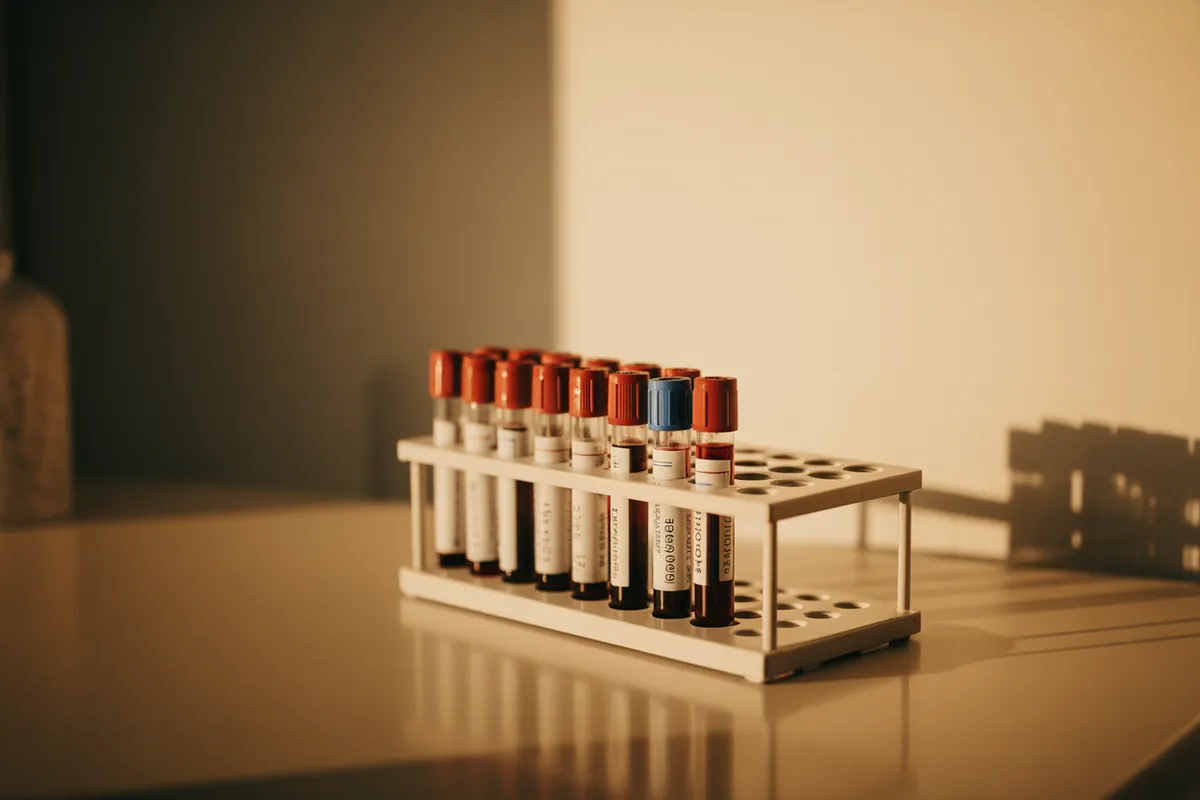
Blood is the workhorse for recent and ongoing exposure. Because blood is the first compartment a metal enters, an elevated blood level is a strong signal of current or recent contact — and it is the standard specimen for the two metals clinicians worry about most. For lead, the blood lead level is the established measurement, with public-health action thresholds anchored to it. For mercury, whole blood (not serum or plasma) is the preferred specimen, because mercury concentrates in red blood cells.
Blood also offers supporting markers. Erythrocyte protoporphyrin and zinc protoporphyrin can reflect lead's interference with heme synthesis over a somewhat longer window, though they are insensitive at low concentrations and are not good screening tools on their own. On a peripheral smear, basophilic stippling is a classic, relatively specific clue to lead exposure, and a hypochromic, microcytic anemia can reflect impaired heme synthesis — which is also why iron deficiency should be ruled out, since the two can look similar and frequently coexist.
What blood does not reliably show is the metal that entered the body years ago and has since redistributed into bone or soft tissue. A normal blood level does not exclude a meaningful historical exposure; it tells you about the recent window. That single limitation is the reason urine and hair testing exist at all — and the reason matching the specimen to the question is the whole game.
Urine testing — and the provoked (challenge) controversy
Urine testing comes in two very different forms, and conflating them is a common mistake. The first is straightforward random or 24-hour urine, which measures what the kidneys are currently excreting. A spot or 24-hour collection is useful when there is acute or ongoing exposure — elevated urinary metals point to something the body is actively clearing — and it is a reasonable choice for arsenic, where whole blood or a 24-hour urine both have a role, and for following metals during and after chelation. A common 24-hour panel bundles cadmium, lead, arsenic, and mercury.
The second form is the provoked or “challenge” urine test, and this is where candor is required. In a provoked test, the patient is given a chelating agent and then collects urine, on the theory that the chelator pulls stored metals into the urine and reveals a hidden body burden a baseline test would miss. It is widely used in functional and integrative medicine. It is also not validated or endorsed by mainstream toxicology, and it is important to say why plainly.
The central problem is mechanistic: chelators raise urinary metal levels in almost everyone, including people with no meaningful exposure. As Dr. Bongiorno acknowledges directly, if you ran a provoked test on a room of healthy people with no complaints, you would expect to see substantial post-challenge increases — because we all carry some metal. A widely cited 2013 review made exactly this point about mercury: it is detectable in most people's urine without known exposure, chelator administration raises urinary excretion unpredictably regardless of history, and because there are no established reference ranges for the provoked specimen in healthy subjects, the review concluded the test has no proven diagnostic value and should not be used.
Dr. Bongiorno offers a candid, two-sided take. He pushes back on the idea that the absence of a reference range should disqualify the test — his argument being that the “healthy” level for a true poison should be zero, so debating a normal range is itself questionable. At the same time, he openly agrees that the data and science are not at the level of confidence we would like, and that this is the prevailing view in conventional toxicology. The honest synthesis for a provider: the provoked test is a functional-medicine tool that can add information when other causes have been ruled out and the source and symptoms already align — but it is not a standardized, validated test, its numbers cannot be read against a clean reference range, and it must never be the sole basis for diagnosing toxicity or starting treatment.
There is also a safety dimension that is not optional. A provoked test is a small chelation event, so kidney function must be checked first; mobilizing metals through compromised kidneys is a real risk, and the specific agents, dosing, kidney-function cutoffs, and the pre-provocation steps that make it safer are taught in Empire's course rather than reproduced here. The takeaway for this page is interpretive, not procedural: treat a provoked result as a hypothesis to weigh against the whole clinical picture, never as a verdict.
Hair and nail analysis: a record of longer-term exposure
Hair and nail analysis answers a different question again — not “what is circulating now,” but “what has this person been exposed to over time.” Several metals, notably methylmercury and arsenic, have an affinity for keratin and become incorporated into the growing hair and nail, so the sample acts as a slow-moving record of exposure. Arsenic's keratin affinity is why chronic exposure can show up in hair and fingernails, sometimes alongside transverse (Mees') lines on the nails.
The limits, though, are real and must be respected. The biggest is external contamination: hair products, treatments, and ambient environmental deposition can put metal on the hair that was never in the body. The practical consequence is preparation — patients should be asked what they use in their hair, ideally pause those products for a week or so, and wash thoroughly before sampling, so the result reflects what is built into the hair rather than what is sitting on it. Hair analysis is best read as a complement to blood and urine, not a stand-alone verdict, and it is poorly suited to questions about acute exposure.
Choosing the right test for the metal
Pulling it together, test selection is really specimen-to-question matching. A few patterns recur in practice:
- Lead — blood lead is the established measurement for current and recent exposure; supporting clues include basophilic stippling and protoporphyrin markers. See lead poisoning.
- Mercury — whole blood for recent exposure; urine to follow renal burden, including after chelation; hair for longer-term methylmercury exposure. See mercury toxicity.
- Arsenic — whole blood or 24-hour urine for recent exposure; hair and fingernails for chronic exposure, given arsenic's keratin affinity. See arsenic toxicity.
- Cadmium — blood reflects recent exposure; urine reflects cumulative renal burden, which is where cadmium's toxicity concentrates.
- Body-burden questions — some clinicians add a 24-hour collection or, with the caveats above, a provoked test; both should be read against the clinical picture, not in isolation.
The unifying rule is that the test follows the metal and the timeline. Order blood when you suspect something current, reach for hair when the question is historical, and use urine to watch what the kidneys are doing — while staying honest about what a provoked challenge can and cannot prove.
Interpreting results responsibly
Interpretation is where good testing is won or lost. Three principles keep it honest. First, reference ranges are a starting point, not an answer — and for some specimens, especially the provoked urine, a clean validated range simply does not exist. A value inside the “normal” range can still be high-normal and clinically relevant for a given patient, and for true poisons the biologically ideal level is effectively zero, which is why ranges describe populations more than they describe risk in one person.
Second, numbers gain meaning only in clinical context. A metal level is a signal to weigh against the source history and the symptom pattern — the same three-pillar logic that opened this guide. A modestly elevated result with a clear exposure source and a fitting clinical picture is far more actionable than an isolated number with no story behind it. The corollary matters just as much: a result without a plausible source and matching symptoms should not, by itself, launch treatment.
Third, resist over-diagnosis. Because nearly everyone carries some metal burden and because provoked testing inflates urinary values across the board, it is easy to manufacture a diagnosis from a test alone. Significant acute or chronic poisoning is a medical emergency and a referral question, and it should be confirmed as real toxicity before anyone is treated — not inferred from a single provoked specimen. Testing exists to inform judgment, not to replace it. The discipline of choosing the right test, reading it against the whole patient, and knowing when to refer is precisely what separates responsible practice from “detox” marketing.
Learn to test — and interpret — the right way
Empire Medical Training's Heavy Metals & Chronic Illness course teaches clinicians how to choose the right specimen for each metal, read results against reference ranges and clinical context, navigate the limits of provoked and hair testing, and recognize when toxicity requires referral. Taught by Dr. Peter Bongiorno, ND, LAc.
Explore the Heavy Metals Course → Claim Your Prize!