






 Medically reviewed by
Faride Ramos, MD
Double Board-Certified, Internal & Functional Medicine; Functional Endocrinology
Medically reviewed by
Faride Ramos, MD
Double Board-Certified, Internal & Functional Medicine; Functional Endocrinology Thyroid dysfunction is one of the most common — and most commonly missed — endocrine problems in primary care. Symptoms such as fatigue, weight gain, cold intolerance, constipation, and low mood are nonspecific, and they overlap heavily with depression, perimenopause, and ordinary aging. As a result, patients are frequently handed an antidepressant when the real driver is a quietly underperforming thyroid. A functional-medicine approach widens the lens: it reads the whole thyroid axis, looks for why conversion or autoimmunity might be off, and treats the patient in front of you rather than a lab flag in isolation.
This guide is written for clinicians who want an accurate, honest overview of thyroid physiology and the functional-versus-mainstream debates that surround it. It is clinical education, not medical advice or a treatment protocol, and it is not a substitute for proper diagnosis and monitoring by a qualified prescriber.
The thyroid axis: what each marker actually measures
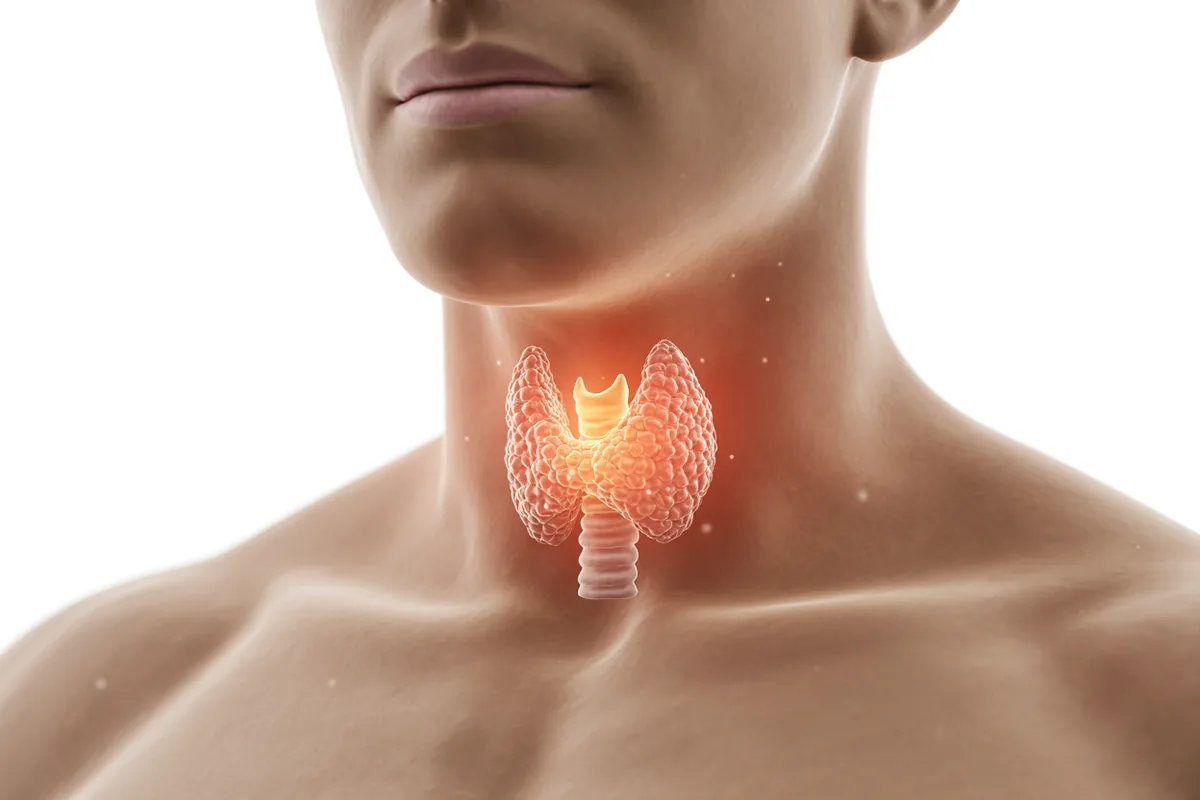
The classic single-test approach screens with TSH alone. But TSH is not made by the thyroid — it is the pituitary's instruction to the gland. Reading TSH in isolation is like judging a thermostat's setting without ever measuring the room temperature. A complete picture layers several markers:
- TSH — the pituitary signal. It rises when the brain senses too little thyroid hormone and falls when there is enough or too much.
- Free T4 (thyroxine) — the main hormone released by the thyroid gland. It is largely a storage and transport form that the body must activate.
- Free T3 (triiodothyronine) — the active hormone at the tissue level. T3 is roughly ten to fifteen times stronger than T4, and much of it is produced not by the gland but by peripheral conversion in other tissues.
- Reverse T3 — an inactive metabolite that competes with T3 for the same receptor. It tends to rise in illness and stress.
- Thyroid antibodies (anti-TPO) — markers of autoimmune attack on the gland, the hallmark of Hashimoto's.
Hormone production itself starts when thyroid peroxidase (TPO) prepares iodine for attachment to thyroglobulin, building the precursors that become T4 and T3. That same TPO enzyme is the most common antibody target in autoimmune hypothyroidism — a detail that links the production pathway directly to the most frequent cause of an underactive gland.
T4 to T3: the conversion that decides how a patient feels
Here is the concept that single-number screening misses entirely. T4 is mostly a storage hormone; T3 is the one that does the work. The gland releases predominantly T4, and peripheral tissues convert it into the far more potent T3. If that conversion is impaired, a patient can have a perfectly normal TSH and a normal T4 and still feel profoundly hypothyroid — sluggish, cold, foggy, gaining weight despite no change in habits.
Several things impair conversion, and most of them are not "thyroid problems" at all:
- Stress and elevated cortisol. The thyroid does not work alone — it sits downstream of the stress axis. Chronic cortisol elevation, and the dysregulation that follows it, suppresses T4-to-T3 conversion. This is why thyroid symptoms and stress so often travel together; see cortisol and chronic stress and HPA-axis dysregulation.
- Acute illness. A classic pattern is a normal TSH with a low T3 during illness — sometimes called low-T3 syndrome — as the body deliberately downshifts metabolism.
- Nutrient deficiencies. Selenium and zinc are required cofactors for healthy conversion, and deficiency in either is linked with reduced T4-to-T3 conversion. Selenium also helps lower antibodies against TPO.
- Estrogen and binding proteins. Oral estrogen raises thyroid-binding globulin and can lower measured free hormone, one reason thyroid status should be read alongside the rest of the endocrine picture.
The clinical takeaway is not a supplement list — the specific nutritional and lifestyle work-up belongs in the course — but a way of thinking: when the labs say "normal" and the patient says "I don't feel myself," conversion is one of the first places a functional clinician looks.
"Optimal" range vs lab reference range: the honest debate
This is the most contested area in thyroid care, and it deserves a straight answer rather than a sales pitch. The laboratory reference range for TSH is a statistical band derived from a reference population. The functional "optimal" range is a narrower target some clinicians aim for — typically a lower TSH — on the belief that many patients feel better there and that the upper reference limit has crept too high, leaving symptomatic people labeled "normal."
There is a legitimate argument on the functional side: a reference range that widens over time can cause genuinely hypothyroid patients to be reassured and sent away, with clinical signs and symptoms ignored in favor of a number. There is an equally legitimate argument on the mainstream side: treating a TSH that sits within the reference range risks over-treatment, and pushing thyroid hormone to chase a target carries real harms — including effects on the heart and on bone density. Both can be true.
Reverse T3: useful context or a distraction?
Reverse T3 is the body's brake. It is structurally similar to T3 but inactive, and it competes for the same receptor — so when reverse T3 is high relative to T3, the active hormone is effectively blocked at the door. Levels rise during stress, illness, and low-calorie states, which is consistent with a protective downshift in metabolism.
Functional clinicians sometimes use reverse T3 to assess conversion and to make sense of a patient who looks hypothyroid despite normal standard labs. But its clinical utility is genuinely contested. Many endocrinologists regard reverse T3 as nonspecific — it goes up in any acute stress — and not validated for routine diagnosis or for deciding who needs thyroid hormone. The honest framing: reverse T3 can add context in a complex case, but it should never be the lone justification for treatment, and a high value usually points back to stress, illness, or under-eating rather than to a thyroid that needs medicating.
Hashimoto's and autoimmune thyroid disease
Hashimoto's thyroiditis is the most common cause of hypothyroidism in iodine-sufficient countries, and it is fundamentally an autoimmune problem: the immune system produces antibodies — most often anti-TPO — against thyroid tissue. A crucial point for screening is that antibodies can appear before the TSH ever becomes abnormal. A patient can have rising autoimmune activity, and the symptoms that come with it, while a TSH-only screen still reads "normal." This is precisely why a functional work-up checks antibodies rather than relying on TSH alone.
Because Hashimoto's is autoimmune, the functional approach looks beyond the gland to the broader terrain that drives immune activation — stress load, nutrient status, and gut health among them. Selenium, for instance, has been associated with lower TPO antibodies. These are reasons to investigate the whole patient, not a prescription to self-treat; antibody-positive disease still requires a clinician to diagnose, monitor, and decide on therapy. The deeper autoimmune and nutritional reasoning is taught in Empire's course.
Where thyroid sits in the hormone symphony
One of the central ideas in functional endocrinology is that hormones do not act in isolation — they play together. As Dr. Ramos frames it, there is a symphony among the hormones, starting with cortisol, followed by thyroid, and then the sex hormones. The order matters clinically: an unmanaged stress response sits upstream of the thyroid, and the thyroid in turn shapes how estrogen, progesterone, and the others are felt.
That is why chasing thyroid numbers in a vacuum so often fails. A patient with chronic stress and HPA-axis dysregulation may have impaired T4-to-T3 conversion that no dose adjustment fully fixes until the stress and sleep are addressed. A perimenopausal patient's shifting estrogen can change thyroid-binding proteins and muddy the labs. Reading the thyroid as one instrument in an ensemble — alongside overall hormone imbalance and the rest of the functional-endocrinology picture — is the core of the approach.
Testing and treatment: what's taught in the course
Two practical questions follow naturally: how do you test the full axis well, and how do you treat what you find? Both are where structured education earns its place, and both are taught in depth in Empire's Anti-Aging and Functional Medicine course rather than reduced to a recipe here.
On testing, the principle is that a panel should answer a specific clinical question, not fish blindly. Knowing when to add free T3, reverse T3, or antibodies to a basic TSH and free T4 — and how to interpret patterns such as a normal TSH with a low T3, or a suppressed TSH with a high reverse T3 — is judgment, not a checklist. The broader skill of ordering and reading these panels lives in functional-medicine lab testing.
On treatment, options range from synthetic T4 to combination and desiccated preparations that supply both T4 and T3, each with real trade-offs in dosing, timing, titration, and monitoring — including the fact that some foods and supplements interfere with absorption, and that re-testing follows defined intervals rather than guesswork. Those specifics, including when replacement is appropriate versus when a lifestyle-first approach comes first, are part of the curriculum. Where a patient is heading toward hormone replacement more broadly, the hormone replacement therapy cluster covers that side; bioidentical and compounded preparations carry their own regulatory and safety nuances that belong with a prescriber, not a web page.
Learn functional thyroid care the right way
Empire Medical Training's Anti-Aging & Functional Medicine training, taught by Dr. Faride Ramos, MD, covers thyroid physiology, the full panel and how to read it, T4-to-T3 conversion, Hashimoto's, and where thyroid fits in the cortisol-thyroid-sex-hormone symphony — with the testing and treatment judgment that a single page cannot teach.
Explore the Anti-Aging & Functional Medicine Training → Claim Your Prize!