








A cosmetic nurse is a licensed registered nurse who performs aesthetic procedures — neurotoxin and dermal filler injections, chemical peels, laser treatments — in a medical spa, dermatology practice, or plastic surgery office. It’s one of the few nursing specialties where you build a book of returning patients, work regular hours, and see your results the same week you produce them. That combination is why so many nurses start looking at it.
The path there is straightforward, but it’s widely misunderstood. Search “cosmetic nurse school” and you’ll find a lot of pages implying there’s a dedicated degree program you enroll in to become one. There isn’t. This guide lays out the actual pathway, what the work involves, how certification works, and — the part that determines whether you’re competent or just credentialed — how to evaluate an aesthetics training program before you pay for it.
What Does a Cosmetic Nurse Do?
Cosmetic nurses — also called aesthetic nurses — perform and assist with minimally invasive cosmetic procedures. They typically work under the supervision or delegation of a board-certified physician, most often a dermatologist or plastic surgeon, though the specifics of that relationship vary considerably by state.
Common services include:
- Botox® and other neurotoxin injections
- Dermal filler injections
- Chemical peels
- Laser hair removal and laser skin treatments
- Microdermabrasion
- Sclerotherapy for varicose and spider veins
- Tattoo removal
- Scar treatment
- Body contouring and fat reduction procedures such as CoolSculpting
- Other injectables offered in medical spa settings, such as MIC/B12 injections
- Pre-operative and post-operative care for cosmetic surgery patients
What cosmetic nurses generally do not do is perform surgery. Traditional plastic surgical procedures sit outside RN scope of practice. The specialty lives in the minimally invasive space — which happens to be exactly where patient demand has been concentrating.
It’s worth being clear about how this differs from adjacent roles. A cosmetologist performs non-medical services — hairstyling, nail care, makeup, basic skincare, hair removal — and works in salons, day spas, and medical spas. Cosmetologists complete a state-approved program (typically 9 to 15 months full-time, depending on the state) and pass a state licensing exam. When cosmetologists work with lasers, pulsed light, or medical-grade chemicals, they generally do so under the supervision of a cosmetic nurse or aesthetic physician. The dividing line is a medical license, and it’s the reason a cosmetic nurse can inject and a cosmetologist can’t.
Why Nurses Are Moving Into Aesthetics
Demand for nurses who can perform aesthetic procedures has been climbing, and the reasons are structural rather than faddish:
- Minimally invasive procedures went mainstream. Botox, dermal fillers, and laser resurfacing are no longer niche. As the market for non-surgical treatment expands, so does the need for qualified clinicians to administer it.
- The population is aging. Baby Boomers, Generation X, and now Millennials are all seeking age-management treatment in larger numbers than any prior cohort.
- Patients prefer a medical background. Consumers have become far more discerning about who holds the syringe, and many actively seek out a nurse rather than a non-medical provider.
- Medical spas keep opening. The growth of medspas and dedicated aesthetic clinics has created a steady stream of practices looking to staff injectors.
None of that makes the field easy to enter well. It makes it easy to enter badly — which is why the training question matters so much.
How to Become a Cosmetic Nurse: The Actual Pathway
There is no dedicated, degree-granting “cosmetic nurse school” in the way the phrase suggests. You don’t apply to a four-year cosmetic nursing college. What people mean when they say “cosmetic nurse school” is really the aesthetics-specific training you complete after you’re already a licensed nurse. The full pathway looks like this.
1. Complete a Nursing Program
You need a nursing degree from an accredited program. An Associate Degree in Nursing (ADN) is the minimum that qualifies you to sit for licensure. A Bachelor of Science in Nursing (BSN) is not strictly required, but it is what many aesthetic employers prefer and it opens more doors later — including advanced practice, if you eventually want it.
2. Pass the NCLEX-RN and Get Licensed
The National Council Licensure Examination for Registered Nurses (NCLEX-RN) is the exam that converts your degree into a license. Pass it, meet your state board’s requirements, and you’re an RN. Everything downstream depends on this license.
3. Build Clinical Experience
Aesthetic employers want nurses who can assess a patient, recognize a complication, and handle it. Experience in a related field — dermatology, plastic surgery, facial plastic surgery, or ophthalmology — is the most direct preparation, and it also positions you for certification later. General clinical experience still counts; injecting is a technical skill layered on top of nursing judgment, not a replacement for it.
4. Complete Aesthetics-Specific Training
This is the step people are actually searching for. Aesthetic procedures aren’t taught in nursing school, so you learn them through continuing medical education — hands-on courses in neurotoxin injection, dermal fillers, lasers, peels, and the rest. This is where competence is built or isn’t, and it’s covered in detail in the next section.
5. Pursue Certification (Optional, But Valuable)
Board certification isn’t required to practice, but it signals a level of commitment employers notice. See the certification section below for how it works.
6. Keep Training
Aesthetics moves. New products, new devices, new techniques. Ongoing workshops — advanced injectables, laser therapy, advanced skincare — are how you stay current, and they satisfy continuing education requirements at the same time.
How to Choose a Training Program
This is the decision that separates nurses who build real careers in aesthetics from nurses who paid for a certificate and still can’t confidently treat a patient. Not all “cosmetic nurse school” programs are equivalent, and the marketing rarely tells you which is which. Here is what to actually check.
Accreditation and CME Credit
The course should be offered by an accredited training institution and count toward your continuing medical education requirements. If a program can’t tell you plainly whether it confers CME credit, that answers a different question about the program.
Faculty Credentials
Instruction should come from licensed, board-certified medical professionals who actually perform these procedures. Ask who is teaching, what their specialty is, and whether they still practice. “Certified trainer” is not a credential.
Live Patients, Not Mannequins
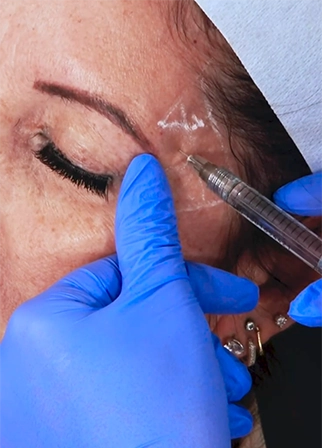
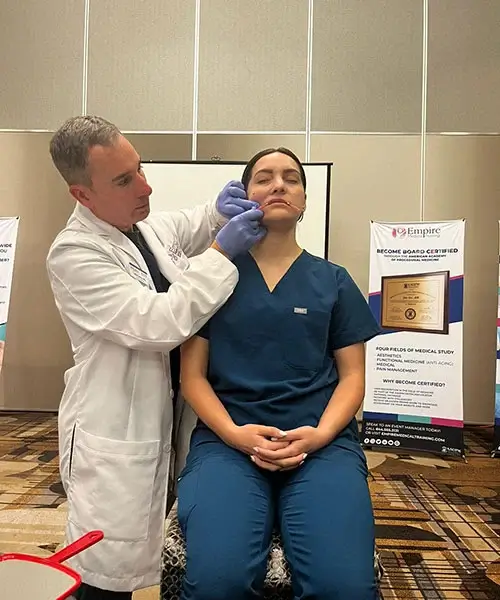
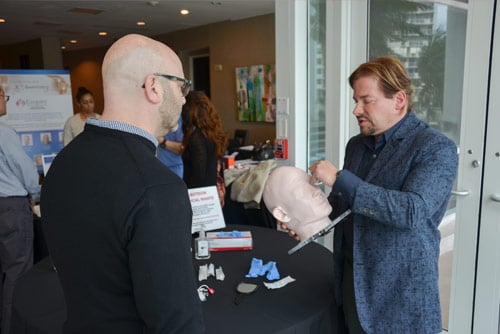
This is the single biggest differentiator. Injecting a silicone head teaches you where a needle goes in a silicone head. It teaches you nothing about tissue resistance, real anatomy that varies from the textbook, patient movement, or the judgment call you make when the face in front of you doesn’t match the diagram. A serious program pairs classroom-based didactic instruction with hands-on training on live patients under supervision. If a course is hands-on in name only, keep looking.
Student-to-Instructor Ratio
Hands-on training only works if a qualified instructor is close enough to correct your hand before you inject, not after. Ask for the ratio. A program that won’t give you a number is telling you the number.
Course Materials and Post-Course Support
You should leave with comprehensive materials you can review at your own pace, and you should have somewhere to turn when you hit your first difficult case. Training that ends the moment you walk out of the room has a short shelf life.
A Path Beyond the Introductory Level
Look for a program that offers progression — the ability to follow an introductory Botox and filler course with advanced injectable training. A one-and-done certificate is a starting line dressed up as a finish line.
Ready to put this into practice?
Explore Empire's hands-on, CME-accredited Medical Aesthetics Career Pathways courses — live patients, expert faculty, and ongoing mentorship.
Certification on Completion
The course should confer certification following successful completion, and should be honest with you about what that certification is: proof you completed structured training, not a license expansion. Our guide to Botox certification for nurses covers what these credentials do and don’t authorize.
What Aesthetic Training Actually Covers
A well-built aesthetics curriculum for nurses covers considerably more than injection mechanics:
- Anatomy and physiology of the face, skin, and body, including facial aesthetics and the aging process
- Principles and techniques for common procedures — neurotoxins, dermal fillers, laser treatments, chemical peels, body contouring
- Injection technique, dosing, and the management of complications and side effects
- Patient assessment, treatment planning, and pre- and post-procedure care
- Ethical and legal considerations specific to aesthetic practice
- Business and practice management for working in a medical spa or aesthetic clinic
That last item gets dismissed more often than it should. Aesthetics is an elective, cash-pay specialty. Understanding consultation, retention, and pricing isn’t a side interest — it’s part of the job.
If you’re deciding where to start, injectables are the usual entry point because they carry the broadest demand. Botox training and dermal filler training together cover the majority of what a working medspa injector does day to day.
Do Cosmetic Nurses Need Certification?
You don’t need a specialty certification to work as a cosmetic nurse. Your RN license plus appropriate training is what makes you eligible to practice within your state’s scope rules. But formal certification is a recognized marker of expertise, and it can widen your options.
The Plastic Surgical Nursing Certification Board (PSNCB) offers two tracks:
- Certified Aesthetic Nurse Specialist (CANS)
- Certified Plastic Surgical Nurse (CPSN)
Eligibility is demanding by design. You’ll need to work under a board-certified physician for two years while logging at least 1,000 hours in one of four aesthetic disciplines:
- Facial plastic surgery
- General plastic surgery
- Dermatology
- Ophthalmology
Then you sit for the exam. After that, you maintain the credential through continuing medical education — expect to log at least 45 contact hours every three years. Note that certification is a credential layered on top of your license; it doesn’t by itself expand what you’re legally permitted to do.
Scope of Practice: Verify With Your State Board
Who may inject, under what level of physician supervision, and with what delegation or protocol requirements — all of it varies by state. Some states permit RNs to inject under physician supervision with relatively light requirements. Others are considerably more restrictive about supervision, delegation, and the good-faith exam.
Do not take a training company’s word for what you’re allowed to do, and don’t take an employer’s either. Verify current requirements directly with your state board of nursing before you accept a role or perform a procedure. Our overview of who can administer Botox explains the general landscape, but your board is the only authority that governs your license.
Frequently Asked Questions
How long does it take to become a cosmetic nurse?
It depends entirely on where you’re starting. If you’re not yet a nurse, you’ll need a nursing degree — an ADN or a BSN — and then you’ll need to pass the NCLEX-RN. If you’re already a licensed RN, aesthetics-specific training is measured in days rather than years, though building genuine competence takes ongoing practice and continued coursework. Board certification adds substantially more time: CANS and CPSN eligibility requires two years working under a board-certified physician and at least 1,000 logged hours in an aesthetic discipline.
Do you need a BSN to be a cosmetic nurse?
No. An Associate Degree in Nursing is enough to sit for the NCLEX-RN and become a licensed RN, and an RN license is the foundational requirement. That said, a BSN is preferred by many aesthetic employers and gives you more flexibility over a full career, including a route into advanced practice.
How much do cosmetic nurses make?
Compensation varies widely by state, practice setting, experience, and whether your role includes commission or production-based pay — medical spa arrangements often do. Nurses who hold board certification and advanced injectable skills generally command more than those who don’t, and specialization tends to be rewarded. For a real number, look at current postings in your own market rather than national averages, which flatten out the variables that actually determine your offer.
What does a cosmetic nurse do?
Cosmetic nurses perform and assist with minimally invasive aesthetic procedures: neurotoxin and dermal filler injections, chemical peels, laser hair removal and skin treatments, microdermabrasion, sclerotherapy, tattoo and scar treatment, body contouring, and other medspa injectables. Many also provide pre- and post-operative care for cosmetic surgery patients. They do not perform surgical procedures.
Do cosmetic nurses need certification?
Not to practice. Your RN license and appropriate training determine your eligibility, within your state’s scope rules. Certification through the PSNCB — CANS or CPSN — is optional but recognized, and it demonstrates a level of specialization employers value.
What is the difference between a cosmetic nurse and a nurse esthetician?
The terms get used loosely, which causes real confusion. A cosmetic nurse is a licensed RN performing medical aesthetic procedures under the authority of a nursing license. “Nurse esthetician” is sometimes used for the same role and sometimes for a licensed esthetician working in a medical setting — a very different credential with a very different scope. The operative question is never the job title; it’s the underlying license. Our nurse esthetician guide walks through the distinction.
Where do cosmetic nurses work?
Medical spas, dermatology practices, plastic surgery and facial plastic surgery offices, and dedicated aesthetic clinics. Some cosmetic nurses eventually open or co-own a medspa, which is where the business and practice-management side of the training earns its keep.
Looking for a Role, or Hiring for One?
Empire runs a placement service for exactly this. The Medical Match is free to Empire graduates and works in both directions: clinicians looking for a position complete a job opportunity form, practices looking to fill one complete an employer form, and Empire matches against its database of healthcare professionals.
Empire members also get Empire Jobs, the job board inside the Empire portal — browse and apply to current postings, or post a role and manage the applications if you are the one hiring.
Start Your Aesthetics Training
There’s no cosmetic nurse school. There’s your RN license, your clinical judgment, and the aesthetics training you choose to layer on top — and the quality of that third piece is the part fully within your control.
Empire Medical Training has trained healthcare professionals since 1998. Our courses are CME-accredited and hands-on with live patients under expert supervision — because you cannot learn to read tissue, control depth, or manage a real face from a mannequin or a slide deck.
If you’re an RN mapping out where to begin, our medical training for registered nurses lays out the workshops open to you and the order that makes sense. If you want to move faster and build a full aesthetic skill set rather than one procedure at a time, the Empire Clinical Fellowship is the structured route.



 Claim Your Prize!