







 Medically reviewed by
Betsy Greenleaf, DO
Board-Certified OB/GYN & Urogynecologist; Empire Director of Anti-Aging
Medically reviewed by
Betsy Greenleaf, DO
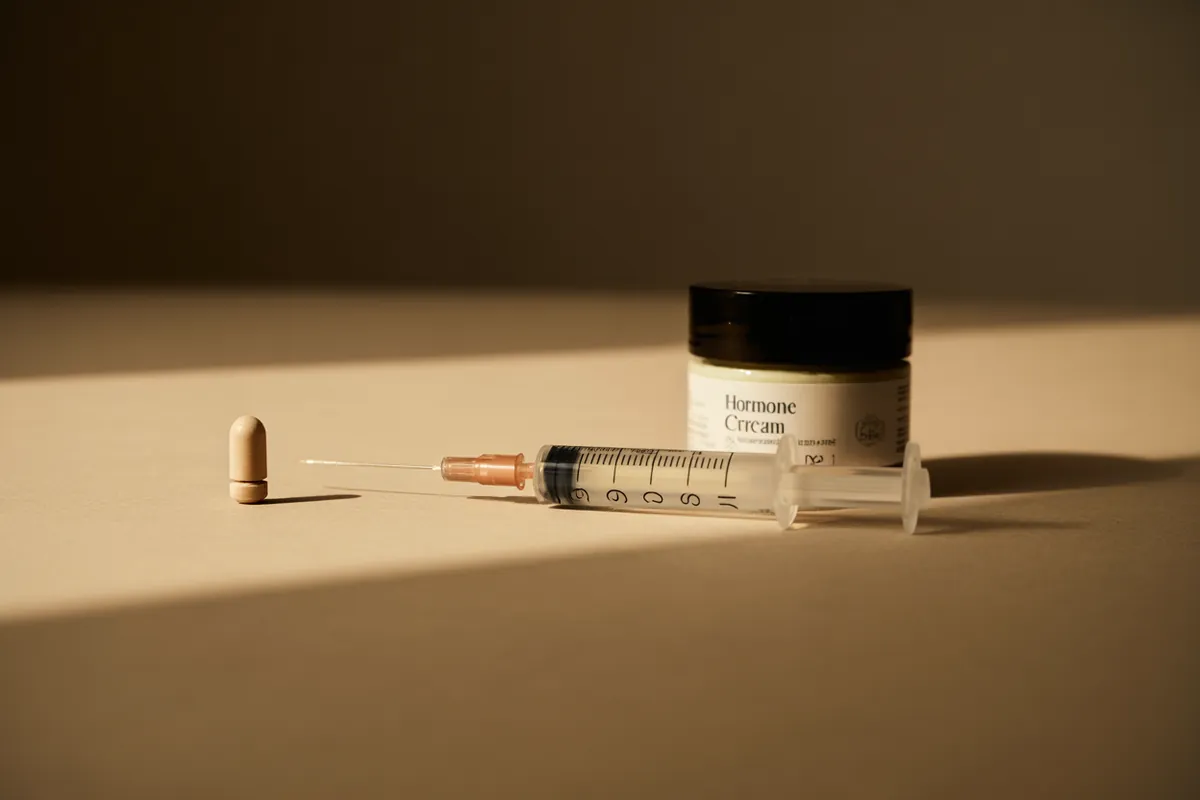
Board-Certified OB/GYN & Urogynecologist; Empire Director of Anti-Aging When clinicians compare hormone pellets, injections, and creams, the instinct is to ask which delivery method is “best.” That is the wrong question. All three can deliver the same bioidentical hormone — testosterone, estradiol, or, in topical form, progesterone — and the molecule is identical once it reaches the receptor. What differs is the pharmacokinetics: how fast levels rise, how steady they stay, how long they last, and how easily you can change course. Those differences decide convenience, safety, titratability, and even long-term efficacy.
This comparison is written for providers weighing delivery options within a hormone replacement therapy practice. It is clinical education, not medical advice, and it deliberately stops short of dosing schedules and insertion technique — those are taught in Empire’s hands-on course.
Why delivery method matters more than people think
Hormones are messengers that bind to specific receptors to produce their effect. The body did not evolve to receive those messengers as a flat, unchanging signal — it evolved around natural fluctuation. Testosterone, for example, peaks in the morning and runs lower at night, and is highest in the late summer and early fall. That rhythm is not incidental. As Dr. Greenleaf puts it, “it is the natural fluctuations in hormone levels that helps to keep receptors sensitive.”
This is the steady-state lesson, and it reframes the entire pellets-versus-injections debate. “Anything that stays in the body at steady state, the body is tuning it out.” When a hormone is held at a perfectly constant level, receptors can down-regulate — a desensitization Greenleaf compares to cortisol insensitivity. The clinical trap is predictable: the patient does great, then gradually does worse, and a provider who chases symptoms keeps escalating the dose. “In the long run, you’re going to be chasing the receptor insensitivity, and you’re going to end up giving more and more and more.”
So the way a hormone is delivered is not a packaging detail. A method that produces peaks and troughs mimics natural rhythm and tends to keep receptors responsive. A method that produces a perfectly flat steady state maximizes convenience and smoothness but, left unmanaged, can blunt receptor sensitivity over time. Every delivery method below sits somewhere on that spectrum, and choosing well means matching the method — and how you manage it — to the patient.
Pellets: steady release, hands-off, every few months
Subcutaneous hormone pellets are compounded crystalline implants placed under the skin, usually in the upper buttock or hip, where they dissolve slowly. They are reinserted roughly every three to six months, and between insertions the patient does nothing — no daily dose, no weekly injection. Pellets also offer high bioavailability: because the hormone enters the bloodstream directly, you do not have to worry about first-pass liver metabolism or gut absorption the way you do with oral forms.
The defining feature is a steady release that produces the smoothest blood levels of any common method. For patients who hate needles, forget daily applications, or simply want a set-and-forget approach, that is a powerful selling point — and it is why pellet practices are popular. The full insertion procedure, trocar technique, and aftercare are covered in our companion guide to the hormone pellet insertion procedure, and the science behind pellets in our hormone pellet therapy overview.
The honest downsides follow directly from the steadiness. First, pellets are the least reversible method: once placed, the hormone is committed for months and cannot simply be stopped. Greenleaf is blunt that estrogen pellets in particular carry a risk of inconsistent absorption, with cumulative rises that can occur for up to two years after a single placement. Second, absorption varies “from person to person, pharmacy to pharmacy, and batch to batch.” Third — and most important — pellets are the method most prone to the steady-state insensitivity described above. Greenleaf’s management is to space insertions out deliberately rather than reflexively redosing at three months: “Maybe try to go four months, see if you can go five months, so that you keep those receptors sensitive,” and to bridge symptomatic gaps with a short-acting form rather than placing the next pellet early.
Injections: peaks and troughs, frequent, self-administered
Injectable hormones — most commonly testosterone esters — are administered intramuscularly or subcutaneously on a schedule set by the ester’s duration. Cypionate and enanthate are typically given about every two weeks; short-acting propionate every two to three days; and long-acting depot formulations far less often. Patients can be taught to self-administer, which keeps injections inexpensive and accessible.
The signature of injections is a peak-and-trough curve: levels rise after each dose and fall before the next. Some patients feel that rise and fall, especially on longer intervals, and frequency is often adjusted to smooth it. But that same fluctuation is also injections’ quiet advantage — because levels are never perfectly flat, the method more closely mirrors the body’s natural rhythm and is less prone to the receptor desensitization that flat steady state can cause. Injections are also far more controllable and reversible than pellets: change the dose or interval at the next injection, or stop, and levels respond within days to weeks. This is exactly why Greenleaf reaches for a short-acting injection (or a topical) to bridge a patient between pellets and “keep those receptors sensitive to the hormone.” The trade-off is adherence and comfort: injections demand a needle on a recurring schedule, and not every patient will keep it up.
Creams and gels: daily, controllable, transference risk
Topical creams and gels are applied to the skin daily and absorbed transdermally. Their great strength is fine control: because they wash out of the system quickly, dosing is easy to titrate and easy to taper. Greenleaf describes topicals as “short-acting therapies that provide a quicker and more controllable ability to taper,” and uses them — like short-acting injections — to bridge gaps and adjust a patient who needs hands-on management. Transdermal dosing also bypasses the liver; her rule of thumb that “one hundred milligrams orally is equivalent to ten milligrams transdermally” reflects how much more efficiently a hormone reaches the blood when it skips first-pass metabolism.
The defining downside is transference. Until a topical fully absorbs, it can rub off through skin contact onto a partner, a child, or a pet — a real safety concern with testosterone in particular, and a counseling point every prescriber must cover. The second downside is adherence: a daily application only works if the patient actually applies it consistently, every day. Topicals are the most reversible and the most adjustable of the three methods, which makes them the natural tool for titration and bridging — but the least “set and forget.”
Pellets vs injections vs creams: side-by-side
No method wins every row. Read the table as a map of trade-offs, not a scoreboard — the right column depends entirely on the patient in front of you.
| Factor | Pellets | Injections | Creams / Gels |
|---|---|---|---|
| Frequency | Every 3–6 months | Every 2–3 days to every 2 weeks | Daily |
| Blood-level stability | Most stable (steady state); absorption varies by batch | Peaks and troughs between doses | Daily on-off cycle; depends on adherence |
| Convenience | Highest — hands-off for months | Moderate — recurring self-injection | Lowest — daily application required |
| Procedure required | Yes — minor in-office insertion | Injection (often self-administered) | None |
| Transference risk | None | None | Yes — skin contact before absorption |
| Reversibility / titration | Lowest — committed for months once placed | Moderate — adjust at next dose | Highest — washes out quickly, easy to taper |
A useful way to hold the table in your head: pellets optimize for stability and convenience, topicals optimize for control and reversibility, and injections sit in between — frequent but cheap, fluctuating but adjustable. This is why providers so often combine them, anchoring a patient on pellets and reaching for a topical or short-acting injection to fine-tune or bridge.
How providers choose
The choice is rarely about the molecule and almost always about the patient’s life and physiology. A few questions drive most decisions:
- How much does the patient value convenience versus control? A busy patient who wants to forget about it for months is a pellet candidate. A patient whose levels need careful titration — or who is early in optimization — is better served by an adjustable topical or injection.
- Is there a transference exposure at home? Young children or a partner trying to conceive can make a topical the wrong choice and push toward pellets or injections.
- Will the patient adhere? Daily creams and recurring injections only work if the patient keeps up. Pellets remove adherence from the equation — at the cost of reversibility.
- Is receptor insensitivity already in play? If a previously stable patient suddenly does worse, the answer is usually not more hormone. Greenleaf’s move is to space pellets out, sometimes have patients skip topical doses on weekends, and bridge with short-acting forms to re-sensitize receptors — “not just giving hormones based on symptoms.”
- How will you taper or exit? Stopping is straightforward with a topical, manageable with injections, and slow with pellets. Greenleaf will deliberately transition a patient toward short-acting therapy when a controllable taper is the goal.
Two clinical principles tie it together. First, check levels and keep them within normal limits — do not chase symptoms, because symptom-chasing is exactly how providers over-dose into insensitivity. Second, “patients don’t follow a textbook”: the safest practice often blends methods, using one for the baseline and another for adjustment. Getting that judgment right is what separates a confident hormone practice from a reactive one — and it is learned with reps, lab interpretation, and the dose-conversion math between forms, all of which Empire teaches.
Master every delivery method — and the judgment behind them
Empire Medical Training’s Hormone Pellet Therapy training, developed by Dr. Betsy Greenleaf, DO, teaches the full protocols: dose conversion across pellets, injections, and topicals; lab interpretation; managing steady-state insensitivity; contraindications; and hands-on pellet insertion practice. Get certified to offer hormone optimization the right way.
Explore the Hormone Pellet Training →Pellets vs injections vs creams: frequently asked questions
Are hormone pellets better than injections?
Neither is universally better — they solve different problems. Pellets deliver a steady, hands-off release over several months and avoid the peaks and troughs of injections, which suits patients who want convenience and stable levels. Injections are cheaper, easily self-administered, and more controllable, but produce a rise-and-fall pattern between doses. The right choice depends on the patient's goals, tolerance for a minor procedure, and how tightly levels need to be titrated.
How often do pellets vs injections need redosing?
Hormone pellets are typically reinserted roughly every three to six months as they slowly absorb. Injectable testosterone is dosed far more frequently — commonly every one to two weeks for cypionate or enanthate, and as often as every two to three days for short-acting propionate. Creams and gels are applied daily. Dosing and spacing are individualized and taught in Empire's hormone pellet course.
What is the downside of creams?
The main downsides of hormone creams and gels are daily-application burden and transference risk — the medication can rub off onto a partner, child, or pet through skin contact before it absorbs. Adherence also depends on the patient remembering to apply consistently. Their advantage is control: because they wash out quickly, dosing is easy to adjust and taper, which is why providers often use topicals to bridge between pellet insertions.
Which delivery method is most stable?
Pellets produce the most stable blood levels because they release hormone continuously over months rather than in discrete doses, avoiding the peaks-and-troughs pattern of injections and the daily on-off cycle of topicals. Dr. Betsy Greenleaf teaches an important caveat, however: the body can tune out hormone held at a constant steady state, so very stable delivery can paradoxically drive receptor insensitivity over time, which is why pellet spacing is managed deliberately.
What training do providers need?
Prescribing hormones across delivery methods requires understanding hormone physiology, lab interpretation, dose conversion between forms, patient selection, and contraindications — and, for pellets, sterile insertion technique. Empire Medical Training's CME-accredited Hormone Pellet Therapy training, taught by Dr. Betsy Greenleaf, DO, covers all delivery methods and includes hands-on pellet insertion practice.
Empire Rewards Wheel
 Claim Your Prize!
*Restrictions apply.