







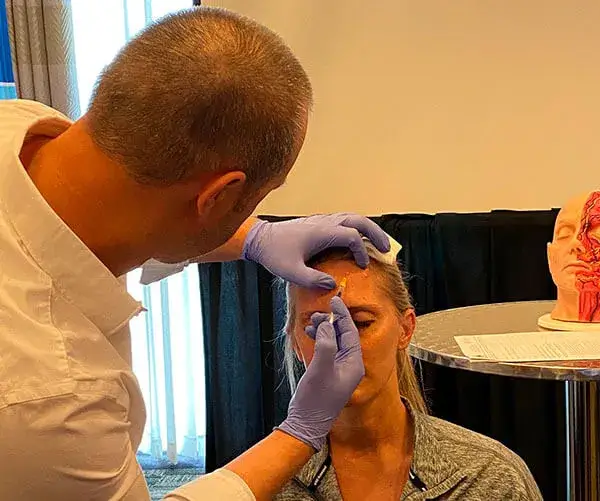
Botox® certification for nurses is one of the most searched career questions in aesthetic medicine — and one of the most misunderstood. Registered nurses inject neuromodulators every day in medical spas, dermatology practices, plastic surgery offices, and nurse-run clinics across the country. But the path to getting there is not what most nurses assume it is, and the confusion starts with the word “certification” itself.
Here is the single most important thing to understand before you spend a dollar on training: there is no national Botox license and no government-issued Botox certification. No federal agency certifies injectors. Your authority to inject comes from your nursing license, your state board of nursing’s scope-of-practice rules, and your state’s delegation and supervision requirements. A training certificate documents that you were taught and assessed — it demonstrates competency. It does not, by itself, grant you legal permission to inject.
This guide covers what that distinction means in practice, what a legitimate Botox training program for nurses should teach, how to evaluate accreditation claims, what supervision typically looks like, and what happens after your first course.
Can Nurses Inject Botox? The Honest Answer
In many states, yes — registered nurses and nurse practitioners can inject Botox and other botulinum toxin products. But the answer is conditional, and the conditions are set at the state level.
Three separate things have to line up:
- Your license. You must hold an active RN or APRN license in the state where you intend to practice.
- Your state’s scope of practice. Your state board of nursing determines whether administering a prescription neuromodulator falls within an RN’s scope, and under what conditions. Some states address this explicitly; others govern it through general delegation rules, advisory opinions, or joint statements with the medical board.
- Delegation and supervision. Botox is a prescription drug. Someone with prescriptive authority — a physician, and in many states an NP or PA — has to be involved. That involvement may take the form of direct supervision, indirect supervision, delegation, or standing orders, and the definitions vary meaningfully between states.
There is one requirement nurses routinely overlook, and it is the one that most often creates trouble: many states require a good-faith examination of the patient by a qualified prescriber before treatment is administered. The prescriber evaluates the patient, establishes the treatment plan, and issues the order. The RN carries it out. A model where an RN independently consults, diagnoses, and injects without any prescriber involvement is not legal in most jurisdictions, no matter how many certificates hang on the wall.
The specific rules — who must supervise, whether they must be on-site, whether an NP or PA can serve in that role, what documentation is required — genuinely vary by state and they change. Do not take a training company’s word for what is legal in your state, including ours. Our overview of Botox laws by state and our guide to who can administer Botox are useful starting points, but the authoritative source is your state board of nursing, and the correct final step is to verify with them directly.
What Botox Certification for Nurses Actually Means
If certification isn’t a license, what is it?
A certificate of completion from a training program is documentation. It says you completed a defined curriculum, received hands-on instruction, and were assessed as competent by qualified faculty. That documentation matters — a great deal — but for reasons that are practical rather than legal:
- Employers require it. A supervising physician or medspa owner is putting their license and their liability behind your needle. Documented training is how you demonstrate you are worth that risk.
- Malpractice carriers care. Insurers underwriting aesthetic procedures generally want evidence of formal training in the procedures you perform.
- Your state board may look at it. Boards that permit RN injection typically expect the nurse to be appropriately trained and competent in the procedure. If your competency is ever questioned, your training record is your evidence.
- Patients are safer. This is the part that doesn’t show up on a resume and matters most.
So the mental model is: your license and your state’s rules give you the authority. Training gives you the competence — and the documentation that proves it. You need both. Neither substitutes for the other.
Prerequisites: Who Can Take Botox Training for Nurses?
Botox training is continuing medical education for licensed clinicians. Programs are built for people who already have a clinical foundation — who understand sterile technique, patient assessment, pharmacology, and how to recognize an adverse event.
Practically, that means an active RN or APRN license. You do not need prior aesthetic experience, and you do not need to have injected a neuromodulator before — beginner-level courses assume you haven’t. What you should bring is a realistic plan for how you will practice legally once you’re trained: which state, under whose supervision, in what setting. Nurses who sort that out before training convert it into a job far faster than nurses who sort it out after.
What a Botox Course for Nurses Should Cover
Curricula differ between providers, so treat this as a general benchmark rather than a syllabus. A credible foundational Botox program for nurses should address five areas.
Patient Screening and Assessment
- Initial patient assessment and consultation procedures
- Evaluating patient objectives, expectations, and suitability for treatment
- Indications and contraindications for Botox and other botulinum toxin medications
- Dosing considerations for aesthetic procedures
Botox Handling and Safety
- Proper transportation and storage of Botox and similar medications
- Dilution and reconstitution guidelines
- Sterile handling and preparation
- General risks of botulinum toxin injection
- Side effects and complications to watch for immediately post-treatment
- What to tell patients about self-monitoring in the hours and days afterward
Oral and Maxillofacial Anatomy
This is the part that separates a competent injector from a dangerous one. Any foundational course must cover facial anatomy, musculature, neurophysiology, and vasculature in depth — for every injection site taught, that means muscle location, size, and depth, plus the non-muscular structures nearby that shape treatment decisions. Advanced courses extend the same rigor to the rest of the head, neck, and body; a first course generally will not.
Hands-On Injection Training
Foundational programs typically cover common facial sites such as:
- Forehead lines
- Glabellar lines
- Crow’s feet
- Lip lines
- Marionette lines
- Nasal lines
For each procedure, instruction should cover condition-specific diagnosis, treatment planning (how many injections and where), dose determination for that patient and that muscle, and proper technique.
Worth setting expectations here: there are roughly a hundred anatomical areas where botulinum toxin can be injected. A foundational workshop teaches a small subset of them — the highest-demand, highest-safety-margin sites — thoroughly. That is the right trade. Breadth comes later.
Practice Considerations
The non-clinical material that determines whether your training turns into a career:
- Integrating Botox administration into an existing practice
- Regulatory and licensing considerations specific to nurses
- Patient intake, documentation, and billing procedures
- Pricing for Botox and related procedures
- Securing liability insurance
A Caution About Non-Accredited Botox Courses
Accreditation is where marketing language gets loose, so be precise about what you’re looking for.
State boards do not accredit Botox courses. What legitimate CME accreditation means is that the program is accredited to award continuing medical education credit — such as AMA PRA Category 1 Credit™ — by a recognized accrediting body, which requires the provider to meet real standards for curriculum, faculty qualification, and independence from commercial influence. Any program can print a certificate. Not every program has been reviewed by anyone.
Ready to put this into practice?
Explore Empire's hands-on, CME-accredited Aesthetic & Injectable Training courses — live patients, expert faculty, and ongoing mentorship.
The risk of a non-accredited course isn’t only that a board or employer may not accept it. It’s that nobody has verified the teaching is any good. A nurse trained by a substandard program may not know what they weren’t taught — and the gap tends to surface in front of a patient.
When you evaluate a program, look for hands-on instruction with live patients, faculty who have years or decades of actual injecting experience, curriculum built by established aesthetic clinicians, and accreditation you can verify.
Why Botox Training Is Worth It for Nurses
Botox is consistently the most popular minimally invasive cosmetic procedure in the United States, performed millions of times a year — overwhelmingly in physician offices and medical spas rather than hospitals. Demand is not a forecast; it already exists.
For an RN, injection skills change your position in the market in a few concrete ways:
- You become more marketable. A supervising physician can delegate injections to a trained nurse. That makes you more valuable to the practice than a nurse who can’t.
- The revenue is recurring. A treatment typically brings in a few hundred dollars depending on the area treated, the office’s location, and the provider — and results wear off, so patients return every few months. This isn’t a one-time procedure; it’s a relationship.
- It compounds. Patients who come in for Botox frequently want dermal fillers too, and they prefer one office for everything. Adding one service tends to pull the others along. Our post on how to increase revenue with Botox injections covers the practice-side math.
- It opens a career track. Injecting is the entry point to the broader cosmetic nurse role, and for nurses mapping the full path, our guide to becoming a Botox injector lays out the sequence.
Beyond Your First Course: Advanced Training
Foundational certification is a starting line. Nurses who make injectables a core practice area typically keep building.
Botox Beyond the Face
Foundational courses focus on common facial indications. Additional coursework covers other territory:
- Bruxism and TMJ disorder (sometimes included in foundational courses, given the maxillofacial location)
- Platysmal bands and other neck concerns
- Chronic migraine, which involves injections across the head, neck, and shoulders
- Cervical dystonia
- Upper and lower limb spasticity
- Urinary incontinence
- Hyperhidrosis of the axillae, palms, and soles
Advanced Injection Techniques
- Advanced eyebrow lifting and sculpting
- Advanced lip sculpting
- Treating deficient dental papillae (“black triangles”)
- The Nefertiti lift for the lower face
- Facial volumization techniques
Off-Label Procedures
Several of the above are technically off-label — the FDA has not formally approved them, despite broad clinical agreement that they are safe and effective. Off-label use is legal and common, but it should be documented and consented as such. Advanced programs often devote substantial time to it.
Frequently Asked Questions
Can an RN inject Botox?
In many states, yes. Authority comes from your nursing license combined with your state board of nursing’s scope-of-practice and delegation rules — not from a certificate. Because the rules vary by state and change over time, verify your specific situation with your state board before you inject.
Do nurses need physician supervision to inject Botox?
Most states require some involvement from a physician, NP, or PA — Botox is a prescription drug and someone with prescriptive authority has to order it. That involvement may be direct supervision, indirect supervision, delegation, or standing orders, and many states also require a good-faith exam of the patient by a qualified prescriber before injection. The specifics differ by state; confirm yours with your board.
How long is Botox certification for nurses?
Foundational training can take as little as one or two days of coursework, though some programs spread the material over one to two weeks. Length varies by provider and by how much hands-on time is built in. Certificates don’t expire the way a license does — but competency is expected to be maintained, which is why ongoing CME matters.
What states allow RNs to inject Botox?
Many do, under varying supervision and delegation conditions — but there is no reliable shortcut list, because requirements differ in the details and are revised periodically. Start with our overview of Botox laws by state, then confirm the current rule directly with the board of nursing in the state where you intend to practice.
How much do Botox nurses make?
Compensation varies too widely by state, setting, employment model, and experience for a single figure to be meaningful — an employed RN in a dermatology practice, a nurse injector paid on commission in a medspa, and an NP running an independent clinic have very different economics. What is consistent is the underlying demand: treatments generate a few hundred dollars per area and patients return every few months, which is why practices are willing to pay for trained injectors.
What are the prerequisites for Botox training?
An active RN or APRN license. Prior aesthetic experience isn’t required — foundational courses are built for clinicians who have never injected a neuromodulator. What you should have worked out in advance is where you’ll practice and under whose supervision.
Is Botox certification required by law?
No — because no such legal certification exists. There is no national Botox license or government certification. What the law requires is that you hold an appropriate license, practice within your state’s scope-of-practice and delegation rules, and be competent in the procedures you perform. Training certification is how you demonstrate that competence to boards, employers, and insurers. It is essential in practice, but it is not a substitute for legal authority — and it never grants it.
Looking for a Role, or Hiring for One?
Empire runs a placement service for exactly this. The Medical Match is free to Empire graduates and works in both directions: clinicians looking for a position complete a job opportunity form, practices looking to fill one complete an employer form, and Empire matches against its database of healthcare professionals.
Empire members also get Empire Jobs, the job board inside the Empire portal — browse and apply to current postings, or post a role and manage the applications if you are the one hiring.
Get Trained by Faculty Who Actually Inject
Botox’s safety record rests on the skill of the person holding the syringe. Anatomy, dosing by muscle mass, injection depth, diffusion control, patient selection, and complication management are learnable — but not from a slide deck.
Empire Medical Training has trained healthcare professionals since 1998, with workshops across the United States. Our Botox Training & Certification course is CME-accredited and hands-on, with live-patient injection under expert supervision, taught by experienced faculty including board-certified dermatologists and plastic surgeons. Attendees who successfully complete the course and fulfill the hands-on requirements receive a completion certificate and AMA PRA Category 1 Credit™. Programs run from beginner through advanced levels, so you can start where you are and keep building — many nurses add dermal filler training next, since the patient demand overlaps almost completely.
If you’re a registered nurse mapping out a longer path in aesthetics, our Medical Training for Registered Nurses overview shows which programs are open to you and how they fit together. Check current dates and registration — early registration pricing is often available — and verify your state’s requirements with your board of nursing before you book.



 Claim Your Prize!